Teacher Portal:
Exploring Electricity
Investigation 4 – PreLab
 PRINT IT
Use your browser to download a printable PDF as help during the slide presentation and to make additional notes. In your browser, go to File > Print and then choose to save as PDF.
MINDSET
This Investigation is designed to:
- reinforce the concept of a simple circuit and electrical current.
- introduce students to the concept that materials act as conductors or insulators for electrical current, depending upon their properties.
- help students realize that a simple circuit can be used to test whether a material is a conductor or an insulator of electricity.
- increase student understanding that some materials can conduct electrical current better than others.
- demonstrate to students that materials with metallic properties are often good conductors of electricity.
- provide students with the opportunity to test whether various types of materials are conductors or insulators of electricity.
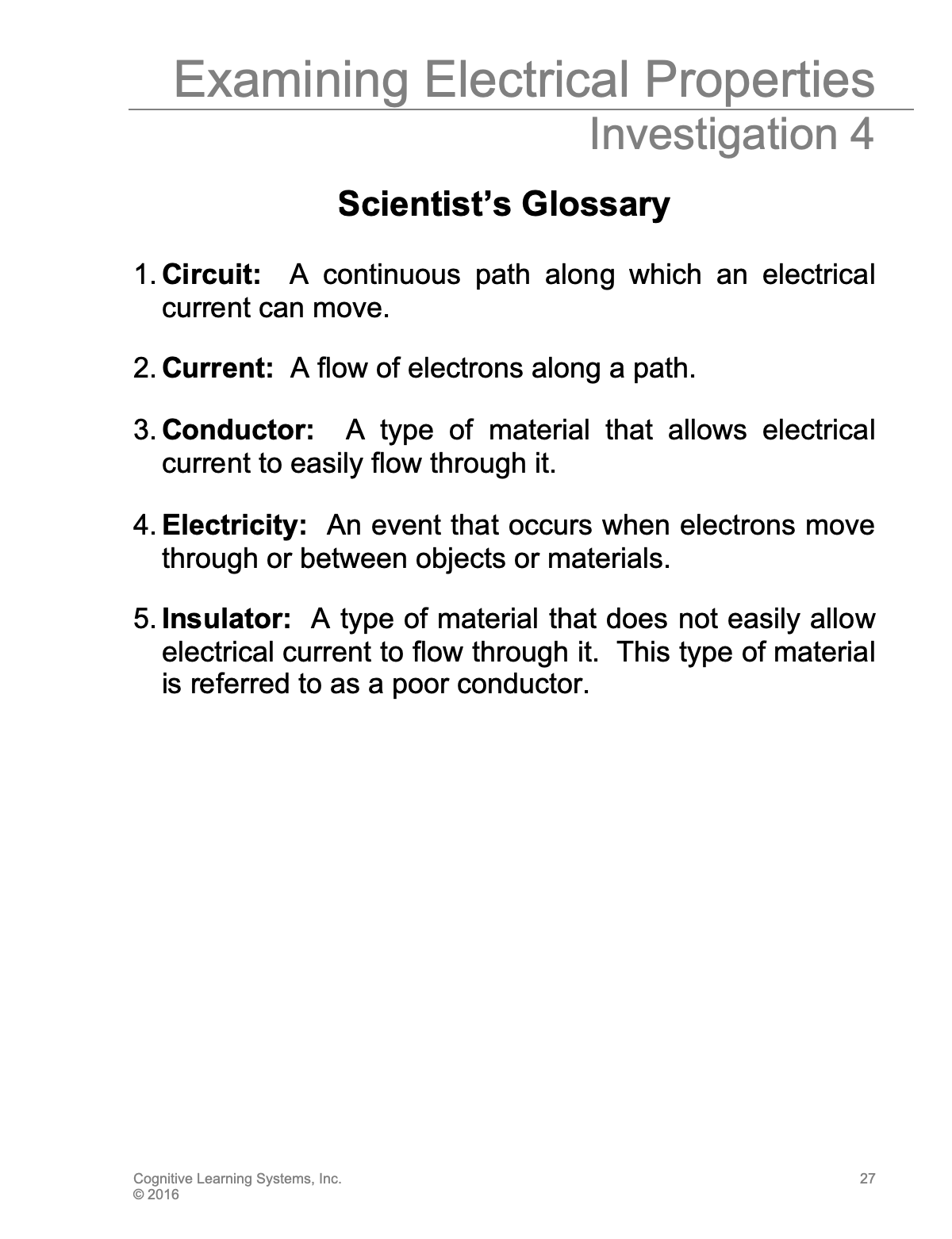
SCIENTIST’S GLOSSARY
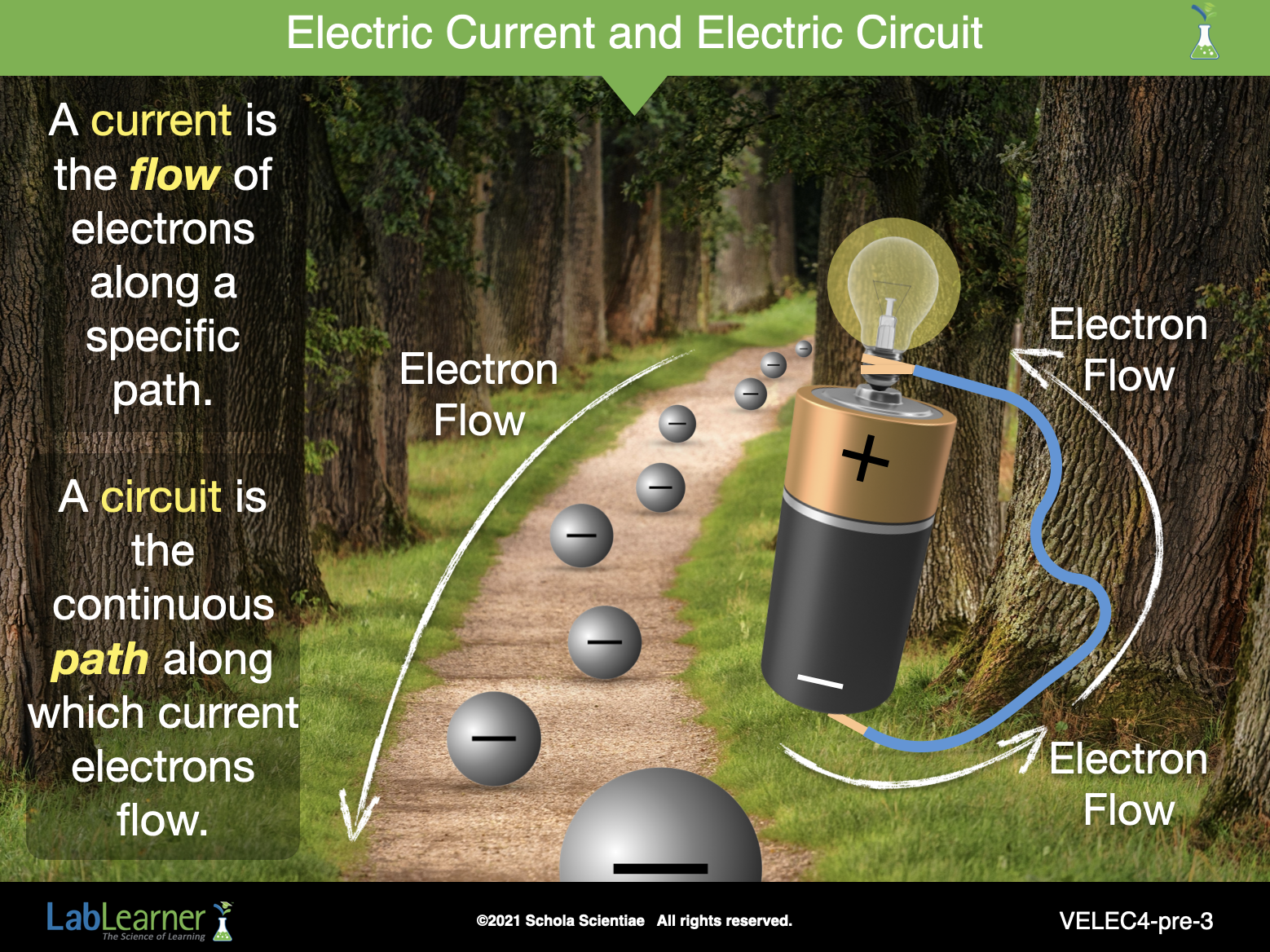
- Circuit: A continuous path along which an electrical current can move.
- Current: A flow of electrons along a path.
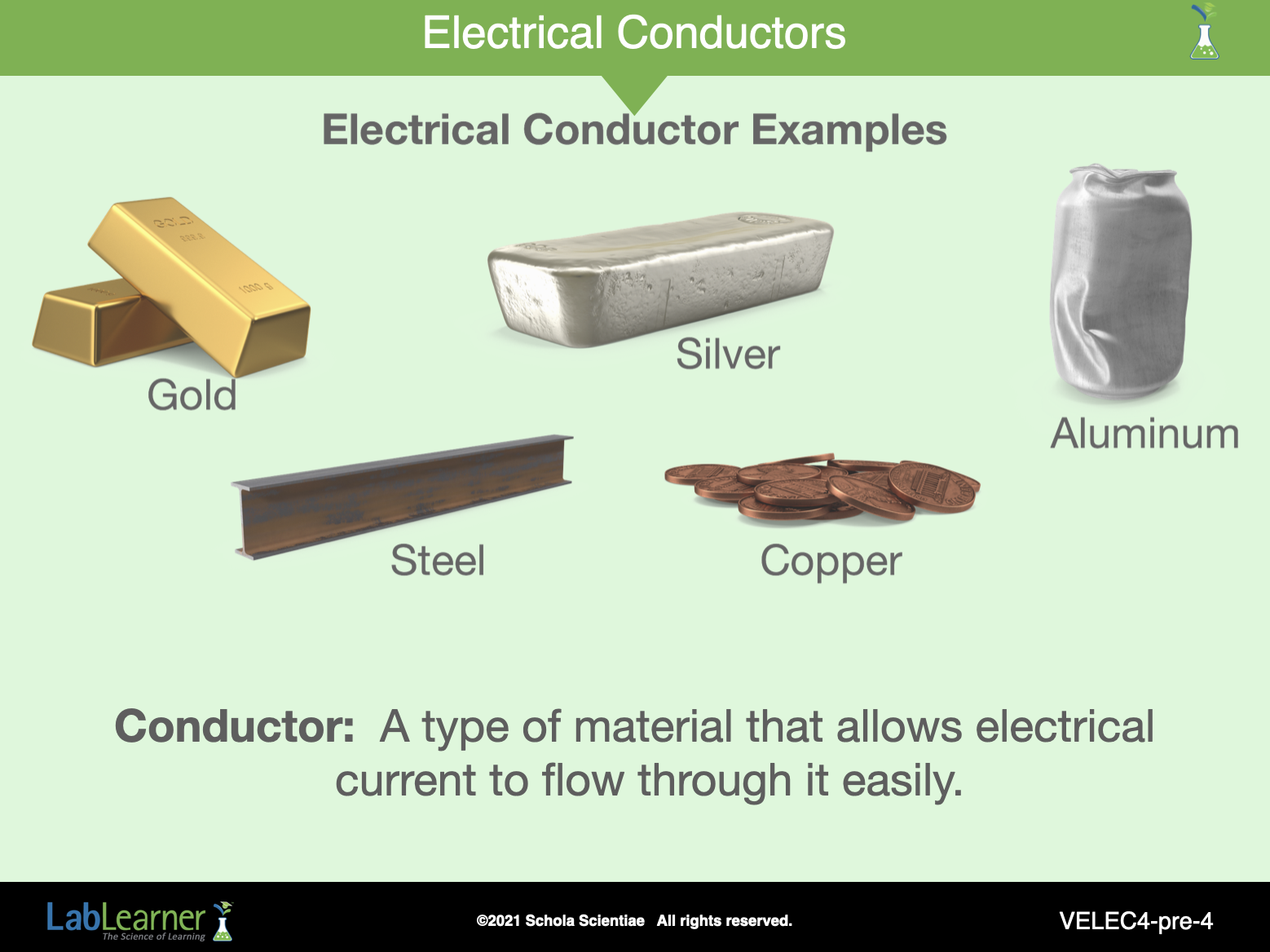
- Conductor: A type of material that allows electrical current to flow through it easily.
- Electricity: An event that occurs when electrons move through or between objects or materials.
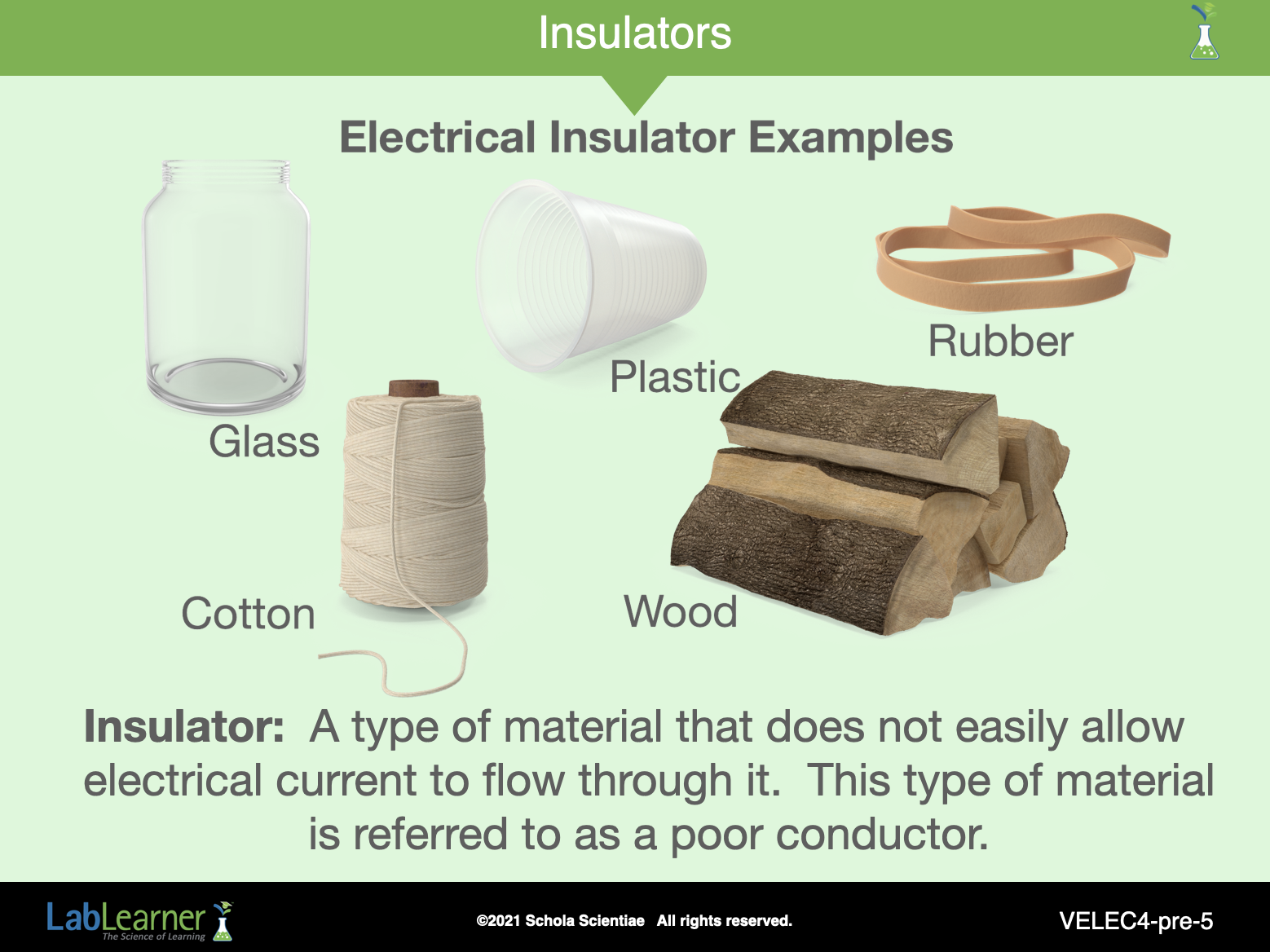
- Insulator: A type of material that does not easily allow electrical current to flow through it. This type of material is referred to as a poor conductor.
BE PREPARED
Watch the Investigation 4 Teacher Video and Student Video below to prepare for the PreLab.
SET FOR SUCCESS
- Tell students that they will continue their work on the Exploring Electricity CELL.
- Tell them that they will study insulators and conductors of current electricity.
- Ask students to share the kinds of things they might learn in this Investigation.
Begin the PreLab Concept Slides to start students on their learning journey. Then watch the Pre-Lab Student Video afterward as a class.
NAVIGATE IT
Once the slide presentation is launched
- use your left and right arrows to advance or go back in the slide presentation, and
- hover your mouse over the left edge of the presentation to get a view of the thumbnails for all the slides so that you can quickly move anywhere in the presentation.
- Click HERE to launch the slide presentation for the CELL.
SHARE IT
SLIDE VELEC4-pre-1
This is the fourth Investigation of the LabLearner CELL Exploring Electricity. In it, students will begin to learn about electrical conductors and insulators.
______________________________________________
SLIDE VELEC4-pre-2
A. Begin the Investigation by reading a short story to the students. The story is designed to promote student curiosity about the travel of electrical current, insulators, and conductors of electricity.
1. Read the story to the class:
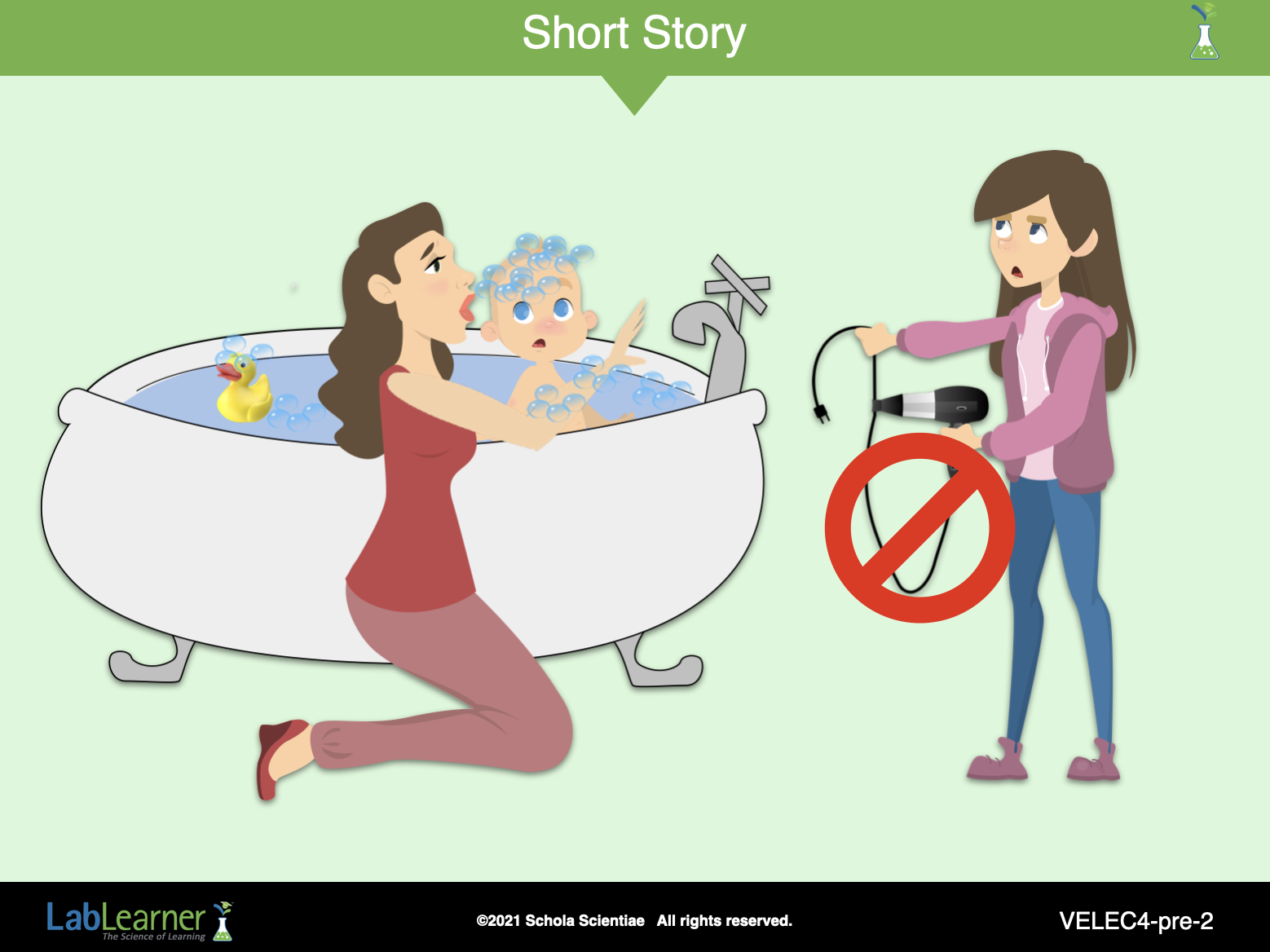
Sierra’s mother is giving her sister, Savannah, a bath in the tub. Sierra is helping her mother. “Can you pass me the baby shampoo?” asks her mother.
Sierra’s mother rinses the soap from Savannah’s hair. Sierra knows that Savannah will need to have her hair dried. She runs to her room to find her blow dryer and brings it to her mother.
“Mom, here’s the blow dryer,” she says as she stands by the tub.
“Sierra, please take the blow dryer away from the tub!” her mother exclaims.
2. Ask students: Why do you think Sierra’s mother asked her to take the blow dryer away from the bathtub? Student answers will vary.
3. Tell students that they will learn more about electricity and how an electrical current can flow through materials as they continue through this Investigation. Direct students to continue to think about the previous question as they conduct their Lab experiments.
______________________________________________
SLIDE VELEC4-pre-3
B. Continue the lesson by reviewing the concepts students learned in Investigation Three. As you review, incorporate the use of two new terms, conductors and insulators, into the discussion. Ask students to locate their Scientist’s Glossary. Utilize the steps and questions that follow to encourage class discussion:
1. Ask students: What is the difference between a circuit and a current? Students should indicate that a current is a flow of electrons along a path and a circuit is the path the current follows.
2. Ask students: What provided the electrical current for the simple circuit you constructed in Investigation 3? The battery provided the current.
3. Ask students: Did the simple circuit you built allow an electrical current to flow through it? How did you know? Students should indicate that the circuit did allow a current to flow through it because the light bulb was illuminated.
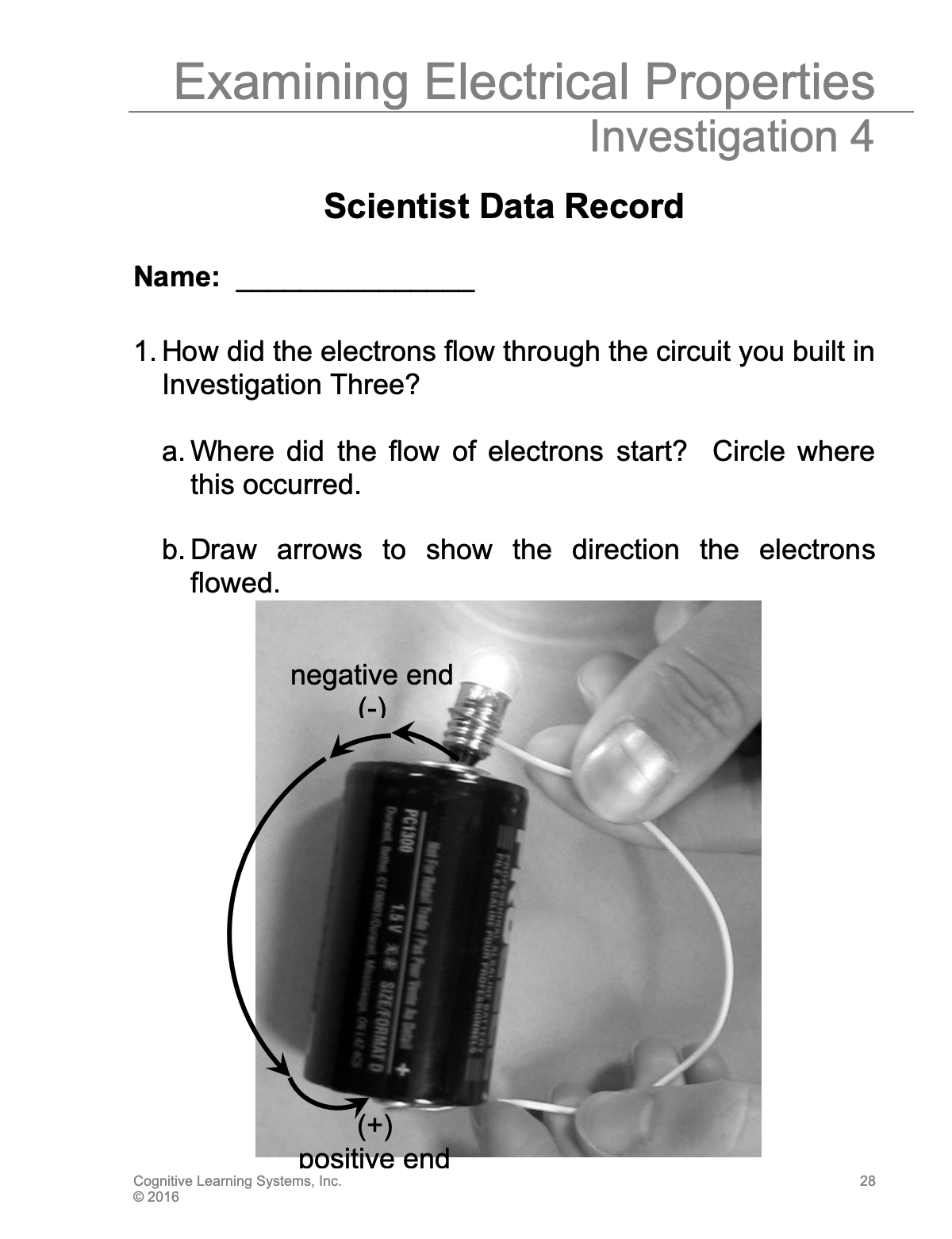
a. Direct students to locate Problem 1 of their Student Data Record.
b. Ask students: Where did the flow of electrons start in your circuit? At the negative end of the battery.
c. Tell students to indicate where the flow of electrons began in their circuit by drawing a circle around the area.
d. Instruct students to draw arrows on the picture to indicate how the electrons flowed through their circuit.
e. After students have completed this task, discuss the results with the class.
4. Ask students: Does this mean that the circuit you built in Investigation 3 was a complete or incomplete circuit? Because electrical current could flow through the circuit, it was a complete circuit. An incomplete circuit would not have allowed an electrical current to flow through it.
______________________________________________
SLIDE VELEC4-pre-4
5. Ask Students: Which terms on your Scientist’s Glossary are new terms? The terms conductor and insulator are both new terms.
6. Refer to the definition of conductor on this slide as well as five examples of conductors.
Teacher Note: Many other metals are also conductors. In addition, while pure water (only H2O) is not a conductor, seawater is as is freshwater that comes from the faucet. This is because of the charged ions in salts. We do not discuss this further in grade 3 as students may have already connected (as in the opening short story) electricity and water because of such dangers. Nonetheless, pure H2O is not a good electrical conductor, but most water students will have come in contact with is not pure but contains other components and impurities.
______________________________________________
SLIDE VELEC4-pre-5
Next, refer to this slide for the definition of an electrical insulator and five common insulators.
7. Ask students: What can you say about the two definitions? Student answers may vary, but guide them toward understanding that conductors and insulators are opposites. A conductor allows electrical current to easily flow through it, but an insulator does not.
8. Ask students: If the circuit you built in Investigation 3 was complete, were the wires and bulbs conductors or insulators? Students may indicate that the wires and bulbs were conductors. This is partially true. The material that is a conductor is the wire.
Teacher Note: However, with the exception of the exposed parts, the wire is surrounded by a material that is an insulator. Do not indicate to students whether their answer is correct or incorrect at this time. This will be discussed further in the PostLab.
______________________________________________
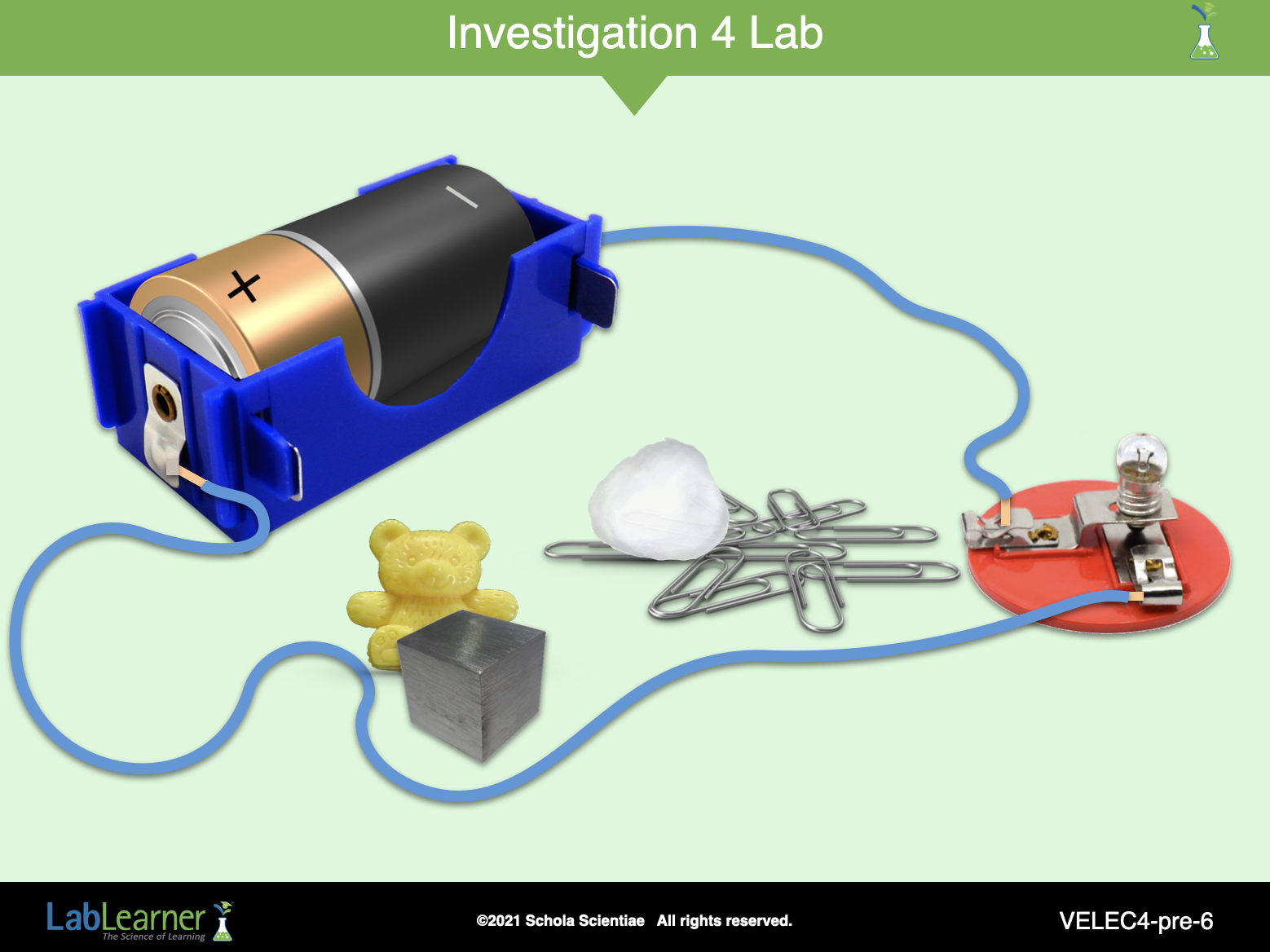
SLIDE VELEC4-pre-6
C. Tell students they will build another simple circuit in Lab to test whether different materials are conductors or insulators of electricity. As they perform their experiments, they should think about the following two questions.
• Are some materials better conductors of electricity than others?
• Do you think a material’s properties determine whether it is a conductor or insulator of electricity?
Student Video
Watch the Investigation 4 Student Video after the Share It presentation to prepare for the PreLab.
KEYS