Teacher Portal:
Exploring Electricity
Investigation 2 – PreLab
 PRINT IT
Use your browser to download a printable PDF as help during the slide presentation and to make additional notes. In your browser, go to File > Print and then choose to save as PDF.
MINDSET
This Investigation is designed to:
- reinforce student understanding of the concept of static electricity.
- help students understand that when objects or materials are rubbed together negatively charged electrons can move from one object or material to another.
- reinforce the concept that when the surfaces of objects or materials are rubbed together, they can become electrically charged.
- increase student understanding that objects with opposite electrical charges attract each other and objects with the same electrical charge repel each other.
- provide students with the opportunity to observe the attraction that occurs between objects that have opposite electrical charges.
- provide students with the opportunity to observe that objects with the same electrical charge repel each other.
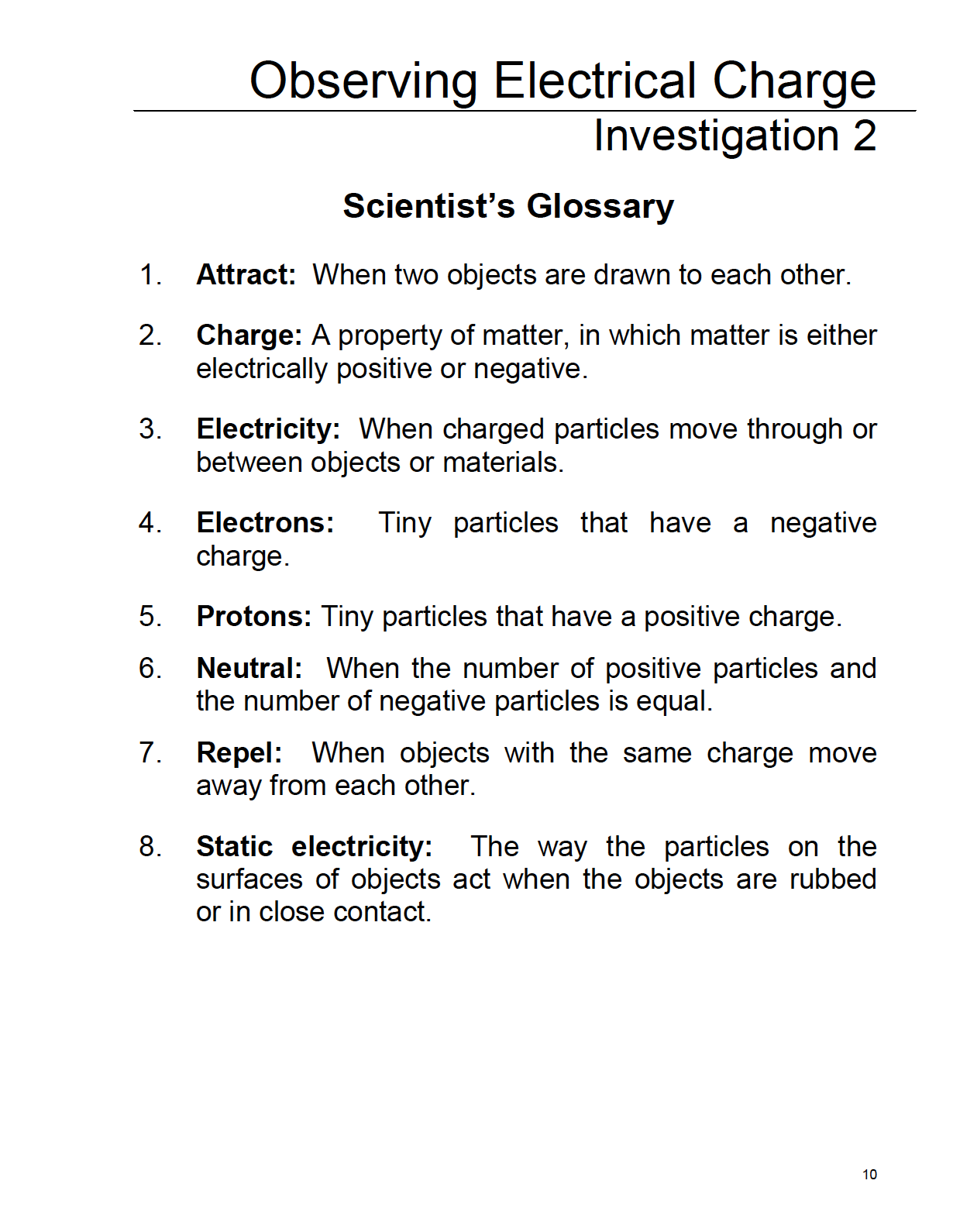
SCIENTIST’S GLOSSARY
- Attract: When two objects are drawn to each other.
- Charge: A property of matter, in which matter is either electrically positive or negative.
- Electricity: When charged particles move through or between objects or materials.
- Electrons: Tiny particles that have a negative charge.
- Protons: Tiny particles that have a positive charge.
- Neutral: When the number of positive particles and the number of negative particles is equal.
- Repel: When objects with the same charge move away from each other.
- Static electricity: The way the particles on the surfaces of objects act when the objects are rubbed or in close contact.
BE PREPARED
Watch the Investigation 2 Teacher Video and Student Video below to prepare for the PreLab.
SET FOR SUCCESS
- Tell students that they will continue their work on the Exploring Electricity CELL.
- Ask students to share the kinds of things they might learn in this Investigation.
Begin the PreLab Concept Slides to start students on their learning journey. Then watch the Pre-Lab Student Video afterward as a class.
NAVIGATE IT
Once the slide presentation is launched
- use your left and right arrows to advance or go back in the slide presentation, and
- hover your mouse over the left edge of the presentation to get a view of the thumbnails for all the slides so that you can quickly move anywhere in the presentation.
- Click HERE to launch the slide presentation for the CELL.
SHARE IT
SLIDE VELEC2-pre-1
This is the first Investigation of the LabLearner CELL Exploring Electricity. In it, students will become familiar with the concept of positive and negative charged particles and surfaces.
______________________________________________
SLIDE VELEC2-pre-2
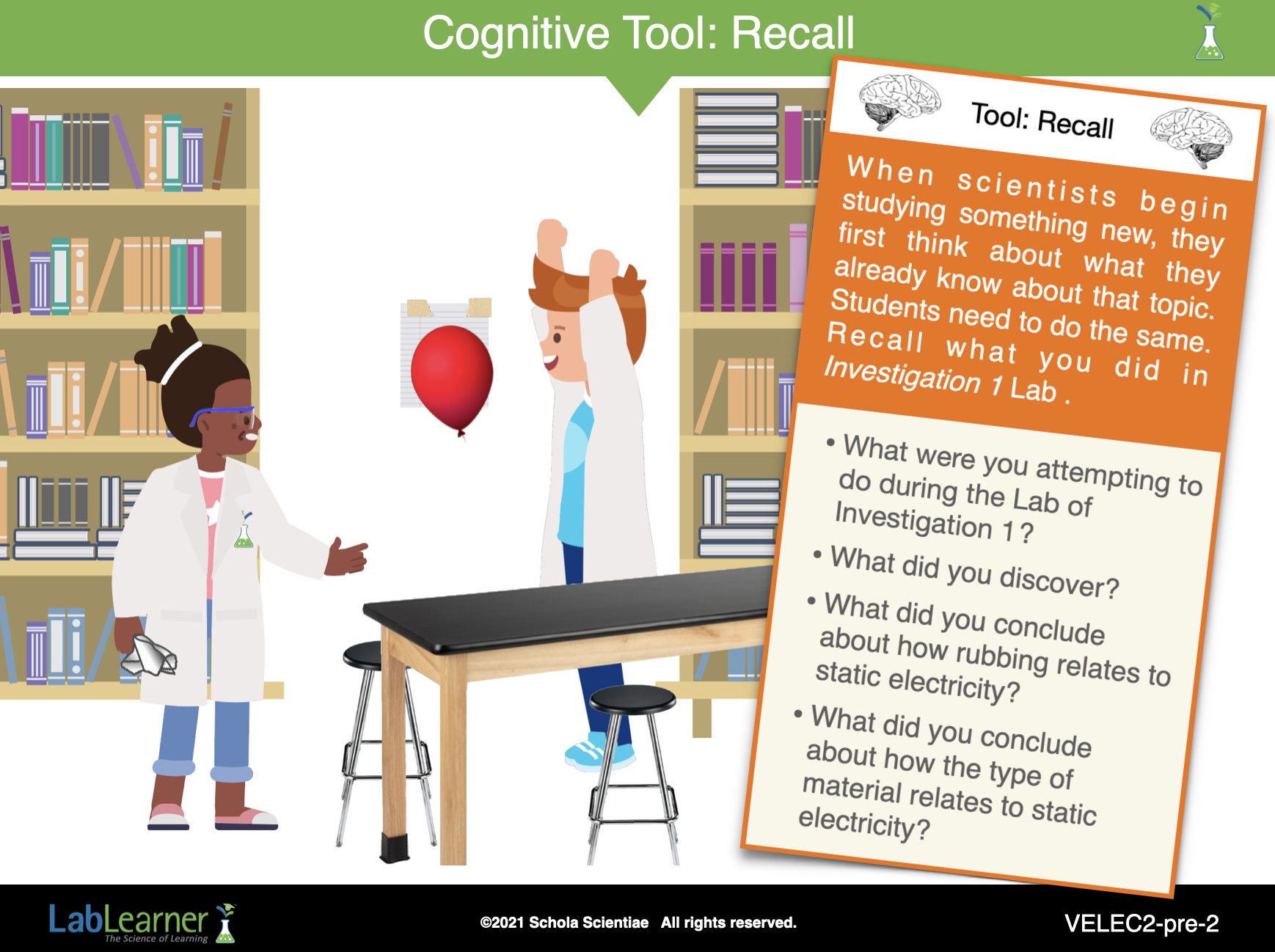
A. Use the following questions in order to prompt discussion of Investigation 1:
1. Ask students: What were you attempting to do during the Lab of Investigation 1? Why? Students should indicate they tried to get balloons to stick to paper. They performed these experiments in order to discover what causes the balloons to stick to paper and to determine whether rubbing the balloons with different materials would make a difference in whether the balloons stuck to the paper.
2. Ask students: What did you discover? Rubbing a balloon was a good method for getting it stick to the paper. Some materials, such as the wool, when rubbed against the balloon were very successful in getting the balloon to stick to the paper. Rubbing other materials, such as the paper plate or sponge did not result in balloons that would stick to the paper.
3. Ask students: What did you conclude about how rubbing relates to static electricity? As the number of times an object is rubbed increases, the amount of electrical charge on its surface increases. As the amount of electrical charge increases on an object, the amount of static electricity increases.
4. Ask students: What did you conclude about how the type of material relates to static electricity? It was concluded that when materials are rubbed, some produce more static electricity than others.
5. Ask students: What did you conclude about how rubbing relates to the transfer of electrons? If an object or material is not rubbed, it is likely that electrons are not transferred. Rubbing an object or material helps to transfer electrons between objects and the objects or materials rubbed together become either positively or negatively charged.
______________________________________________
SLIDE VELEC2-pre-3
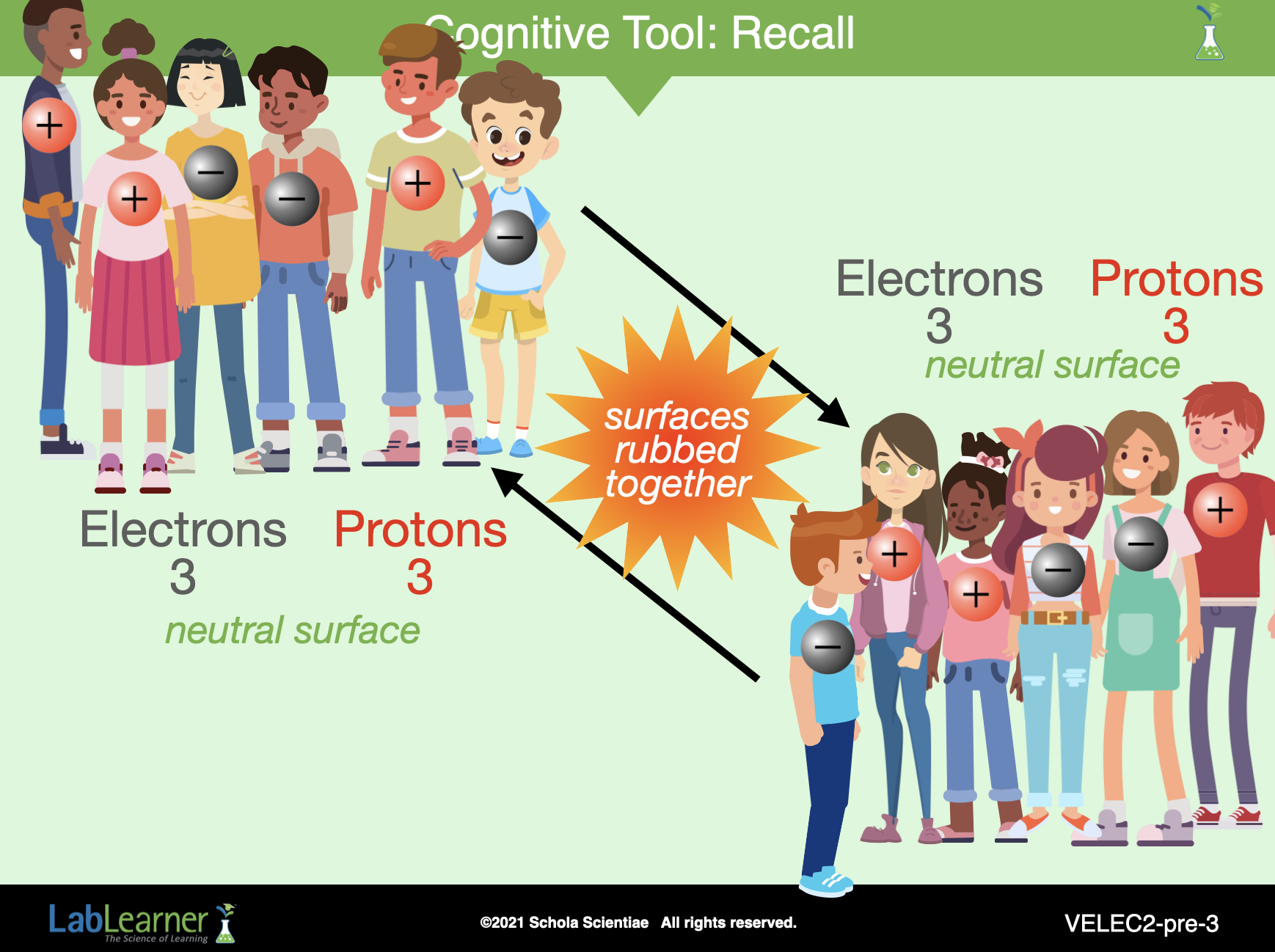
B. Ask students to think back to the role-play they performed during the PreLab and PostLab of Investigation One. During the role-play, five students represented the positive particles on the surface of an object and five students represented the negative particles on the surface of an object.
1. As a quick review, ask students to perform the role-play again.
2. Use the questions that follow to help students to review the movement of electrons and protons that occurred during the Lab experiments:
3. Ask students: How would the objects in the role play relate to the experiment you conducted with the balloon and wool? The balloons and the piece of wool would be similar to the two objects (two groups of students). When they were rubbed, negatively charged particles (electrons) moved from one object to another.
4. Explain that each of these materials have a specific number of electrons and protons. Tell students that it’s not important in this CELL to know the exact number of protons and electrons contained in an object, but rather to understand that the electrons move.
5. Ask students: How would you compare the amount of protons and electrons a neutral object has? A neutral object has an equal number of protons and electrons.
6. Ask students: Which of the objects were neutral before you began your experiments in Investigation 1? The balloon and the wool were neutral before starting the experiments.
7. Ask students: Which materials were rubbed together? What do you think happened when they were rubbed together? Student answers may vary. The balloon and wool were rubbed together. Electrons were transferred.
8. Explain that as the balloon and the wool were rubbed together, electrons were transferred between the objects. Remind students that only electrons, not protons can be transferred when objects are rubbed.
9. Ask students: Can you tell how the electrons moved? Did they move from balloon to wool or wool to balloon? Student answers may vary. Students should indicate that they cannot tell the direction the electrons moved, only that they did move because the two objects developed a charge and static electricity. Reassure students that without sophisticated equipment it is hard to tell how and in which direction electrons move. Using special tools, scientists have discovered in which direction the electrons move between many different types of objects, including the wool and balloon.
______________________________________________
SLIDE VELEC2-pre-4
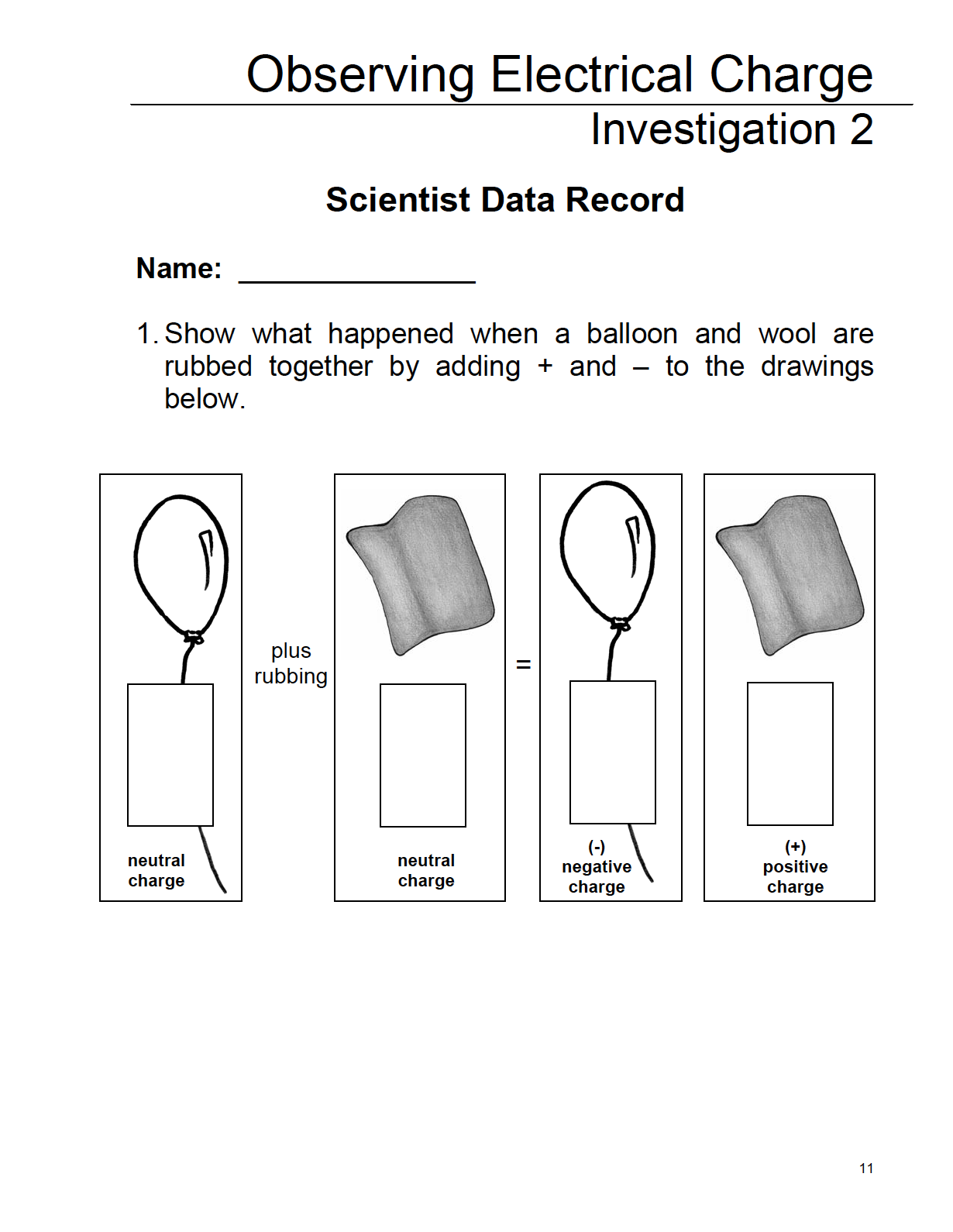
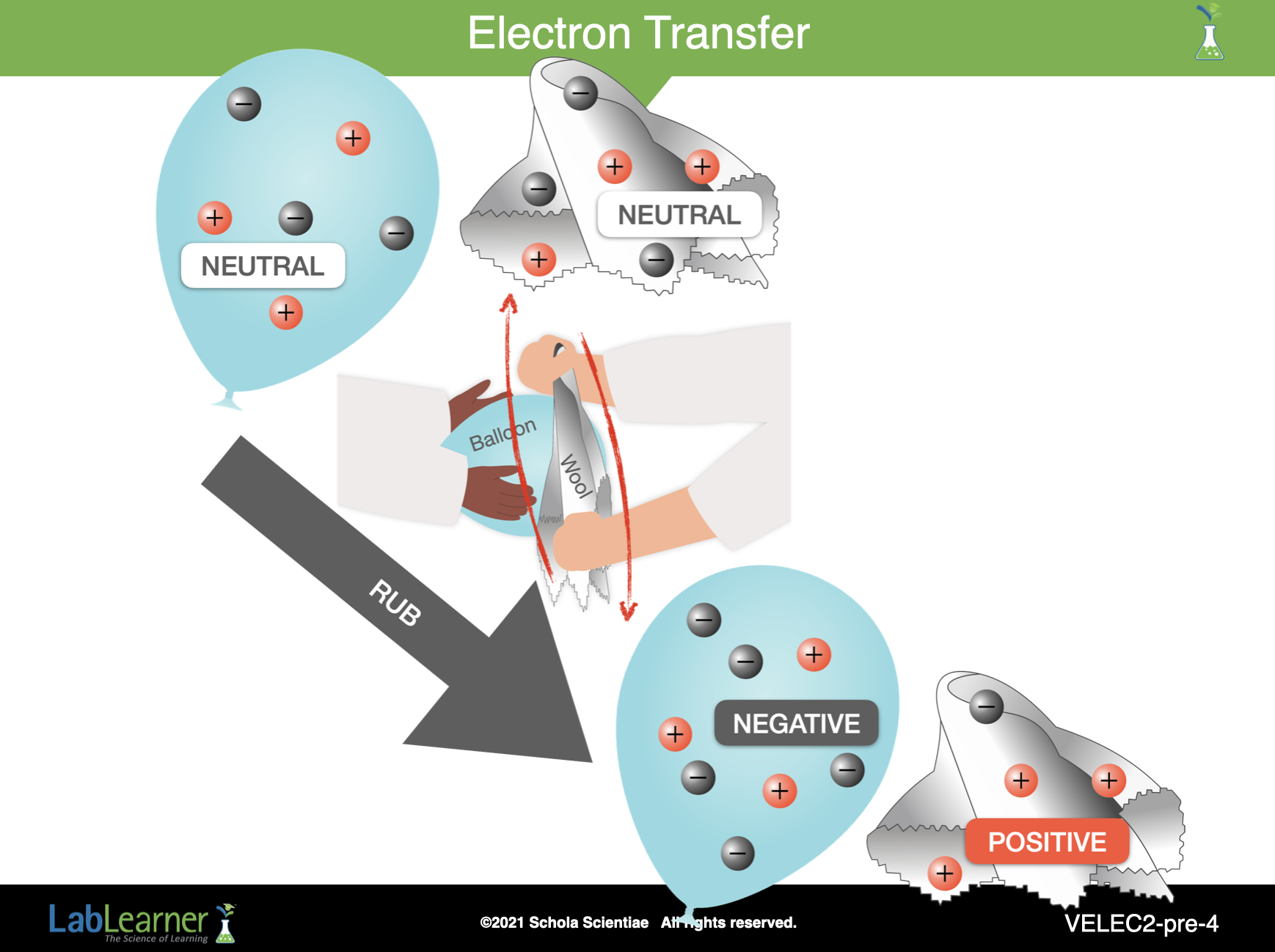
10. Explain this process on the board using the diagrams on this slide. Similar diagrams are in Problem 1 of the Student Data Record.
Walk students through the transfer of electrons from wool to balloon. Remind them that the drawing is a model. The balloon and the wool have more than three electrons and protons but you are using this number just to represent the equal number of electrons and protons on a neutral object and the transfer process.
Note: After rubbing, an electron moves from the wool to the balloon. Since protons don’t move, this results in more electrons, ( – ) negative charges, on the balloon than ( + ) positive charges. In turn, the loss of a negatively charged electron from the wool causes it to have more protons than electrons. Therefore, the wool develops a ( + ) positive charge.
11. Direct students to study the diagram on the board and complete the diagram in Problem 1 of their Student Data Record.
Ask students: Why does the wool have a positive charge after it is rubbed against the balloon? Its electrons were transferred from its surface to the balloon; therefore an imbalance occurred that resulted in the wool having more protons than electrons. The result is the wool is positively charged after rubbing.
12. Ask students: Why does the balloon have a negative charge after being rubbed with the wool? After rubbing, the electrons from the wool transferred onto the surface of the balloon. This resulted in an imbalance on the balloon’s surface of more electrons than protons. The result is the balloon has a negative charge.
______________________________________________
SLIDE VELEC2-pre-5
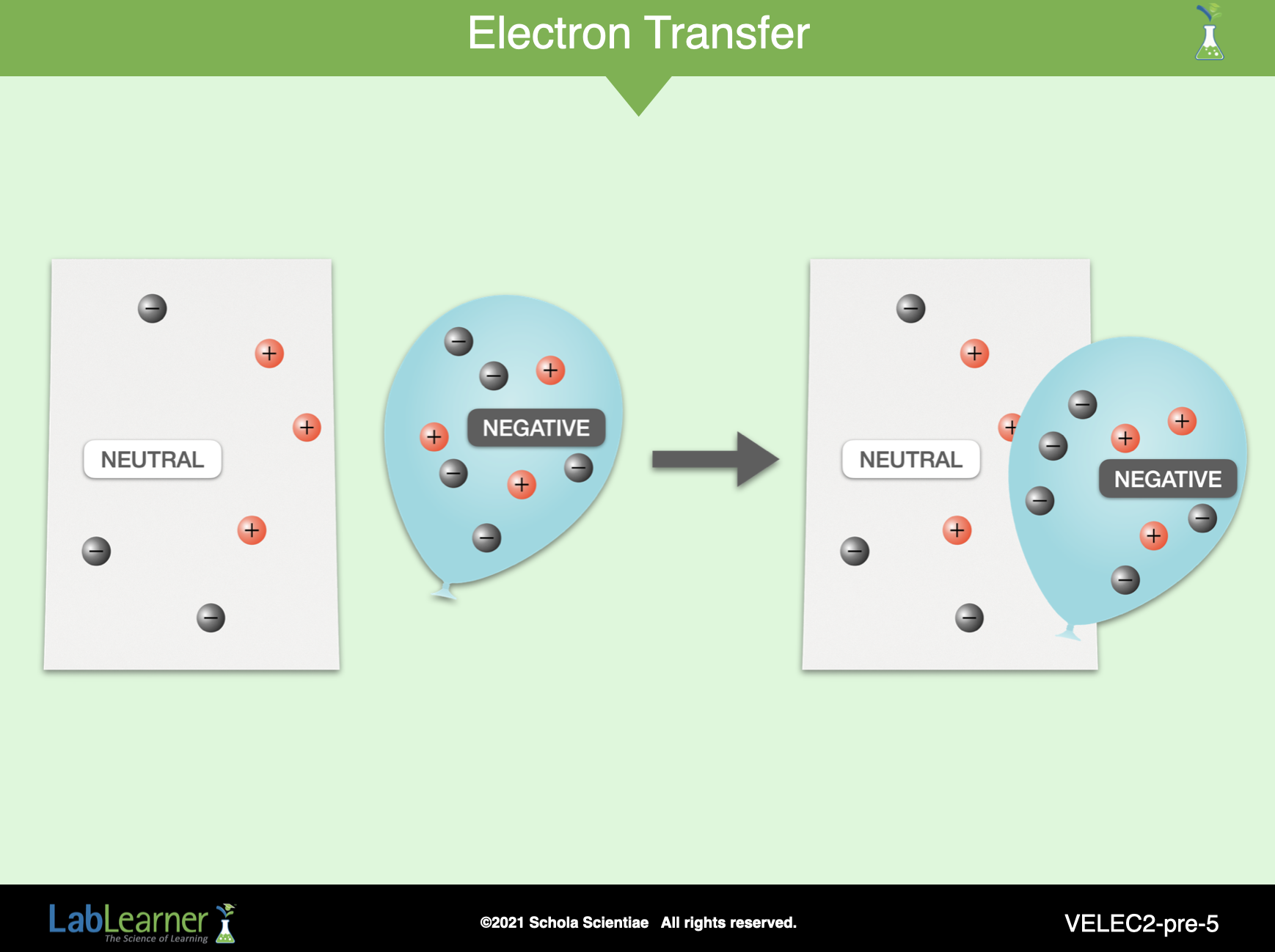
13. Ask students: Why do you think the balloon stuck to the paper after it was rubbed with the wool? Student answers may vary. Explain that after the balloon was rubbed, it had an imbalance of too many electrons that resulted in a negative charge. The large amounts of electrons on the balloon’s surface were attracted to the positive protons on the paper’s surface and, as a result, the balloon stuck to paper.
______________________________________________
SLIDE VELEC2-pre-6
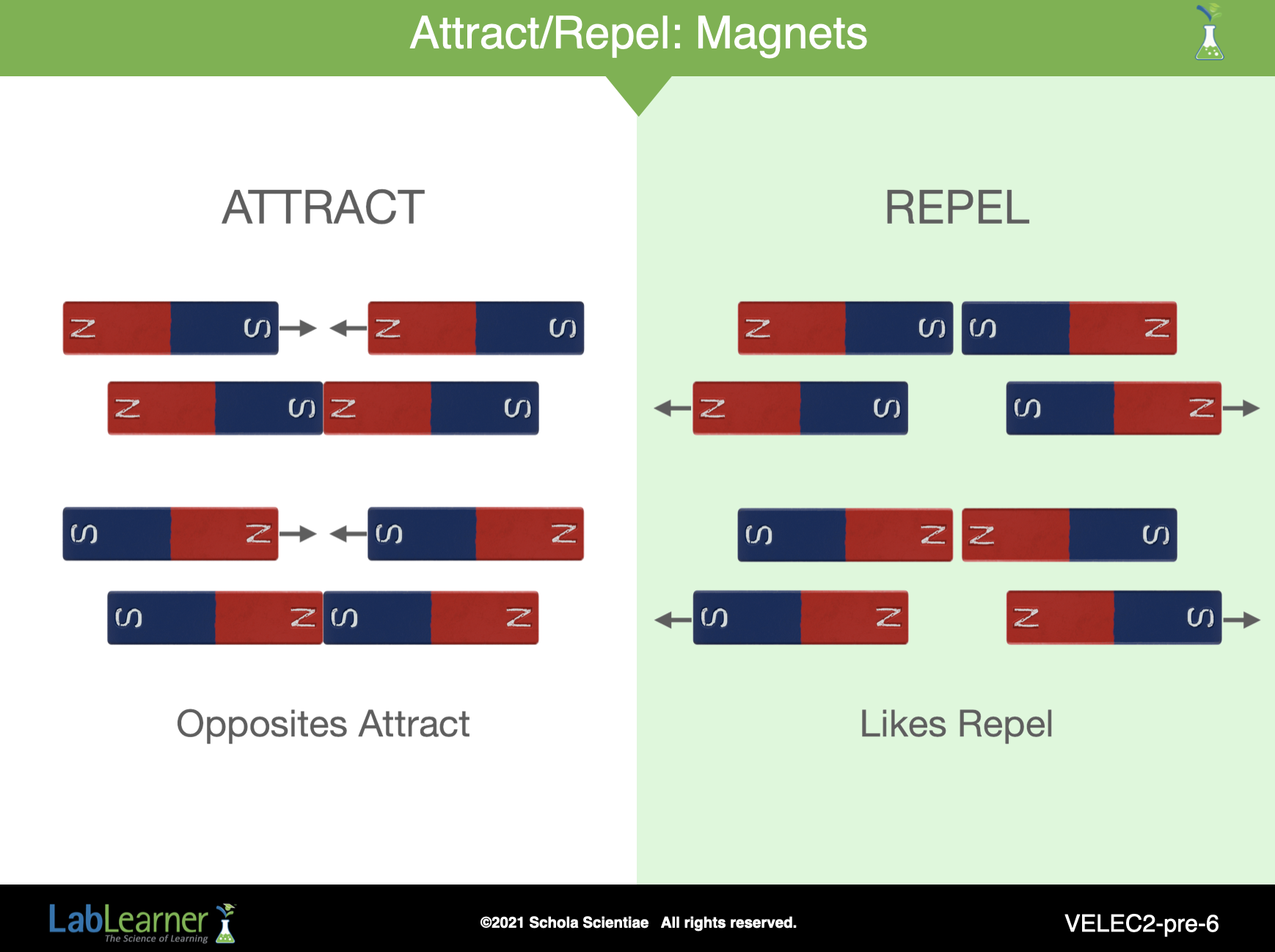
Introduce students to the terms attract and repel in their Scientist’s Glossary. Use this slide to draw an analogy to the attraction and repulsion of magnets. Reinforce what students have already learned about attraction and repulsion.
______________________________________________
SLIDE VELEC2-pre-7
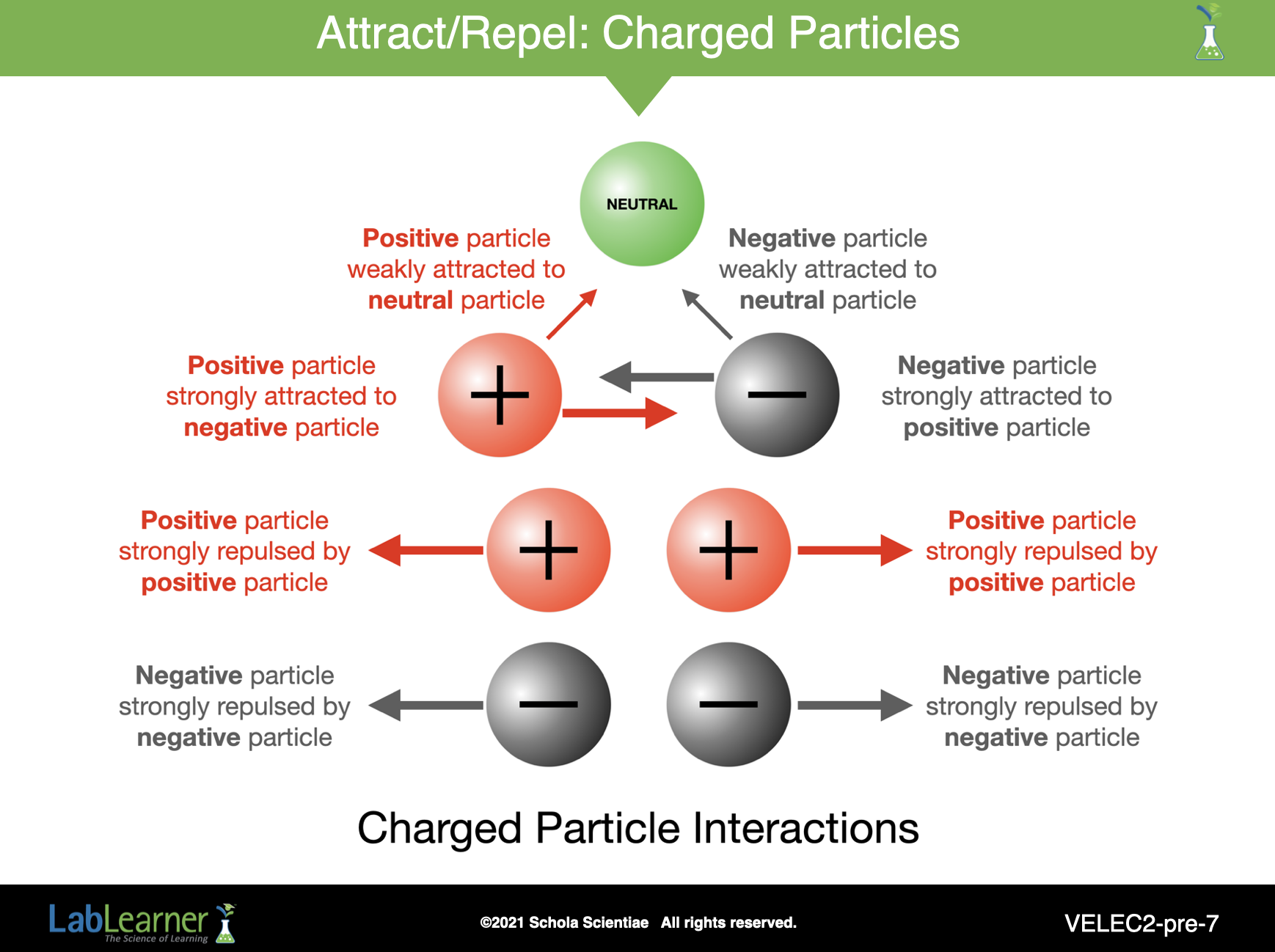
C. Introduce students to the terms attract and repel in their Scientist’s Glossary. Use the drawings on this slide to reinforce what students have already learned about how oppositely charged objects or materials attract.
Attract: When two objects are drawn to each other.
Repel: When objects with the same charge move away from each other.
1. Ask students: What term describes what happens between positively charged and negatively charged objects or materials? Attract.
2. Ask students: Can you give an example of two objects that were attracted to each other from Investigation 1? The negatively charged balloon was attracted to or stuck to the positive protons of the paper. The balloon and paper were attracted to each other.
3. Ask students: What does the term repel mean? When objects with the same charge move away from each other, they are repelled.
4. Ask students: Can you think of what two objects repelling each other may look like? Student answers may vary. Students will investigate in the Lab.
______________________________________________
SLIDE VELEC2-pre-8
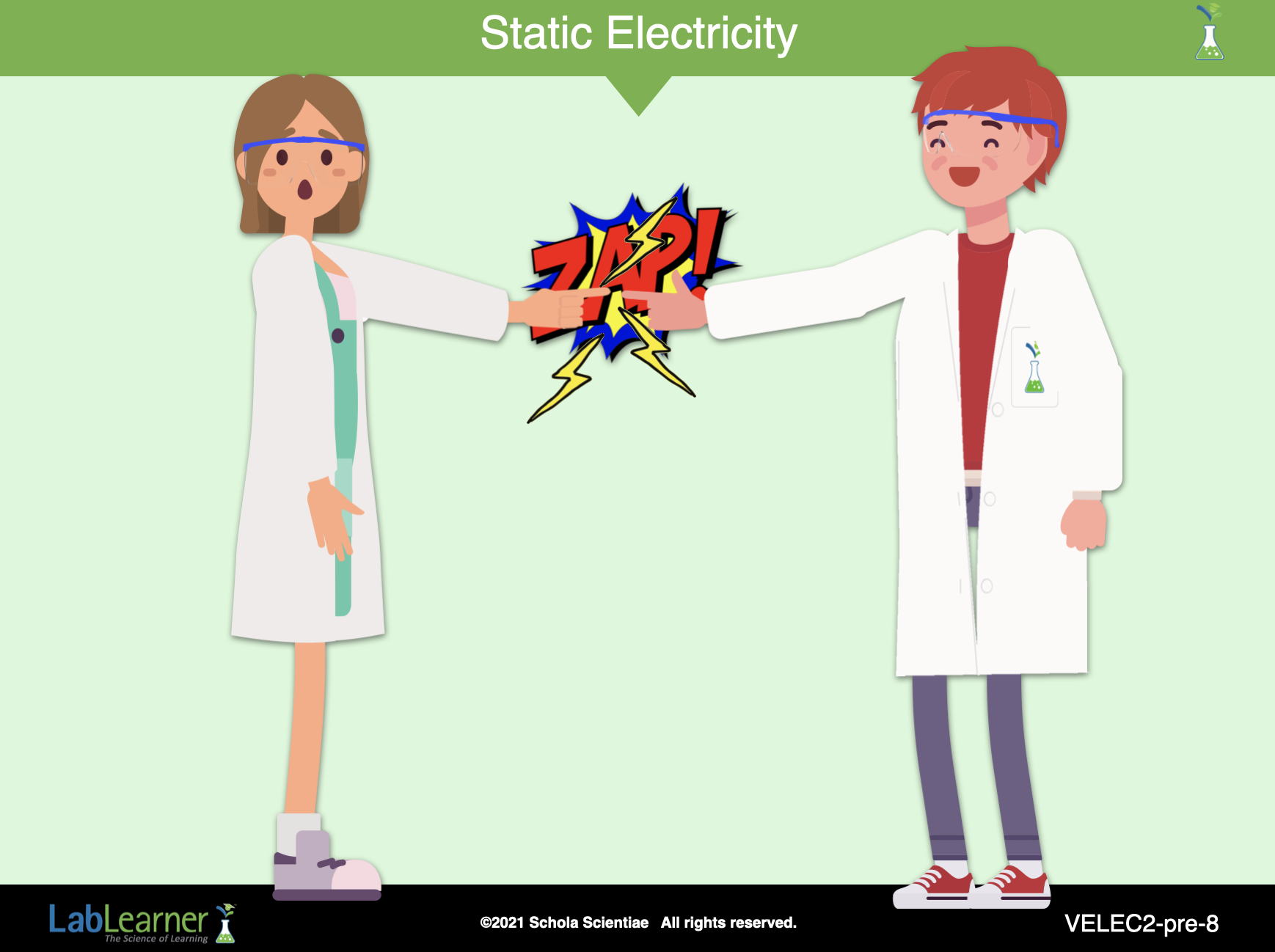
D. Tell students they will be conducting experiments that will increase their understanding of static electricity, how electrons move from one object to another, and whether objects attract or repel each other in the Lab. During their experiments, they will use balloons to explore this concept.
1. As they conduct their experiments, they should think about the following questions.
- What happens when materials or objects have an electrical charge?
- What happens when materials or objects have the same electrical charge?
2. Explain that they should be able to answer these questions after they conduct the experiments.
Student Video
Watch the Investigation 2 Student Video after the Share It presentation to prepare for the PreLab.
KEYS