
Teacher Portal:
Exploring Electricity
Investigation 2 – Lab
 BE PREPARED
Supplies and Equipment:
Class Materials:
- 1 100 ml beaker
- pepper
- 10 paper plates
- 1 roll of string
- 1 roll of masking tape
Group Materials:
- 4 balloons
- 1 precut piece of wool, 16 cm x 16 cm
- 2 paper plates with pepper
- 1 metric ruler
- 1 piece of string, 18 cm in length
- 1 piece of masking tape, approximately 6 cm in length
- 2 pieces of masking tape, approximately 2 cm in length
- 1 marker
Individual Materials:
- 1 Student Data Record
Teacher Preparation:
- Fill a 100 ml beaker up to the 40 ml mark with pepper.
- Place two paper plates for each group on the table and divide the pepper evenly between the paper plates.
- Cut a piece of string 18 cm in length for each group.
- Place the materials each group will need at a central distribution point.
- Separate the class into five cooperative groups.
Instruction:
- Direct each student group to obtain the following necessary materials from the distribution point: four (4) balloons, two (2) paper plates with pepper, one (1) metric ruler, one (1) piece of string, one (1) piece of wool, and one (1) marker. Students should cut a piece of masking tape approximately 6 cm in length and two (2) pieces approximately 2 cm in length.
- Instruct each group to blow up and tie off four (4) balloons. Students should use their metric ruler to insure that each balloon is at least 16 cm in diameter. Some students may need assistance with tying off their balloons. The students should also keep any contact with the balloons to a minimum to reduce any inadvertent build-up of static electricity on the balloons before they begin their experiments.
- Ask student groups to tie a string onto one (1) of the balloons.
Note: During the course of the experiments for this Investigation, students will be directed to rub the object or material a specific number of times. Due to differences in the weather and the surrounding type of environment, this number may need to be adjusted in order to produce the required outcome.

GET FOCUSED
Investigation Two builds on the Investigation One introduction to the concept of electrical charge and static electricity.
INVESTIGATE
1. Trials 1-3: During this part of the Investigation, students will test how static electricity or the transfer of electrons between different materials results in two oppositely charged objects that are attracted to each other and to neutral objects.
Students will conduct three Trials, one in which students will test the attraction between the hairs on their arms and a balloon and wool swatch that have not been rubbed. This will serve as a control for the other two trials.
In the second and third Trials, students will rub a wool swatch over a balloon transferring electrons from the wool to the balloon and creating a negatively charged balloon and a positively charged piece of wool. Students will then test whether both the negatively and positively charged objects can attract other neutral objects or materials, such as the hair on their arms and pepper.
In order that each student can experience the feeling of static electricity on his/her arm and observe the movement of the pepper, the students in each group may wish to switch tasks during the experiments.
Students will be asked the following question and make several predictions in order to direct their attention to the interaction that occurs between charged and neutral materials:
What happens when materials or objects have an electrical charge?
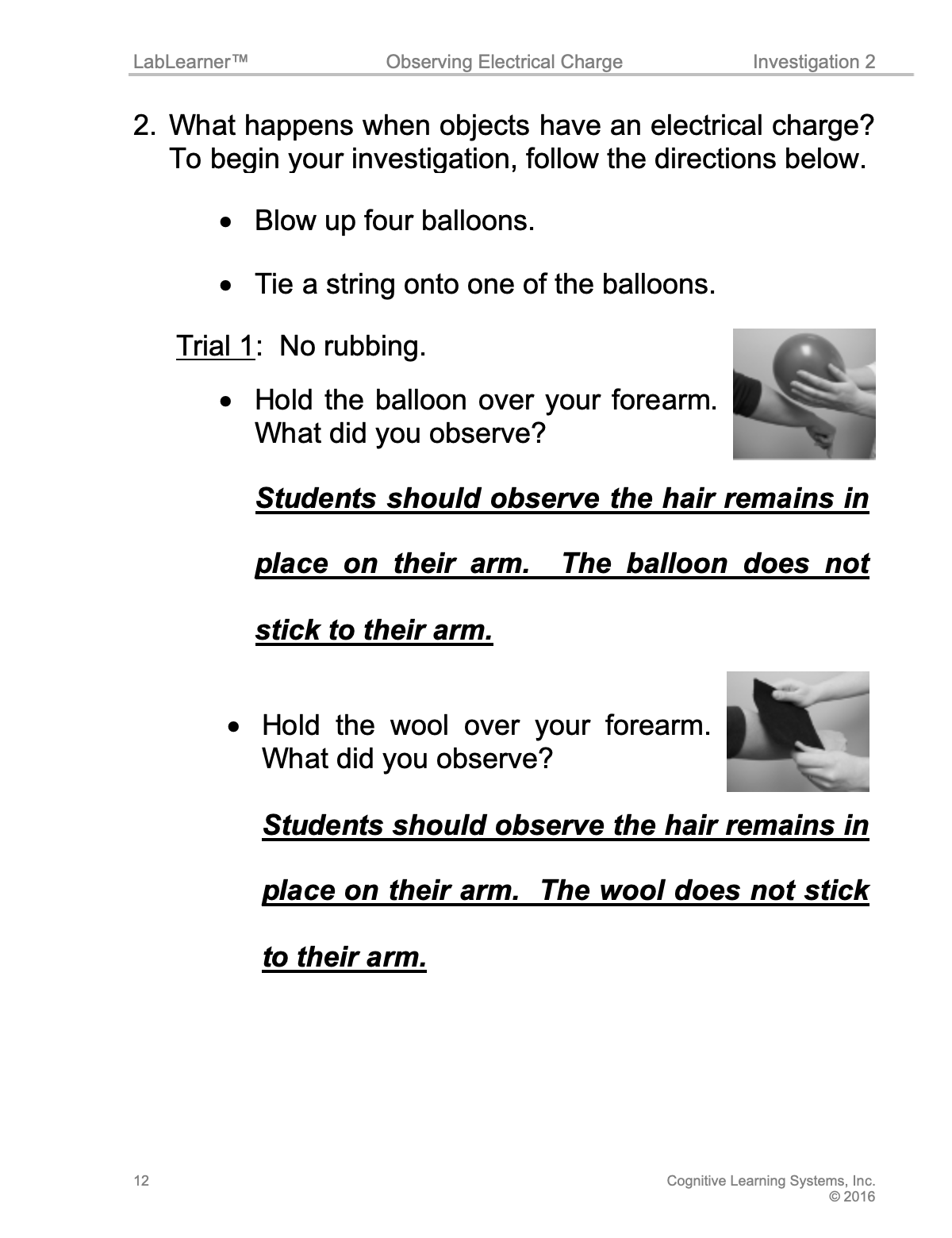
Trial 1
a. Testing the interaction between neutral objects.
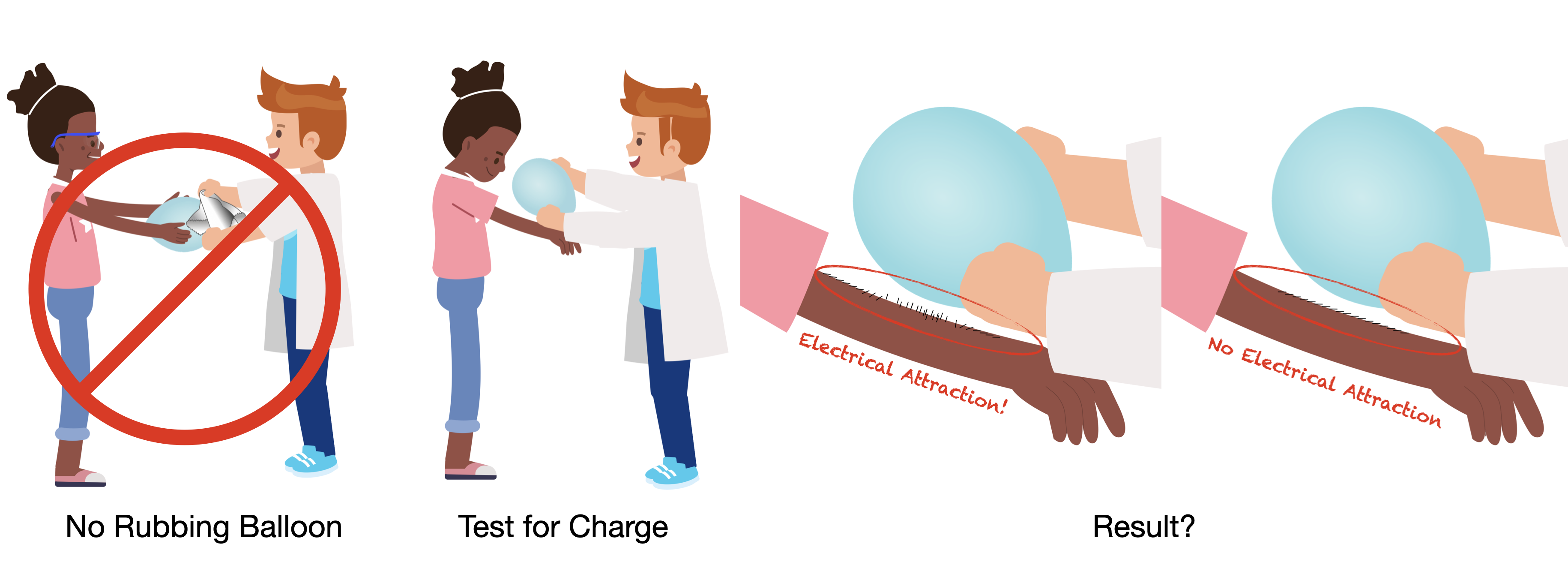
Ask students to select one balloon. This Trial will serve as the control for Trials 2 and 3. Students will test the interaction between skin and both wool and a balloon that has NOT been rubbed.
Tell students to hold the balloon over the skin of their forearm.
Direct students to hold the piece of wool over the skin of their forearm.
Students should record what they observe in Problems 2a and 2b of their Student Data Record.
Trial 2
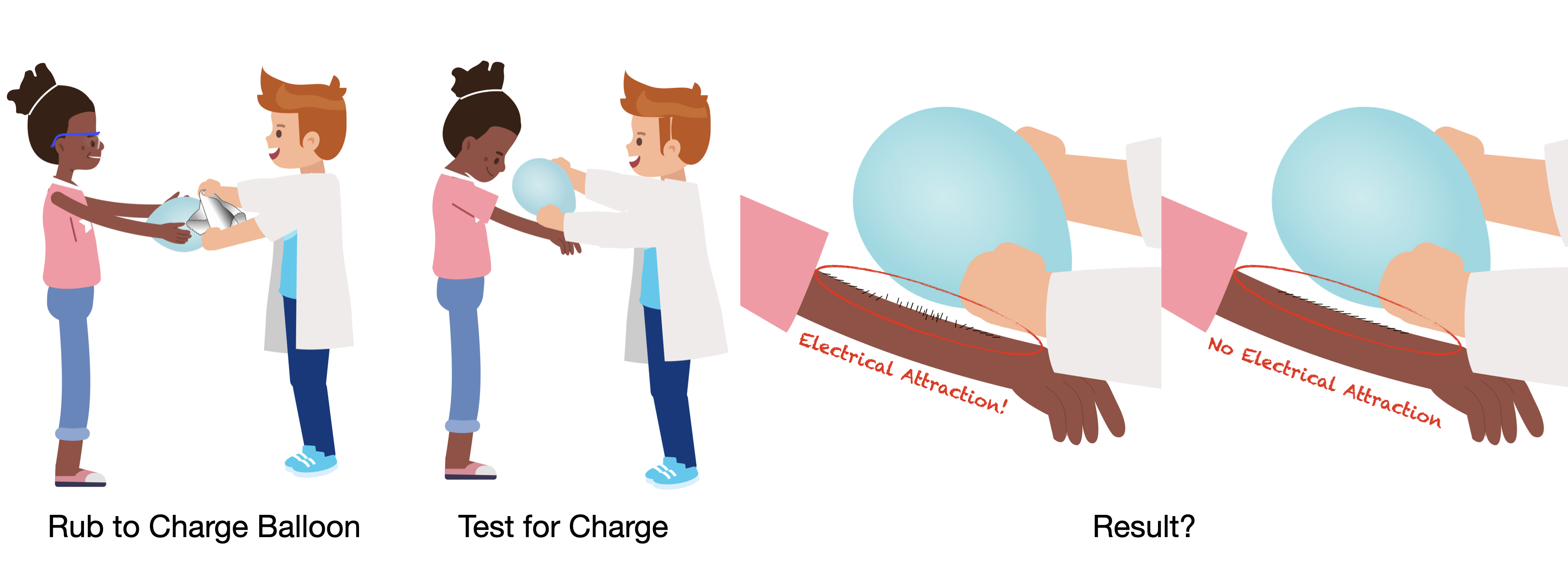
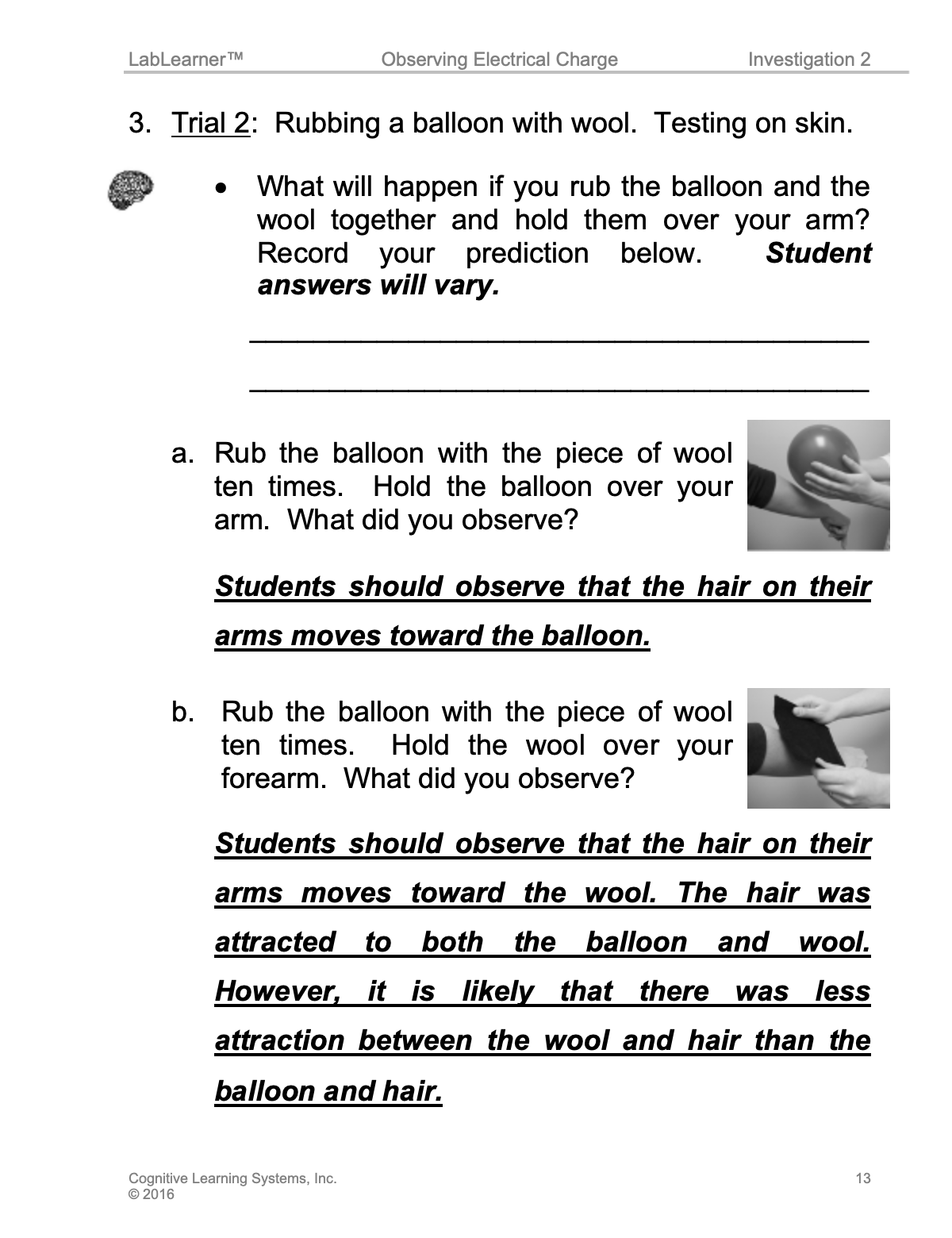
b. Testing the interaction between both positively charged and negatively charged objects and neutral objects. Students will rub a balloon with wool and observe the attraction between both and the hair on the arm.
Students may use the same balloon.
Inform students that they will next rub the balloon and wool together and hold both over their forearms.
Tell students to rub the balloon with the piece of wool ten times and then hold the balloon 1-2 cm over the skin of their forearm.
Direct students to rub the balloon with the piece of wool ten times and then hold the wool 1-2 cm over the skin of their forearm.
Tell students to record what they observe in Problems 3a and 3b of their Student Data Record.
Trial 3
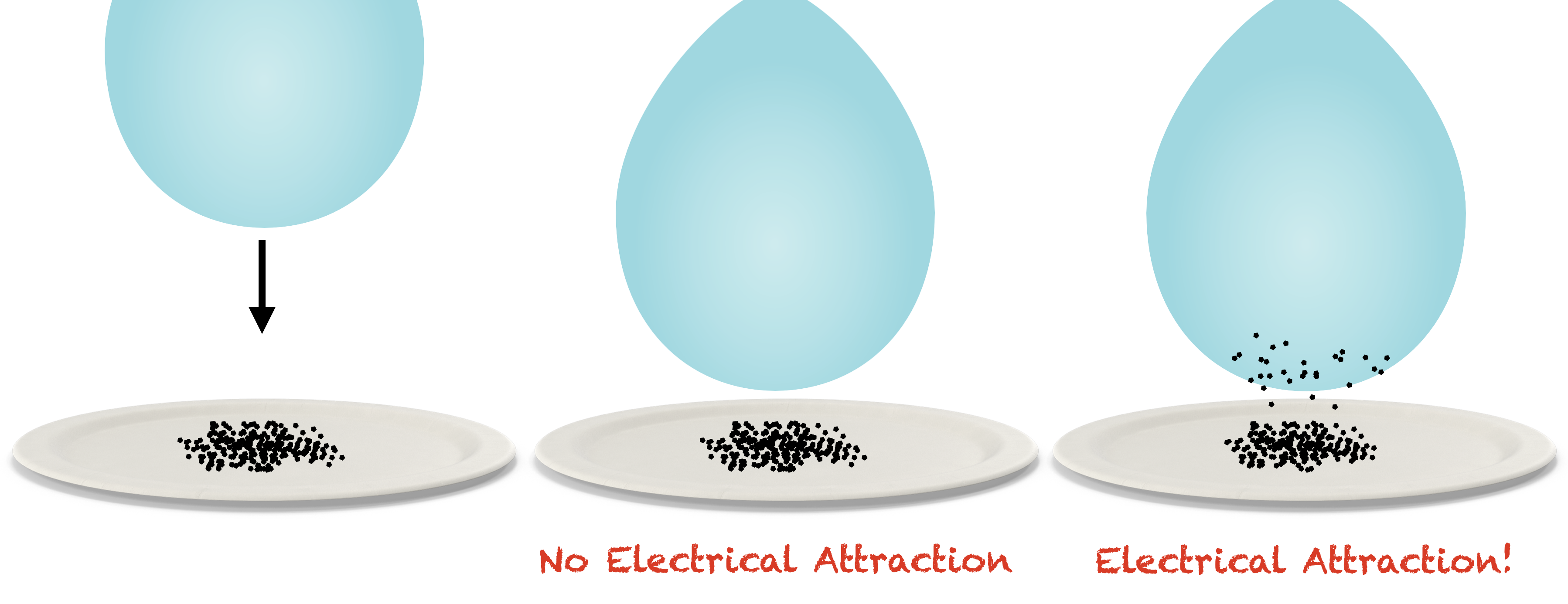
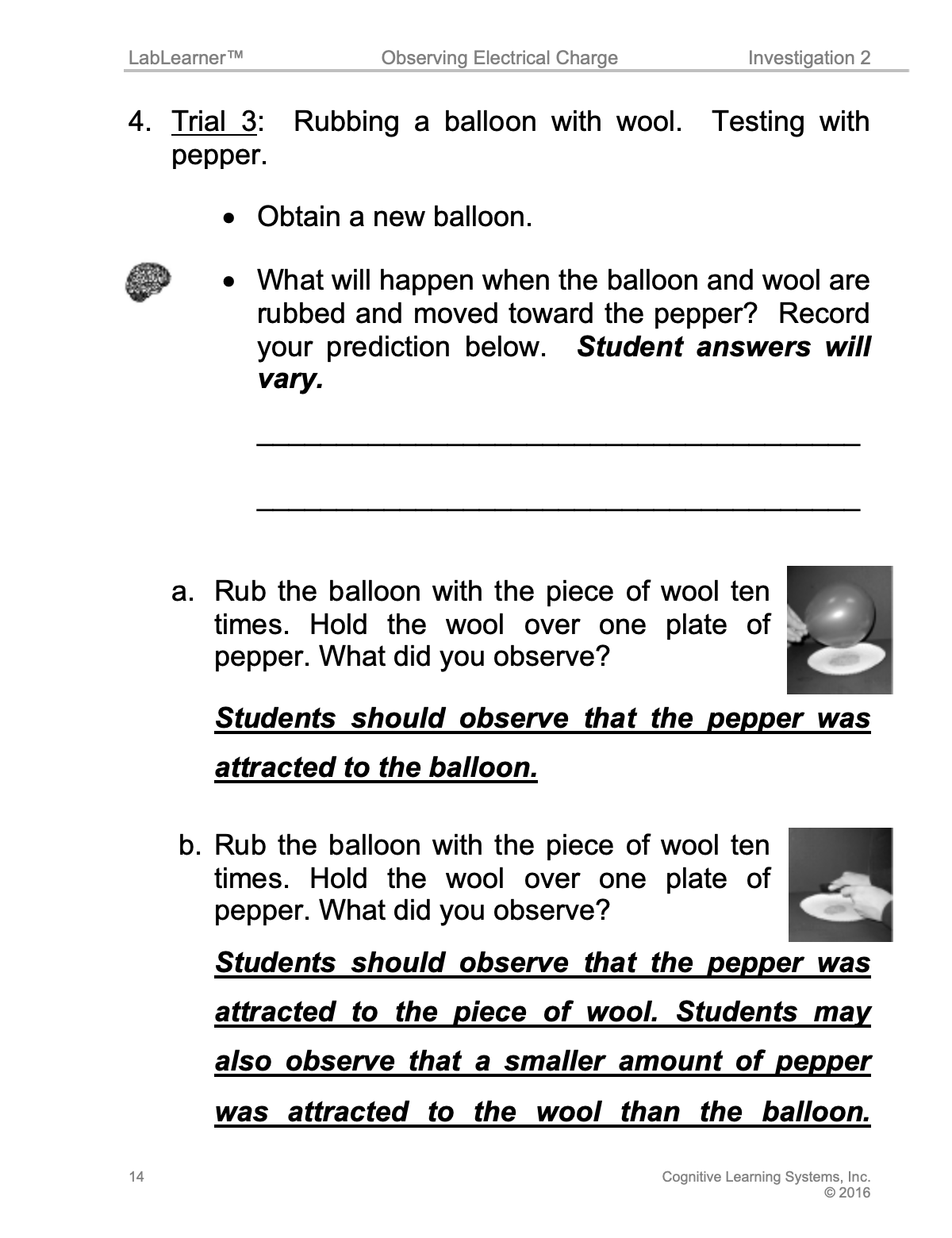
c. Testing the interaction between the electrically charged balloon and wool and neutral pepper.
Ask students to obtain a new balloon.
Inform students that they will next rub the balloon and wool together and hold each over the plate of pepper.
Instruct students to rub the balloon with the piece of wool ten times and then hold the balloon 1-2 cm over the pepper.
Instruct students to rub the balloon with the piece of wool ten times and then hold the wool 1-2 cm over the pepper.
Instruct students to carefully move the balloon and the wool to observe the amount of pepper that adhered to both the wool and balloon. Ask students to record their observations in Problems 4a and 4b of their Student Data Record.
___________________________________________________
2. Trials 4–5: During these experiments, students will explore the interaction between materials with the same electrical charge. In Trial 4, students test the interaction between balloons that have not been rubbed and therefore have not built up electrical charges or are considered neutral. This Trial will serve as a control.
In Trial 5, students will test the interaction of two balloons that have both been rubbed with wool. As a result, both balloons will have a negative charge and will repel each other.
Although students will not test the interaction of two positively charged objects, a similar repulsion would occur. Students may desire to test two pieces of charged wool. However, it is likely because of the weight of the wool, they would not as easily feel or see the repulsion.
Students will be asked the following question to direct their attention to the interaction that occurs between the similarly charged materials:
What happens when two materials or objects have the same electrical charge?
Trial 4
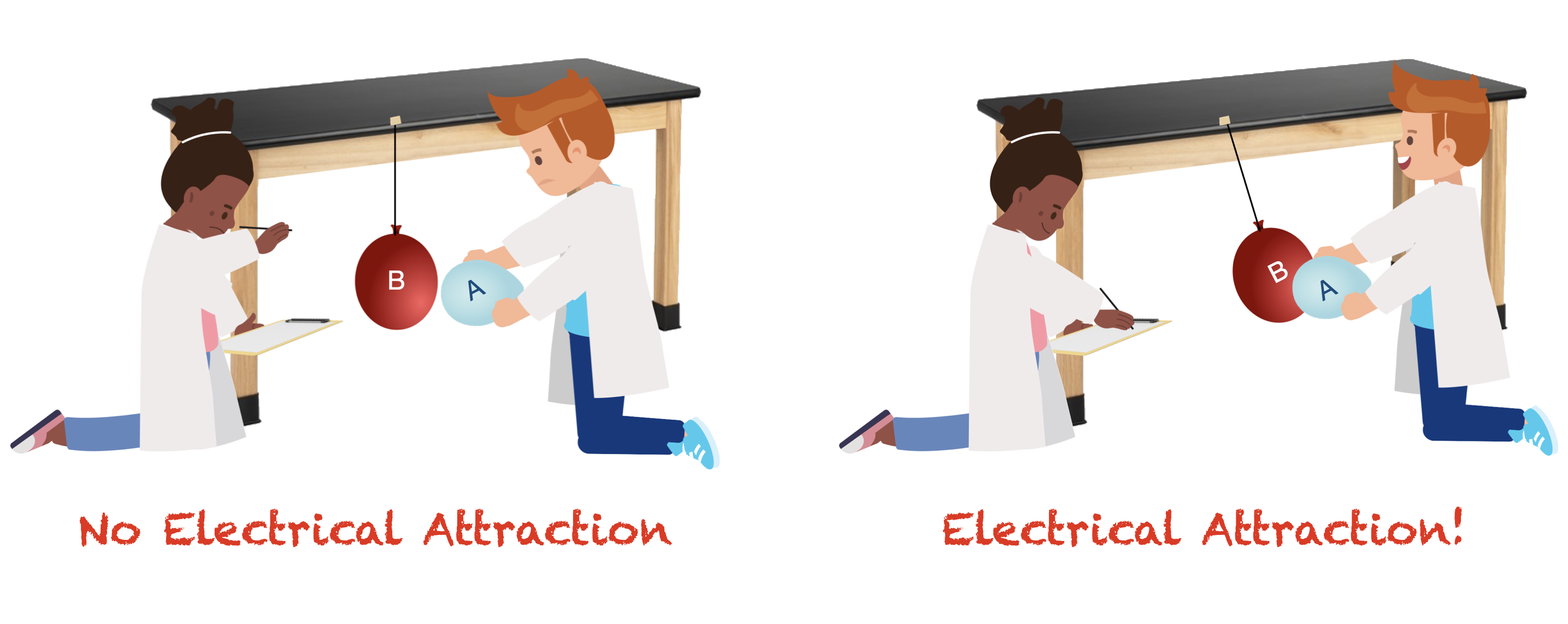
a. Interaction of neutral objects. In this Trial, students will test the interaction of balloons that have NOT been rubbed. This Trial will serve as a control.
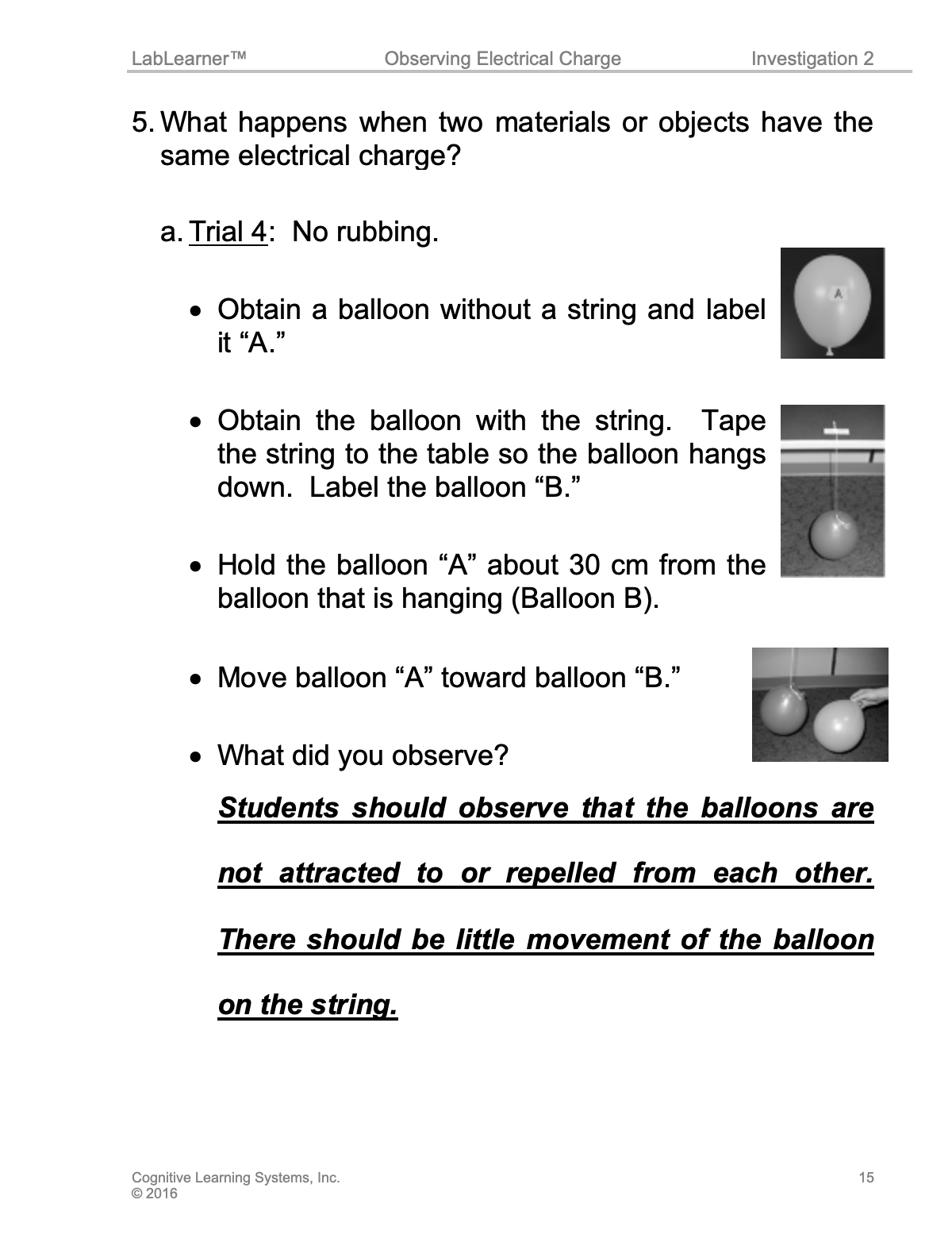
Ask students to select the remaining balloon without the string and label this balloon “A” using a marker.
Instruct students to obtain the balloon tied with a string. Direct them to tape the free end of the string to the table and label this balloon “B.”
Ask one student in each group to hold balloon “A” approximately 30 cm from balloon “B” (the balloon hanging by the string).
Direct students to slowly move balloon “A” toward balloon “B”.
Tell students to record what they observe in Problem 5a.
Trial 5
b. Testing the interaction of objects with similar charges.
Ask students: What will occur when you rub the balloons and move them close together?
Tell students to record their predictions in Problem 6a of their Student Data Record.
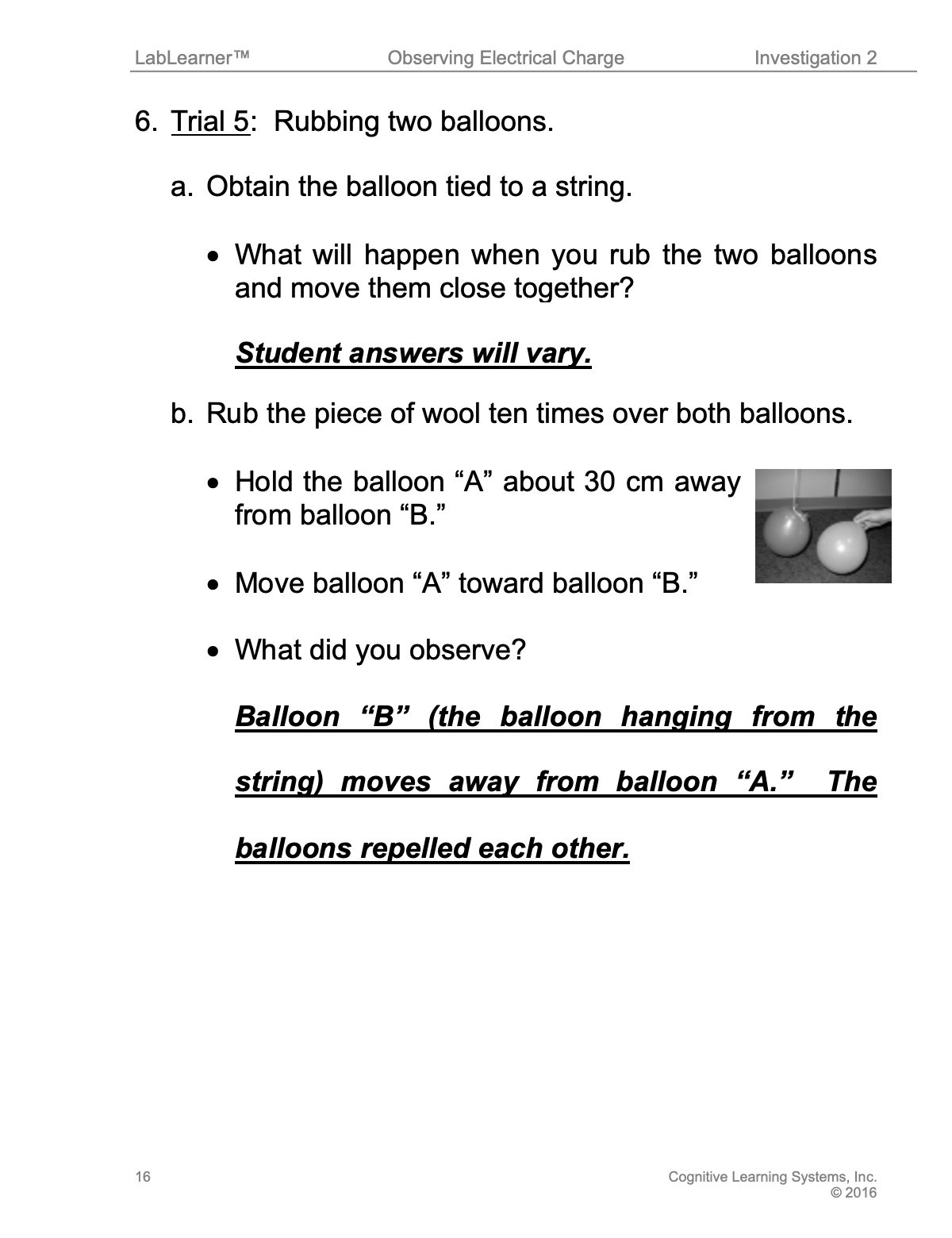
Direct another student in each group to rub the piece of wool ten times over all areas of both balloons.
Inform students that they will next move the balloons close to each other.
Instruct the student holding the balloon to place it approximately 30 cm from the hanging balloon.
Direct students to slowly move the balloon toward the balloon hanging by the string.
Tell students to record what they observe in Problem 6b of their Student Data Record.
KEYS

CLEAN UP
Let students know your expectations for clean-up. Ask them to clean up.