Teacher Portal:
Exploring Electricity
Investigation 1 – PreLab
 PRINT IT
Use your browser to download a printable PDF as help during the slide presentation and to make additional notes. In your browser, go to File > Print and then choose to save as PDF.
MINDSET
This Investigation is designed to:
- introduce students to the concept of static electricity.
- promote student understanding that an electrical charge can be either negative or positive.
- help students understand that negatively charged electrons can move from one object or material to another.
- assist students with the concept that when the surface of objects or materials are rubbed together, they can become electrically charged.
- provide students with the opportunity to observe static electricity.
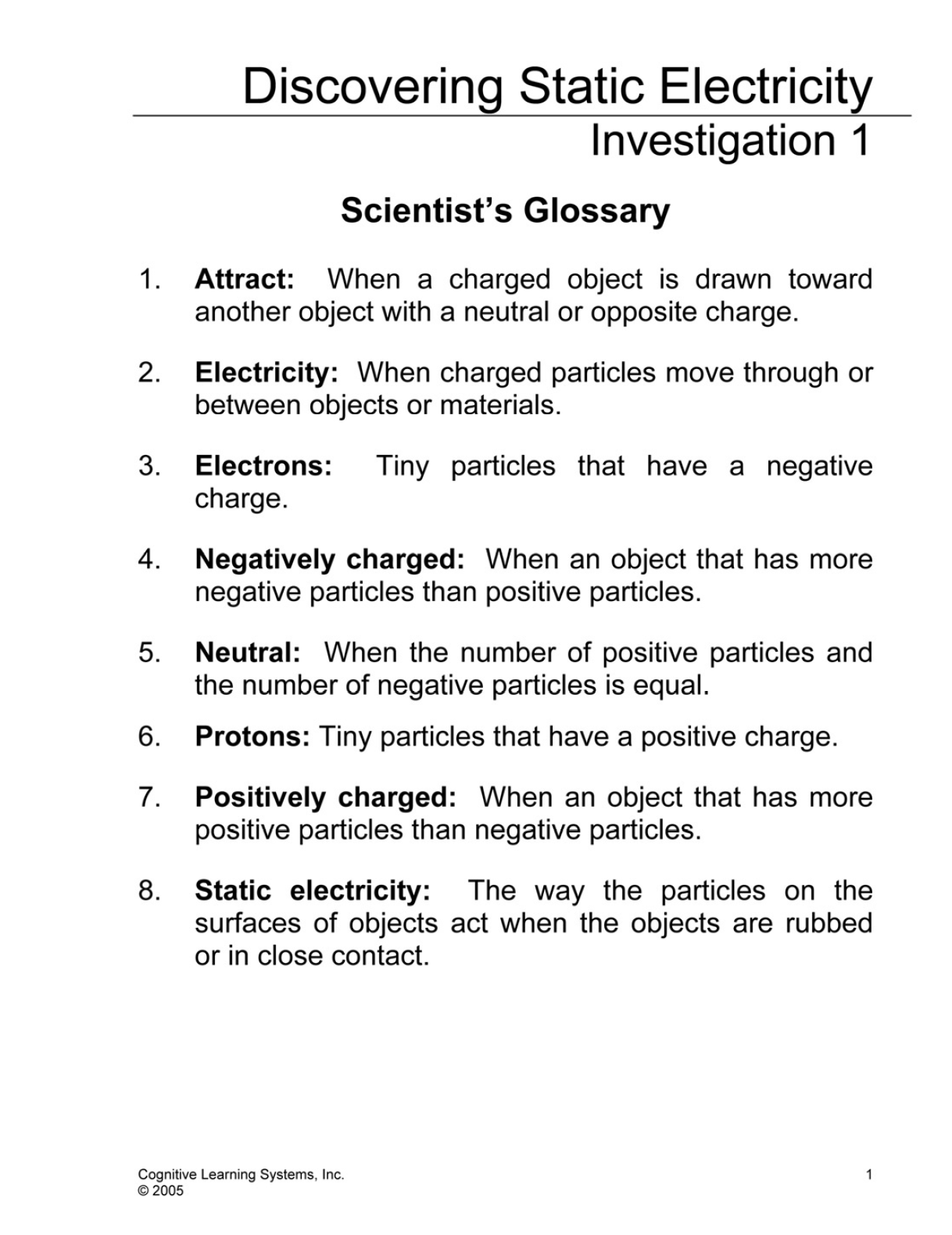
SCIENTIST’S GLOSSARY
- Attract: When a charged object is drawn toward another object with a neutral or opposite charge.
- Electricity: When charged particles move through or between objects or materials.
- Electrons: Tiny particles that have a negative charge.
- Negatively charged: When an object has more negative particles than positive particles.
- Neutral: When the number of positive particles and the number of negative particles is equal.
- Protons: Tiny particles that have a positive charge.
- Positively charged: When an object has more positive particles than negative particles.
- Static electricity: The way the particles on the surfaces of objects act when the objects are rubbed or in close contact.
BE PREPARED
Watch the Investigation 1 Teacher Video and Student Video below to prepare for the PreLab.
 SET FOR SUCCESS
- Tell students that they are about to begin the Exploring Electricity CELL.
- Ask students to share the kinds of things they might learn in these Investigations.
Begin the PreLab Concept Slides to start students on their learning journey. Then watch the Pre-Lab Student Video afterward as a class.
 NAVIGATE IT
Once the slide presentation is launched
- use your left and right arrows to advance or go back in the slide presentation, and
- hover your mouse over the left edge of the presentation to get a view of the thumbnails for all the slides so that you can quickly move anywhere in the presentation.
- Click HERE to launch the slide presentation for the CELL.
SHARE IT
SLIDE VELEC-pre-1
This is the first Investigation of the LabLearner CELL Exploring Electricity. In it, students will become familiar with the concept of positive and negative charged particles and surfaces.
______________________________________________
SLIDE VELEC-pre-2
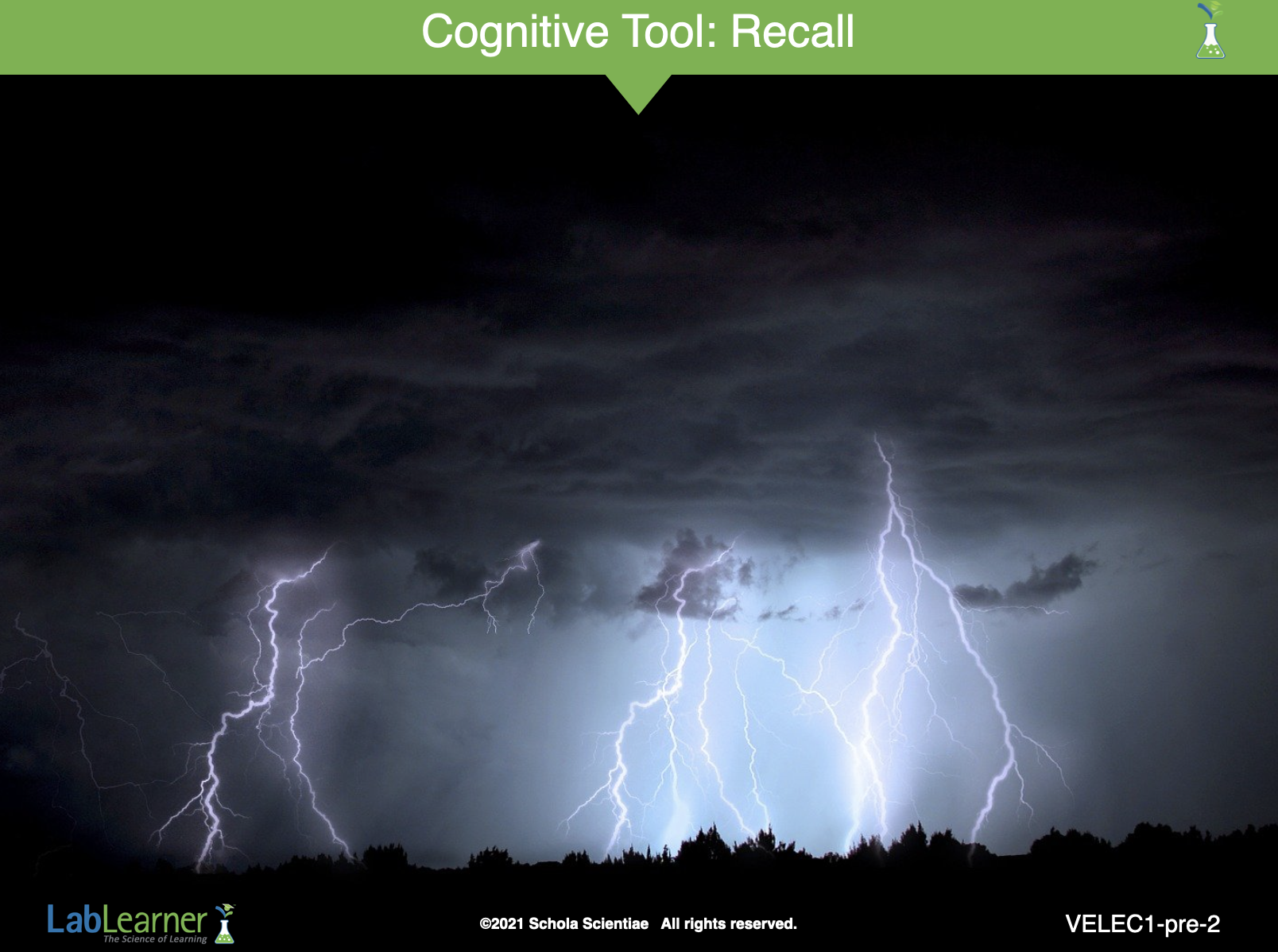
A. Begin the Investigation by describing the focus of the CELL to students.
1. This CELL is designed to introduce students to some basic concepts of electricity. During the Investigations, students will explore static electricity, electrical current, the creation of several different types of circuits, and whether an object or material is a conductor or insulator of electrical current.
2. Tell students that after they conclude their first five Investigations they will be asked to use the knowledge they have acquired to design and construct their own electrical circuits in a model house. In order to perform this assessment, they will need to understand the concepts introduced during this CELL.
______________________________________________
SLIDE VELEC-pre-3
B. Narrow the focus of the discussion by explaining that in Investigation One of the CELL students will begin to explore static electricity.
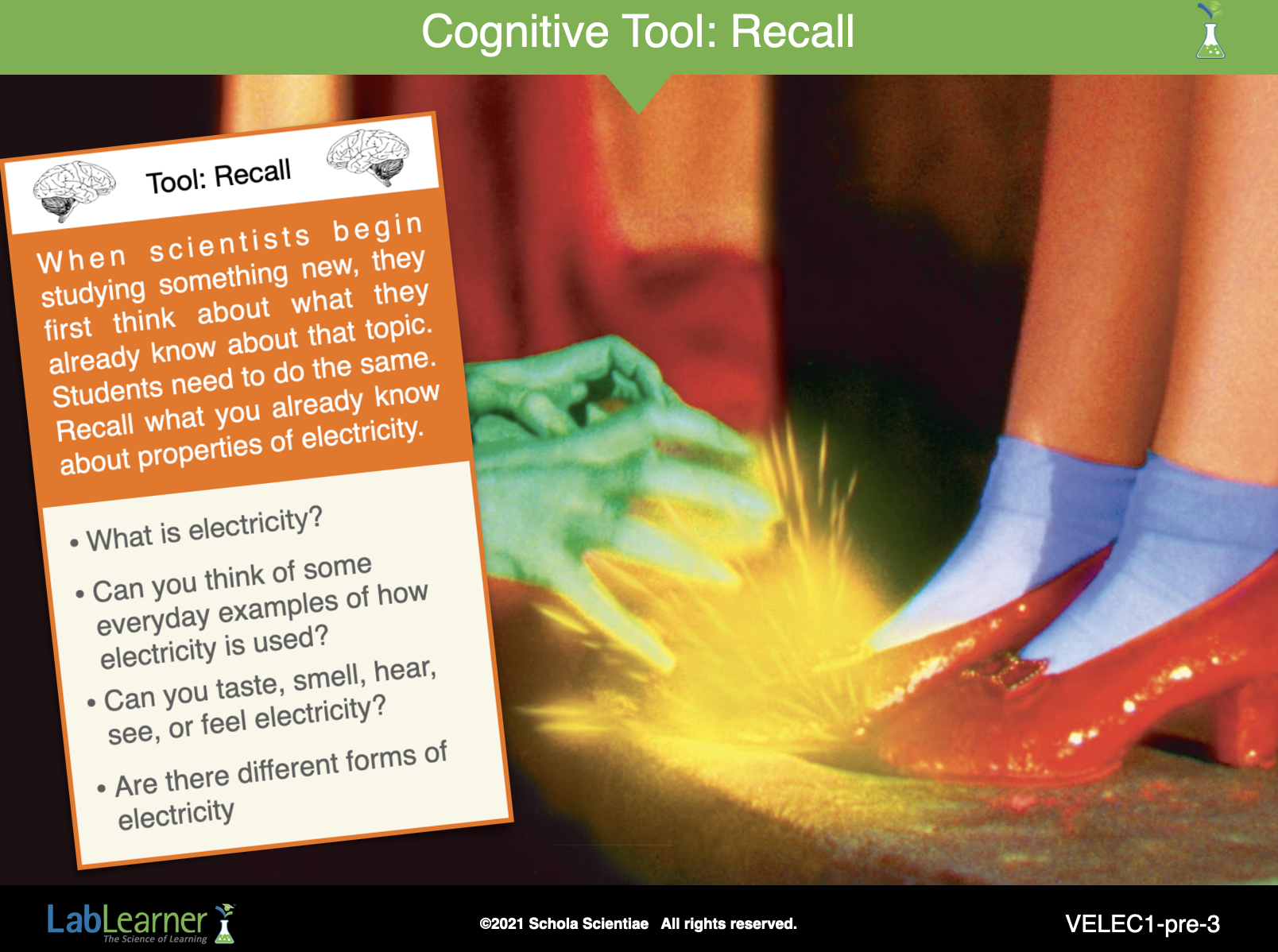
Tell students that they will perform experiments to learn more about electricity, but in order to get ready to learn something new, they should first use the Recall thinking tool from the Cognitive Toolbox.
The Recall tool directs students to think about what they already know about a topic. To use this tool, students should ask themselves what they know about electricity. This will help them recall any useful information they may already know about the topic.
1. Ask students whether they remember what to do in order to get ready to learn about something new. Students should suggest recalling or describing things they may already know about the topic.
2. Encourage students to recall what they know about electricity. Connect their recalled statements about electricity to questions that they may have asked themselves in order to recall previous knowledge. Example questions and statements that derive from them are presented below. Help students to understand that one way to recall previous knowledge is to ask themselves questions about the topic.
a. Ask students: What is electricity? Student answers may vary. Answers may include that electricity is something that makes their radios, lights, etc. work.
b. Ask students: Can you think of some everyday examples of how electricity is used? Student answers may vary. Answers may include suggestions such as electricity is used to run washers and dryers, lights, stereos, CD players, televisions, blow dryers, etc.
c. Ask students: Can you taste, smell, hear, see, or feel electricity? Student answers may vary. It is likely that students should suggest that electricity cannot be tasted or smelled. They may also suggest that electricity cannot be heard, seen, or felt. Depending on the environment students live in, this may be true. However, it is possible for electricity to be felt, seen, and heard. When static electricity discharges, it can be felt as a slight shock and heard as a crackling. Lightning, for example, is a form of static electricity which can be seen, heard, and felt.
d. Ask students: Are there different forms of electricity? Student answers may vary due to the environment students live in. For example, students may suggest that electricity exists as a current or as static. Other students may not mention static electricity, as some areas may not have static electricity due to large amounts of humidity in the air. However, some students that have not experienced static electricity may have been exposed to the concept through other means, such as television, various reading materials, or had it described to them.
3. After students have shared their previous knowledge of electricity, comment on the amount of useful information they could recall. Emphasize that the information they remembered will help them as they perform their experiments.
______________________________________________
SLIDE VELEC-pre-4
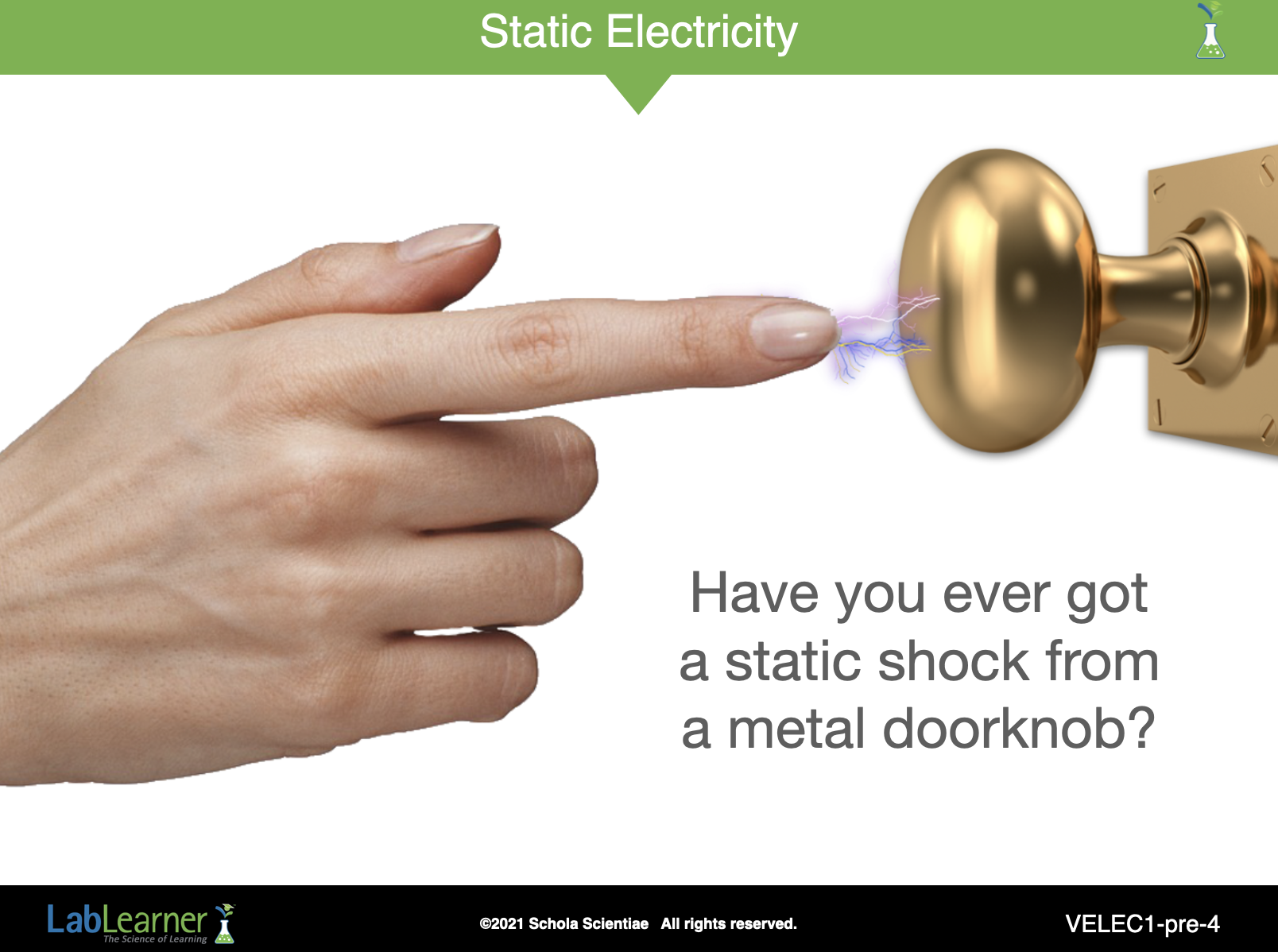
C. Tell students they will begin to explore static electricity during this Investigation. Ask students to locate their Scientist’s Glossary as you discuss the term static electricity.
Static electricity: The interaction between atoms on the surface of some objects or materials caused by friction (rubbing) or close contact.
1. Explain that static electricity is different from the electric current that runs through wires and is responsible for powering lamps, computers, televisions, refrigerators, etc. Static electricity occurs when objects or materials are rubbed together or come in close contact. Static electricity occurs in the absence of wires.
2. Tell students that in order to understand what happens when static electricity occurs, they are going to learn about the different particles that make up objects.
______________________________________________
SLIDE VELEC-pre-5
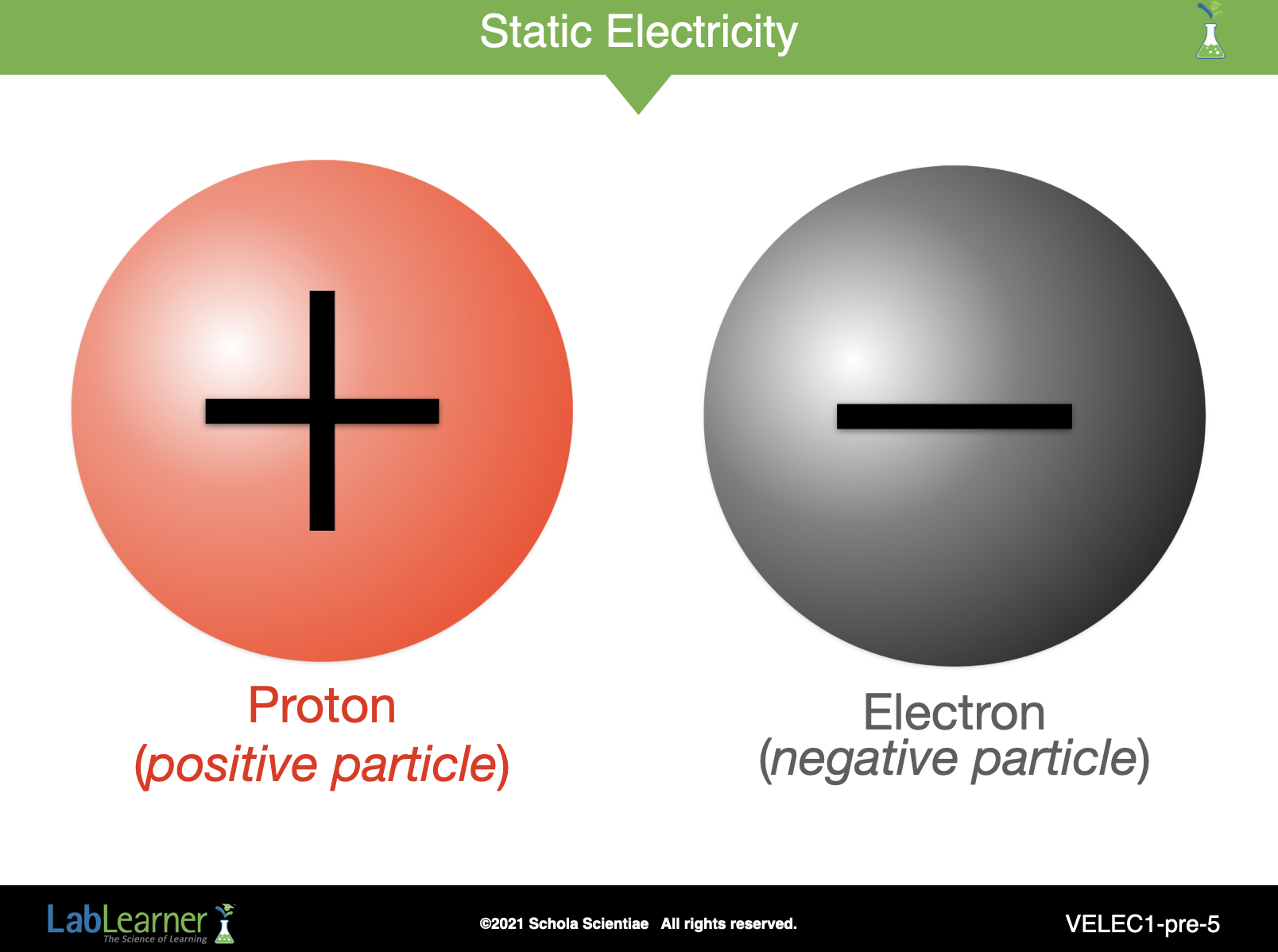
3. Begin by explaining that all substances are made of small particles. The small particles have special names.
a. Substances are made of particles called protons. Protons are special in that scientists say they have a positive charge. Scientists represent protons with a “+” sign.
b. Substances are also made of particles called electrons. Electrons are special in that scientists say they have a negative charge. Scientists represent electrons with a “–“ sign.
Note: This concept can be difficult for students to understand. The steps that follow are designed to provide students with different learning styles the assistance they may need in order to comprehend these terms.
______________________________________________
SLIDE VELEC-pre-6
D. Ask students: What do you think happens to an object when it is rubbed against another object?
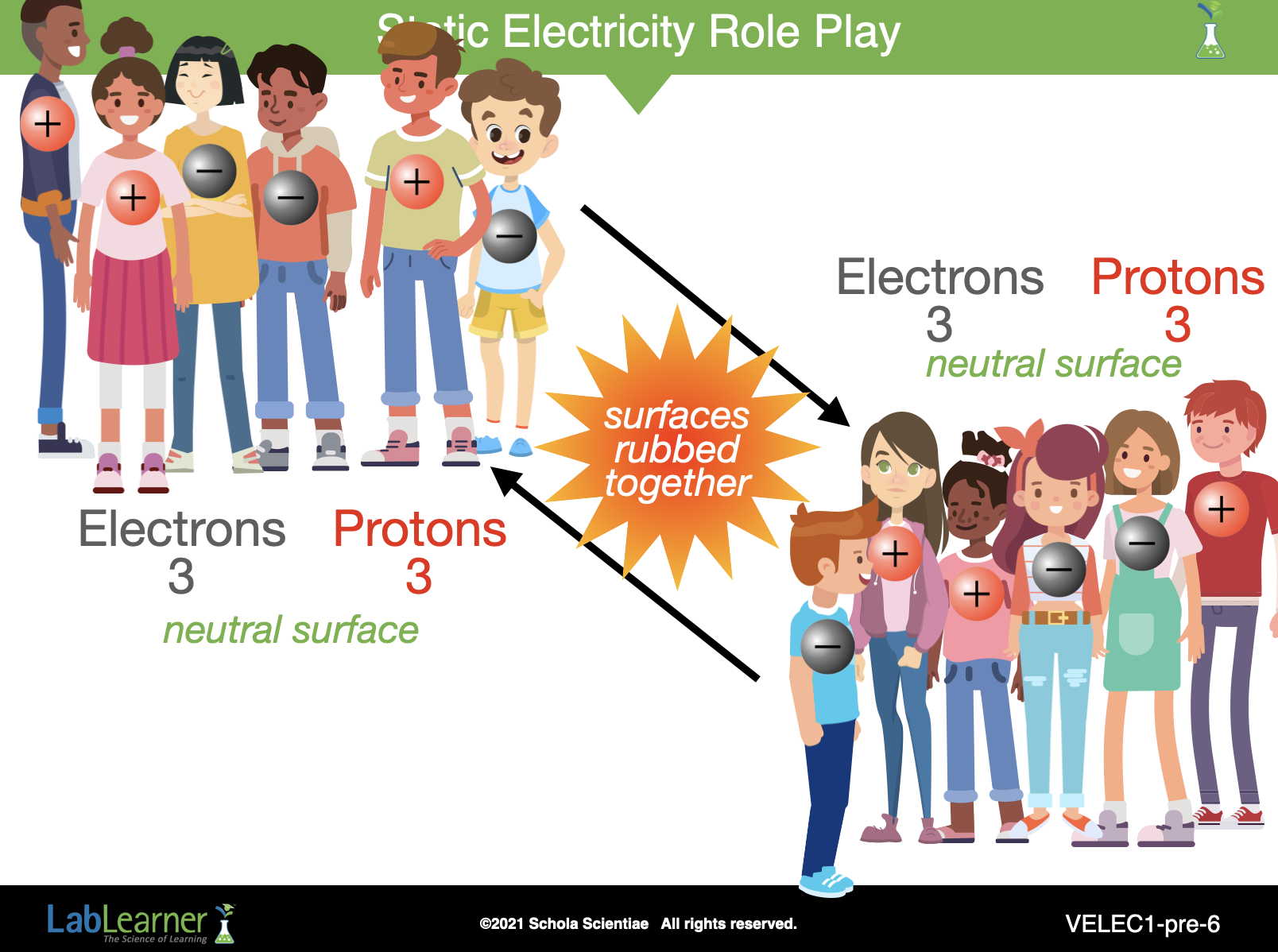
1. Help students answer this question by performing a role play.
a. Select twelve students and ask them to move to an open area of the classroom.
b. Give six of the students a plus sign and six of the students a minus sign. Ask students to hold their signs in front of their chests.
c. Direct six students to stand in one area of the room and six in a second area. Make sure that in each of the two areas there are three students with plus signs and three with minus signs. The plus and minus signs should be distributed throughout the group.
d. Explain to the class the plus signs represent the positive particles or protons on the surface of an object and the minus signs represent the negative particles or electrons on the surface of an object. Ask students the following questions:
• Ask students: How many positive particles are there on each object? Three.
• Ask students: How many negative particles are there on each object? Three.
• Ask students: Are there equal or unequal numbers of positive and negative particles on each object? Students should indicate there is an equal number of positive and negative particles.
• Tell students that when a substance has an equal number of plus (positive) and minus (negative) particles it is described as neutral.
______________________________________________
SLIDE VELEC-pre-7
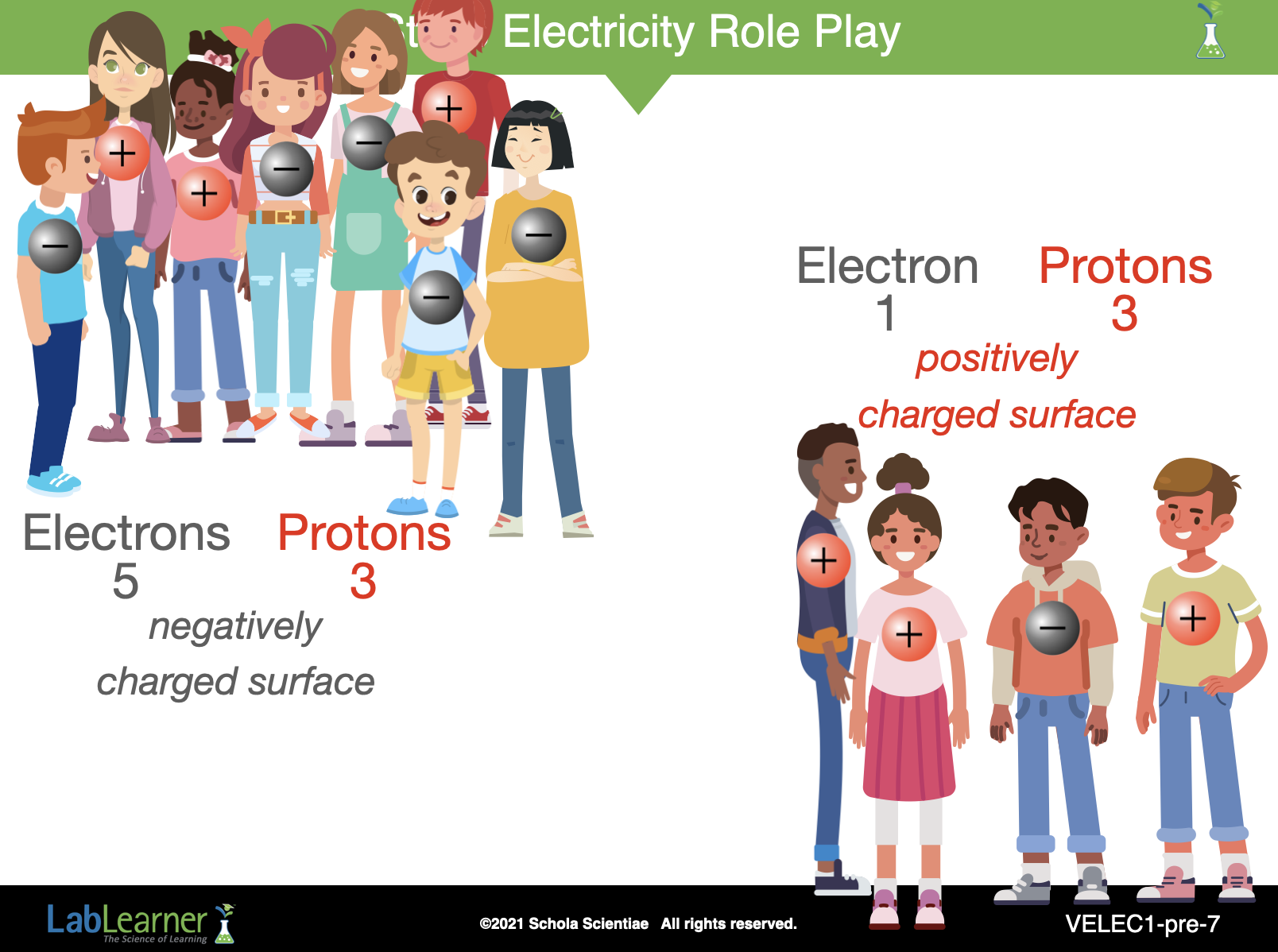
2. Direct two of the students holding the minus signs from one area to separate from the group and move to the other area. Explain that the electrons just moved off of the object.
• Ask students: What does each group represent? Each group still represents the surface of an object.
• Ask students: What just happened? Students should indicate that two electrons (negatively charged particles) moved away from one object or off the object to the other object.
• Ask students: Can you describe what you observe about each object now? Students should indicate that one object has three positive particles (protons) and one electron, and the other object as three positive particles (protons) and five electrons.
• Tell students that scientists would now describe one object as positively charged because it has more protons, or positive particles, than electrons, or negative particles. They would describe the other object as negatively charged because it has more electrons than protons.
Retrieve the signs from the participants and ask them to return to their seats.
______________________________________________
SLIDE VELEC-pre-8
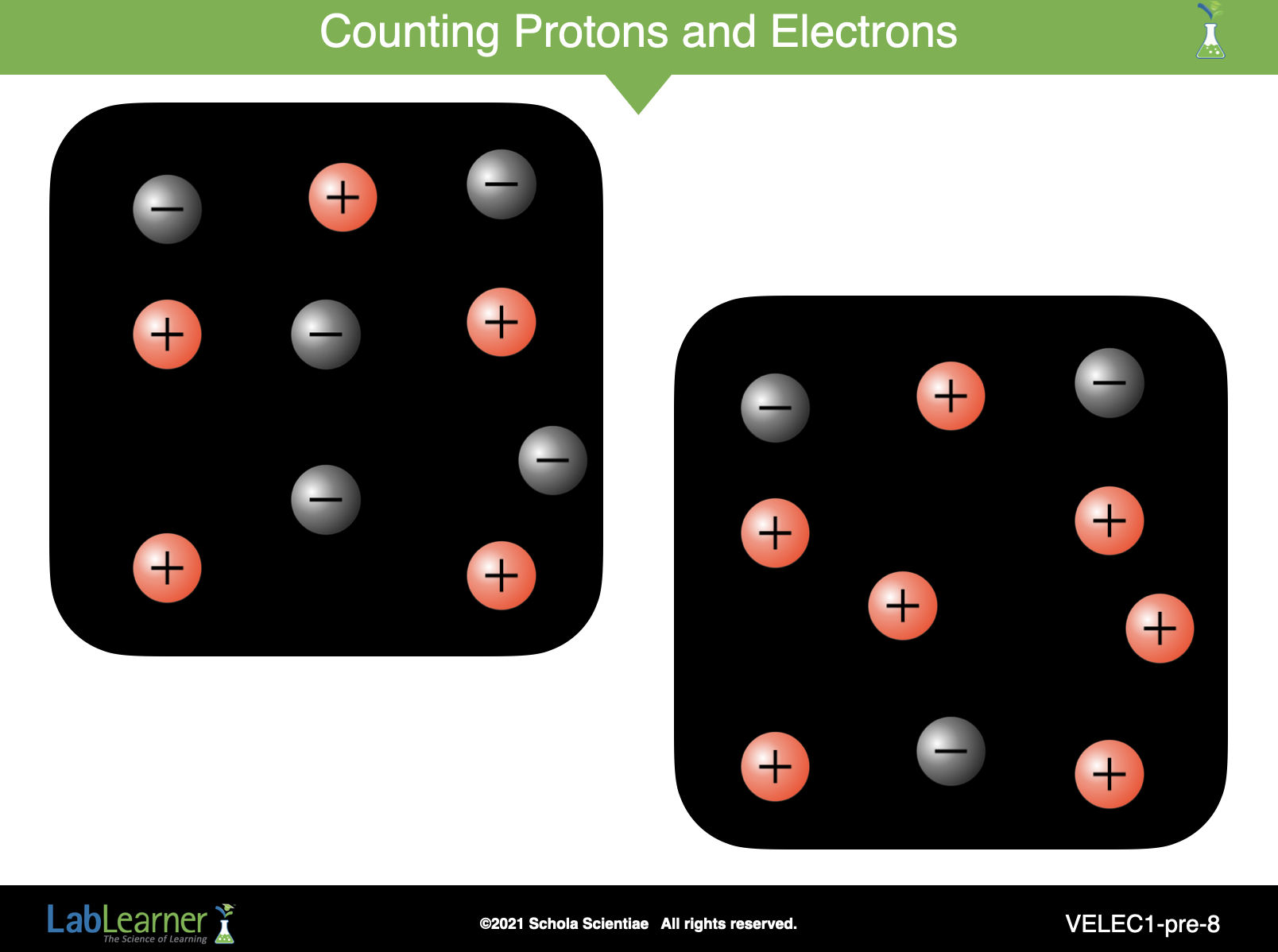
3. Review the role-play with students, emphasizing the movement of electrons when the two objects were rubbed together. Explain that only electrons, not protons, move when two objects are rubbed or come in contact with each other.
a. Continue the discussion of protons and electrons by drawing a square on the board and filling it with five pluses and five minuses. Inform students the square represents an object and the plus and minuses are the positive and negative particles on its surface.
b. Instruct students to count the number of plus (protons) and minus (electrons) signs.
c. Ask students: Would you say this object is positive, negative, or neutral? Student answers may vary, but students should indicate the object is neutral because there are not more positive than negative particles and there are not more negative than positive particles. Therefore, the object could not be either positive or negative and must be neutral. Students may also deduce this outcome due to prior experience with the term “neutral.”
4. Draw one more square on the board. Fill it with seven pluses and three minuses.
a. Instruct students to count the number of positive and negative particles.
b. Students should indicate there are seven protons or positively charged particles and three electrons or negatively charged particles.
c. Explain that this object is positively charged because it has more positive particles (protons) than negative particles (electrons).
______________________________________________
SLIDE VELEC-pre-9
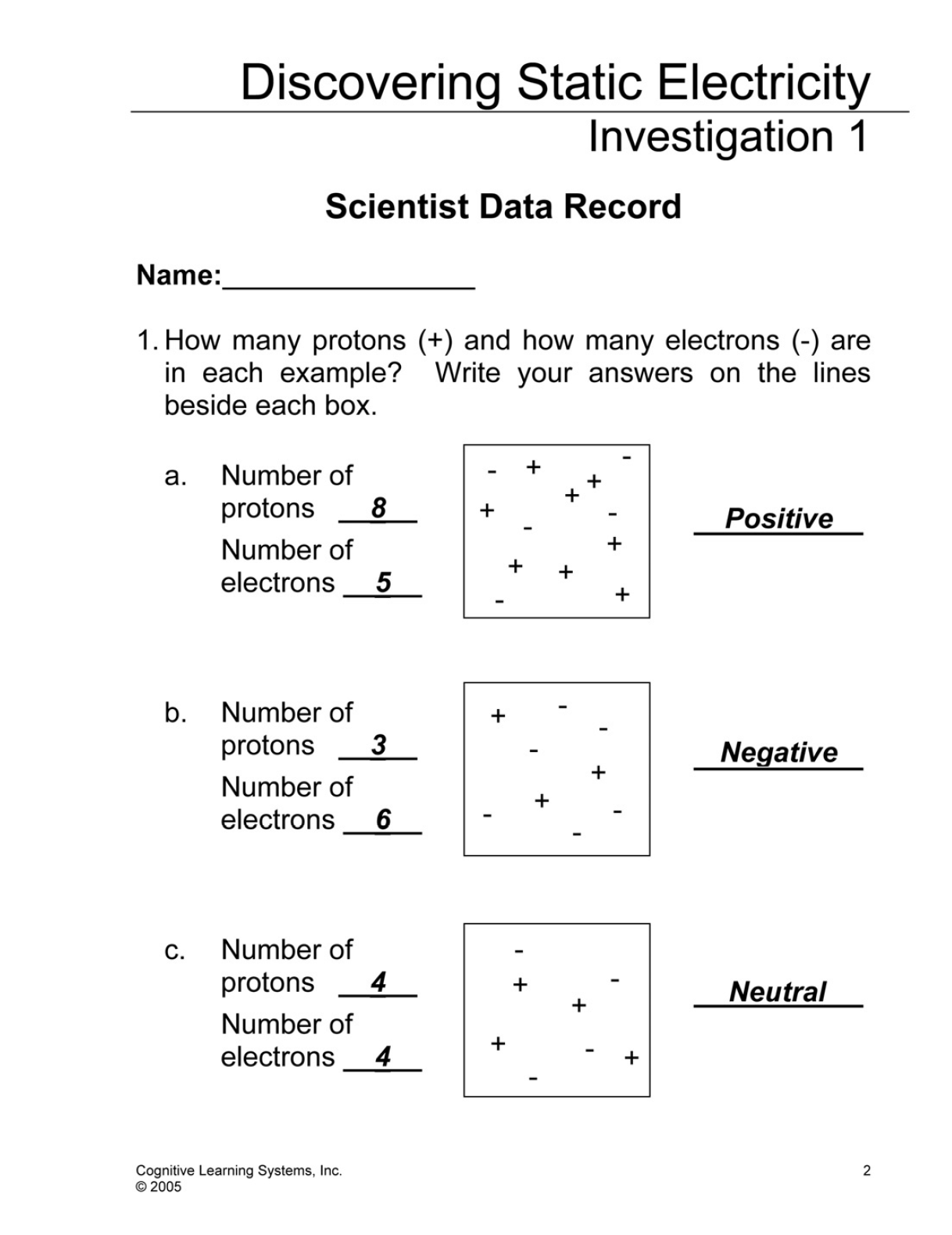
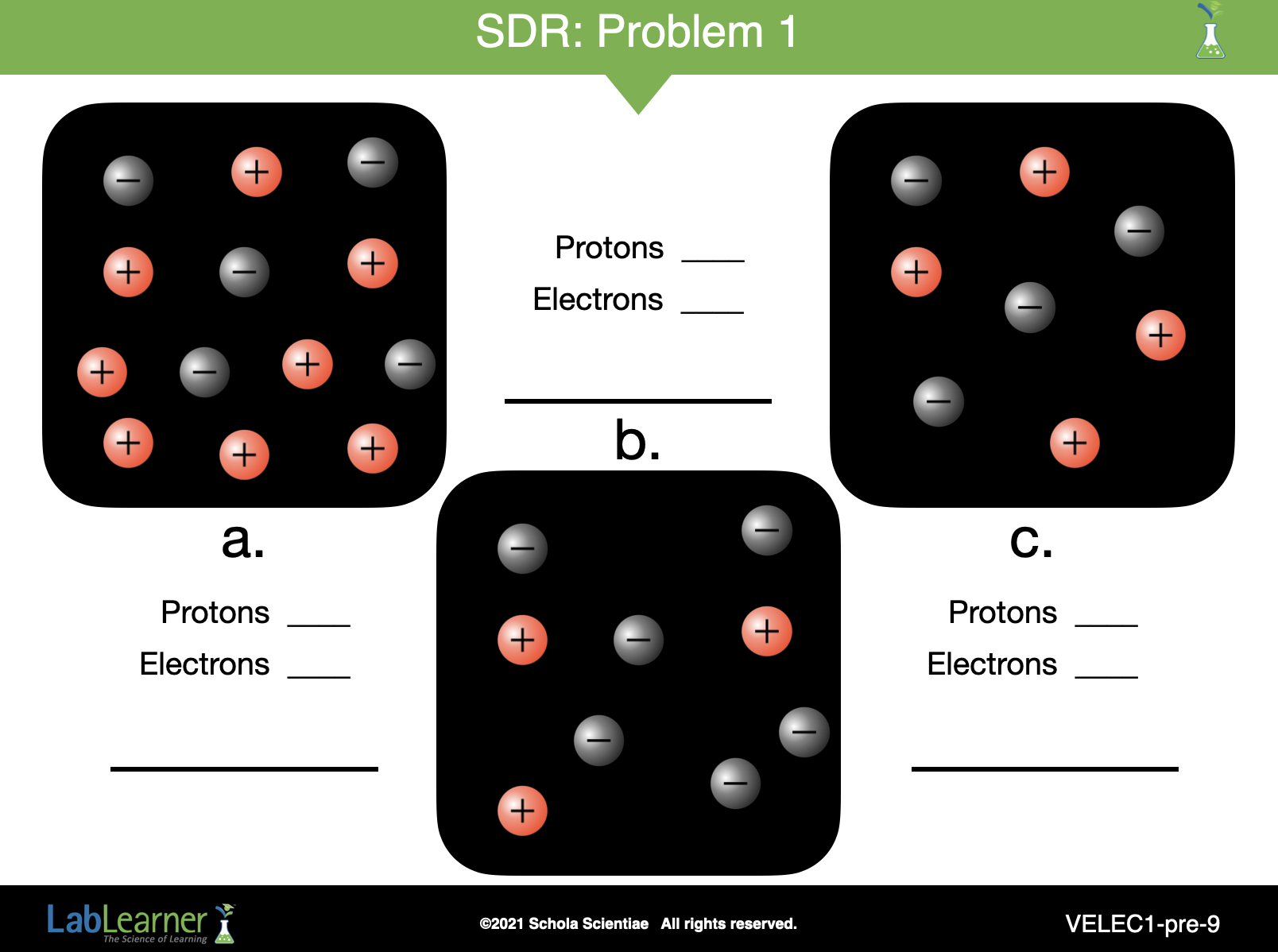
5. Provide an opportunity for students to work with the concepts of positive, negative, and neutral independently. Ask students to locate Problem 1 in their Student Data Record. Tell them to determine the number of protons and electrons in each example.
6. When students have completed their task, ask students: What did you find? Students should have determined that the first object had eight protons (positive particles) and five electrons (negative particles). The second object had three protons (positive particles) and six electrons (negative particles), and the third object had four protons (positive particles) and four electrons (negative particles).
7. Ask students: Would you consider the three objects in Problem 1 positively charged, negatively charged, or neutral? It may be necessary to remind students of the following:
•Positive: When there are more protons than electrons on the surface of an object, scientists describe that object as having a positive charge.
•Negative: When there are more electrons than protons on an object’s surface, they say that object has a negative charge.
•Neutral: When the number of electrons and protons on the surface of an object is equal, they describe that object as neutral in charge or as having no charge.
8. Discuss students’ conclusions and how they arrived at each of the conclusions. Encourage students to record their conclusions on the line next to each box in Problem 1.
•Object (a) = positively charged
•Second object (b) = negatively charged
•Third object (c) = neutral
______________________________________________
SLIDE VELEC-pre-10
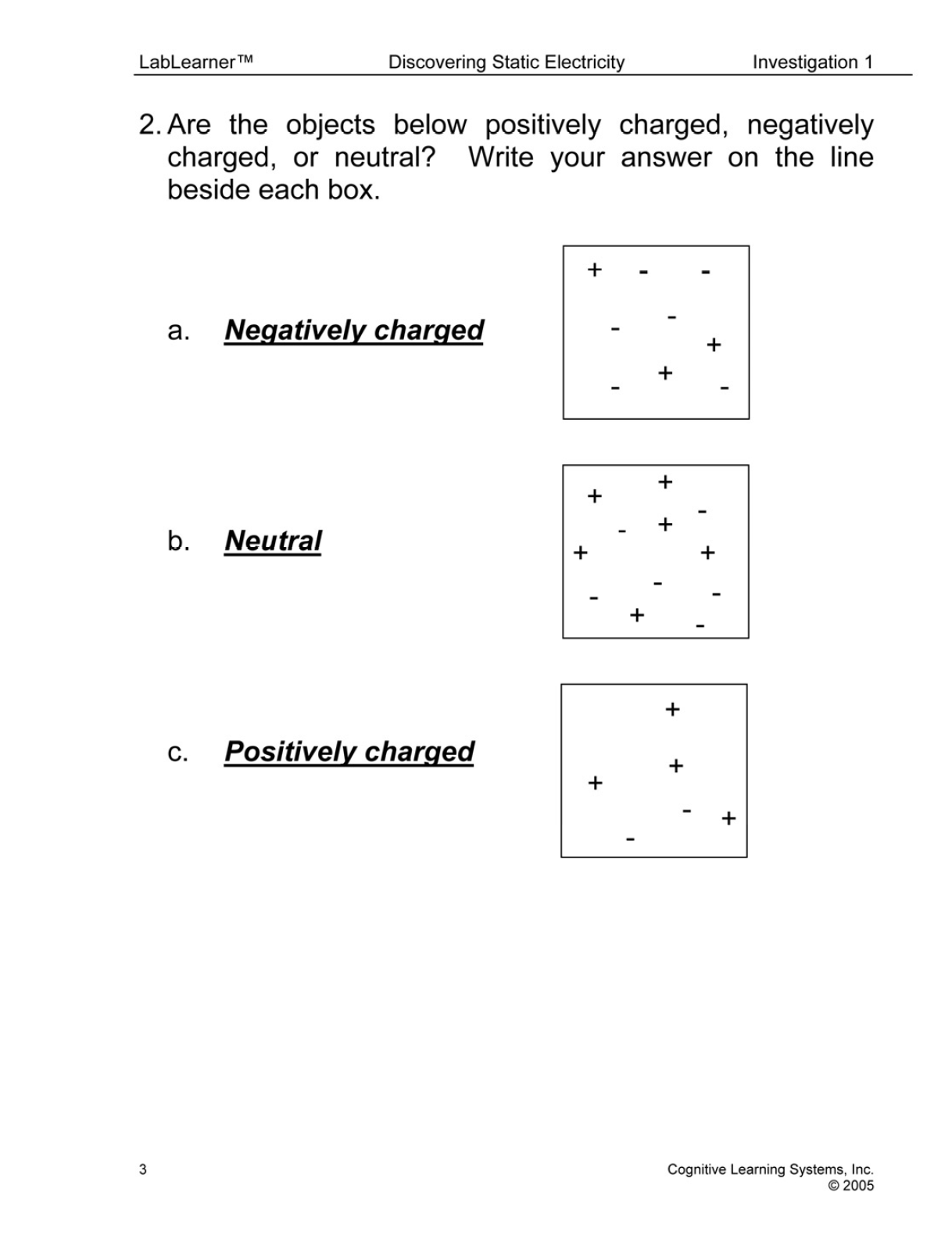
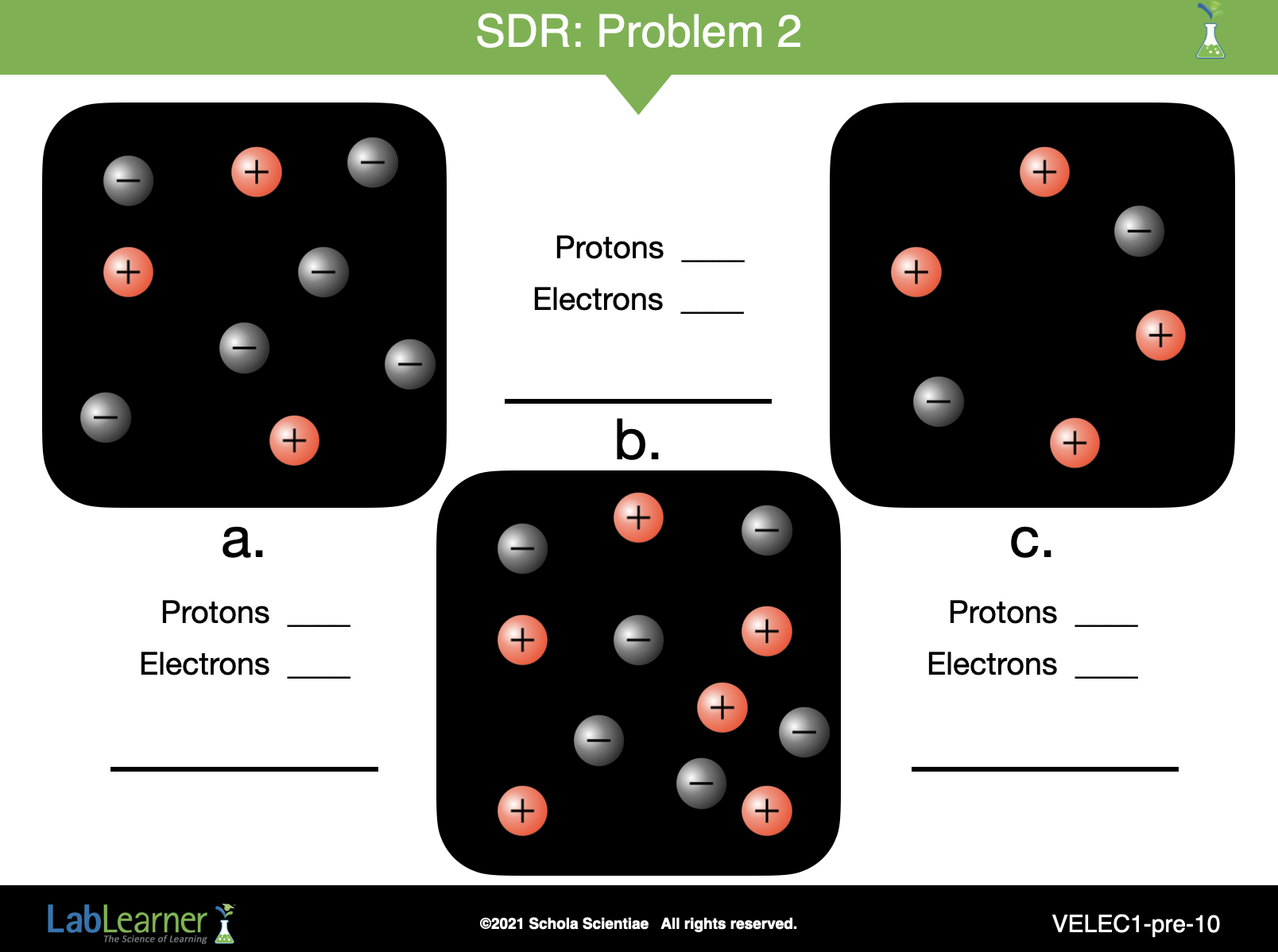
9. Provide an additional opportunity for students to work with the concept by directing them to complete Problem 2 in their Student Data Record.
Ask students: Are the examples positively charged, negatively charged, or neutral? Students should determine the following:
a. Problem a: The object is negatively charged because there are 6 negative electrons and 3 positive protons. Because there are more electrons than protons, the object is negatively charged.
b. Problem b: The object is neutral because there are 6 negative electrons and 6 positive protons. Thus the object is neutral.
c. Problem c: The object is positively charged because there are 4 positive protons and 2 positive electrons. Because there are more protons than electrons, the object is positively charged.
______________________________________________
SLIDE VELEC-pre-11
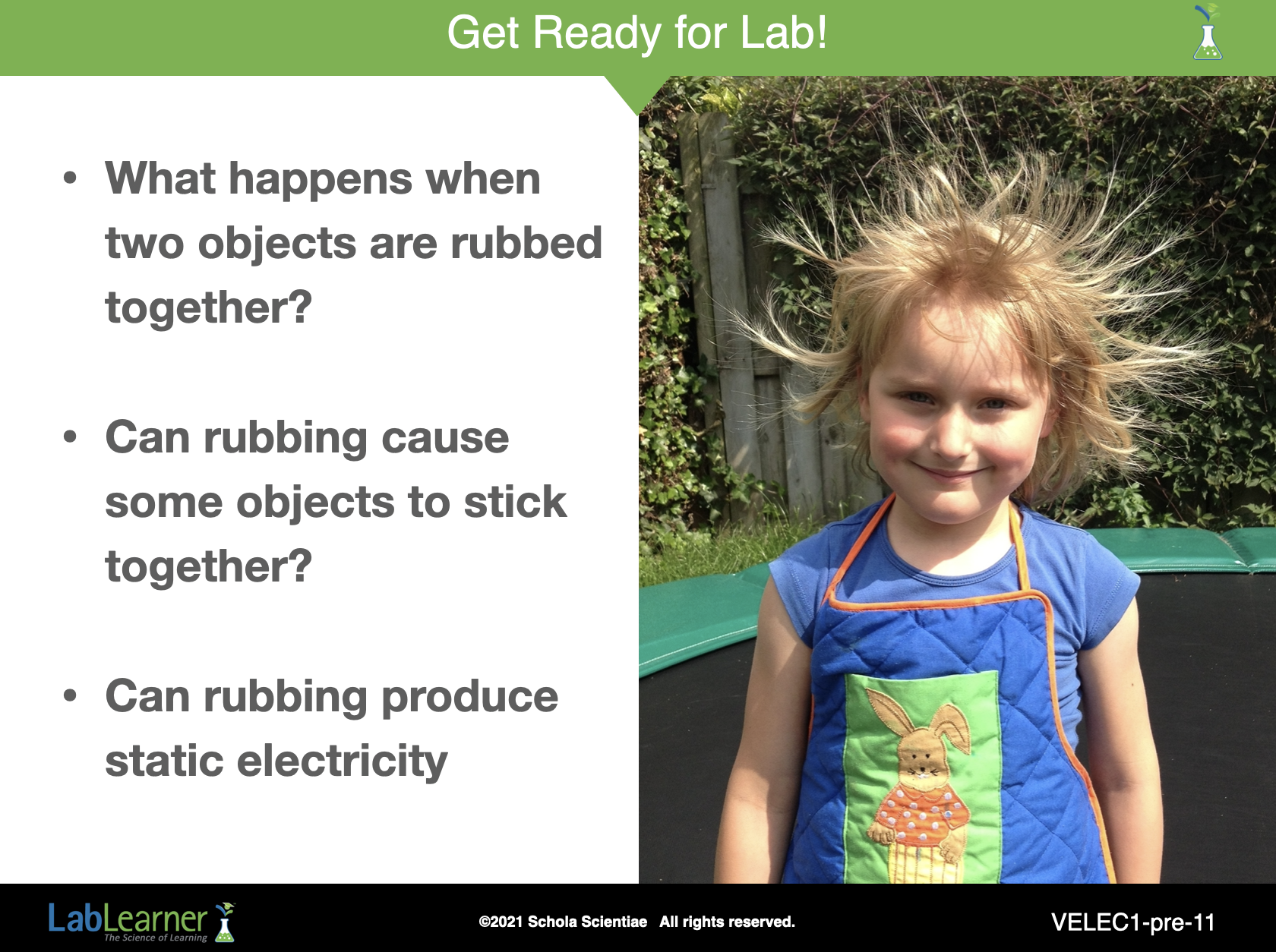
E. Tell students they will be conducting experiments that will increase their understanding of static electricity and how electrons move from one object to another. During their experiments, they will use balloons to explore this concept.
1. As they conduct their experiments, they should think about the following questions.
• What happens when two objects are rubbed together?
• Can rubbing cause some objects to stick together?
• Can rubbing produce static electricity?
2. Explain that they should be able to answer these questions after they conduct the experiments.
Student Video
Watch the Investigation 1 Student Video after the Share It presentation to prepare for the PreLab.
KEYS