Teacher Portal:
Exploring Electricity
Investigation 1 – PostLab
 PRINT IT
Use your browser to download a printable PDF as help during the slide presentation and to make additional notes. In your browser, go to File > Print and then choose to save as PDF.
NAVIGATE IT
Once the slide presentation is launched
- use your left and right arrows to advance or go back in the slide presentation, and
- hover your mouse over the left edge of the presentation to get a view of the thumbnails for all the slides so that you can quickly move anywhere in the presentation.
- Click HERE to launch the slide presentation for the CELL.
SHARE IT
SLIDE VELEC1-post-1
This is the first Investigation of the LabLearner CELL Exploring Electricity. In it, students learned about static electricity and the importance of positive and negative charges.
______________________________________________
SLIDE VELEC1-post-2
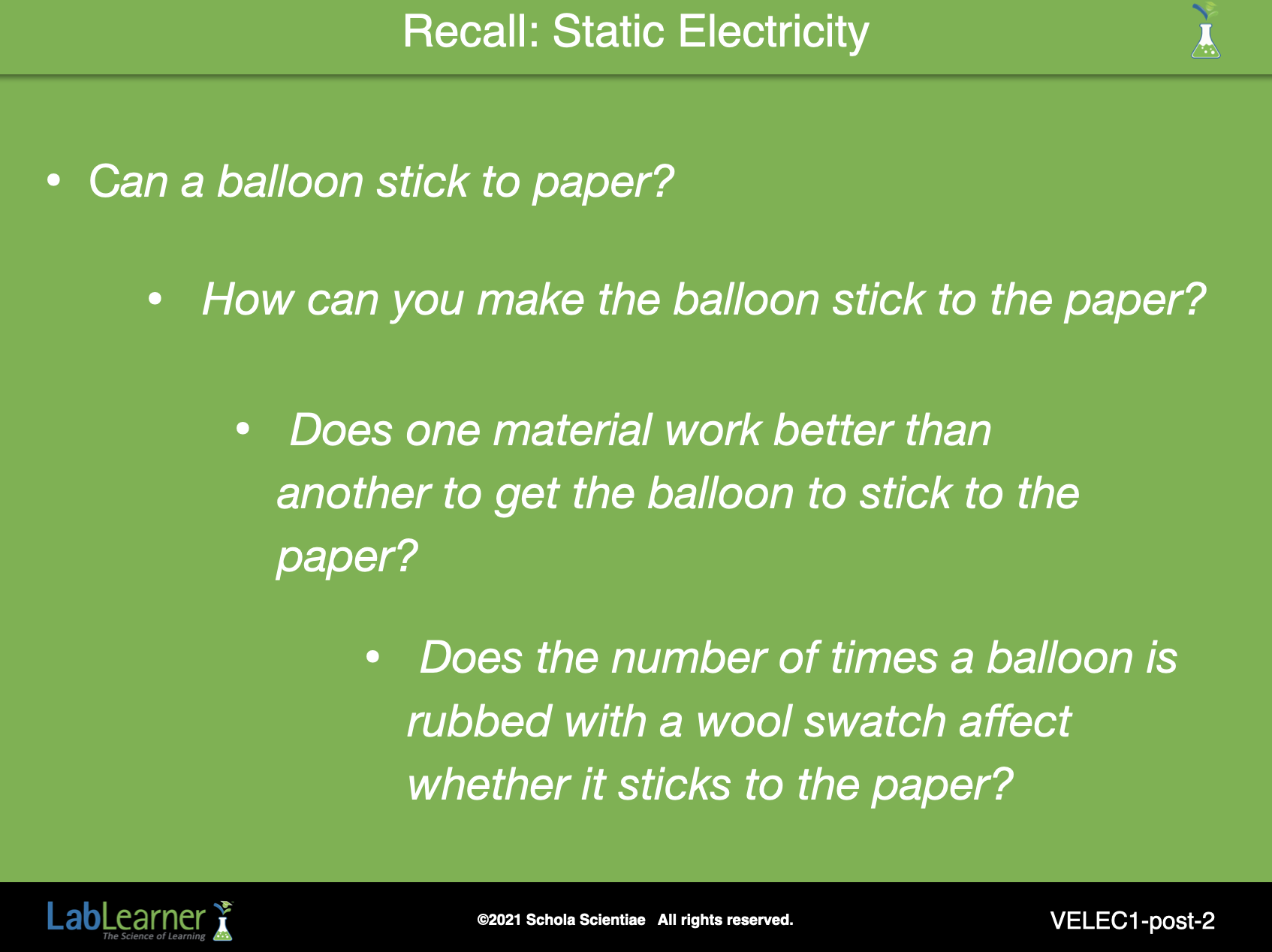
A. Begin the analysis of the Lab by helping students to remember the experiments they conducted. The following questions may be helpful in prompting student discussion.
1. Ask students: Can you remember the four questions that you explored in the Lab? Can a balloon stick to paper? How can you make the balloon stick to the paper? Does one material work better than another to get the balloon to stick to the paper? Does the number of times a balloon is rubbed with the wool affect whether it sticks to the paper?
2. Ask students: Can you describe the types of experiments you performed to answer your questions? Students should suggest that they first tried to stick the balloon to the paper by simply placing it on the wall. After that, they may have tried several methods to get the balloon to stick, one of which was to rub the balloon. Students rubbed the balloons with different materials to determine whether different materials produced differences in the balloons’ attraction to the paper. Finally, students rubbed their balloons a different number of times to determine whether differences in rubbing altered whether the balloon would be attracted to the paper.
______________________________________________
SLIDE VELEC1-post-3
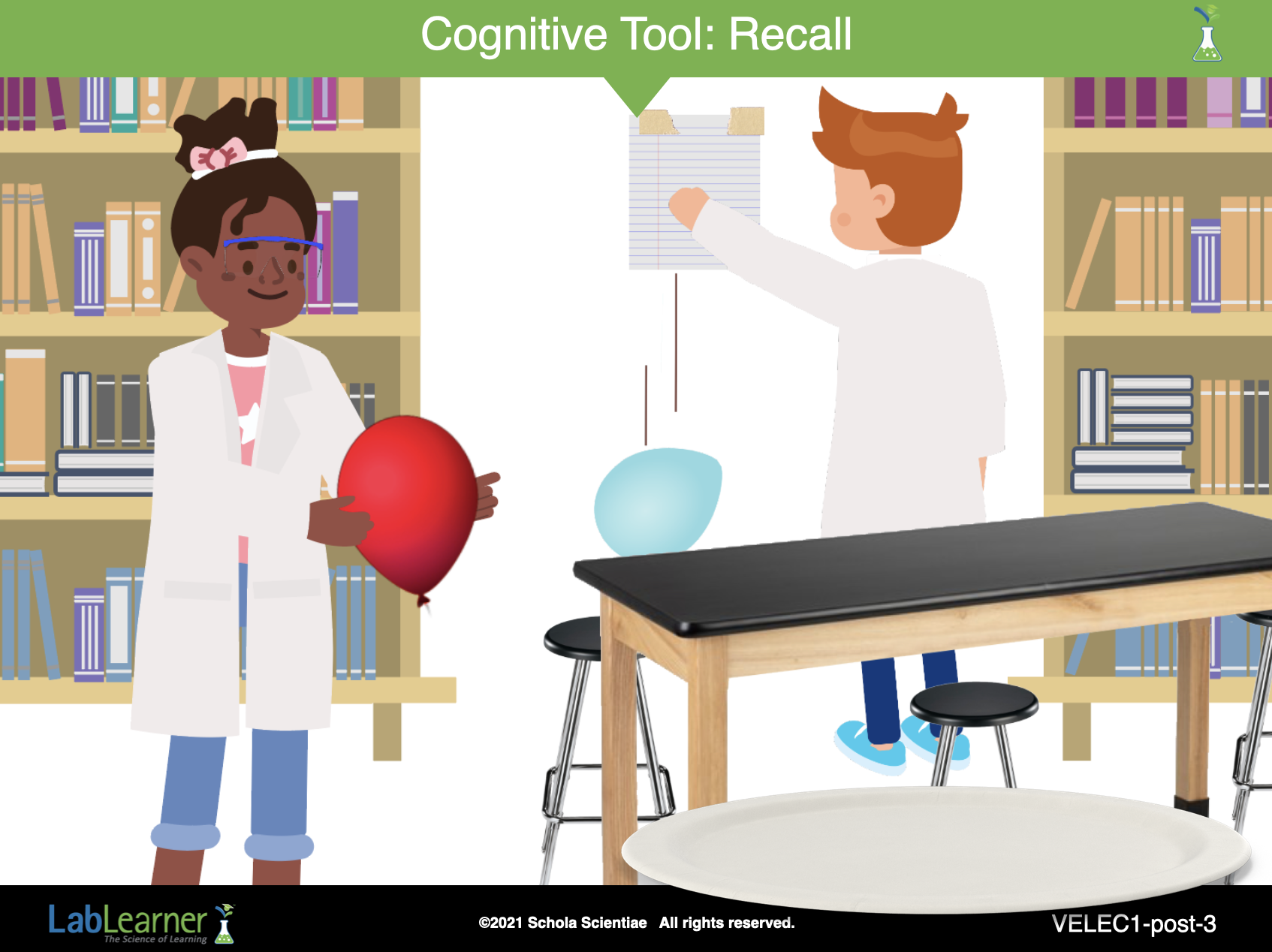
B. Review the first two trials with students by posing the following questions:
1. Ask students: What happened in Trial 1, when you placed the balloon on the paper without rubbing it against something else? The balloon did not stick to the paper at all.
2. Ask students: In Trial 2, you each tried different methods to get the balloon to stick to the paper. Were you successful? How? Student answers may vary. It is likely that students discovered at least one method that resulted in the balloon sticking to the paper. One of the successful methods students should suggest is rubbing the balloon with another material.
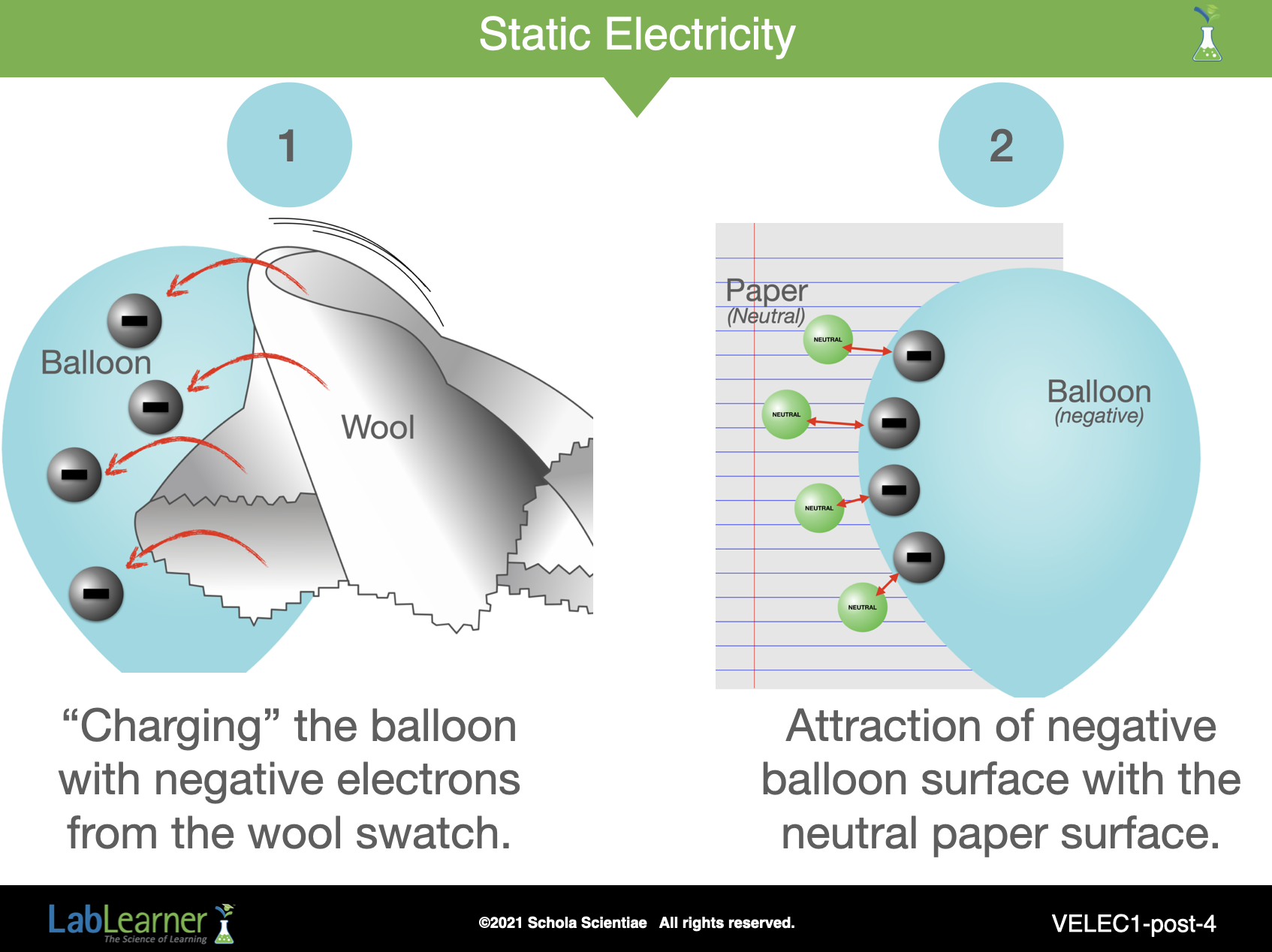
3. Remind students of the role play they conducted during the PreLab. Students modeled the particles (protons and electrons) on the surface of two objects or materials. If necessary, perform the role play again.
a. Ask students: In the role-play what happened when the two materials were rubbed together? The protons remained on the objects but some electrons from one object were transferred to the other object. One object then became positively charged and the other negatively charged.
b. Ask students: Think about the role play and Trials 1 and 2. What do you think happened when you rubbed the balloon? Students should suggest that electrons were transferred either to or from the balloon to the other material or from the other material. The balloon and material then had a positive or negative charge.
______________________________________________
SLIDE VELEC1-post-4
C. Help students connect the results of Trials 1 and 2 with the concept of static electricity.
1. Direct students to review the term static electricity in their Scientist’s Glossary:
Static electricity:
The interaction between atoms on the surface of some objects or materials caused by friction (rubbing) or close contact.
2. Explain that static electricity is the term used to describe the transfer of electrons when two materials are rubbed together.
3. Help students understand that the balloon stuck to the paper after being rubbed as a result of static electricity.
______________________________________________
SLIDE VELEC1-post-5
D. Ask students: What other conclusions about static electricity and the balloon can we draw from our experiments?
1. Encourage students to review their results from Trial 3.
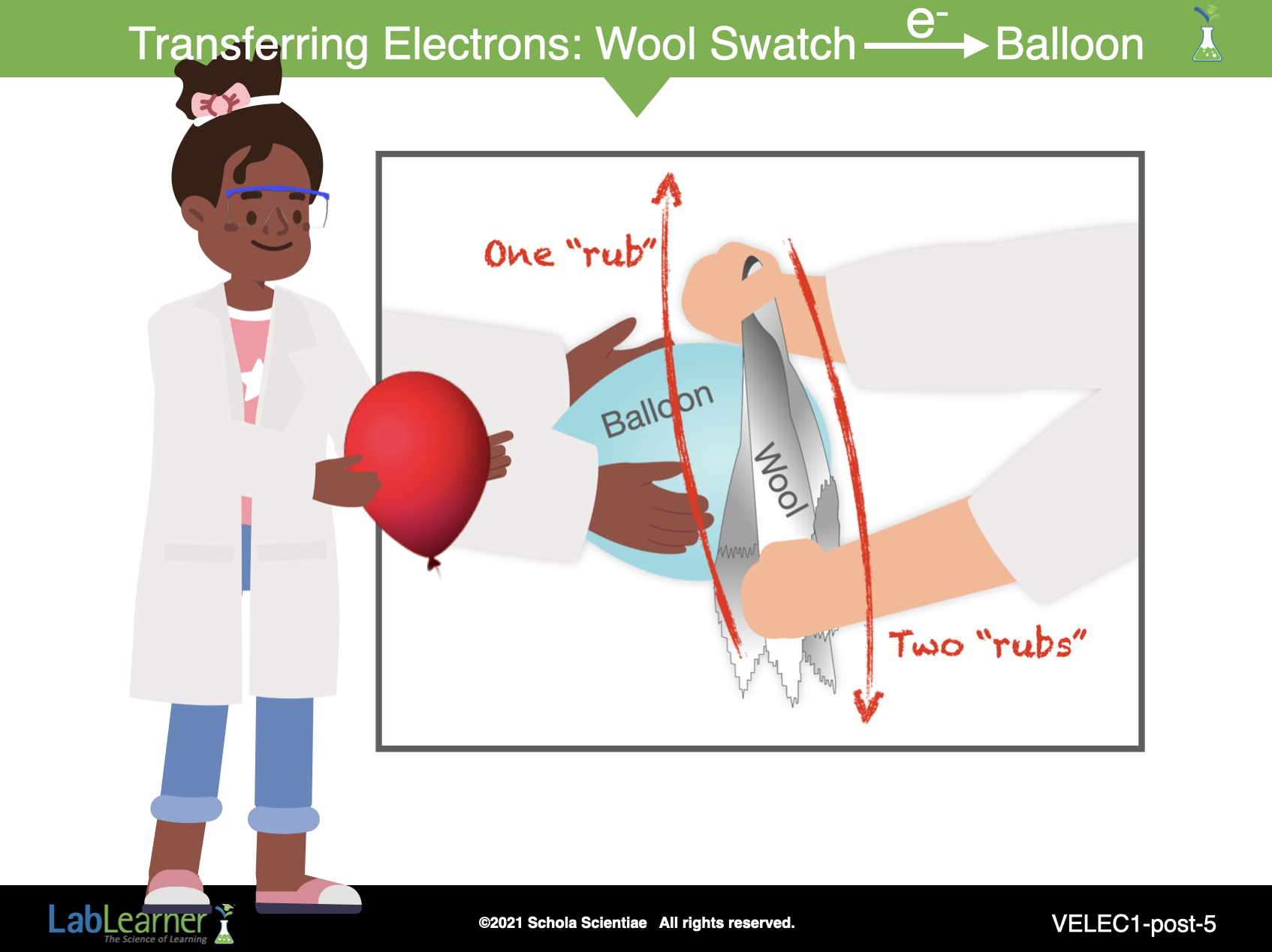
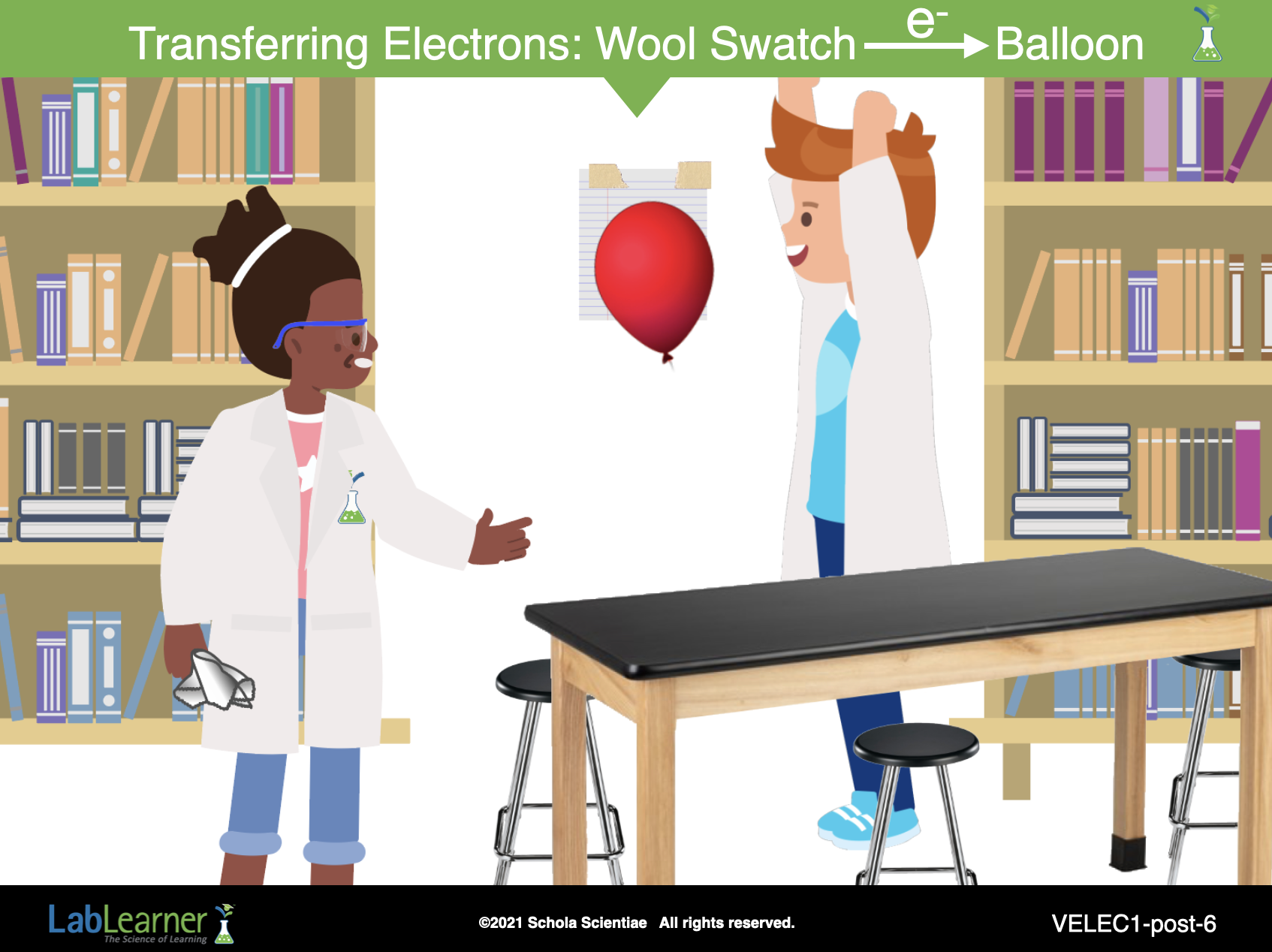
Ask students: Which materials resulted in the balloon sticking to the wall? Student answers may vary. However, it is likely that rubbing with the wool and the paper towel were successful in helping the balloon stick to the paper, but rubbing with the sponge and paper plate were not successful.
2. Ask students: Did any groups try the same materials, but get different results? What may have caused your difference? Student answers may vary. Students may have rubbed a different number of times. One quantity of rubs may have produced enough static electricity to produce the desired results while the other quantity was too small. Students may have used different techniques in rubbing, causing differences in static electricity.
3. Ask students: What can you conclude about the materials you tested and static electricity? Students should suggest that any material that was rubbed against the balloon and caused the balloon to stick to the paper resulted in static electricity.
______________________________________________
SLIDE VELEC1-post-6
E. Ask students: Did the number of times a balloon was rubbed affect static electricity? How could you organize the data results from Trial 4 to answer the question? Student answers may vary.
1. Explain that one way to organize their data is to create a Table of the results.
2. Model the process of creating a Data Table for students. Begin by discussing the questions they will need to ask themselves before they can determine the type of table they will need.
Ask students: Are there any questions we should ask before we create a data table? Guide students to the questions that follow and discuss each.
a. Ask students: Which results or measurements could help us answer our question?
b. Ask students: Did we measure the same type of information each time we recorded results?
c. Ask students: How could we arrange a Table to show the data we recorded for each Trial?
3. Ask students to locate Problem 7 in their Student Data Record. Tell students they will use the blank grid to create their Data Table. Model how to develop their table by working through the questions. Ask students:
a. Ask students: Which results or measurements could help us answer our question? The question we are trying to answer is whether the number of times the balloon was rubbed with the wool changed whether the balloon stuck to the paper. Therefore, it is important to know the number of rubs tried each time and whether the balloon stuck to the paper.
b. Ask students: Did we measure or record the same type of information each time we recorded results? Yes. Students should indicate that they recorded the number of rubs and whether the balloon stuck to the paper each time they tested the balloon.
c. Ask students: How could we arrange a Table to show the data I recorded for each Trial? The Table should list both types of data, the number of rubs, and the result.
______________________________________________
SLIDE VELEC1-post-7
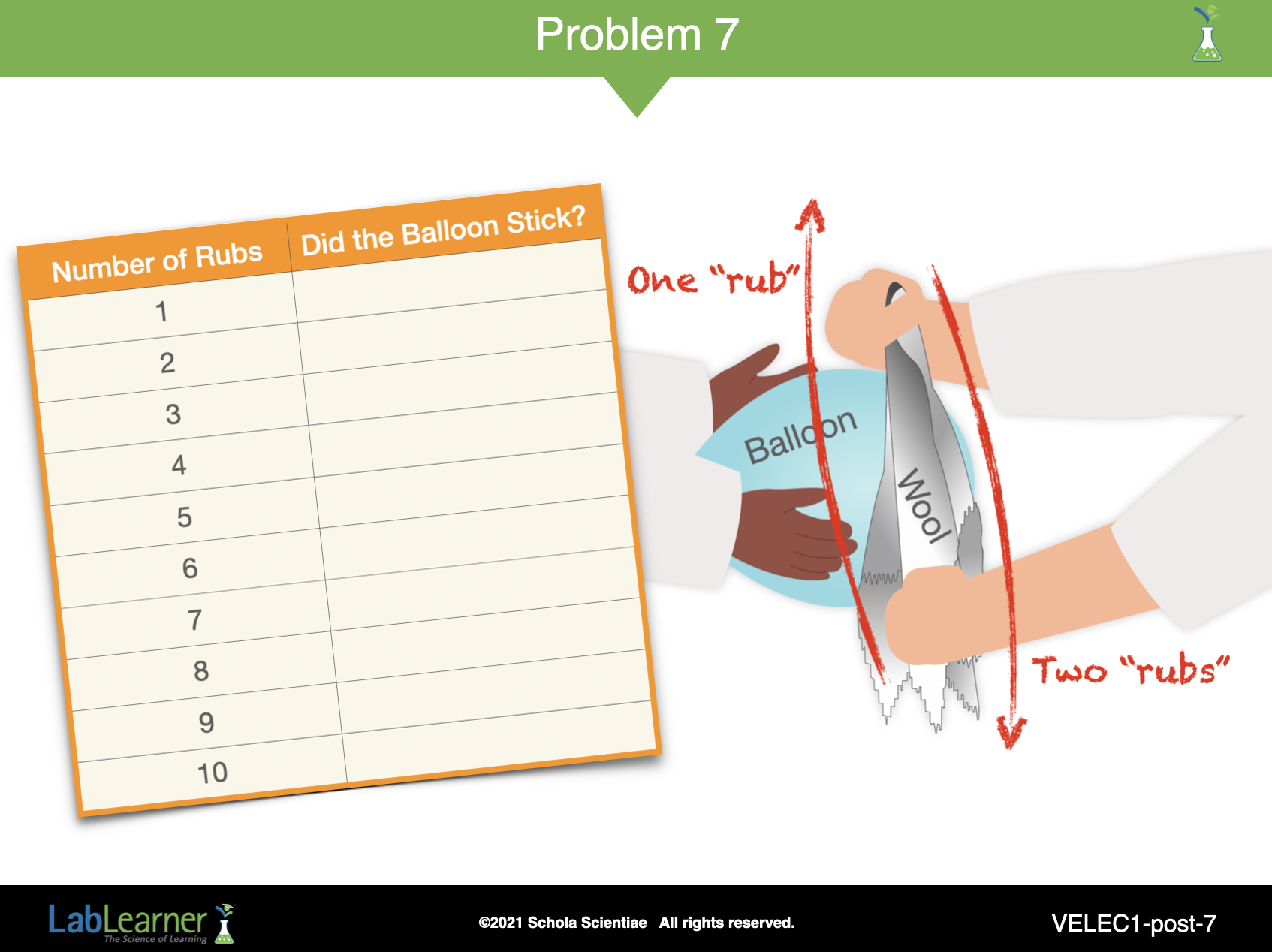
4. In order to complete this task, students should understand that they next need to decide which data would best fit into the columns and which data would best fit into the rows of the grid on their Scientist Data Record.
• Ask students: Which data would fit best into the columns? There are two columns and students collected two types of data. Therefore, one column could indicate the number of rubs and the other the result of the rubs.
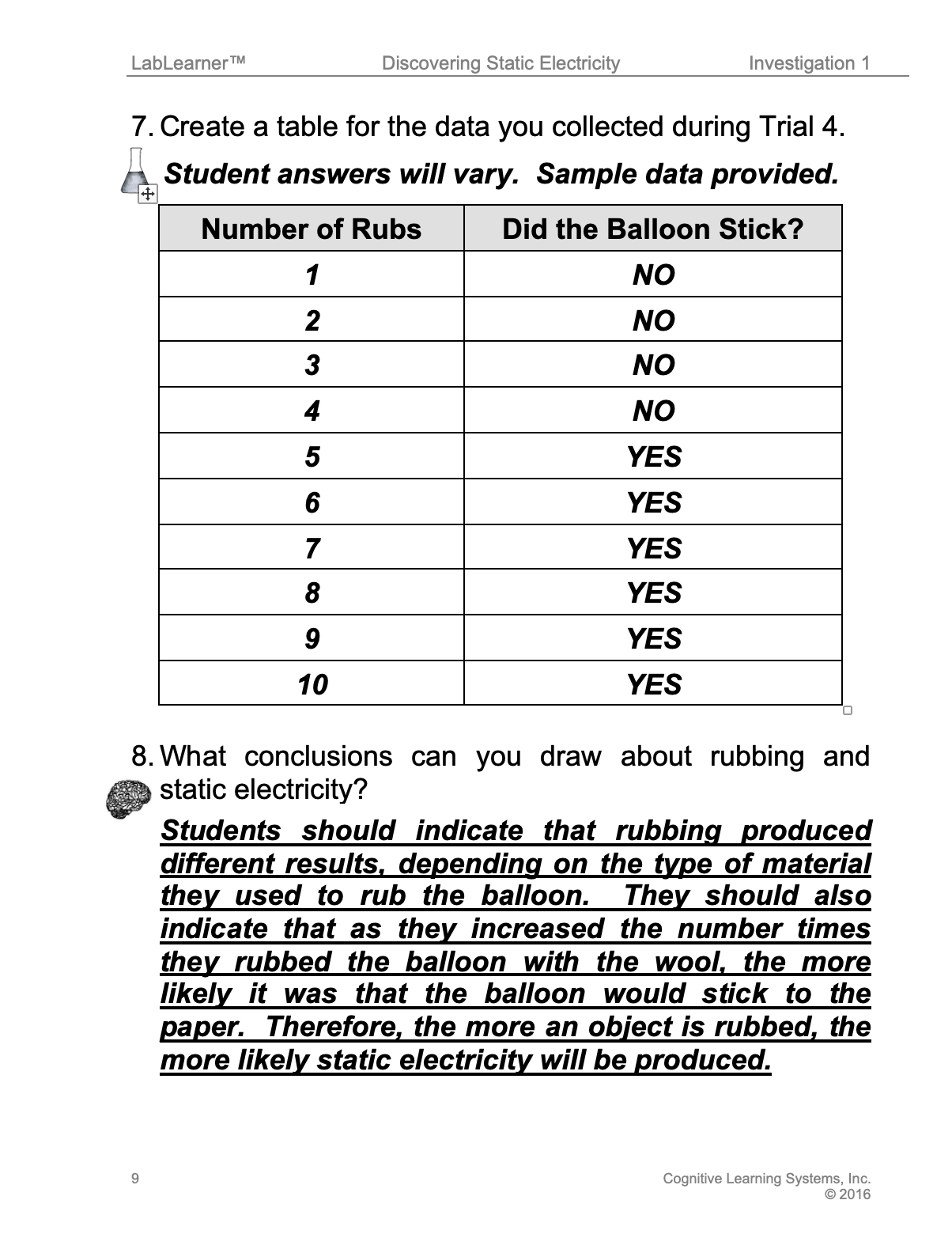
• Ask students: What data should you use as titles for these two columns? Student answers may vary. The sample table lists them as “Number of Rubs” and “Did the Balloon Stick?”
• Ask students: Which data would fit best into the rows? The rows of the first column should indicate the number of rubs tried. The rows of the second column should indicate whether the balloon stuck to the paper.
Direct students to insert their column titles and enter their data from the Student Data Record.
______________________________________________
SLIDE VELEC1-post-8
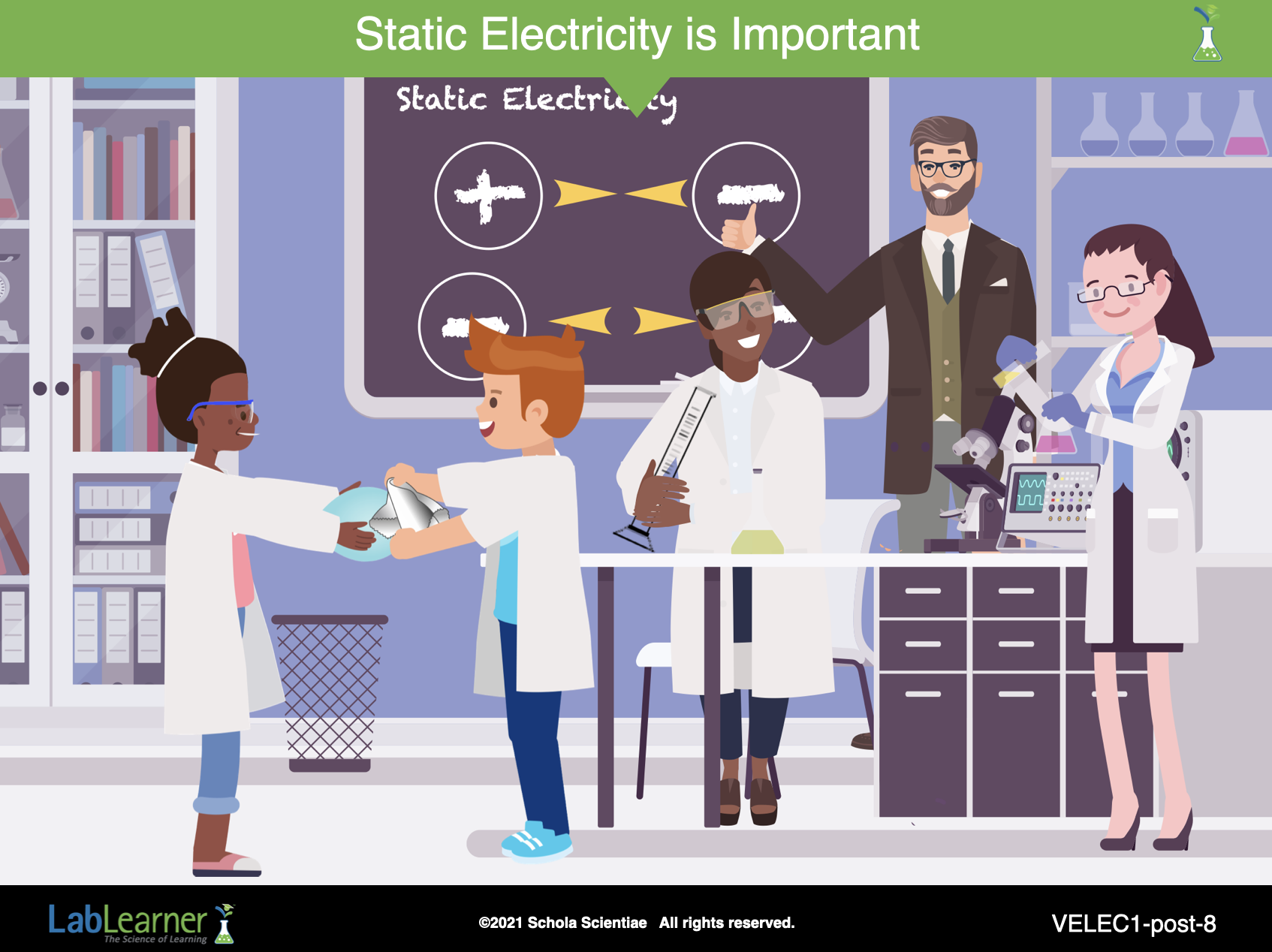
6. Once the data table is completed, ask students: What conclusions can you draw about rubbing and static electricity? The balloon stuck to the paper after rubbing five times or more. Therefore, the more times an object is rubbed the more static electricity that results.
7. Encourage students to recall Trial 3 when different materials were tried.
Ask students: Why do you think it was important that you rubbed the balloon with each material the same number of times? Changes in the number of rubs can change the amount of static electricity. In order to test one material against another, the number of rubs needed to remain constant.
______________________________________________
SLIDE VELEC1-post-9
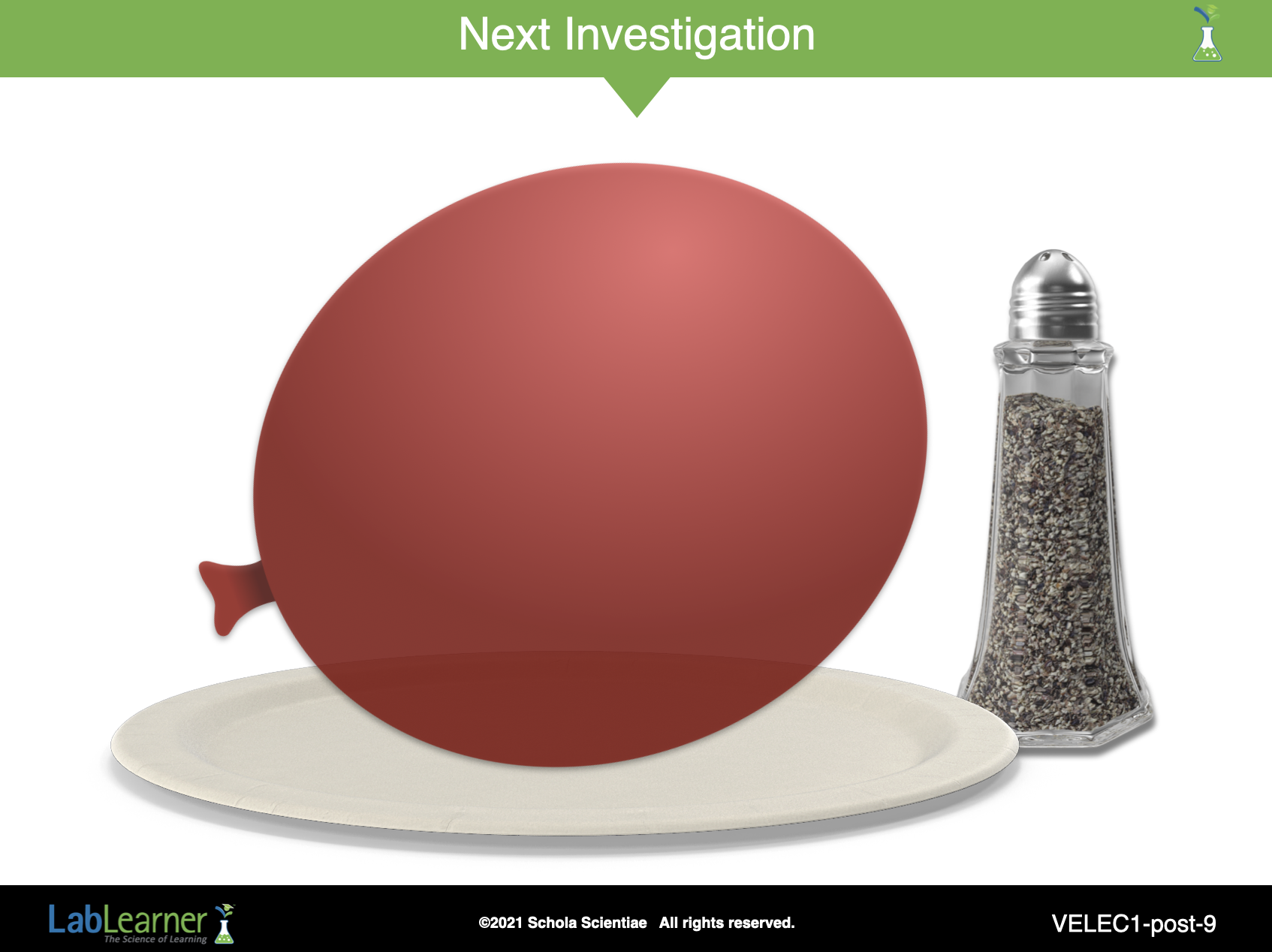
F. To complete their exploration of static electricity, tell students they will continue to study some additional effects of static electricity during the next Investigation. Questions they will explore will include:
-
- What happens when two materials or objects have electrical charges?
- What happens when two materials or objects have the same electrical charge?
KEYS: POSTLAB