
Teacher Portal:
Exploring Electricity
Investigation 1 – Lab
 BE PREPARED
Supplies and Equipment:
Group Materials:
- 7 balloons
- 1 precut piece of wool, 16 cm x 16 cm
- 1 metric ruler
- 2 sheets of 8” x 11” bond paper, unlined
- 4 pieces of masking tape, 10 cm in length
- 1 sponge
- 1 paper towel
- 1 paper plate
Individual Materials:
- 1 Student Data Record
Teacher Preparation:
- Place the materials each group will need at a distribution point.
- Separate the class into five cooperative groups.
Instruction:
1. Direct each student group to obtain the following necessary materials from the distribution point: seven (7) balloons, one (1) metric ruler, one (1) piece of wool, 1 (one) sheet of bond paper, one (1) sponge, one (1) paper towel, one (1) paper plate.
2. During this experiment, students will need to blow up and tie off their balloons. Some students may need assistance with tying their balloons shut. Students should use the metric ruler to ensure their balloons are at least 16 cm in diameter. The students should also keep any contact with the balloons to a minimum. This will reduce any inadvertent build-up of charge on the balloons before they begin their experiments. Students should also keep contact with the sheets of paper to a minimum for the same reason.
Note: These experiments depend upon how dry/humid the environment is on the day they are performed. Static electricity occurs more easily during dry or winter weather. Therefore, students may need to rub more often on a humid day to produce a build-up of charge.

GET FOCUSED
Investigation One introduces students to the concept of electrical charge and static electricity.
INVESTIGATE
 Trial 1
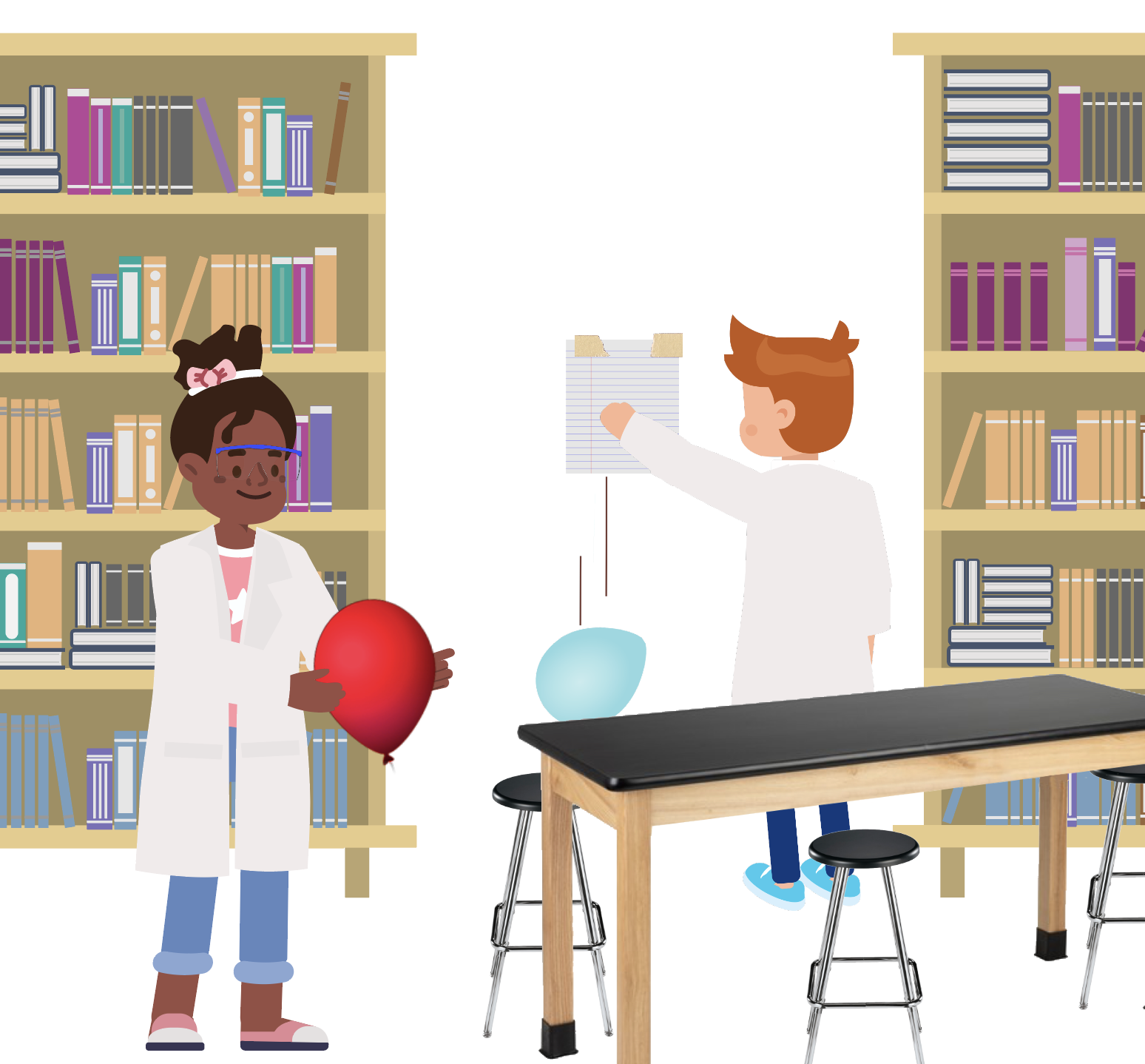
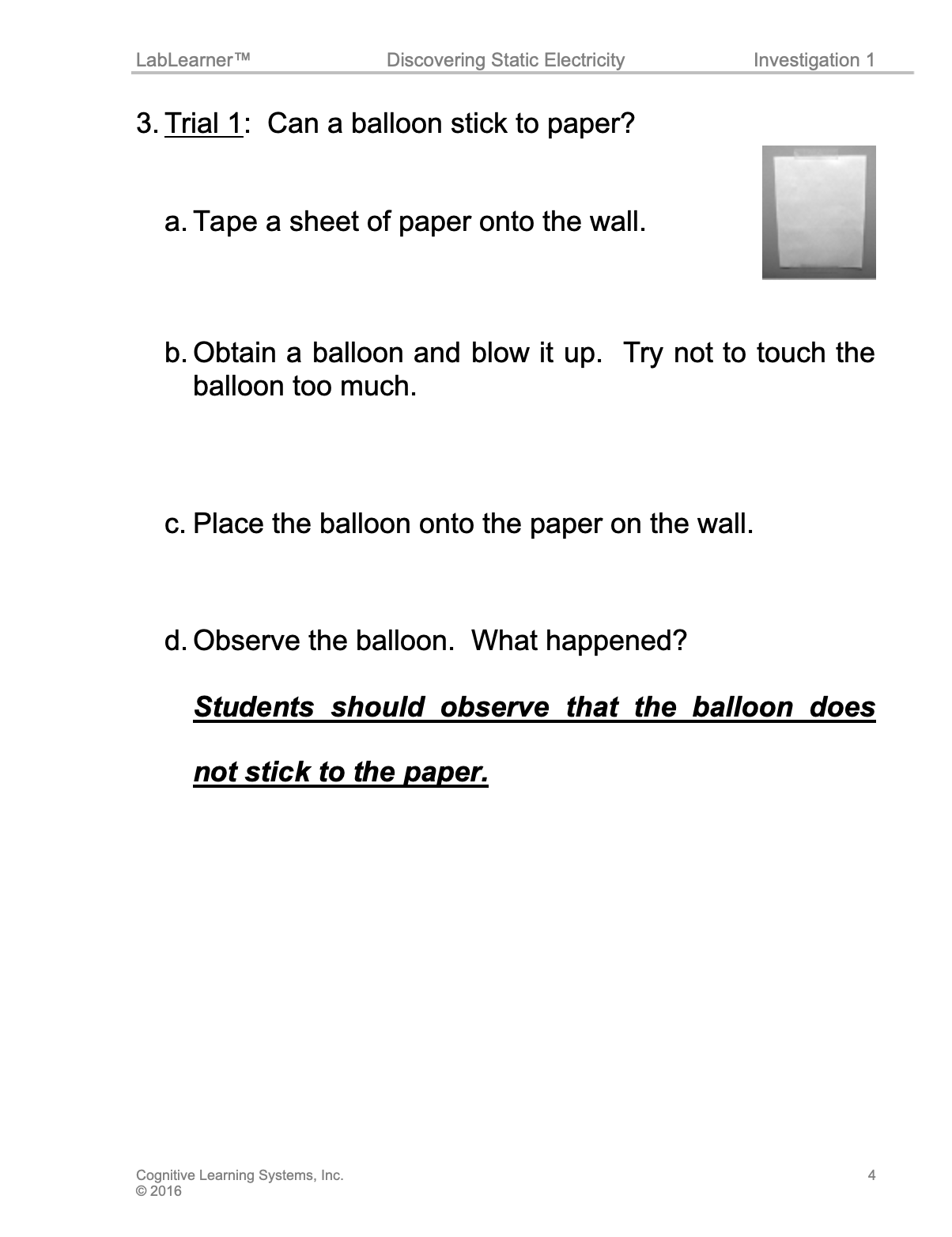
1. To begin their investigation, students will explore static electricity by first testing how a balloon interacts with a sheet of paper. This Trial will serve as a control for other Trials. Students will answer a question as they investigate the interaction of the balloon and paper:
Can a balloon stick to paper?
Use the directions that follow to guide students through the trial.
a. Instruct students to tape a sheet of paper onto the wall next to their table.
b. Tell students to obtain a balloon and blow it up so that its diameter is at least 16 cm. Direct them to place the balloon onto the paper on the wall.
c. Instruct students to observe the balloon.
Ask students: What happened? Did the balloon stick to the wall? Direct students to record their answers in Problem 3 of their Student Data Record.
 Trial 2
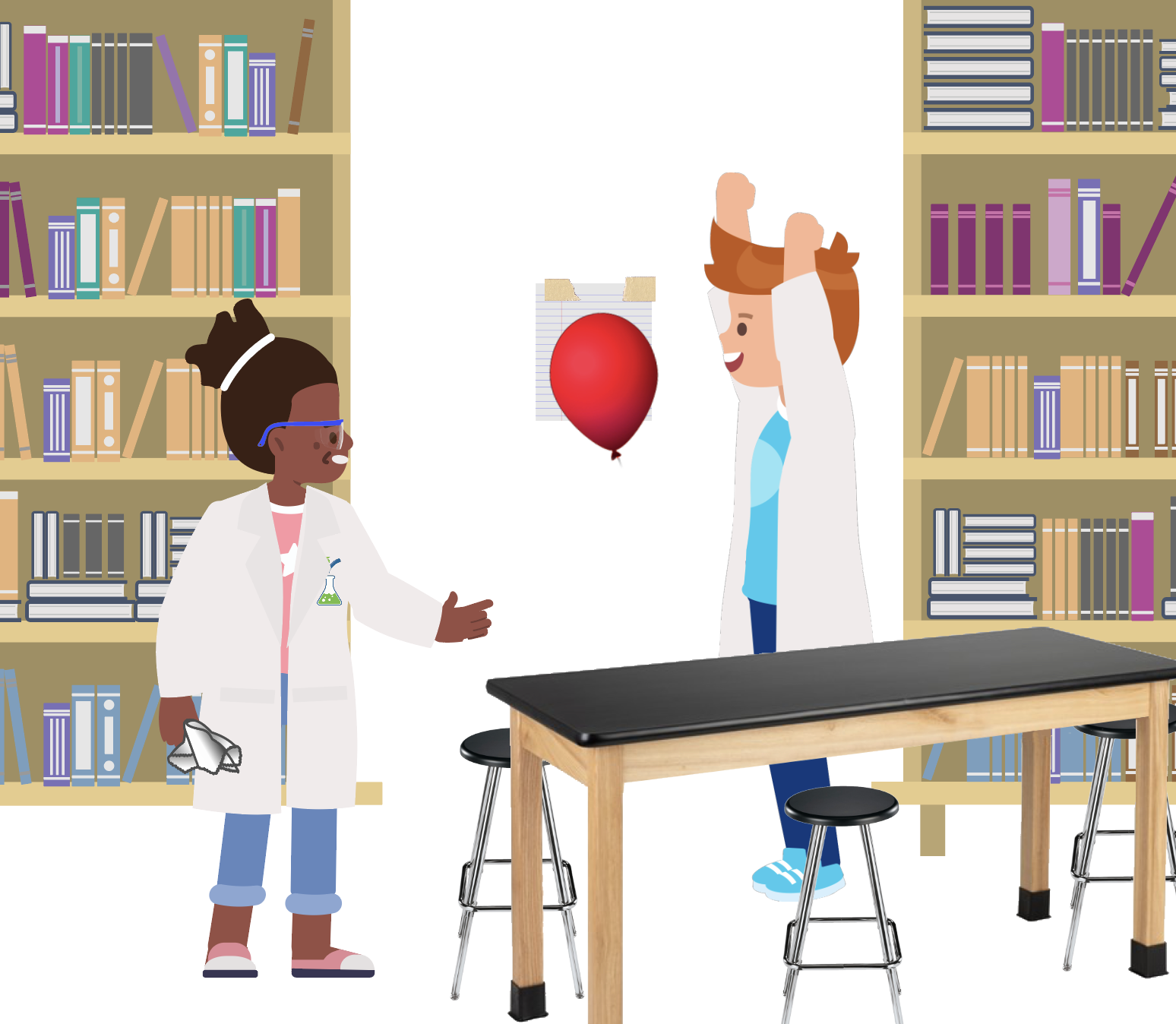
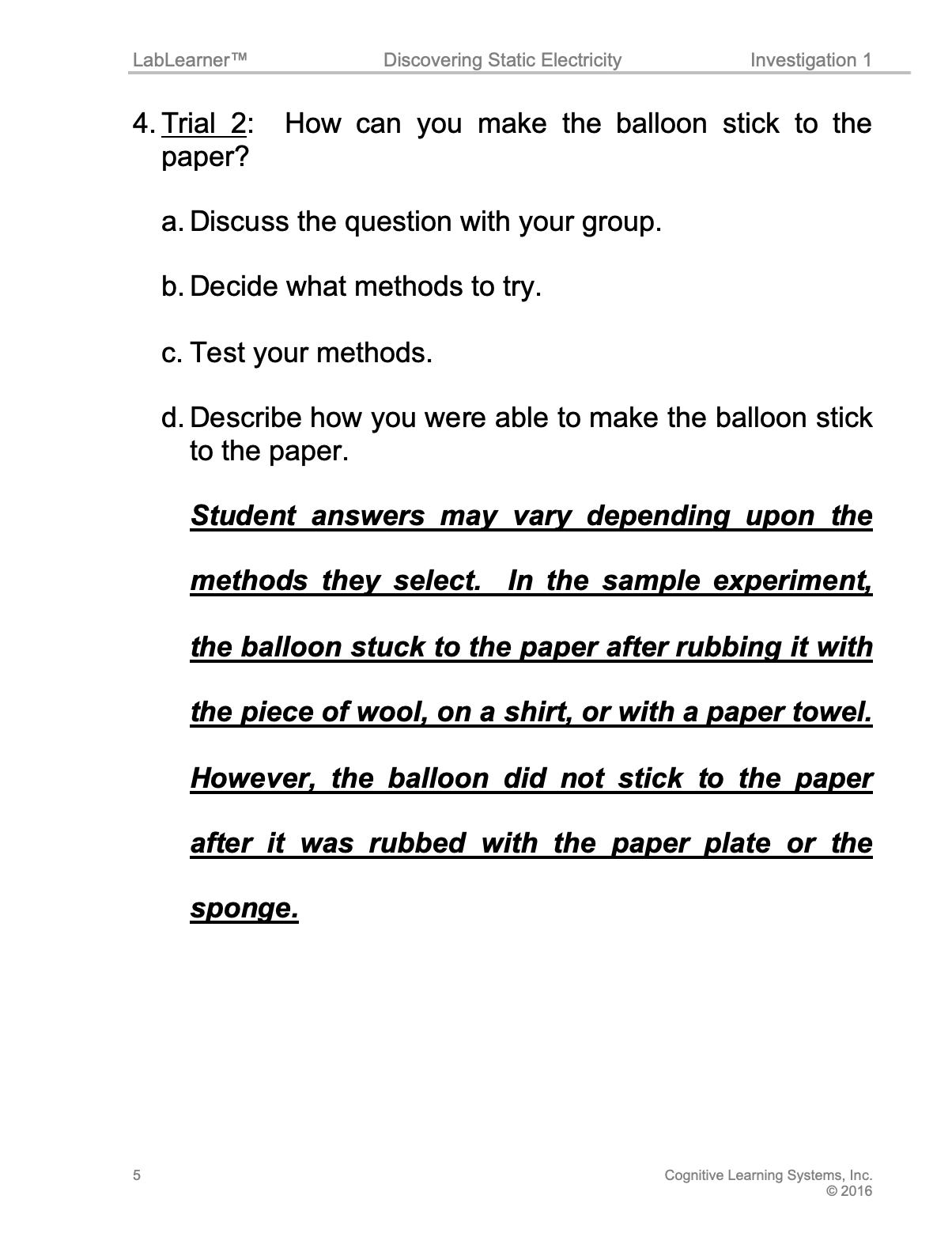
2. For this part of the Investigation, students will continue to explore static electricity. They will be asked to discover how they can get the balloon to stick to the wall using the materials at hand, which can include their clothes, a table, a piece of wool, and a sponge. Direct the students to rub each different material a specific number of times. The question students will investigate in this trial is:
How can you make the balloon stick to the paper?
Use the directions that follow to guide students through the Trial:
a. Begin the trial by asking students: How can you make the balloon stick to the paper?
b. Explain that the goal of this experiment is to get the balloon to stick to the paper and that students may use whatever materials they have on their table to accomplish this.
Note: Students should not rub their hair against the balloon as this could spread head lice.
c. Tell students that they should record how they could get the balloon to stick to the paper in problem 4 of their Scientist Data Record.
d. If students have difficulty with this part of the investigation, suggest they try rubbing the balloon with the wool or other materials available to them.
e. After all groups have completed their trials, ask for one or two groups to share how they were able to get the balloon to stick to the paper. Students should suggest that rubbing the balloon with another object or material caused it to stick to the paper.
 Trial 3
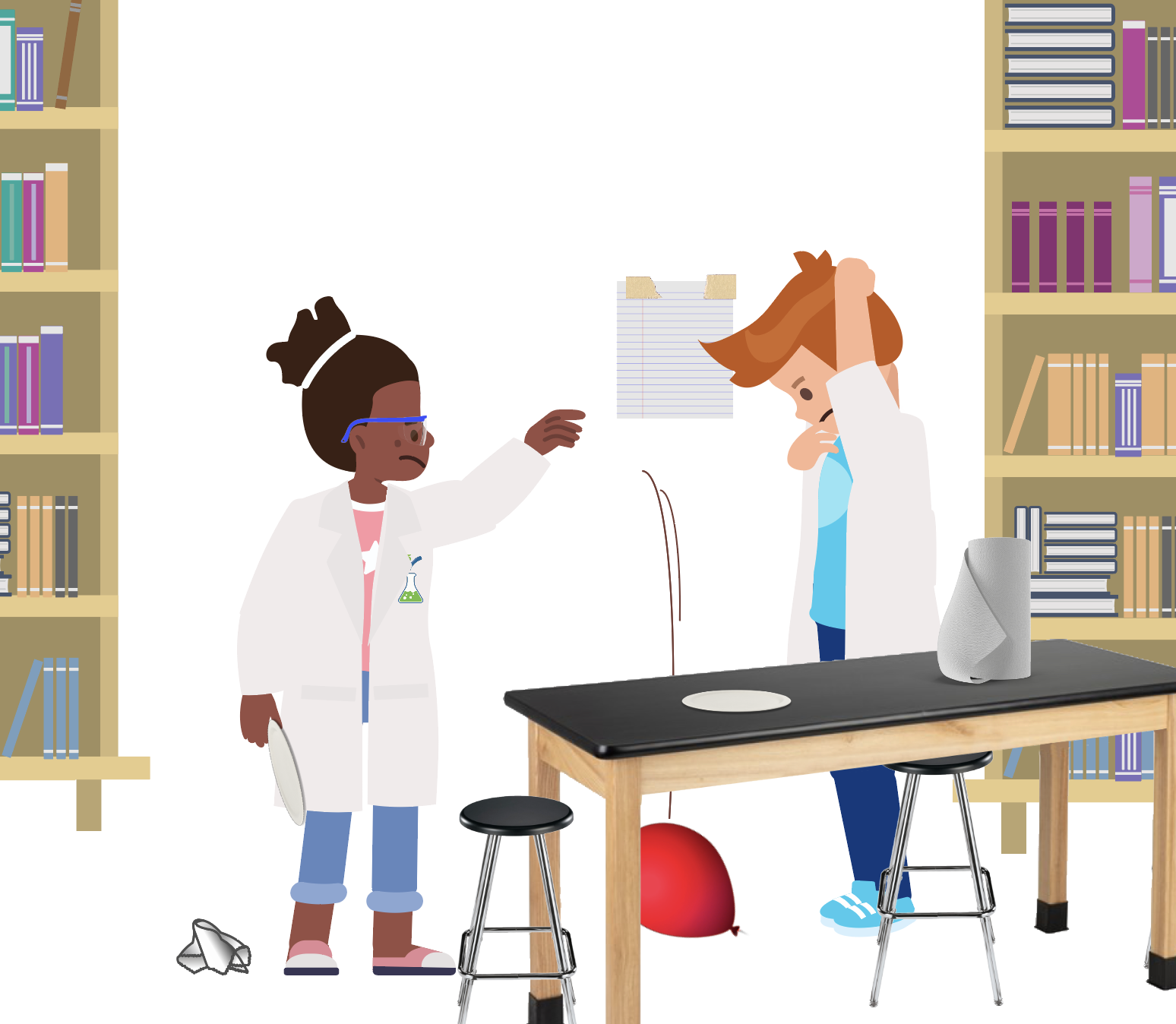
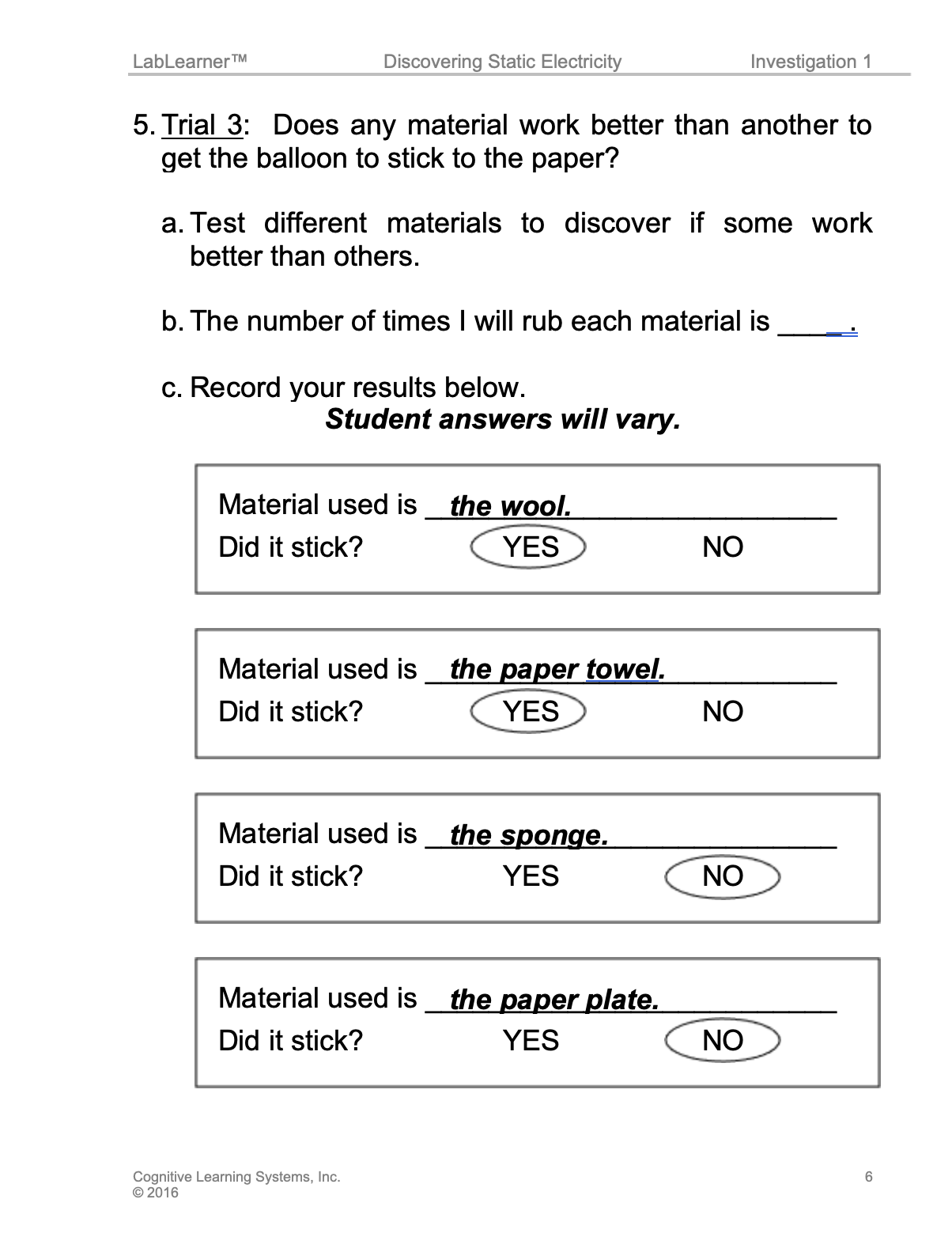
3. In this part of the Investigation, students will determine whether rubbing a balloon with different materials can produce static electricity. The question students will investigate in this trial is:
Does any material work better than the others in getting the balloon to stick to the paper?
Use the directions that follow to guide students through the Trial:
a. Begin by asking students: Does any material work better than the others in getting the balloon to stick to the paper?
b. Direct each group to select four materials they would like to test and record them in problem 5c of their Scientist Data Record.
c. Students should collect four new balloons. Direct students to use a new balloon for each material they test.
d. Remind students that in order to accurately compare the materials, they should rub the balloon the same number of times for each material. Students should record the number of rubs they will use in problem 5b their Scientist Data Record.
Note: If students are unsuccessful with all four materials, you may need to suggest increasing the number of rubs students use.
e. After each group has tested and recorded the results of the four materials, ask that they return all materials except the wool swatch to the distribution center.
Trial 4
For this part of the Investigation, students will test whether the ability of the balloon to stick to the paper is affected by the number of times the balloon is rubbed with their material. Students will test their prediction using wool as the material.
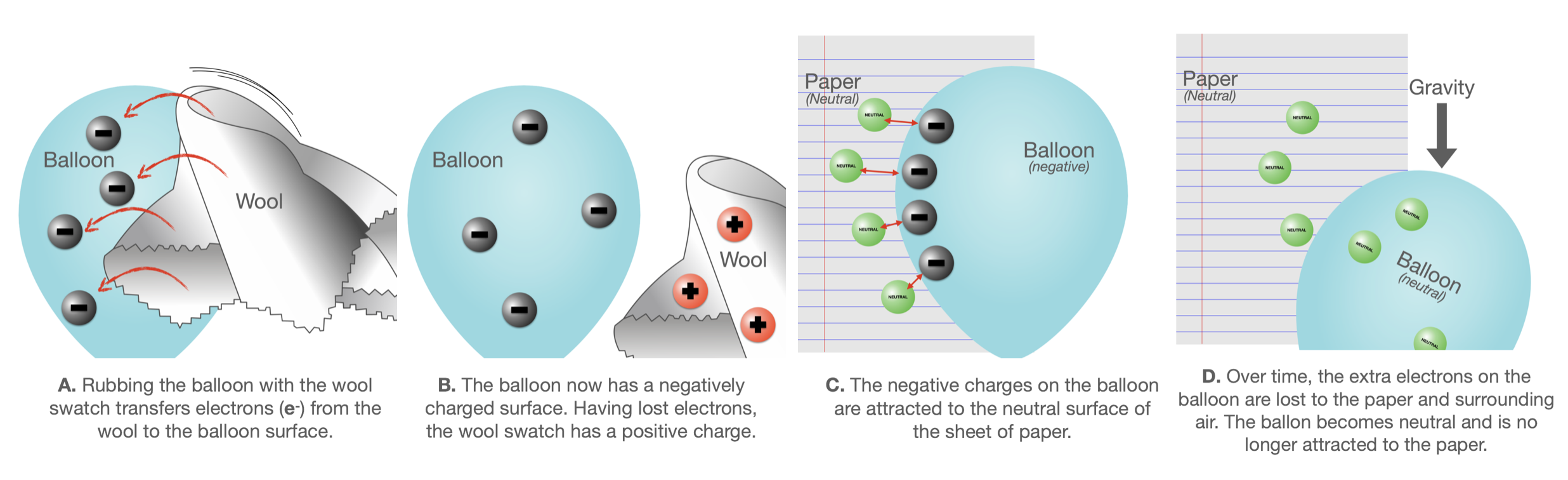
In this Trial, the friction caused by rubbing results in the transfer of electrons from the surface of the wool to the surface of the balloons (A, see illustration below). As a result, the surface of the balloon is negatively charged and that of the wool is positively charged (B).
When the balloon is moved into contact with the paper (C), the negative electrons on the balloon’s surface are attracted to the positive protons on the surface of the neutral sheet of paper.
As the balloon remains in contact with the paper, its extra electrons are transferred to the paper and the surrounding air. Ultimately, both the paper and balloon end with equal numbers of positive and negative particles. The result is the balloon falls off the paper (D).
Through this Trial, students should discover that as they increase the number of times they rub the balloon with wool, the amount of electrical charge transferred to the balloons from the wool increases. The question students will investigate in this Trial is:
Does the number of times a balloon is rubbed with wool affect whether it sticks to the paper?
 Use the directions that follow to guide students through the Trial:
a. Ask students: Does the number of times a balloon is rubbed with wool affect whether it sticks to the paper?
b. Explain to students that the goal of this experiment is to get the balloon to stick to the paper with the lowest number of rubs.
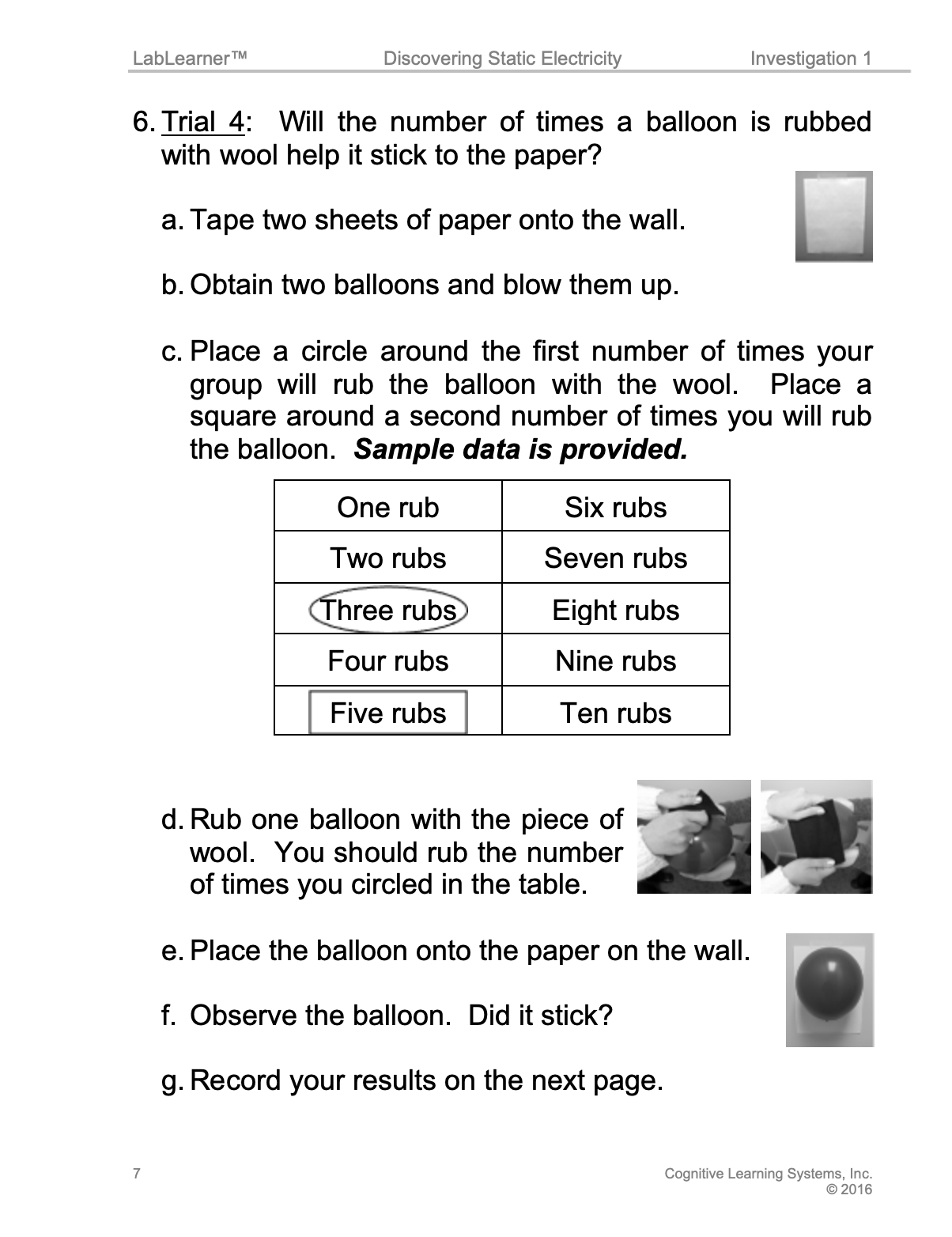
c. Direct students to tape two new sheets of paper beside the other paper on the wall.
d. Ask students: What could we do to find the answer to our question? Provide time for students to suggest a design for this experiment. If after the discussion, students have not yet suggested altering the number of rubs on the balloon, propose the following:
-
- Each group has two balloons.
- Each group could rub the balloon a different number of times and observe whether the balloon sticks to the paper.
- The groups could select numbers of rubs that would provide an ordered sequence of rubs from one rub to ten rubs.
 e. Assign each group two of the quantities of rubs describe above. Encourage students to circle which two quantities they will investigate in their Student Data Record.
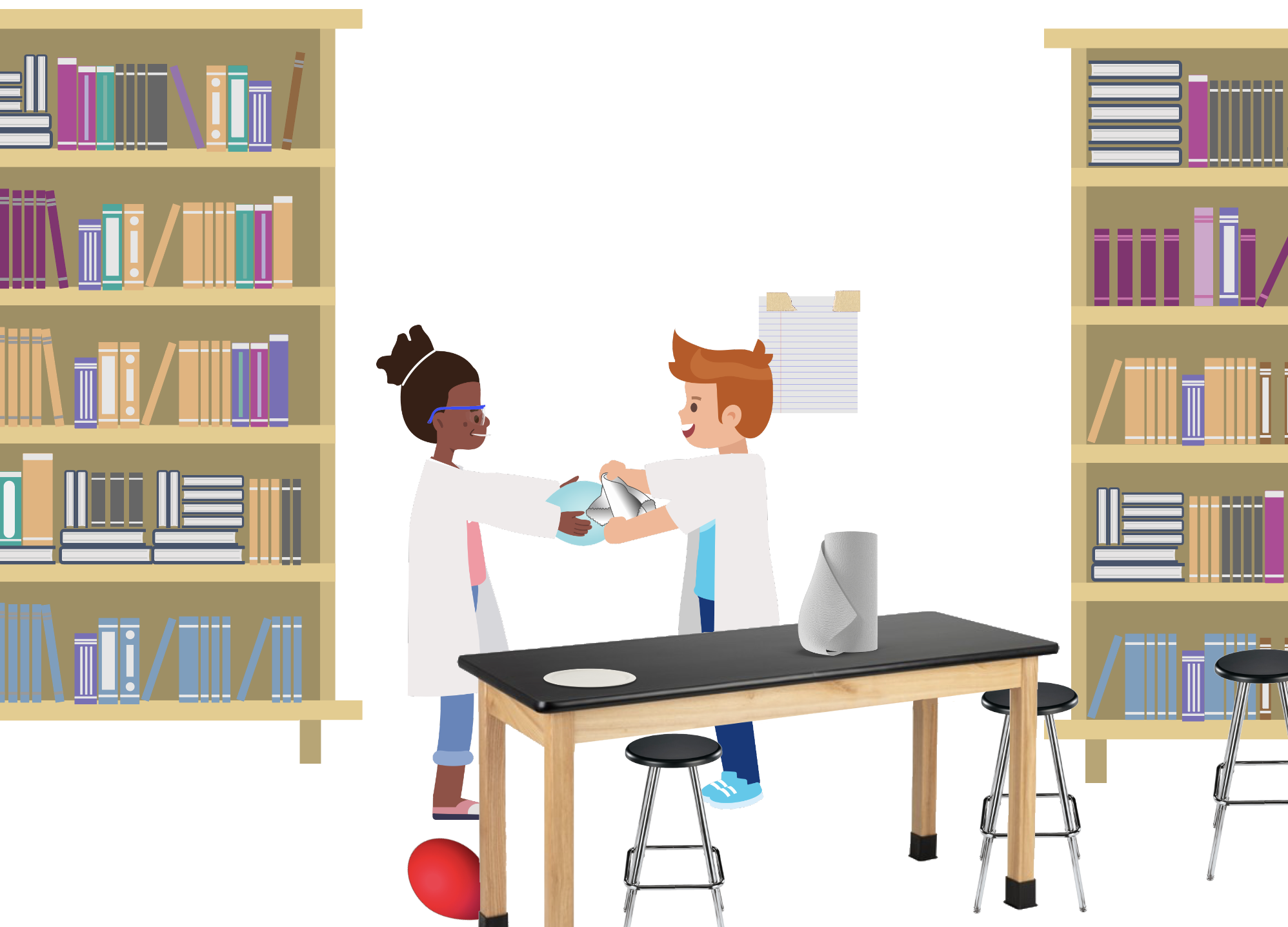
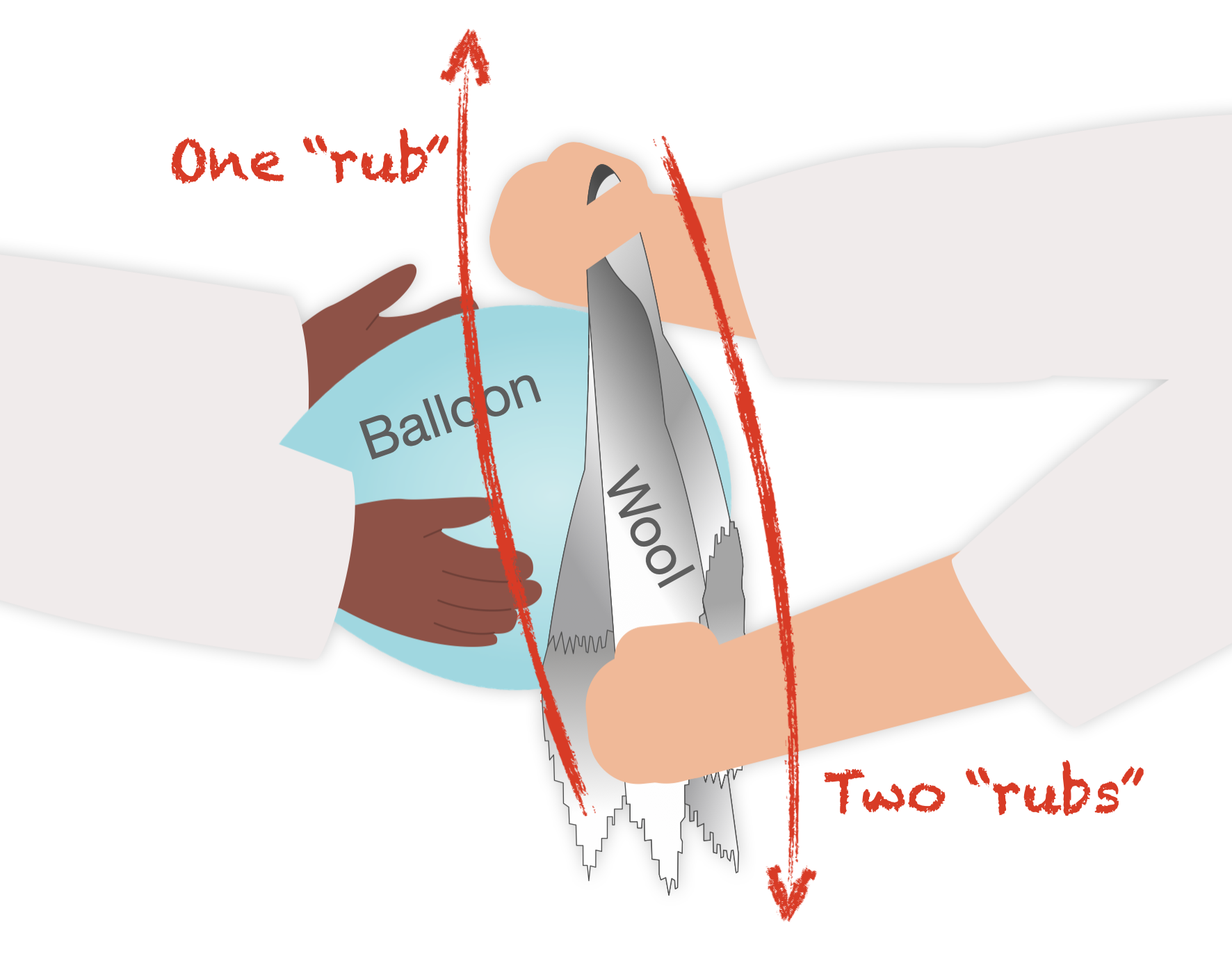
f. During this Trial, students will need to understand how to properly perform the procedure for rubbing their balloons. The following instructions are provided to assist students with this part of the experiment.
- One student in each group should firmly hold the balloon in front of their abdomen.
- Another student in the group should grip the opposite sides of the piece of wool.
- Move the wool across the balloon from one side to the other. This represents one rub.
- Move the piece of wool back across the balloon. This represents two rubs.
- To perform more rubs, continue to move the wool back and forth across the balloon, counting one rub for each time the wool is moved across the balloon.
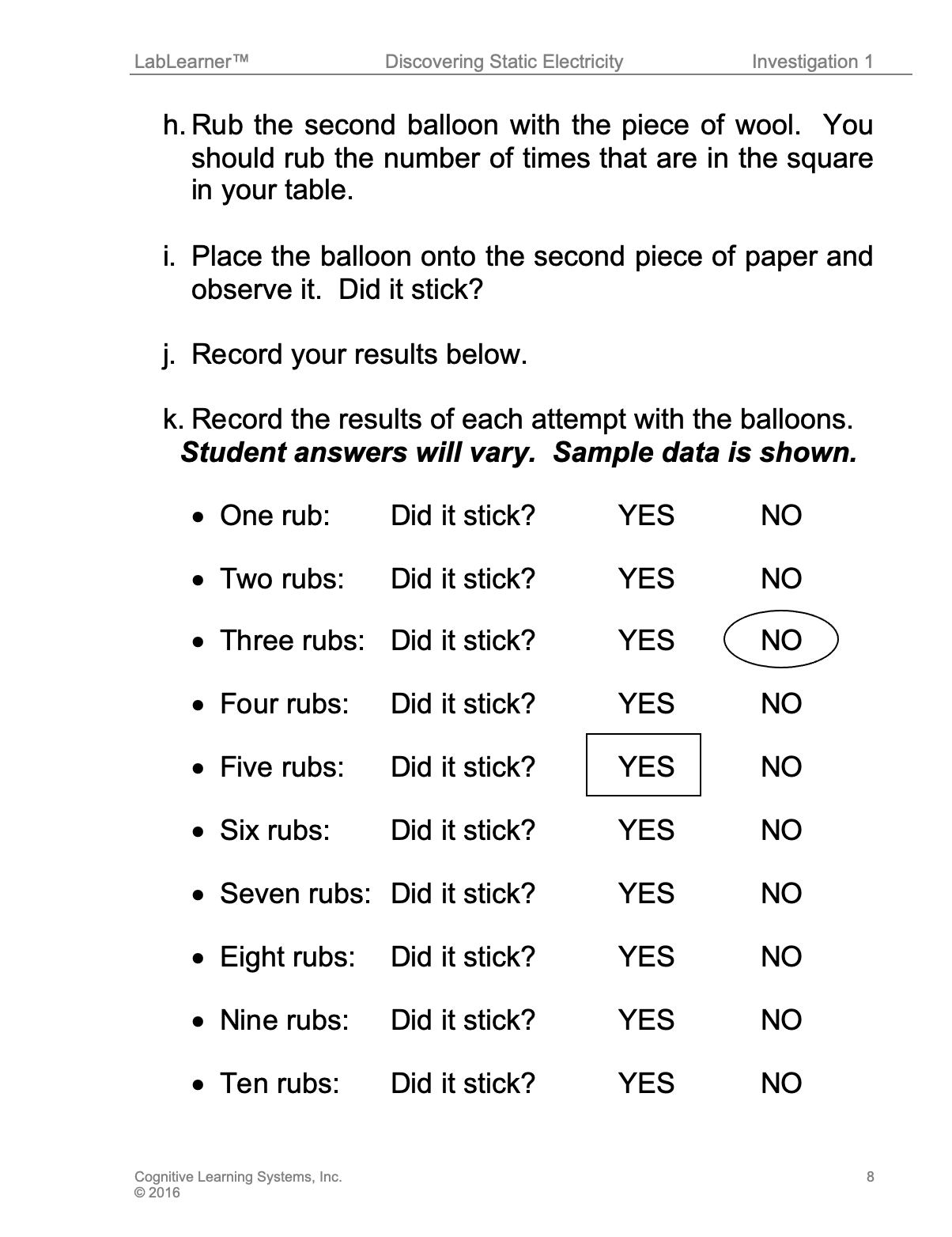
g. Tell students to record the results of each attempt, or number of rubs, in Problem 6 of their Student Data Record.
5. Once all groups have completed their experiments, ask each group to share whether each quantity of rubs was sufficient to get the balloon to stick to the wall. Direct the students to record the results in their Student Data Record.
KEYS

CLEAN UP
Let students know your expectations for clean-up. Ask them to clean up.