
Teacher Portal:
Earth’s Forces
Investigation 3
Work and Simple Machines Investigation-3: The Force of Friction
In Investigation Three, students will study the force of friction. Friction is a force that can occur between two surfaces in contact with each other. Friction acts parallel to the surfaces, and in the opposite direction to motion.
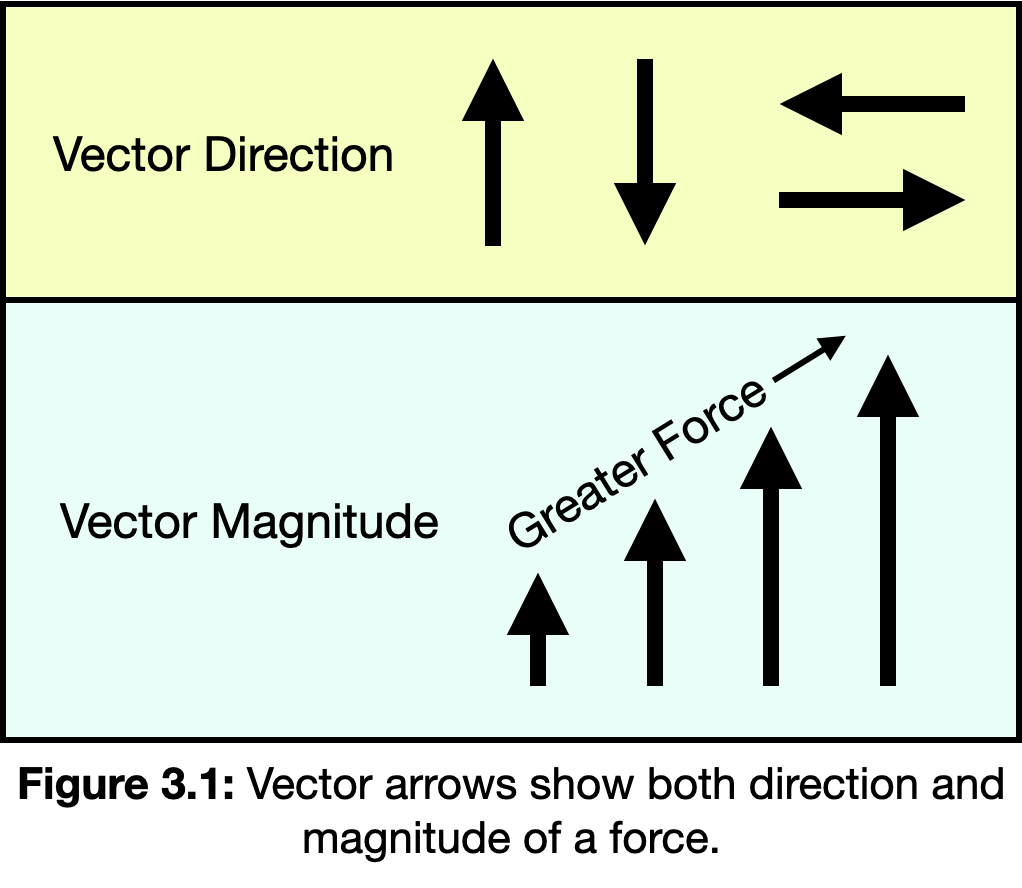
Vectors
In order to understand the force of friction, we will once again make use of vector arrows. If you recall from Investigation Two, vector arrows indicate both direction and magnitude (size). In Figure 3.1, you can see that the vector direction may be up, down, left, or right. Actually, it can be in any direction. The point of the arrow points in the direction of the force. On the other hand, the magnitude of a force is indicated by the length of the vector arrow. The longer the arrow, the larger the force. The shorter the arrow, the smaller the force. Therefore, each vector arrow tells us how much force is applied and in which direction.
Friction
Figure 3.2 shows an object (a wooden box) sliding toward the right. Notice that the vertical forces (up and down vector arrows), normal contact force and force of gravity, are equal and opposite to each other. The gravity vector arrow, of course, points directly down, toward the center of the Earth. This is the 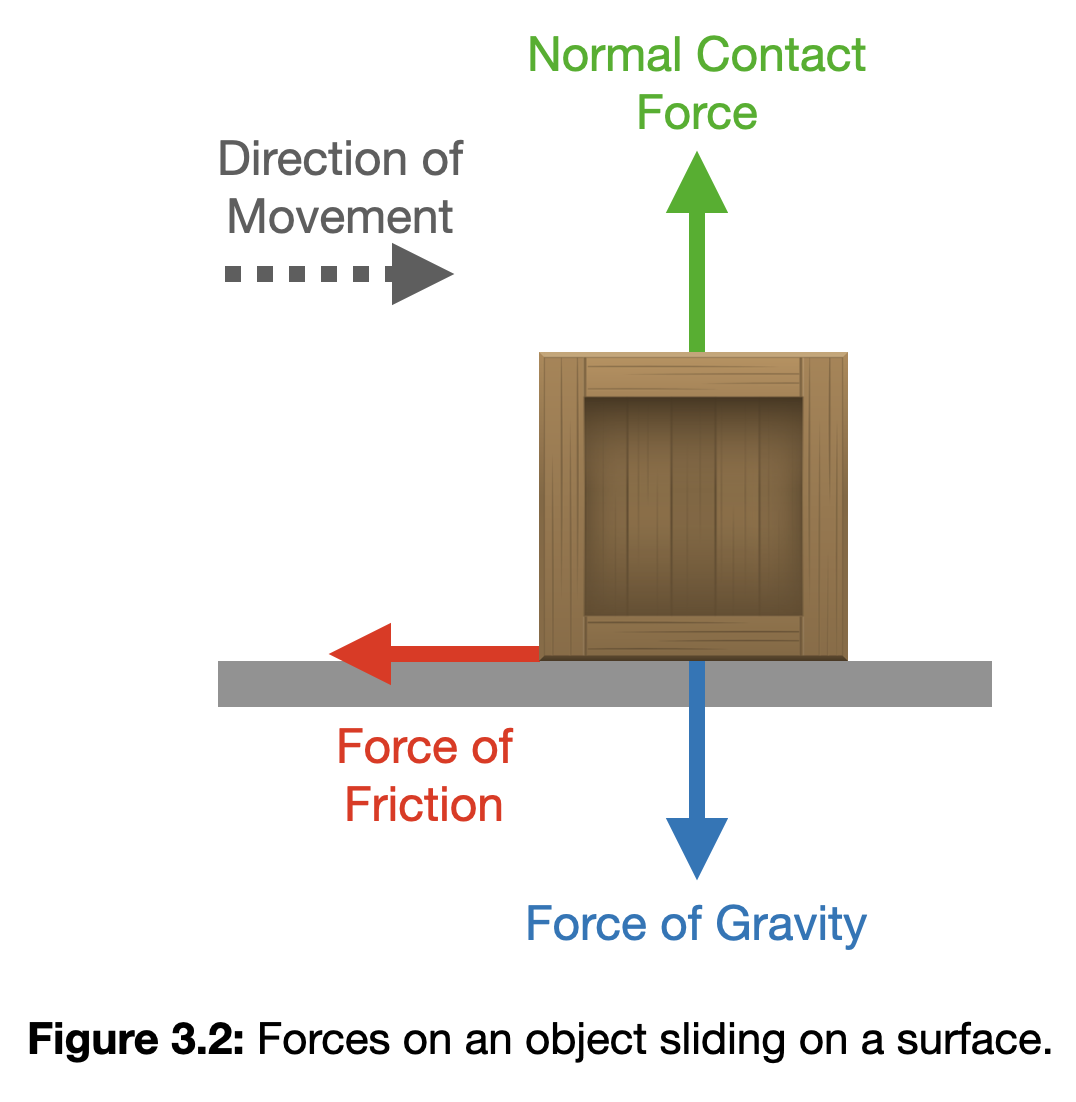 direction a book would fall if you dropped it to the floor. In the opposite direction is a vector arrow labeled normal contact force. The object is not accelerating (moving) upwards or downwards because the normal contact force and the force of gravity have the same vector magnitude, the arrows are the same length. However, these two vectors point in exactly the opposite direction. You may think of the normal contact force as opposing gravity in this case. The box does not follow the direction of the gravity vector and move down through the floor. Such a motion (acceleration) is stopped by the floor “pushing” up on the box with exactly the amount of force that gravity is pushing it down. As discussed in Investigation Two, if two forces with the same strength (that is they have the same length vectors) point in opposite directions, the two forces cancel each other, and no displacement, movement, or acceleration occurs. The box does not move up or down.
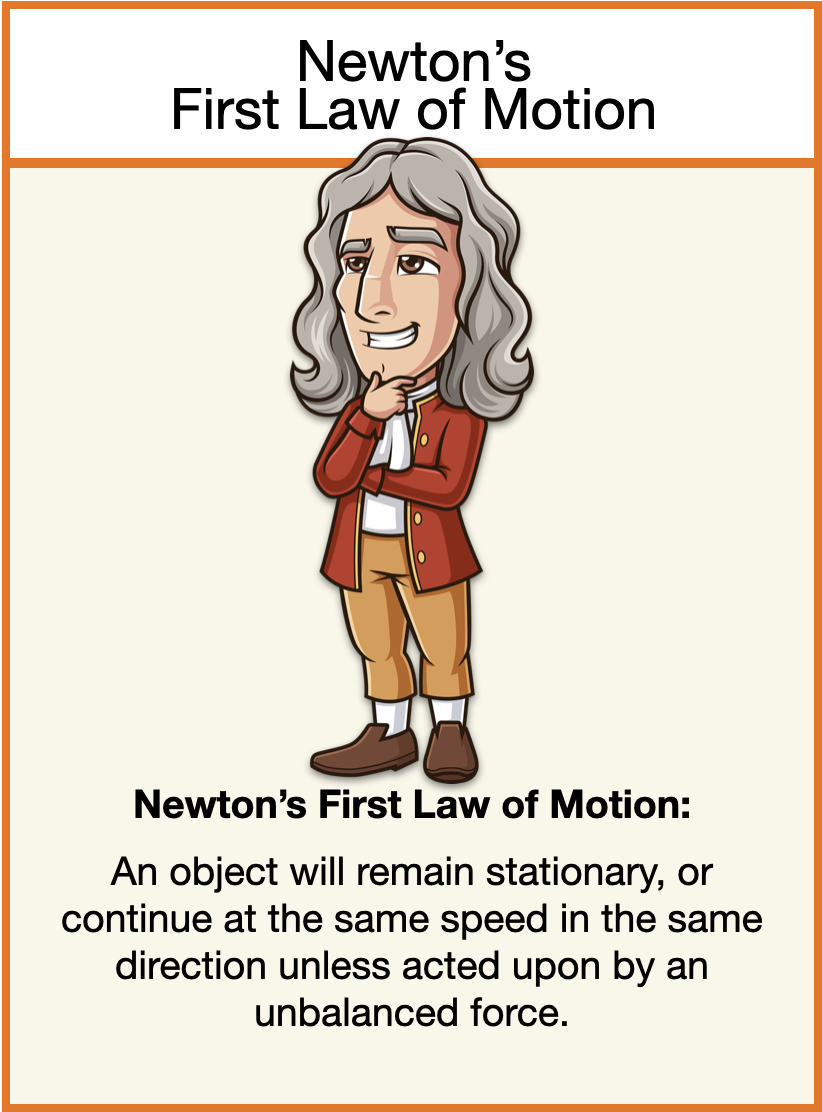 However, the case is different in terms of horizontal (left and right) forces. As indicated in Figure 3.2, the box is moving towards the right. If an object is moving, it immediately tells us that the forces acting on it can not be balanced. The box must have been pushed from somewhere from the left of the illustration and is sliding to the right. If no other forces were involved, Newton’s First Law of Motion would say that the box would continue moving (accelerating) in the same direction forever.
From experience, we know that the box shown in Figure 3.2 will not keep sliding to the right forever. This is because opposing the motion of the object is the force of friction. The unbalanced force (fiction, the red vector arrow in Figure 3.2) acts opposite to the direction of the motion of the box. The box will slow down until it stops. The horizontal forces will be balanced.
Frictional force can also occur to a stationary object. To show this for yourself, place a book on a table and push on the side of the book but make sure the force is not enough to start the book moving. The vertical forces are balanced (see Figure3.3, top), and a horizontal force has been created, which should cause the book to accelerate horizontally. Newton’s 1st law has not been disobeyed. The force of friction balances out the horizontal push force that is applied by the finger and the book does not move. We have a special name for the force of friction of an object that is not moving or has not started to move, it is called static friction.
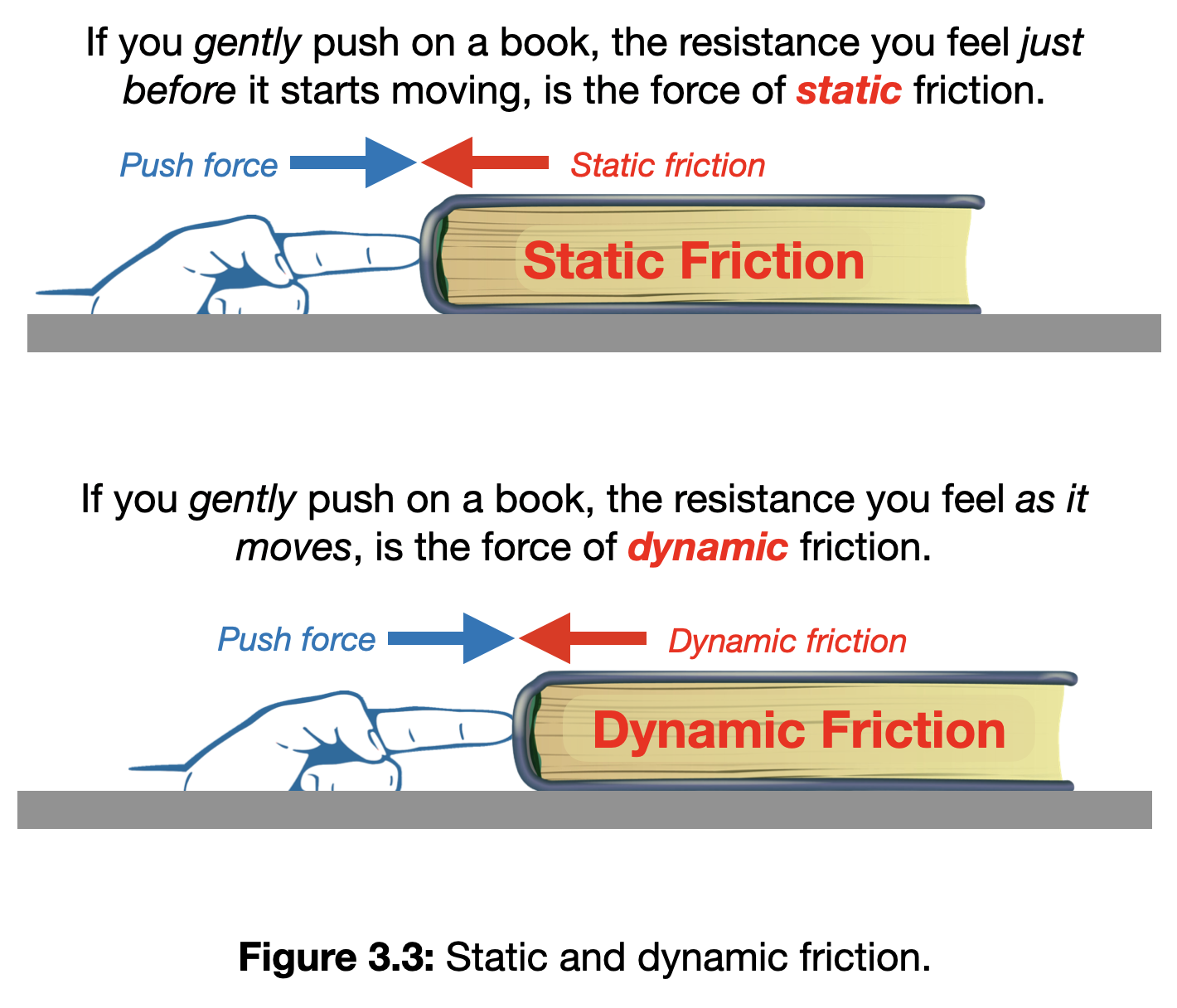
During the case of static, the force of friction equals the push force (the force you gently apply with your finger). If the push force increases (you gently push a little bit harder), the static friction force increases as well but the book still remains stationary. However, at some point, the maximum static frictional force is reached. If the push force becomes any greater, the book will start to move. The frictional force for a moving object is known as dynamic friction and is shown in the lower part of Figure 3.3. Therefore, static friction resists the motion of a stationary object and dynamic friction is the friction of a moving object as it slides across a surface.
Frictional force (Ff) is dependent on two main factors, the coefficient of friction (µ) and the normal contact force (R).
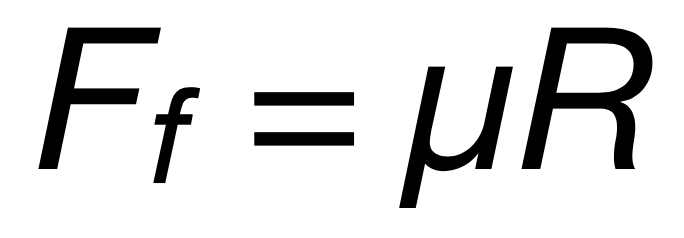
The coefficient of friction is a number between 0 and 1 that tells us the degree of interaction between two surfaces. The greater the interaction between two surfaces, the closer the coefficient of friction is to 1, and the greater the force of friction. For example, steel on ice has a low coefficient of friction, while sandpaper on wood has a high coefficient of friction. There are two different coefficients of friction, one for maximum static friction (the amount of force just before the object moves) and the other for dynamic (moving) friction. The chart below shows the coefficient of friction (μ) for two pairs of surfaces, rubber on concrete and steel on steel.
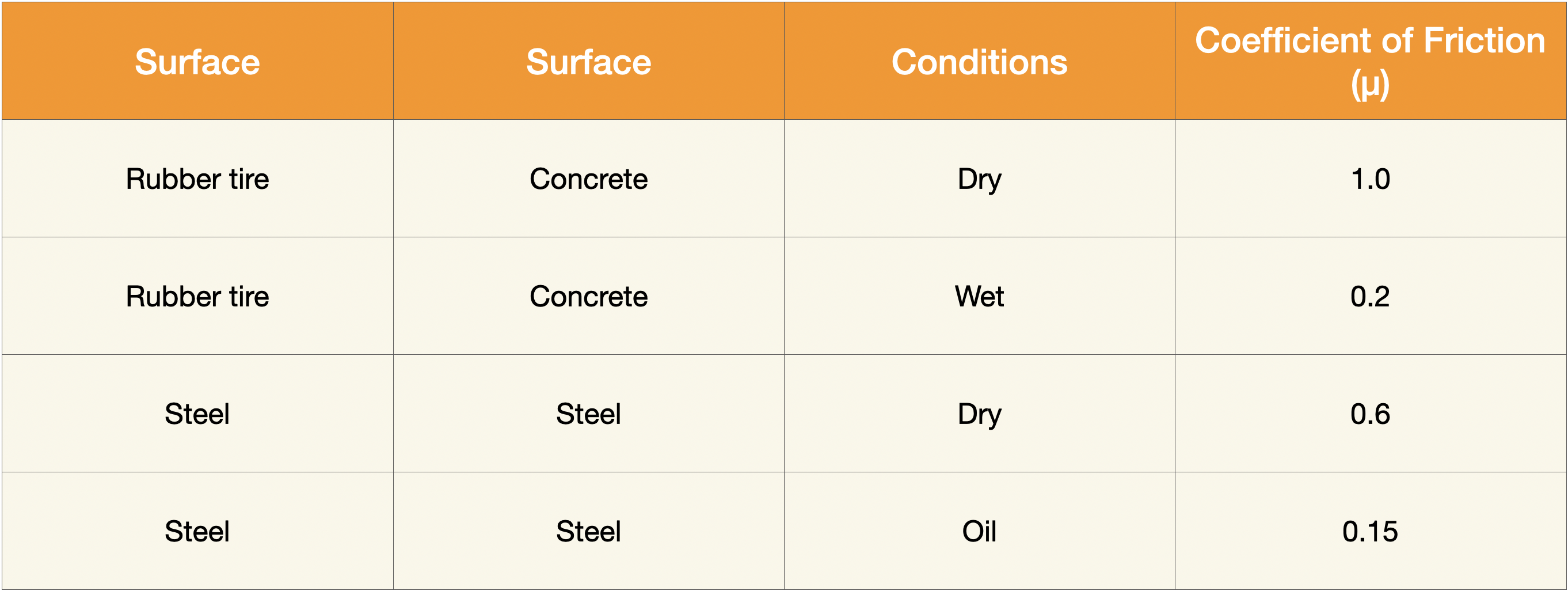
Looking at this chart, remember that the closer the coefficient of friction is to zero, the less interaction or friction the surfaces will exert on each other. You can see that a rubber tire on concrete has a very high coefficient of friction (1.0) on a dry road. That’s why when you sharply apply the breaks on your bike you stop so fast. But look how this number goes down to 0.2 on a wet road. The other surface pair in the chart, steel on steel, is also very interesting. Look how much less friction there is when oil is applied between two steel surfaces (μ goes down from 0.6 to 0.15). This is why mechanics add oil to automobiles where steel parts rub against each other.
The normal contact force is often equal to the weight of an object. Therefore, as you stand in contact with the floor, the normal contact force you exert is exactly equal to your weight (left side of Figure 3.4). Your normal contact force pushes away from the force of gravity. Since your normal contact force points upward and is equal and opposite to the force of gravity pulling down on you, the forces are balanced and there is no motion or acceleration. You do not sink into the Earth or float away.
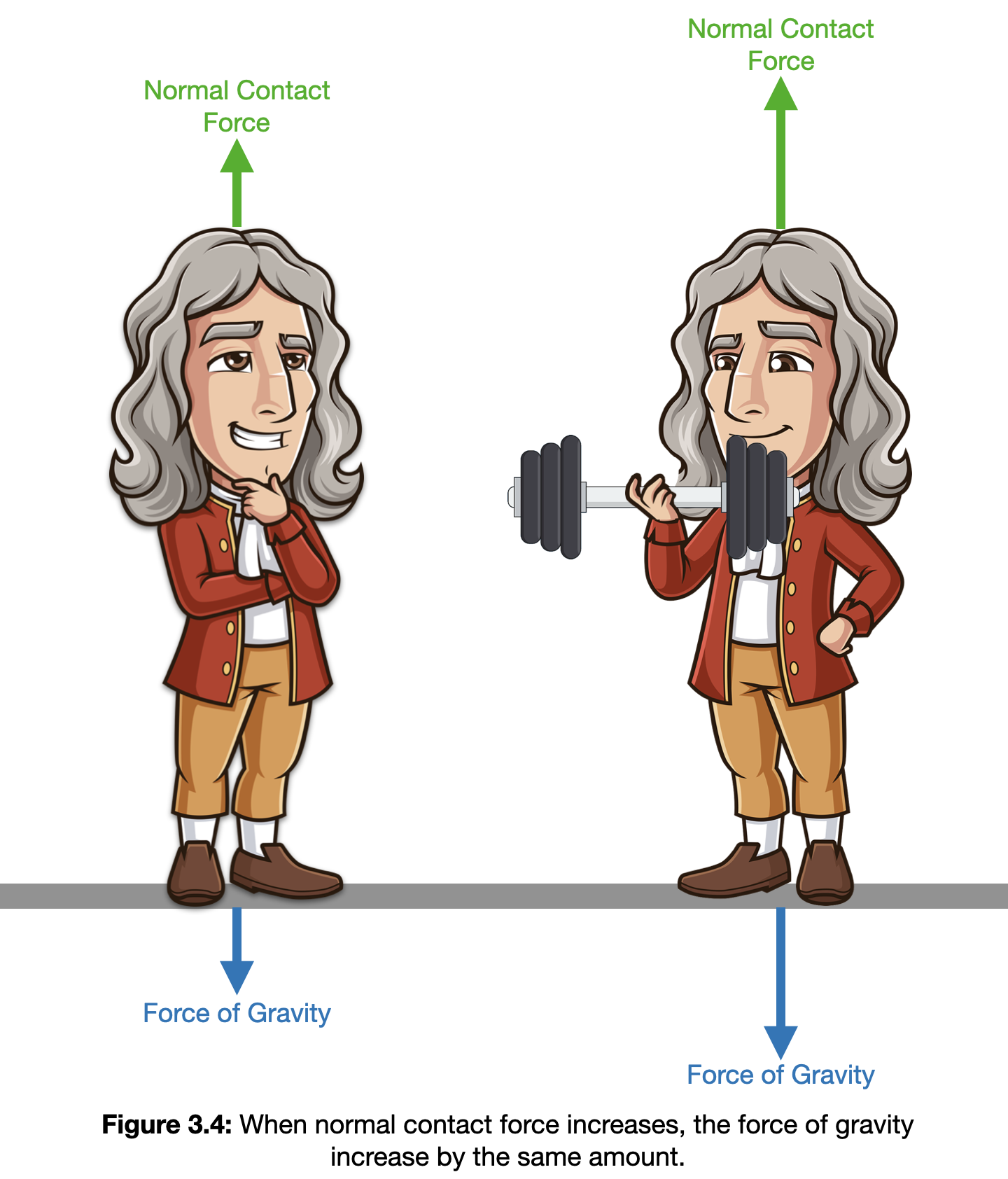
As the equation Ff = μR shows, the greater the normal contact force, the greater the force of friction. The normal contact force can be adjusted by pushing down on an object (perhaps you hold a heavy object in your arms). As shown on the right side of Figure 3.4, the increase in the normal contact force is exactly balanced by an increase in the force of gravity acting on you (look how the length of the vector arrows in the drawing increase).
As you might guess, whether an object is rolling (e,g. a ball) or sliding (e.g., a book) also influences friction force. Rolling friction is less than sliding friction. That is why wheels were such a great invention! In this Investigation, the differences between rolling and sliding friction are not emphasized to students, but the instructor may wish to introduce such terms as he or she desires.
In Investigation Three, students will examine the force of friction. The influence of friction in slowing down a rolling object will be observed. The coefficient of friction will be varied by using three different surfaces with which the rolling object (an acrylic cylinder) interacts, and the impact of the force of friction on the object will be demonstrated by observing the distance the object rolls before stopping. It is important that students understand that without friction an object in motion would continue moving in a straight line at the same speed forever unless acted upon by an unbalanced force.
Earth's Forces: Investigation 3 - Mathematics Concepts
Prelab
- (in)direct relationships
- patterns/trends
Lab
- (in)direct relationships
- patterns/trends
- mass in grams and kg
- weight/force in Newtons
- decimals to the nearest tenth
- metric conversion
- comparing (non)measurable characteristics
Postlab
- line graph
- mass in kg
- force in Newtons
- skip counting by 0.4 and 0.04
- data analysis
- (in)direct relationships
- patterns/trends
- least to greatest
- problem-solving
Earth's Forces: Investigation 3 - Procedural Tools

Earth's Forces: Investigation 3 - Cognitive Tools

Earth’s Forces:
Investigation 3 Quiz

