
Teacher Portal:
Earth’s Forces
Investigation 2
Work and Simple Machines Investigation-2: Acceleration Due to Gravity
 In Investigation One, students learned about the force of gravity acting on an object. In addition, students learned that an unbalanced force causes an object to accelerate, that is speed up, slow down or change direction. Investigation Two examines a further example of the effect of unbalanced force, namely, the acceleration of an object due to the force of gravity. If the only force acting on an object is the force of gravity, the object will accelerate in the direction of the force. According to Newton’s Second Law of Motion, the acceleration is equal to the force divided by the mass: ΣF = ma, where ΣF is the sum of all forces acting on an object, m is the mass of the object, and a is the acceleration due to gravity.
In Investigation One, we demonstrated that the force of gravity (weight) increases in proportion to the mass of the object. Therefore as the mass of an object doubles in size, so too does the force of gravity. The acceleration of any object on Earth is the same, provided gravity is the only force acting. The force ofgravity due to the Earth’s gravity causes any object to accelerate at 9.8 m/s2 , regardless of its mass.
Recall that the factors that influence the force of gravity (FG) are the gravitational constant (G), the mass of the two objects (m1 and m2), and the distance between the centers of the objects (r):
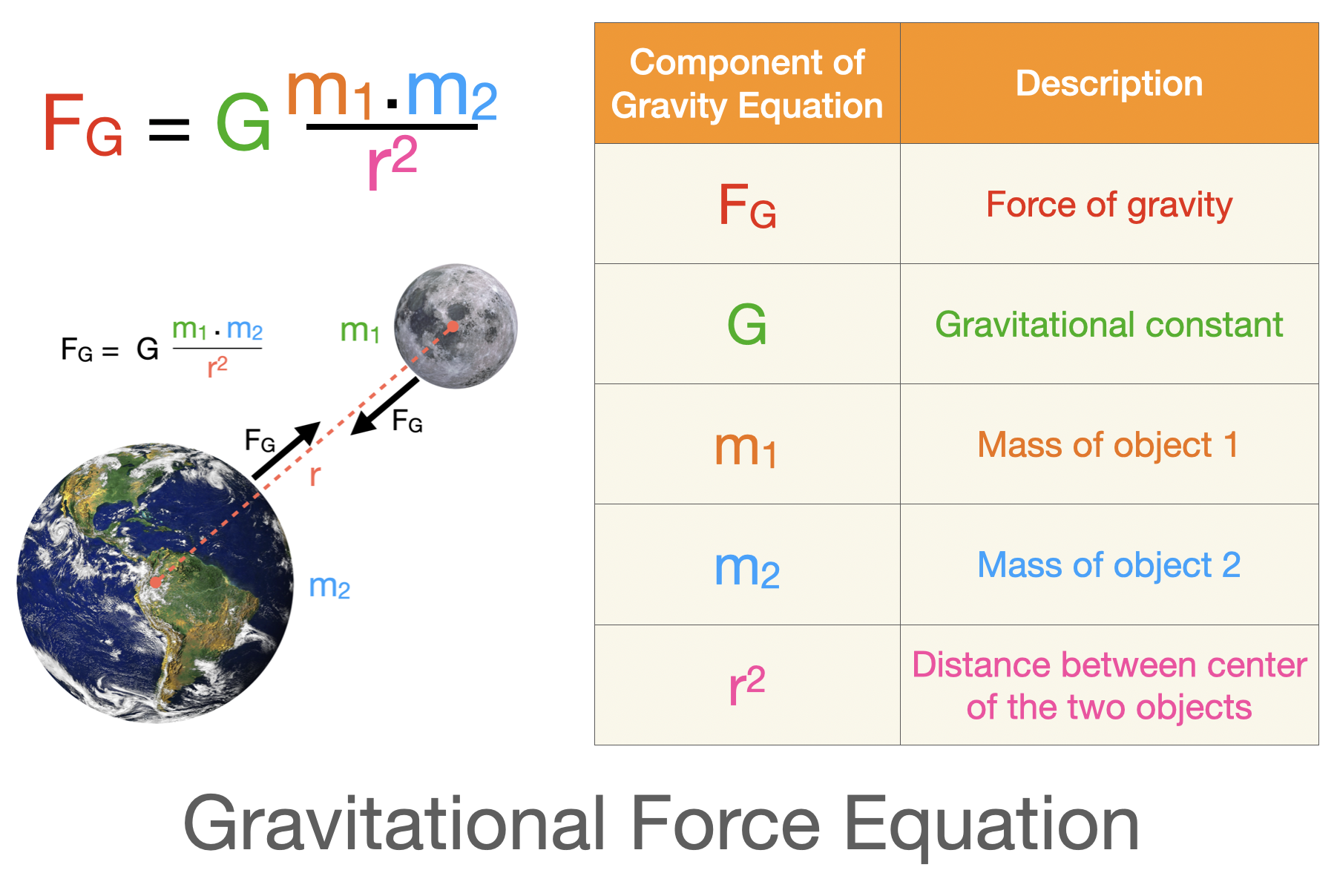
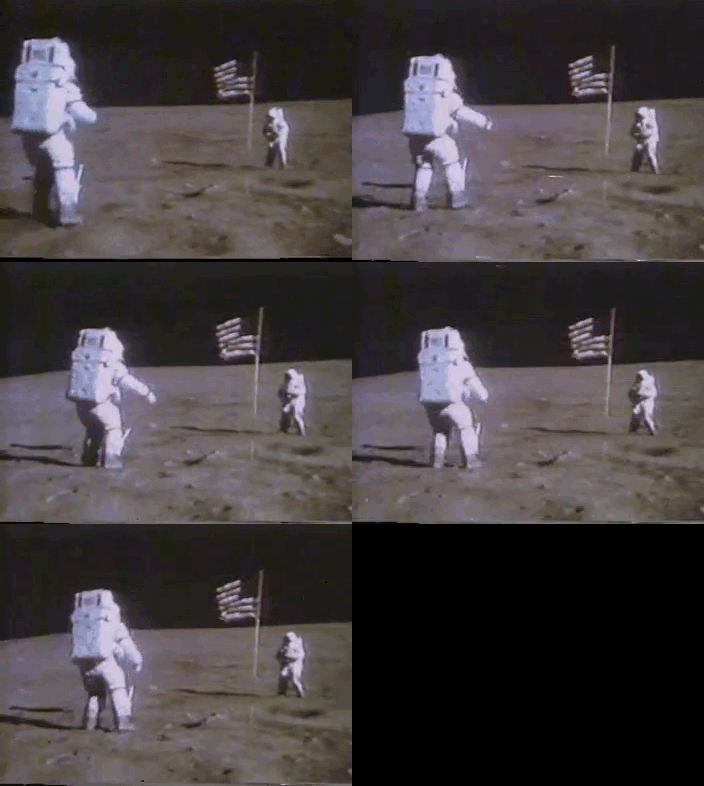
Based on the equation above we can see that the force of gravity on the Moon will be less than on Earth. According to Newton’s Second Law of Motion, if the force of gravity is less, the acceleration due to gravity will be less for the same mass. Therefore, the acceleration due to gravity on the Moon is 1.6 m/s2 for all objects. That means you would weigh about 1/6th your Earth weight on the Moon! This is also why videos of astronauts walking or jumping on the Moon look a bit odd (see video above of astronaut John W. Young commander of the Apollo 16 mission).
Displacement
To fully understand acceleration, let us begin by describing the position of an object on a number line. For the beachball in the figure below, the initial position (xi) is 5 m from the origin (0 m), at t = 0 s, and the final position (xf) is 9 m, at t = 2 s. The displacement (d) of the object is computed by applying the equation: d = Xf – Xi
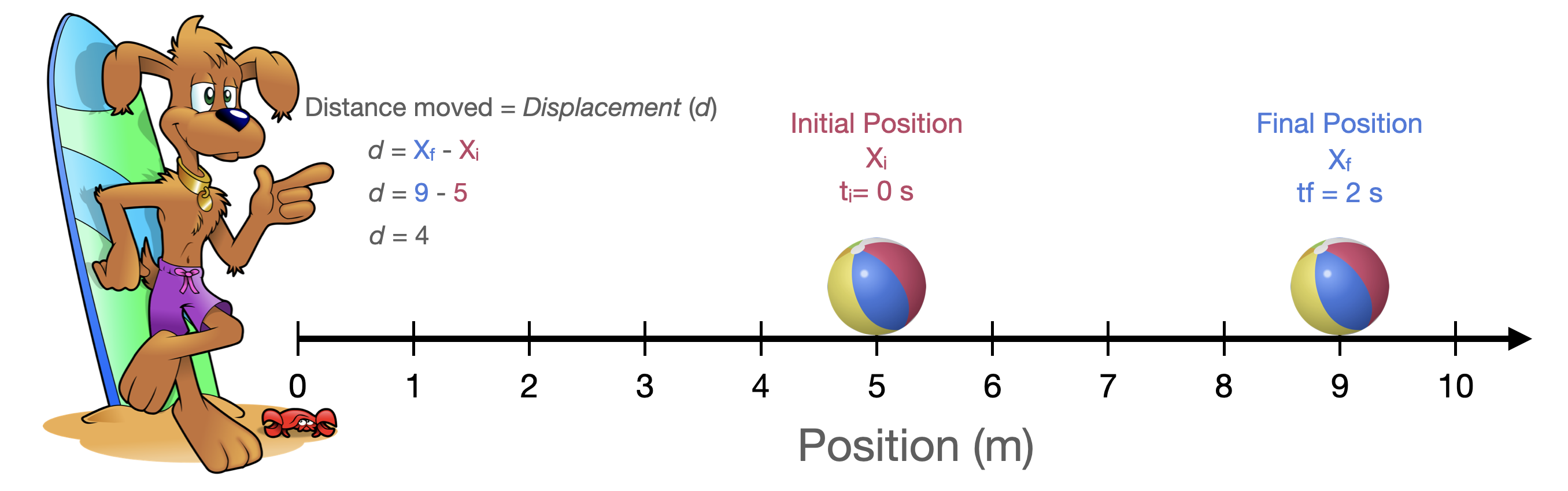
Hence, d = 9 – 5 = 4 m. In this case, the displacement equals the distance traveled, but this is not always true. If the object had begun at x = 5 m (see number line below), traveled to 9 m, and then went back to x = 3 m, the correct total displacement would be -2 m (d = 3 – 5). In contrast, the total distance traveled would be 10 m (4 m to the right and then 6 m to the left). It is important to use the equation to compute the displacement, and it is always the final position minus the initial position.
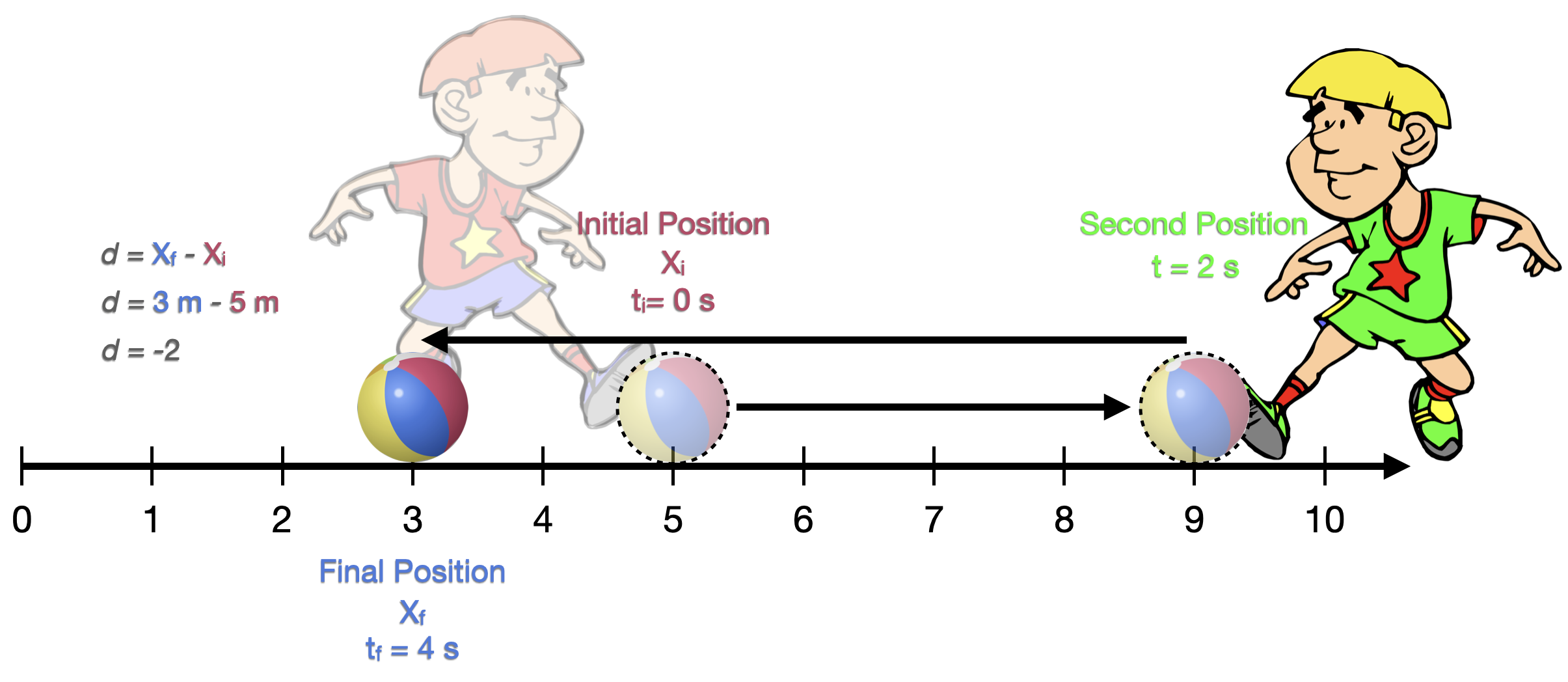
Displacement is what is known as a vector, in that it has both direction and magnitude (size), while distance is a scalar, having only a magnitude. Why is direction important? Imagine someone telling you to 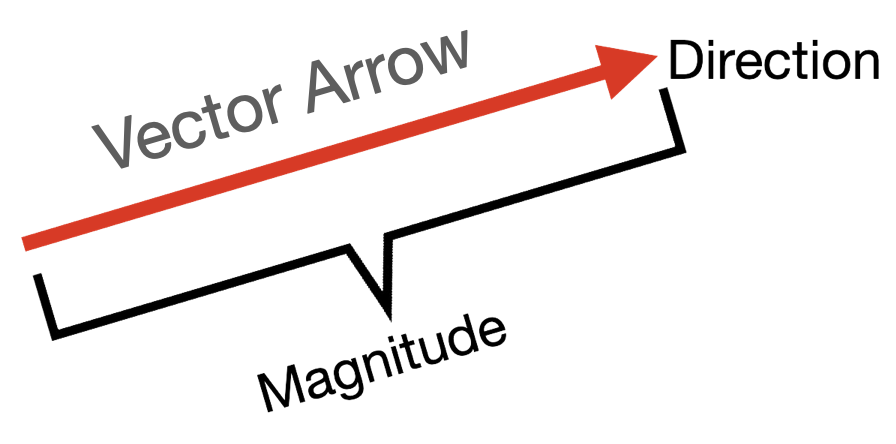 meet them 10 miles away, rather than 10 miles directly north of here, or 10 miles down Maple Street. Which instructions would you prefer?
Velocity
The next step is to calculate how fast the object is traveling. The correct way to do this is to compute its velocity, which is defined as the rate of change of position. To compute the average velocity, divide the change in position (final minus initial position), by the change in time (final minus initial time):
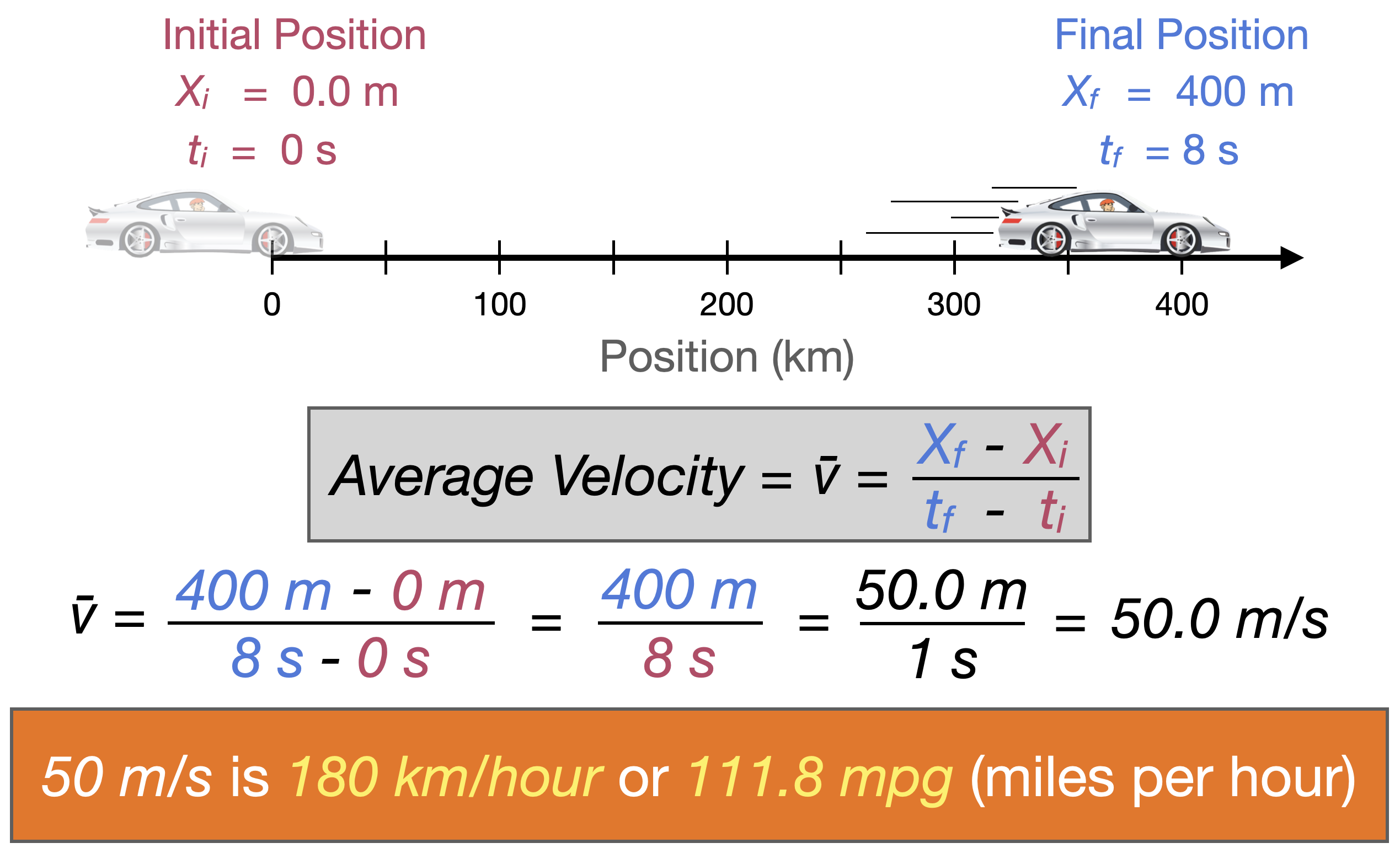
For the case of the drag race shown above, the average velocity is 400/8 m/s = 50 m/s. The average is calculated because the object could speed up and slow down within the interval (length of time, 8 s) we are looking at, so we are only capturing the average across the 8 s of the race. Again, it should be noted that velocity is a vector, like displacement, and has a direction and magnitude. If the race car stopped and move back toward the origin (0 m) the velocity would be negative! In contrast, speed is a scalar and does not indicate direction.
Acceleration
 Now we can finally consider acceleration, which is the rate of change of velocity. Imagine a runner goes from an initial velocity (vi) of 5 m/s at ti = 2 s, to a final velocity (vf) of 10 m/s at ti = 4 s. To compute the average acceleration, divide the change in velocity by the change in time.
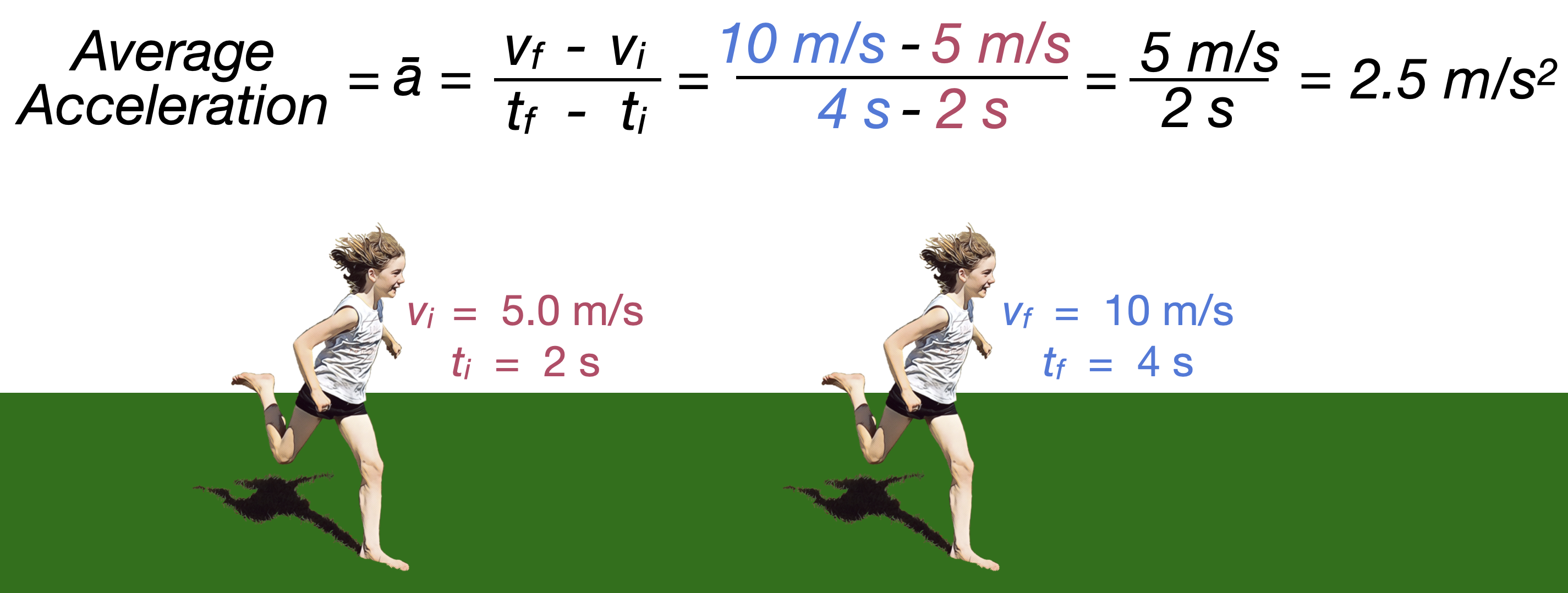
Look at the runner above. The average acceleration of the runner is 2.5 m/s2. The average is calculated as the runner may have accelerated at faster or slower rates within the interval we examined (from 2 s to 4 s), but we can only capture the average across the 2.0 s interval. Acceleration is also a vector, with a direction and magnitude.
If the runner speeds up moving away from the origin (0 m) the acceleration is positive, but the acceleration is negative if the runner slows down while moving away from the origin. On the other hand, if the runner turns around and runs toward the origin (0 m) her acceleration would be negative. Acceleration is any change in velocity, therefore speeding up, slowing down, or changing direction are all forms of acceleration.
Acceleration Due to Gravity
Let us consider an object accelerating due to gravity. Figure 2.2a (below) shows an object dropped from 122.5 m above the ground, which accelerates due to the force of gravity. The position axis begins with the origin (0 m) at the ground. At t = 0 s, the object is let go, therefore it has no velocity. At 1 s intervals, the position of the object is drawn, and the current velocity is listed. After every second the object has speeded up by -9.8 m/s, meaning the object is accelerating at -9.8 m/s2. The acceleration is negative because the object is speeding up towards the origin. In order to better understand that the object in Figure 2a is accelerating, Figure 2b shows an object falling at a constant velocity of -25 m/s.
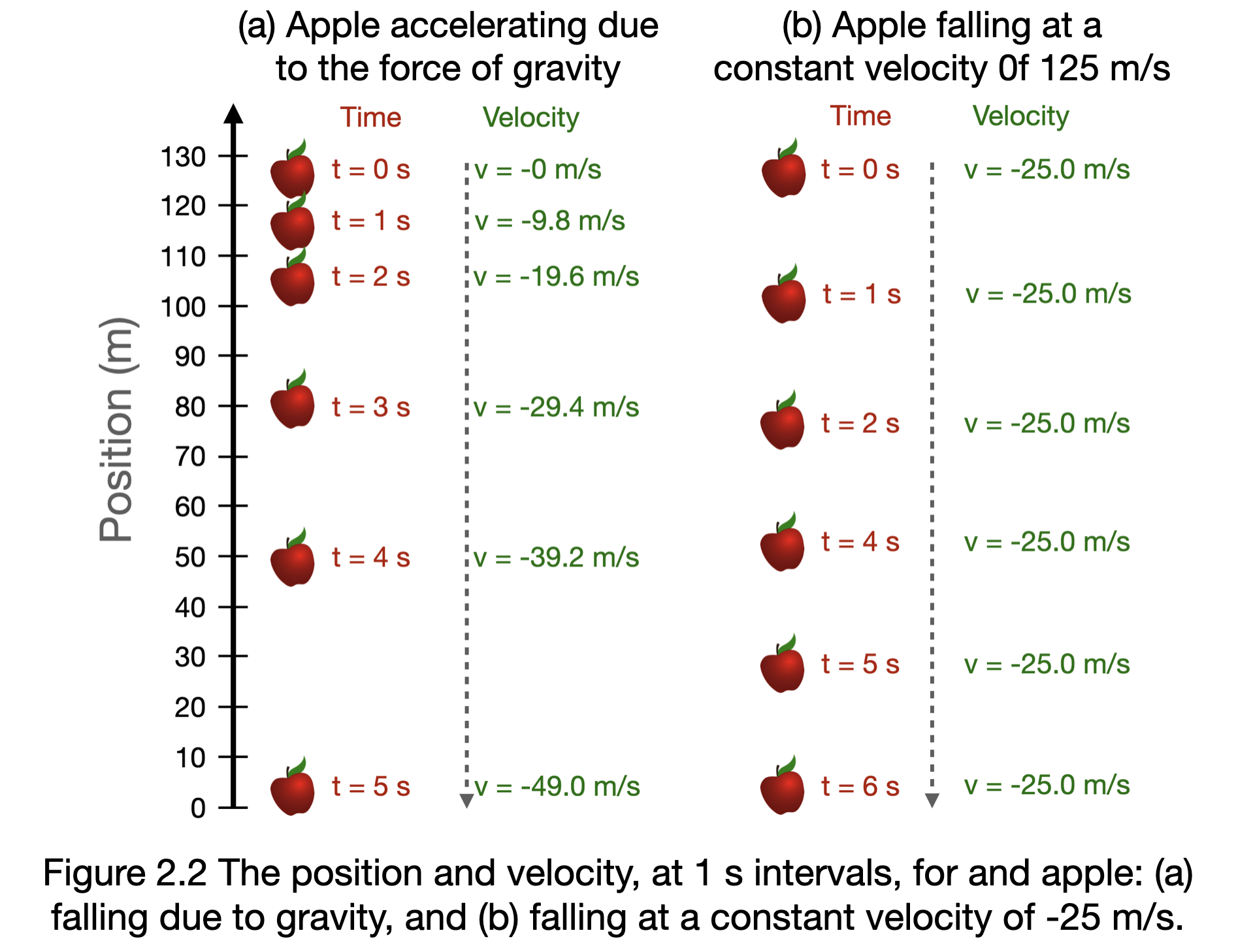
In Figure 2a we have assumed the perfect case, with only the force of gravity acting downwards on the object. On Earth, if the only force present on an object is the force of gravity, the object will accelerate at -9.8 m/s2. If any other force acts upward or downward on the object then the net force will differ and the acceleration will change. For example, if a force of air resistance acts upwards on a falling object this can partially or completely balance out the force of gravity. If the forces are completely balanced the object will stop accelerating. This situation occurs when a skydiver reaches terminal velocity at approximately 56 m/s (125 mph). If an object on Earth accelerates at less than -9.8 m/s2 toward the ground, then an upward force must be present on the object. This information is provided to help the instructor understand all the forces involved in objects falling to the ground, but will not be included in the experiments or analysis conducted by students.
The foregoing explanation of the concepts displacement, velocity, and acceleration is meant to provide background to the scientific descriptors of motion, but will not be taught to students. Instead, students will use the concepts distance and speed. Distance is defined as the length of a path traveled. If the movement is in one direction along a straight line, the distance will be equal to the magnitude of the displacement. Speed is defined as distance divided by the time taken. If the distance moved is in one direction along a straight line, the speed will be equal to the magnitude of velocity. It is important that students understand that acceleration is speeding up, slowing down, or changing direction.
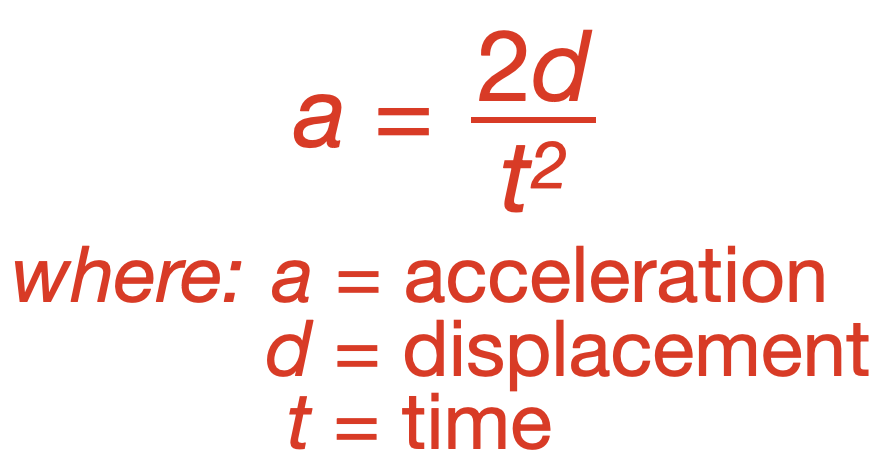 In this Investigation, acceleration will be calculated by students. If acceleration is constant, the following equation of motion can be used. We can use the acceleration equation shown to calculate acceleration for an object that is dropped (has an initial velocity of zero) and accelerates due to gravity (acceleration is constant). The height the object is dropped (d) and the time taken (t) to reach the ground, are needed to calculate acceleration.
In Investigation Two, students will work with a simplified version of this equation. Their experiments will show that a falling object is not moving at a constant velocity, but is speeding up toward the ground. The acceleration of a falling object will be approximated, and students will learn that the acceleration due to the force of gravity is 9.8 m/s2 for any object close to the surface of Earth, regardless of mass.
Earth's Forces: Investigation 2 - Mathematics Concepts
Prelab
- distance in meters
- time in seconds
- greater than/less than/equal to
- data table
- speed in m/s
- multiplication/division
- comparing values
- decimals to the nearest hundredth
Lab
- time in seconds
- distance in cm and meters
- decimals to the nearest hundredth
- calculating averages
- greater than/less than/equal to
- metric conversion
- speed in m/s
- multiplication/division
- line graph
- skip counting by 0.5
Postlab
- data analysis
- patterns/trends
- (in)direct relationships
- calculating averages
- multiplication/division
- addition/subtractions
- exponents
- problem-solving
Earth's Forces: Investigation 2 - Procedural Tools

Earth's Forces: Investigation 2 - Cognitive Tools

Earth’s Forces:
Investigation 2 Quiz

