Teacher Portal:
Exploring Ecosystems
Investigation 1 – PreLab
 PRINT IT
Use your browser to download a printable PDF as help during the slide presentation and to make additional notes. In your browser, go to File > Print and then choose to save as PDF.
MINDSET
This Investigation is designed to:
- introduce students to the concepts of environment and ecosystems.
- introduce students to the relationship between producers and consumers in the ecosystem.
- build an understanding of the interactions between producers, herbivores, carnivores, and omnivores in the context of food chains and food webs.
- use food chains and food webs to demonstrate the interdependence of organisms.
- introduce students to the concept of biomass.
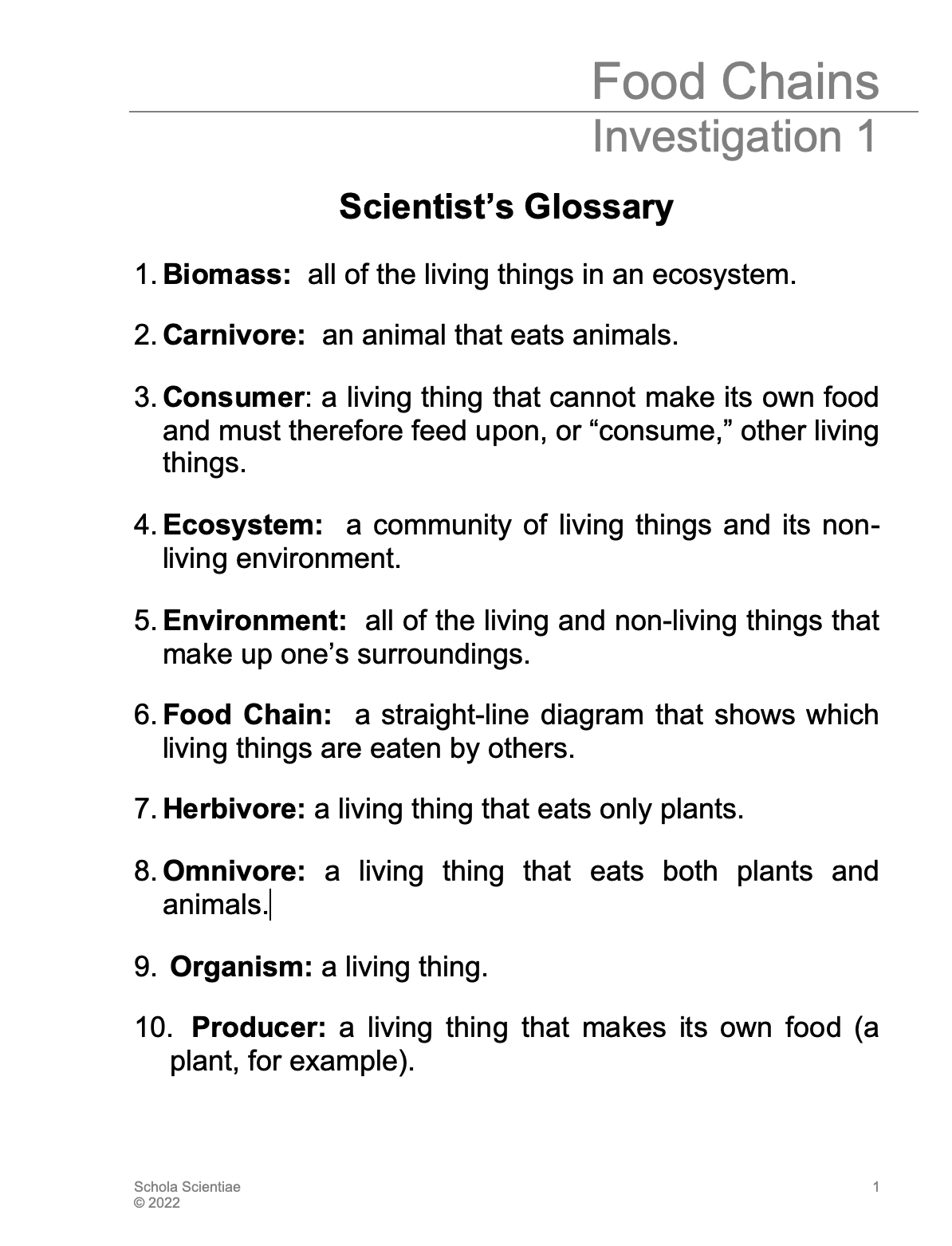
SCIENTIST’S GLOSSARY
1. Biomass: the quantity of living matter in an ecosystem.
2. Carnivore: an animal that eats animals.
3. Consumer: a living thing that can not make its own food and must therefore feed upon, or “consume,” other living things.
4. Ecosystem: a community of living things and its non-living environment.
5. Environment: all of the factors, both living and non-living, that surround and affect an individual organism or biological community.
6. Food Chain: a straight-line diagram that shows which living things are eaten by others.
7. Food Web: a diagram that overlaps many different food chains to show all of the feeding patterns of living things in an ecosystem.
8. Herbivore: a living thing that eats only plants.
9. Omnivore: a living thing that
eats both plants and animals.
10. Organism: a living thing.
11. Producer: a living thing that makes its own food, usually through the process of photosynthesis.
BE PREPARED
Watch the Investigation 1 Teacher Video and Student Video below to prepare for the PreLab.
SET FOR SUCCESS
- Tell students that they are about to begin the Exploring Ecosystems CELL.
- Ask students to share the kinds of things they might learn in these Investigations.
Begin the PreLab Concept Slides to start students on their learning journey. Then watch the Pre-Lab Student Video afterward as a class.
NAVIGATE IT
Once the slide presentation is launched
- use your left and right arrows to advance or go back in the slide presentation, and
- hover your mouse over the left edge of the presentation to get a view of the thumbnails for all the slides so that you can quickly move anywhere in the presentation.
- Click HERE to launch the slide presentation for the CELL.
SHARE IT
SLIDE VECOSYS-pre-1
This is the first Investigation of the LabLearner CELL Exploring Ecosystems. In it, students will be introduced to food chains, food webs, and biomass.
______________________________________________
SLIDE VECOSYS-pre-2
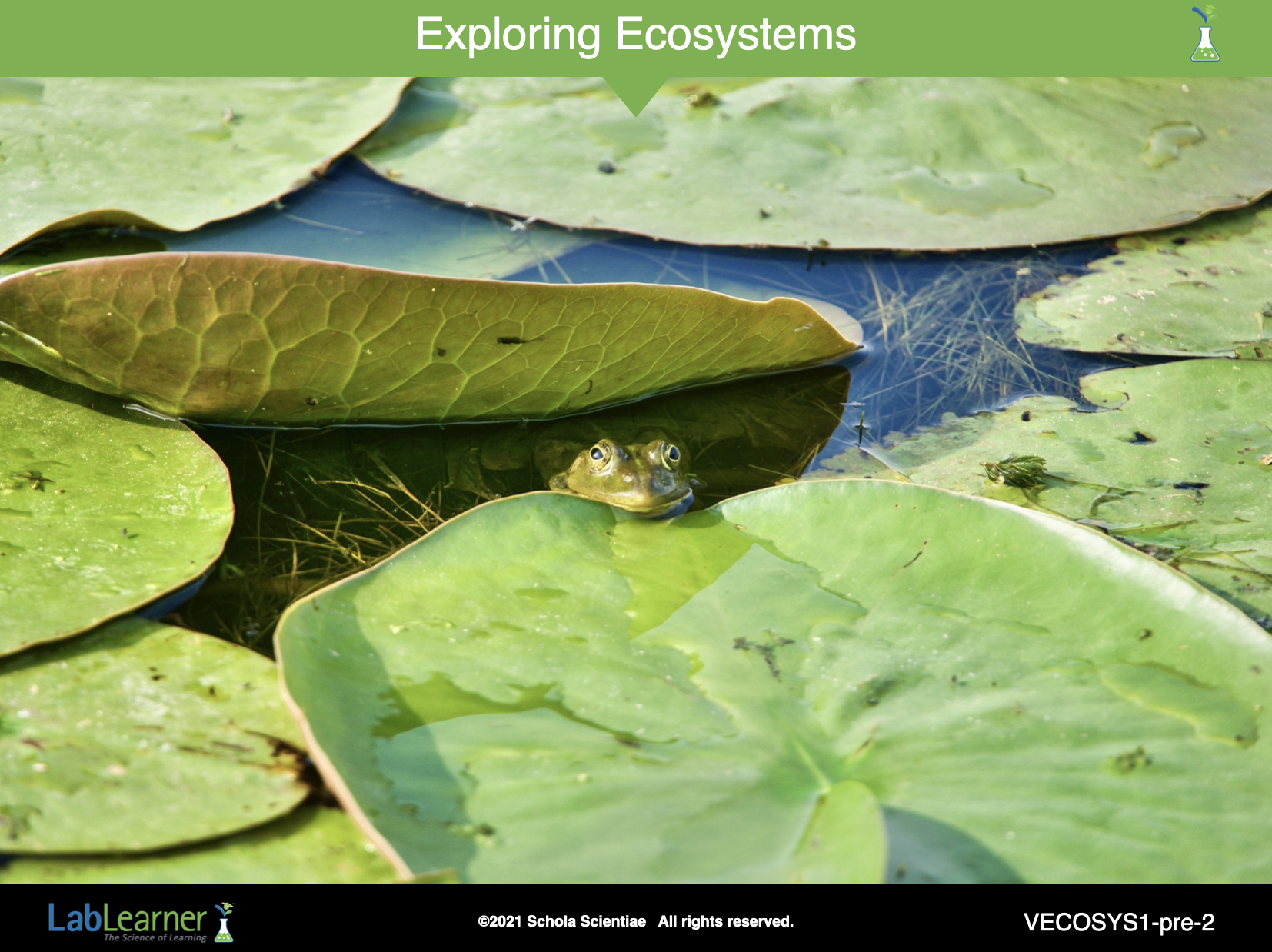
A. Begin the Investigation by describing the focus of the CELL to students.
1. This CELL is designed to introduce students to ecosystems, the effects of the environment on ecosystems, and the adaptations of organisms that allow them to live in particular environments.
2. During the Investigations, students will explore food chains and food webs, the concept of biomass, the structure and function of organisms that enable them to live in specific environments, how changes in the environment affect organisms, extinction, and the fossil record, and the effects of pollution.
______________________________________________
SLIDE VECOSYS-pre-3
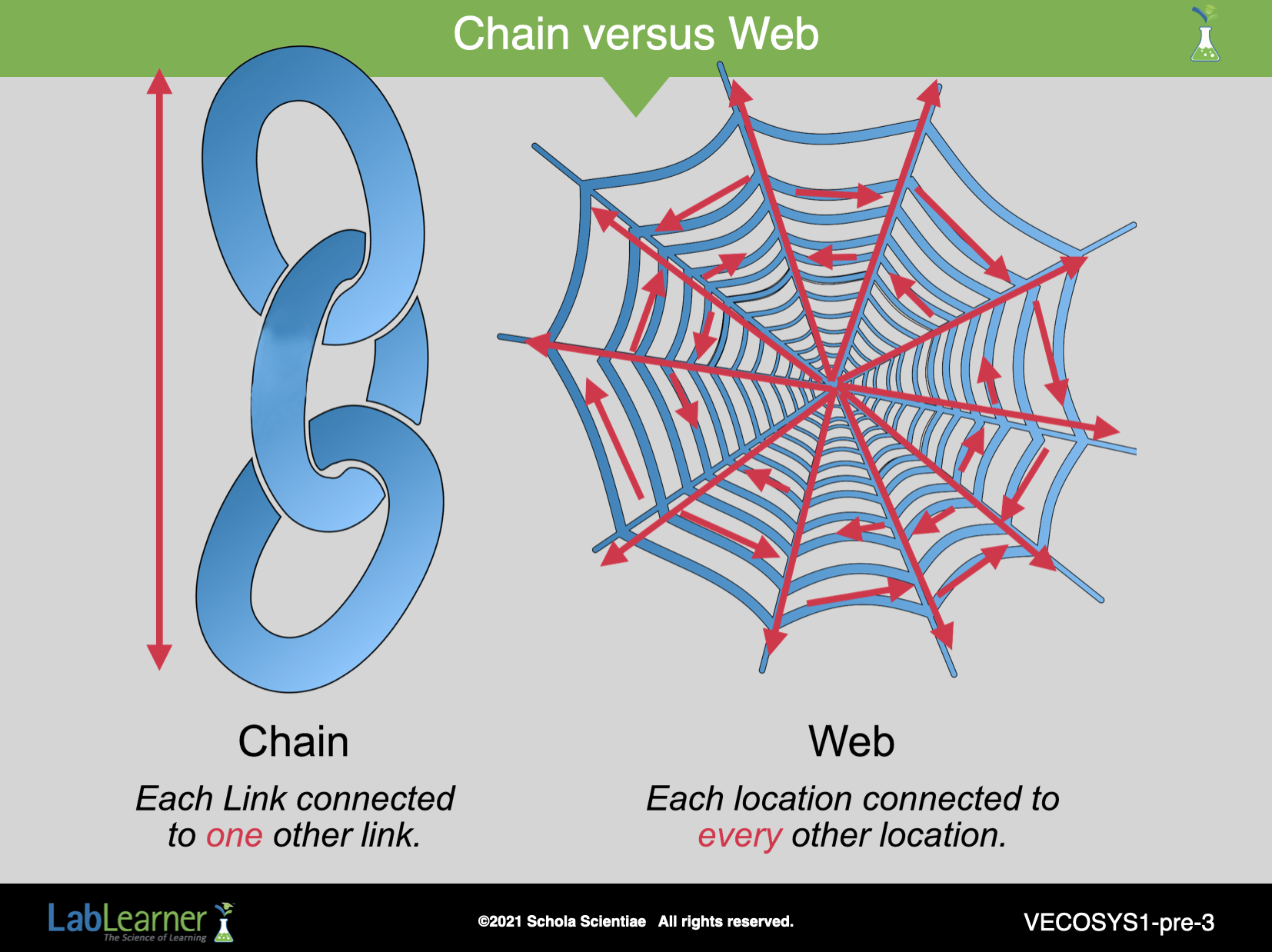
Food chains and food webs are very important in ecosystems. Each stresses the interrelationships of organisms and the physical components of an ecosystem interact with each other. But why do we use these two terms?
Chain: A chain is a linear attachment of individual links. If any link in the chain is broken, the chain is no longer intact.
Web: Unlike a chain, each location in a web is ultimately connected to every other location in the web. An event that occurs in any location on the web reverberates to every other location. Thus every spot in the web affects every other spot.
______________________________________________
SLIDE VECOSYS-pre-4
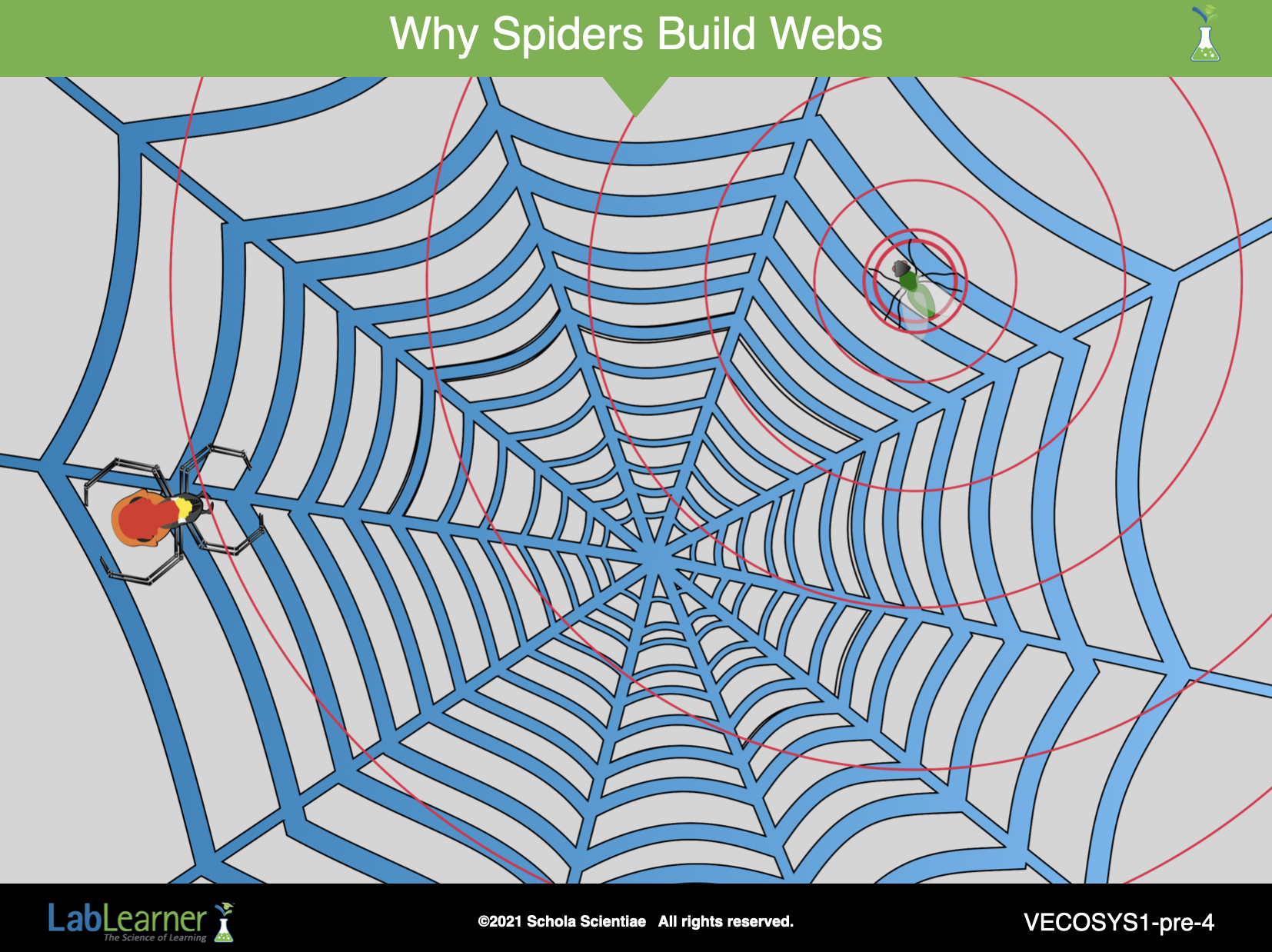
As an interesting side-note, and to clarify the web analogy in an ecosystem, consider how a spider uses a web to capture its food.
Each location on the spiderweb is interconnected to all of the other locations. Through its legs touching various strands of the web, the spider can feel a vibration in the web immediately as the fly is ensnared and tries to get free. Then, it can quickly sprint to the precise spot where the fly is entangled even in the dark.
The analogy to the food web accentuates the interconnectedness of the plants and animals and the nonliving physical and chemical factors in any given environment. If one point in the food web is altered, the effect will be felt throughout the entire web to one extent or another.
Exploring Ecosystems: VECOSYS-pre-4
SLIDE VECOSYS-pre-5
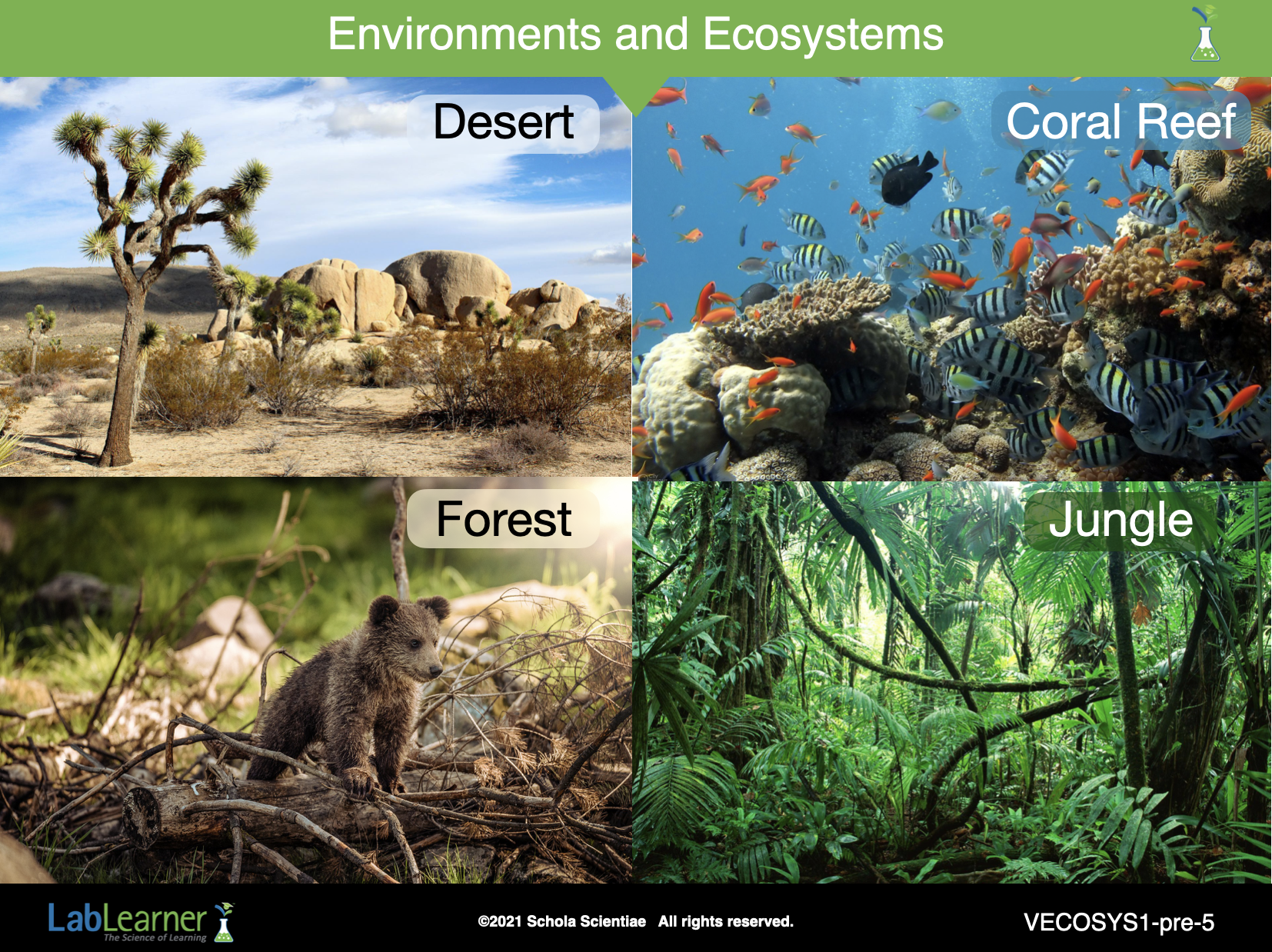
B. Narrow the focus of the discussion by explaining that in Investigation One students will learn how living things, also called organisms interact with each other and their environment.
1. Begin by directing students to locate their Scientist’s Glossary. The questions that follow are intended as a guide when introducing students to the terms. Begin with environment and ecosystem:
a. Read the definition of environment as a class, or ask for a student volunteer to read the definition.
Environment: all of the factors, both living and non-living, that surround and affect an individual organism or biological community.
Explain to students that all of their physical surroundings make up the environment in which they live.
b. Ask students: What living and non-living things are in your environment? Student answers may vary.
Guide students toward understanding that their environment contains non-living things such as air, buildings, light, soil, rivers, and weather. It also contains living things like trees, grass, and insects.
c. Read the definition of ecosystem as a class, or ask for a student volunteer to read the definition.
Ecosystem: a community of living things and its non-living environment.
Explain to students that in science the word “community” means all of the different living things that live in a certain area.
d. Ask students: What are some of the living things that live in your community? Student answers may vary.
Be sure students include examples of people, plants, and animals in their community. Some examples are: parents, friends, trees, flowers, grass, dogs, pigeons, insects, and squirrels.
e. Explain to students that two or more things interact when they act on each other and have an effect upon one another.
Ask students: How do the living things in your community interact with each other? Student answers may vary. Some examples are: Squirrels eat acorns. Birds build nests in trees. Bees pollinate flowers. Birds eat insects.
f. Ask students: How does your environment affect your community? Student answers may vary.
Lead a discussion about the living and non-living factors that affect students. Some examples are: Lack of rain can cause plants to die. Trees provide homes for birds and animals and shade for people. A lake provides drinking water for animals.
g. Remind students that an ecosystem includes both a community and its non-living environment.
______________________________________________
SLIDE VECOSYS-pre-6
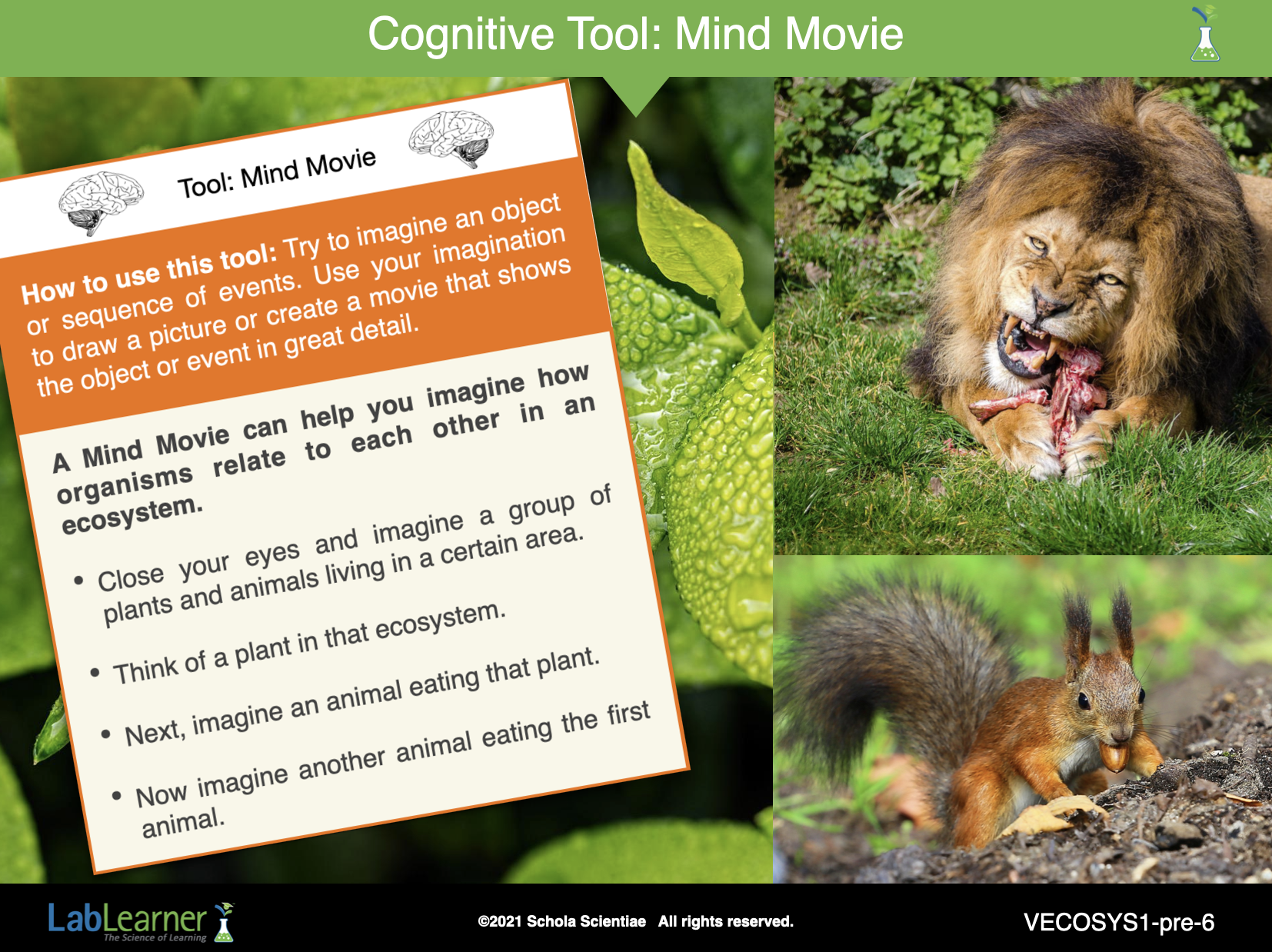
2. Explain that another word for living things is organism. Introduce students to different types of organisms in ecosystems – producers, herbivores, consumers, and omnivores – with the following steps:
Tell students that a Mind Movie can help students imagine how organisms relate to each other in an ecosystem.
______________________________________________
SLIDE VECOSYS-pre-7
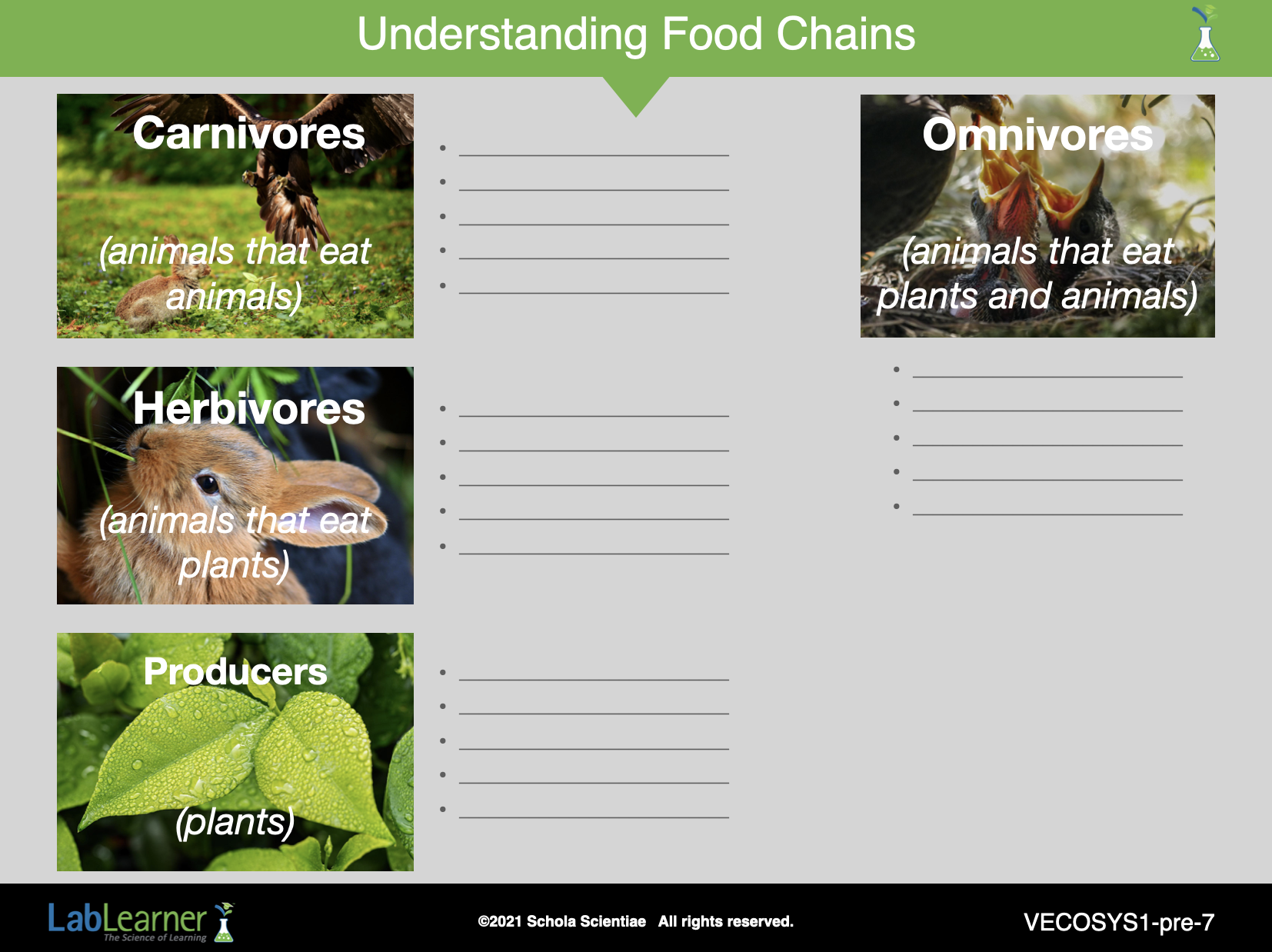
a. Encourage students to share their Mind Movies with the class. As they do, write the plants and animals on the board in the following order: Plants (producers) should be on the bottom, animals that eat plants (herbivores) should be above the plants, and animals that eat other animals should be on the top (carnivores). If students mention any animals that eat both plants and animals (omnivores), place these to the side.
b. Point to the producers in the diagram on the board, and ask students: What do all of these plants have in common? Student answers may vary. Sample answers: They are green. They provide food for animals. They have roots.
Write the word “herbivores” next to the herbivores.
c. Explain to students that plants are called producers because they can produce, or make, their own food. Plants are green because they contain a green pigment called chlorophyll. Plants use chlorophyll and the energy from sunlight to make food (glucose) from carbon dioxide and water. This process is called photosynthesis. During photosynthesis, plants also produce oxygen which humans and animals need to breathe.
d. Refer to the middle of the diagram (herbivores). Ask students: What do all of these animals have in common? Student answers may vary.
Guide students to understand that all of these animals eat plants and only plants.
e. Write the word “herbivores” next to the herbivores. Tell students that herbivores are animals that only eat plants. Herbivores must eat a lot to get enough energy because plants are hard to digest.
f. Refer to the top of the diagram (carnivores). Ask students: What do all of these animals have in common? Student answers may vary.
Guide students to understand that all of these animals are “meat eaters.” They eat other animals, and they do not generally eat plants.
g. Write the word “carnivores” next to the carnivores. Tell students that carnivores are animals that eat other animals. They do not eat plants. Most carnivores hunt other animals.
h. Explain to students that some animals routinely eat both plants and animals. These animals are called omnivores. If there are some omnivores listed on the board, point them out to students.
If not, ask students: Can you think of any omnivores? Student answers may vary. Some common North American omnivores are: bears, foxes, raccoons, skunks, robins, opossums, and catfish. Humans are also omnivores.
i. Ask students to locate the Scientist’s Glossary. Point out the definitions of producer, consumer, herbivore, and omnivore to the students.
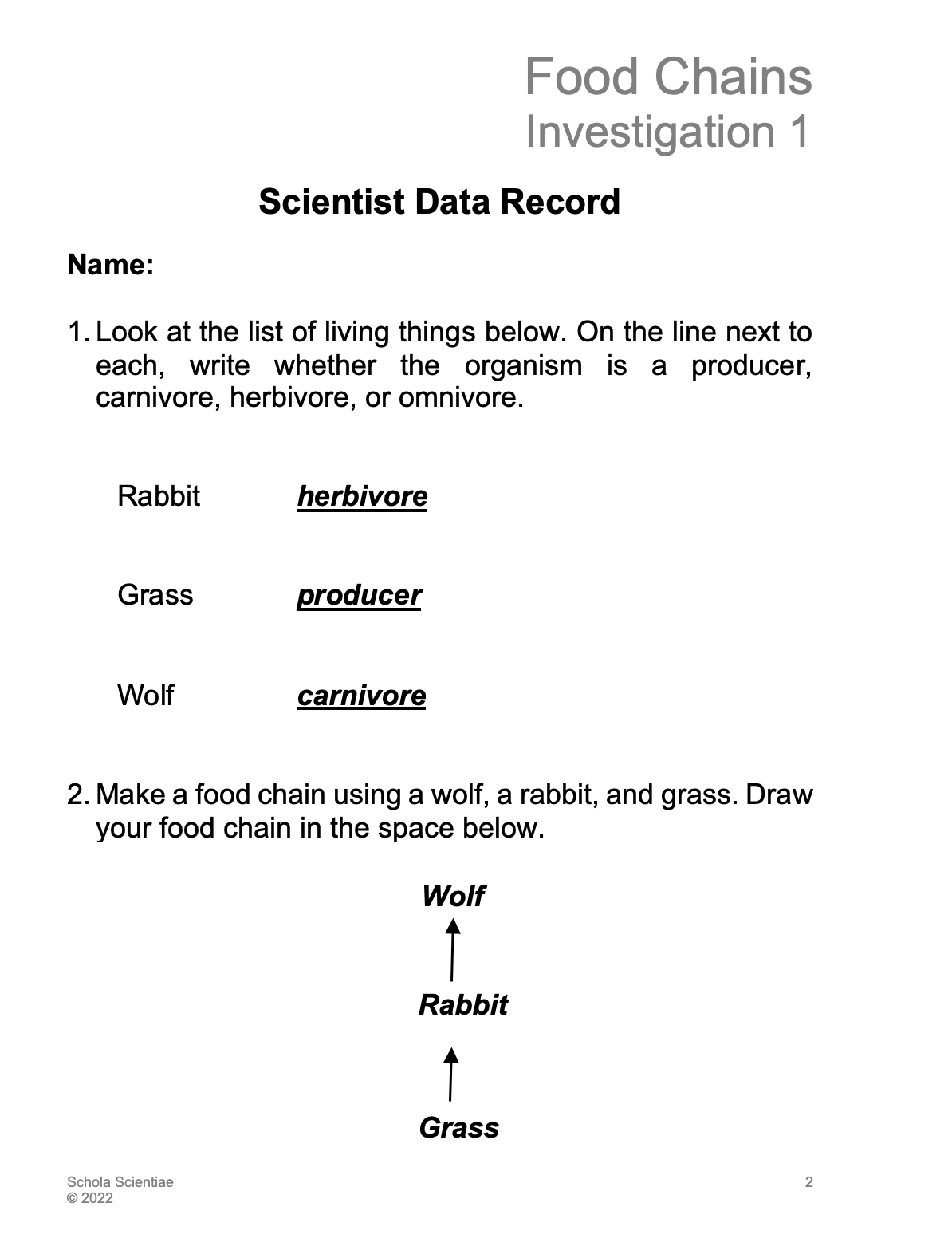
j. Direct students to answer Problem 1 on the Student Data Record. If necessary, point out that rabbits usually eat grasses, vegetables, and small plants. Wolves eat small animals like squirrels, rabbits, and prairie dogs.
______________________________________________
SLIDE VECOSYS-pre-8
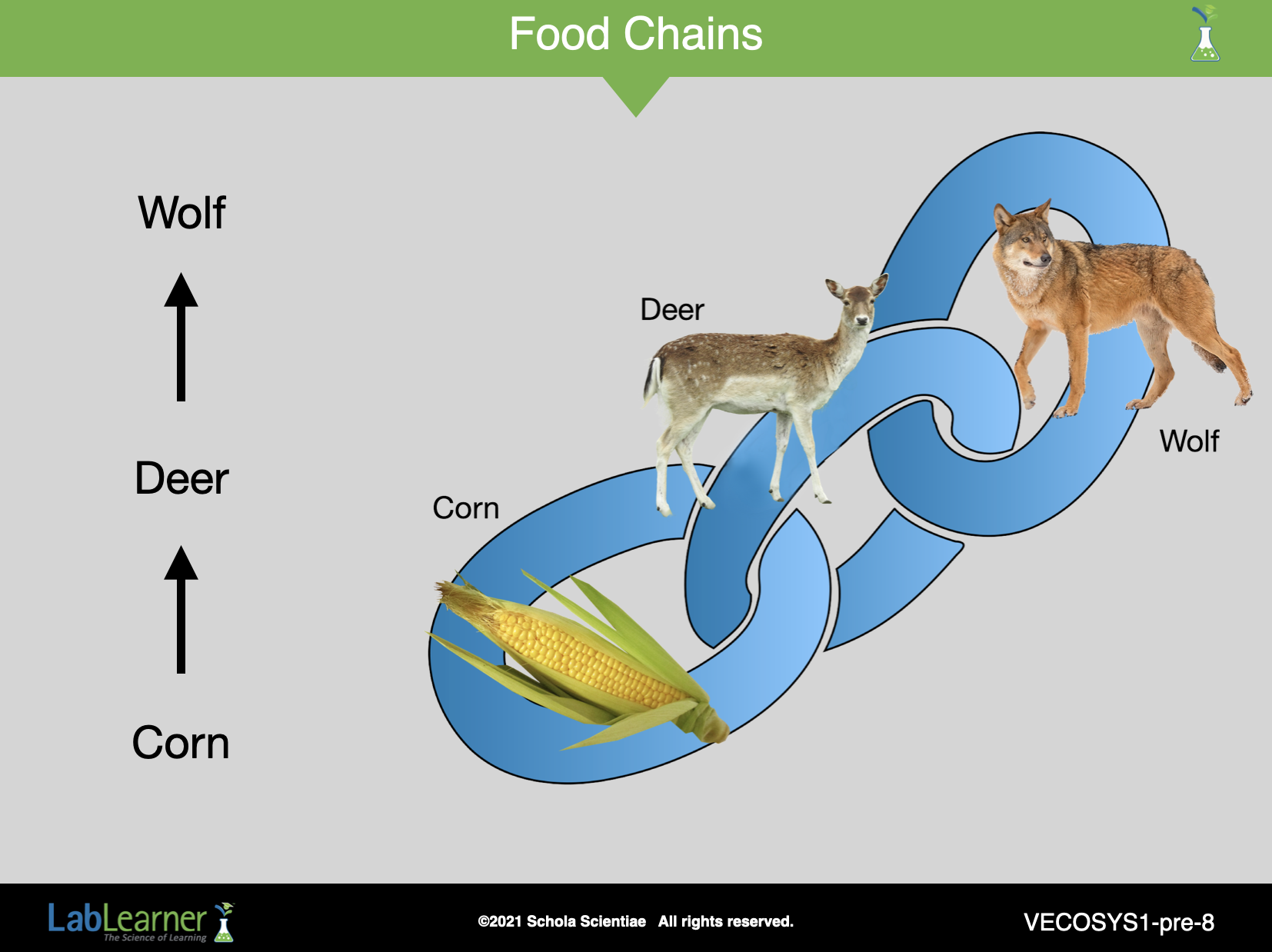
C. Explain to students that the way in which organisms interact in an ecosystem, can be drawn in a diagram called a food chain. Food chains show what animals eat.
1. Select one of the feeding relationships from the board and draw a simple food chain. Do not include omnivores in this simple food chain. The food chain example used in this slide is corn (producer), deer (consumer), and wolf (carnivore).
Explain to students that you have drawn a food chain. A food chain is a straight line. Arrows in a food chain are drawn from the food to the organism that eats the food.
2. Using the food chain on the board, ask students the following questions:
a. Ask students: What is the producer in this food chain? Student answers will depend on the sample food chain. In the sample above, corn is the producer.
- If necessary, remind students that producers are plants.
- Point out to students that producers are always found at the bottom of a food chain.
b. Ask students: What is the herbivore in this food chain? Student answers will depend on the sample food chain. In the sample above, the deer is the herbivore.
- If necessary, remind students that herbivores eat plants.
- Tell students that herbivores make up the second level of food chains.
c. Ask students: What is the carnivore in this food chain? Student answers will depend on the sample food chain. In the sample above, the wolf is the carnivore.
- If necessary, remind students that carnivores eat other animals.
- Explain to students that carnivores are always at the top of a food chain.
______________________________________________
SLIDE VECOSYS-pre-9
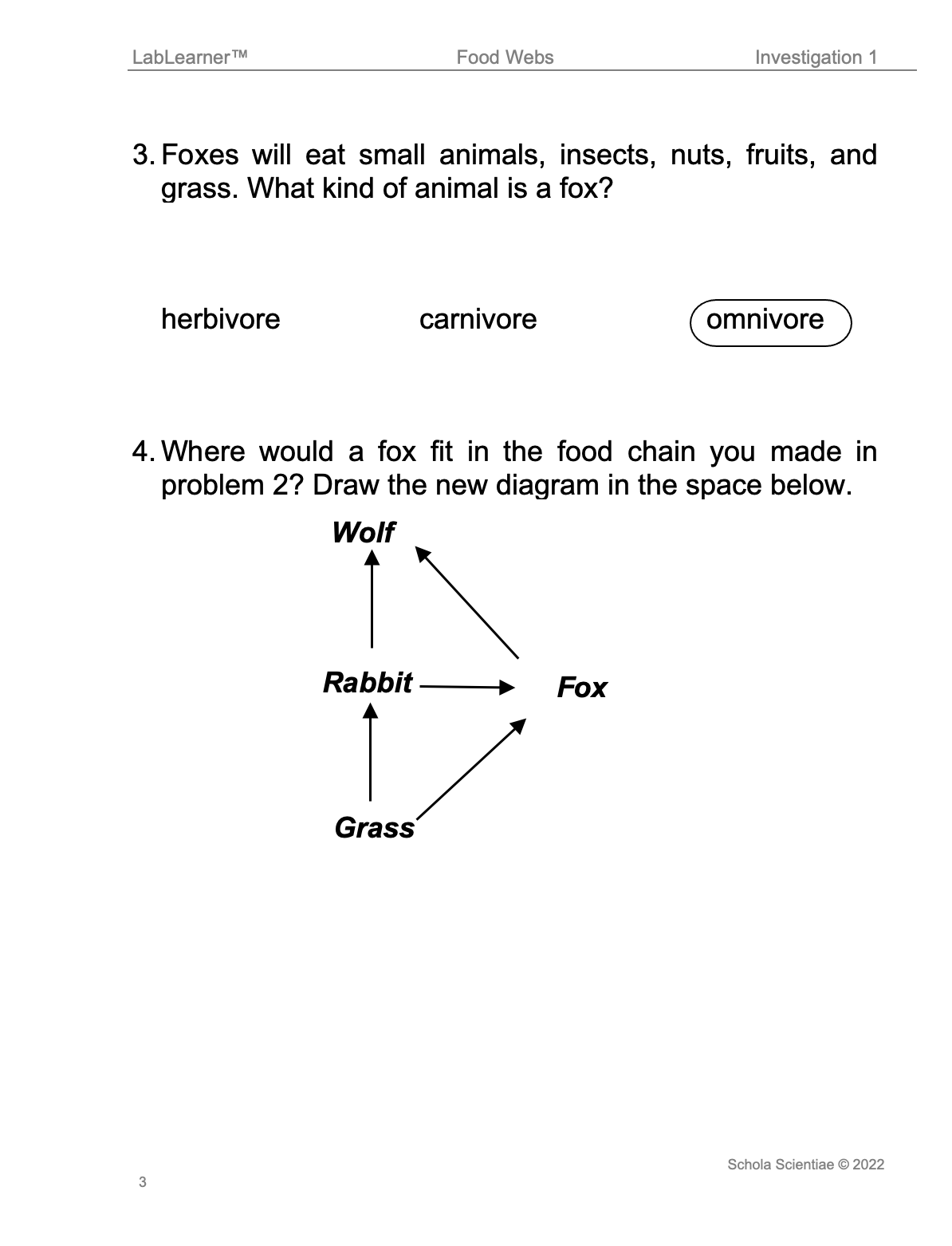
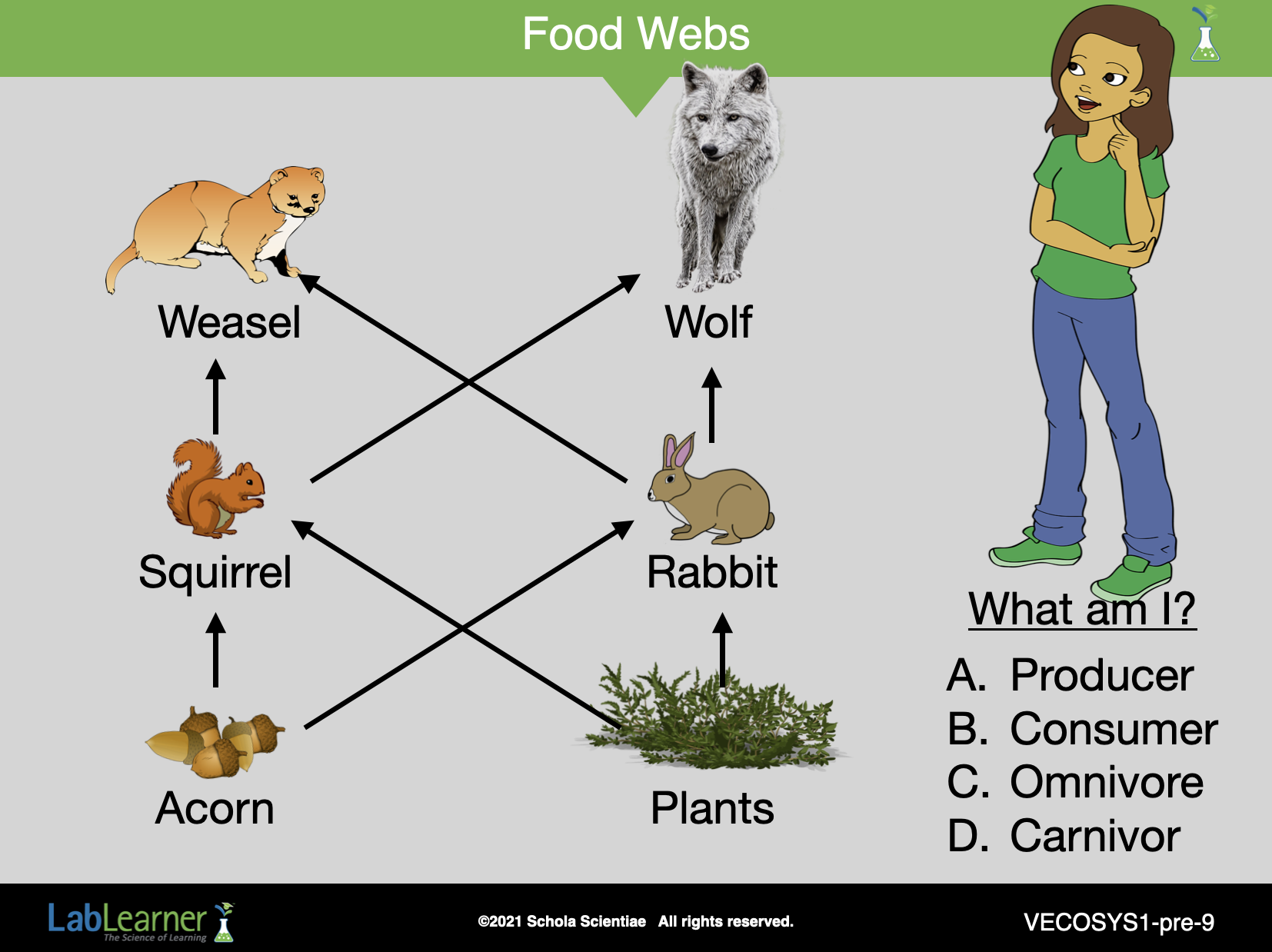
D. Explain to students that the way in which organisms interact in an ecosystem is typically more complex than suggested by a simple, linear, food chain. This is because, in natural communities, animals often feed on more than one type of plant and carnivores and omnivores often hunt and consume more than one type of animal.
a. This slide presents a food web consisting of six components. However, it is easy to imagine and actually identify in nature much more complex food webs with many, many more producers, consumers, omnivores, and carnivores.
b. Also presented on this slide is a picture of a human with the question, “What am I?”
Ask students: What about the human in this slide? Is she a producer, consumer, omnivore, or carnivore? Students answers may vary.
Inform students that when a human consumes plants (producers) it functions as a consumer. When a human consumes other animals, it is a carnivore. However, as human typically consume both plant and animal foods, we would classify humans as omnivores.
______________________________________________
SLIDE VECOSYS-pre-10
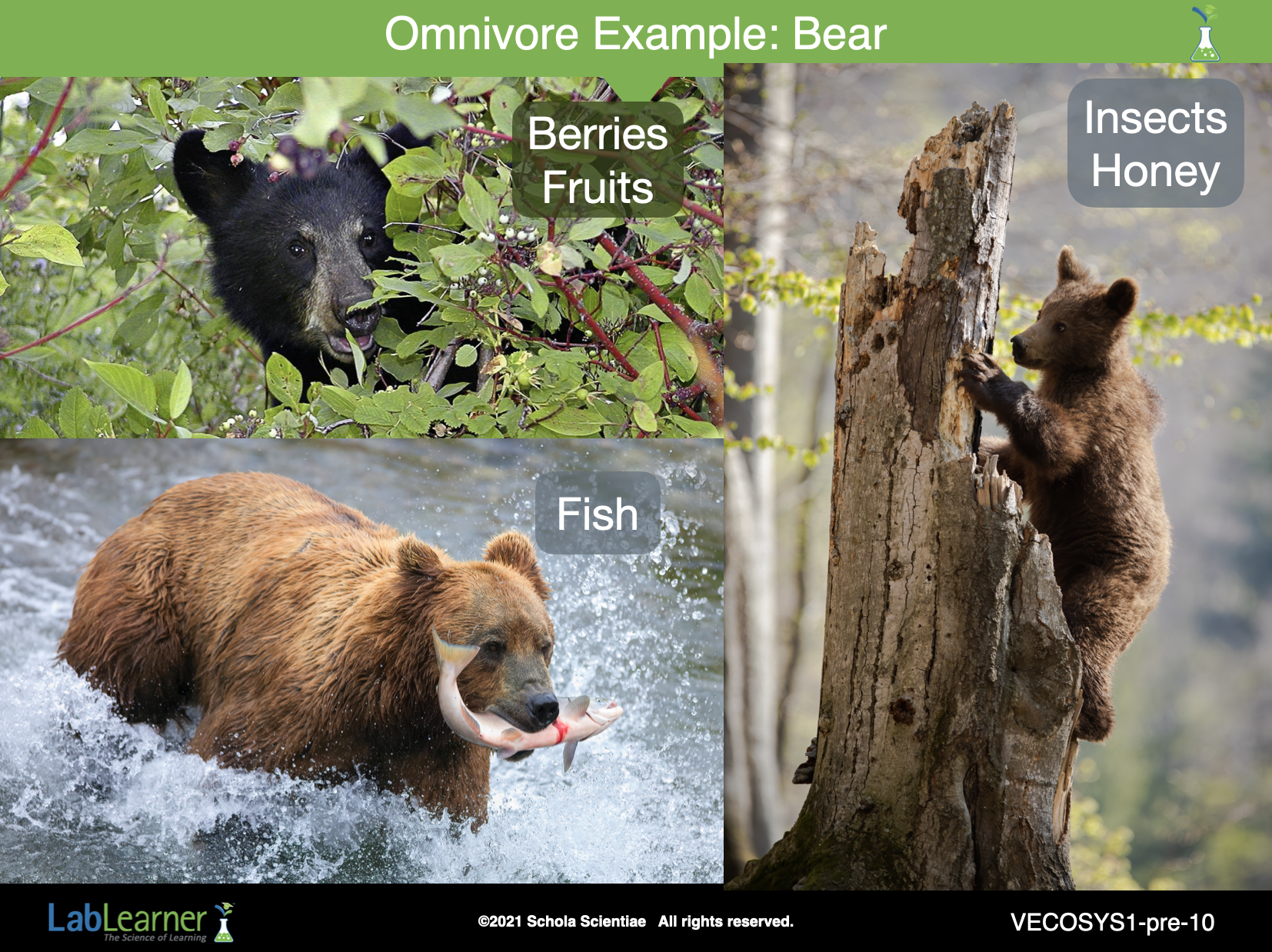
This slide depicts various food items consumed by an omnivore, the bear.
______________________________________________
SLIDE VECOSYS-pre-11
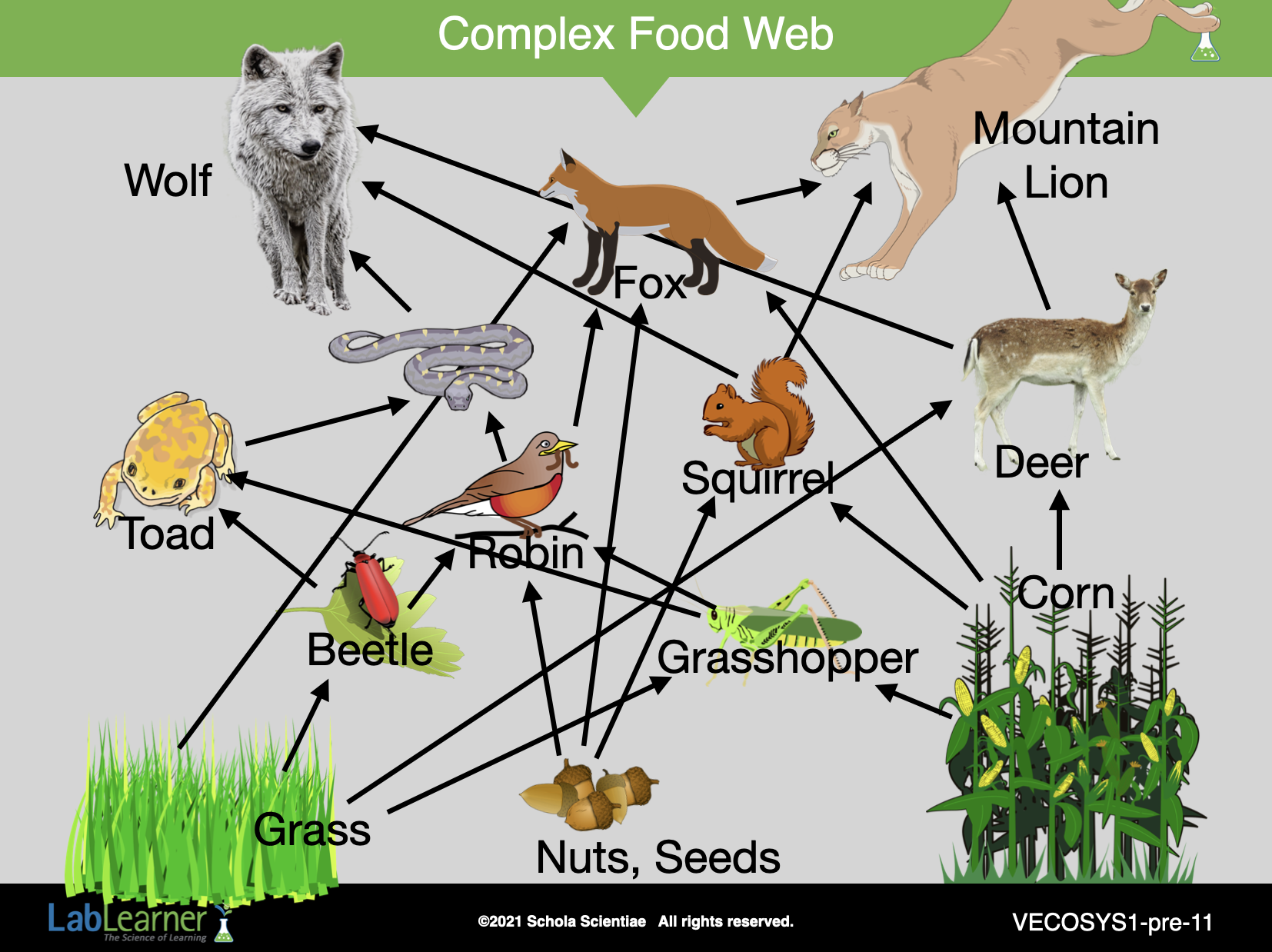
This slide presents a food web with only a fraction of the complexity that can exist in an ecosystem.
Ask students: Can you see from this slide why we call it a food “web”? Student answers may vary. Students may indicate that the many arrows crisscrossing the many interactions look a bit like a spider web. Many or all of the components in the food web are connected to each other.
______________________________________________
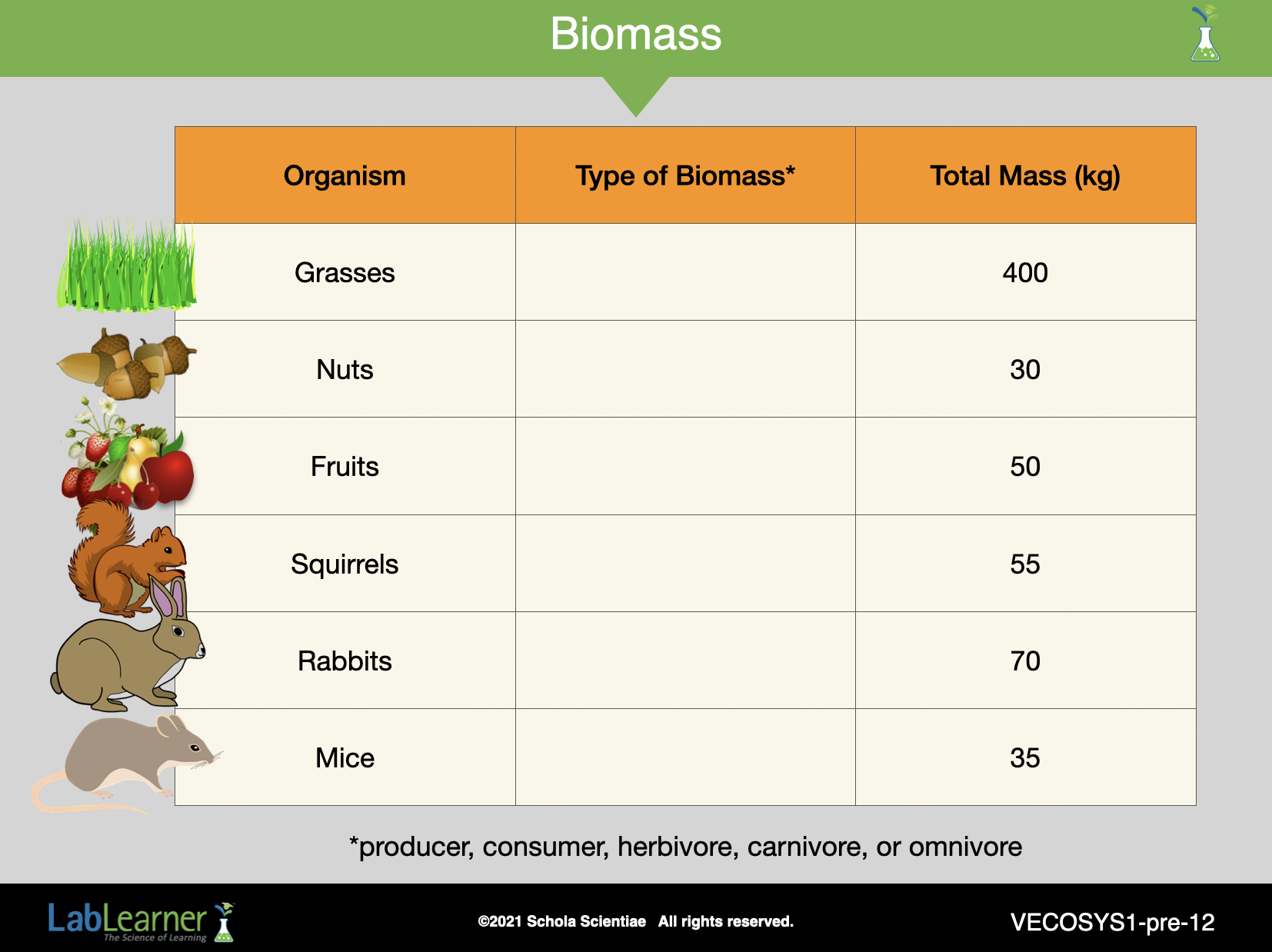
SLIDE VECOSYS-pre-12
E. Introduce students to the concept of biomass as a method of quantifying matter in an ecosystem.
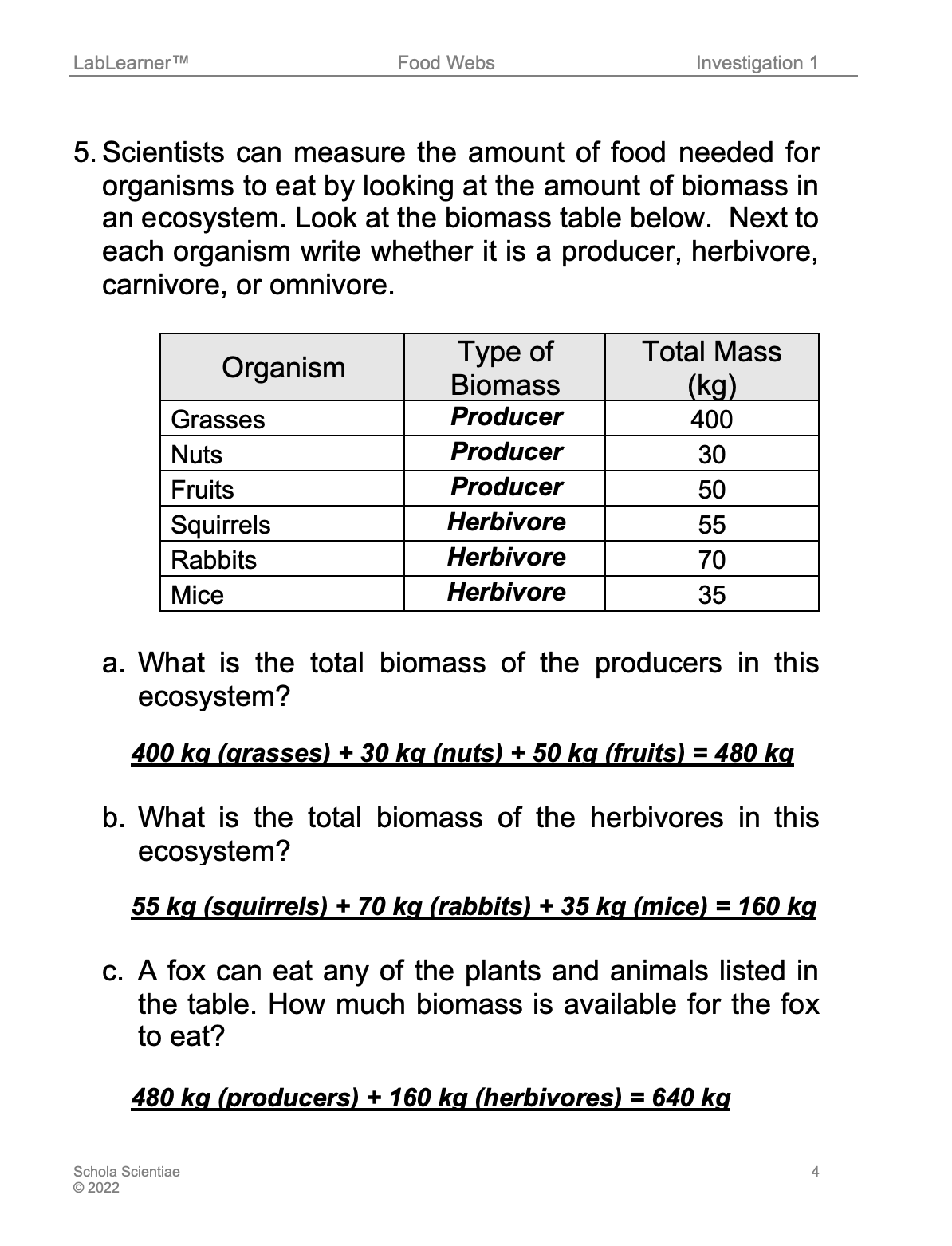
1. Explain to students that one way that scientists study the different food webs in an ecosystem is by determining the amount of food available for each organism. Scientists use the concept of biomass to determine the amount of food available.
Tell students that biomass is the total mass of all of the living organisms in an ecosystem.
2. Read Problem 5 on the Student Data Record aloud to the students and lead the students through Problem 5a.
a. Tell the students to find the biomass of all of the producers in an ecosystem or a food web you would add the mass of each producer together to get the total.
b. Direct students to look at the Table in Problem 5.
Ask students: What are the producers in this ecosystem? The producers are grasses, nuts, and fruits.
c. Ask students: How would you find the total biomass of the producers? Add together the mass of the grasses, the mass of the nuts, and the mass of the fruits.
d. Ask students to read the mass of the grasses, nuts, and fruits from the Table. Add these on the board for the students to get the total biomass of producers in the ecosystem.
3. Direct students to answer Problems 5a, 5b, and 5c. If necessary, lead the students through each math problem.
______________________________________________
SLIDE VECOSYS-pre-13
F. Conclude the lesson by introducing problems to be explored in the Lab.
1. Ask students: Can you think of a way to figure out how many of each type of animal or plant could exist in an ecosystem? Student answers may vary.
2. Tell students that will explore this question and the following questions in the Lab:
• How do the numbers of herbivores in a food chain compare to the number of carnivores?
• How do changes in the amount of producers affect organisms in a food chain?
______________________________________________
Student Video
Watch the Investigation 1 Student Video after the Share It presentation to prepare for the PreLab.
KEYS