Teacher Portal:
Properties of Compounds
Investigation 1 – PreLab
 PRINT IT
Use your browser to download a printable PDF as help during the slide presentation and to make additional notes. In your browser, go to File > Print and then choose to save as PDF.
MINDSET
This Investigation is designed to:
- introduce students to elements and compounds and the relationship between them.
- allow students to investigate some of the properties of compounds.
- encourage students to realize the difference between qualitative and quantitative data.
- promote the understanding that the properties of a compound result from the unique combination of elements in the compound.
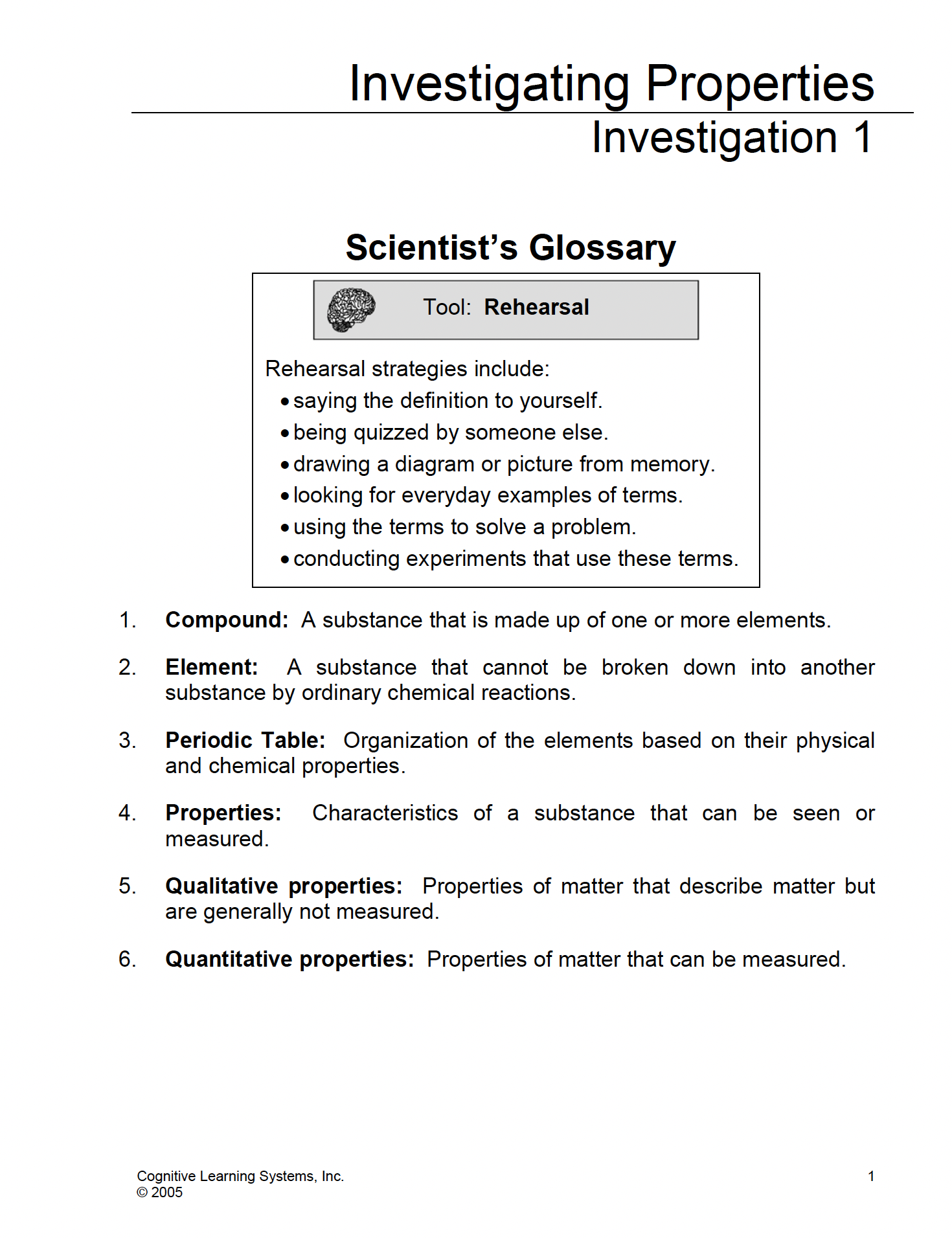
SCIENTIST’S GLOSSARY
- Compound: A substance that is made up of one or more elements. Each compound has a unique set of properties that define it.
- Element: A substance that cannot be broken down into another substance by ordinary chemical reactions. Every element has a unique set of properties that define it.
- Periodic Table of the Elements: Organization of elements according to their physical and chemical properties.
- Properties: Characteristics of a substance that can be seen or measured.
- Qualitative properties: Properties of matter that describe matter but are generally not measured.
- Quantitative properties: Properties of matter that can be measured.
SET FOR SUCCESS
- Tell students that they are about to begin the Properties of Compounds CELL.
- Ask students to share the kinds of things they might learn in these Investigations.
Begin the PreLab Concept Slides to start students on their learning journey.
NAVIGATE IT
Once the slide presentation is launched
- use your left and right arrows to advance or go back in the slide presentation, and
- hover your mouse over the left edge of the presentation to get a view of the thumbnails for all the slides so that you can quickly move anywhere in the presentation.
- Click HERE to launch the slide presentation for the CELL.
SHARE IT
SLIDE VCOMP1-pre-1
This is the first Investigation of the LabLearner CELL Properties of Compounds. In it, students will examine several compounds’ qualitative and quantitative properties.
______________________________________________
SLIDE VCOMP1-pre-2
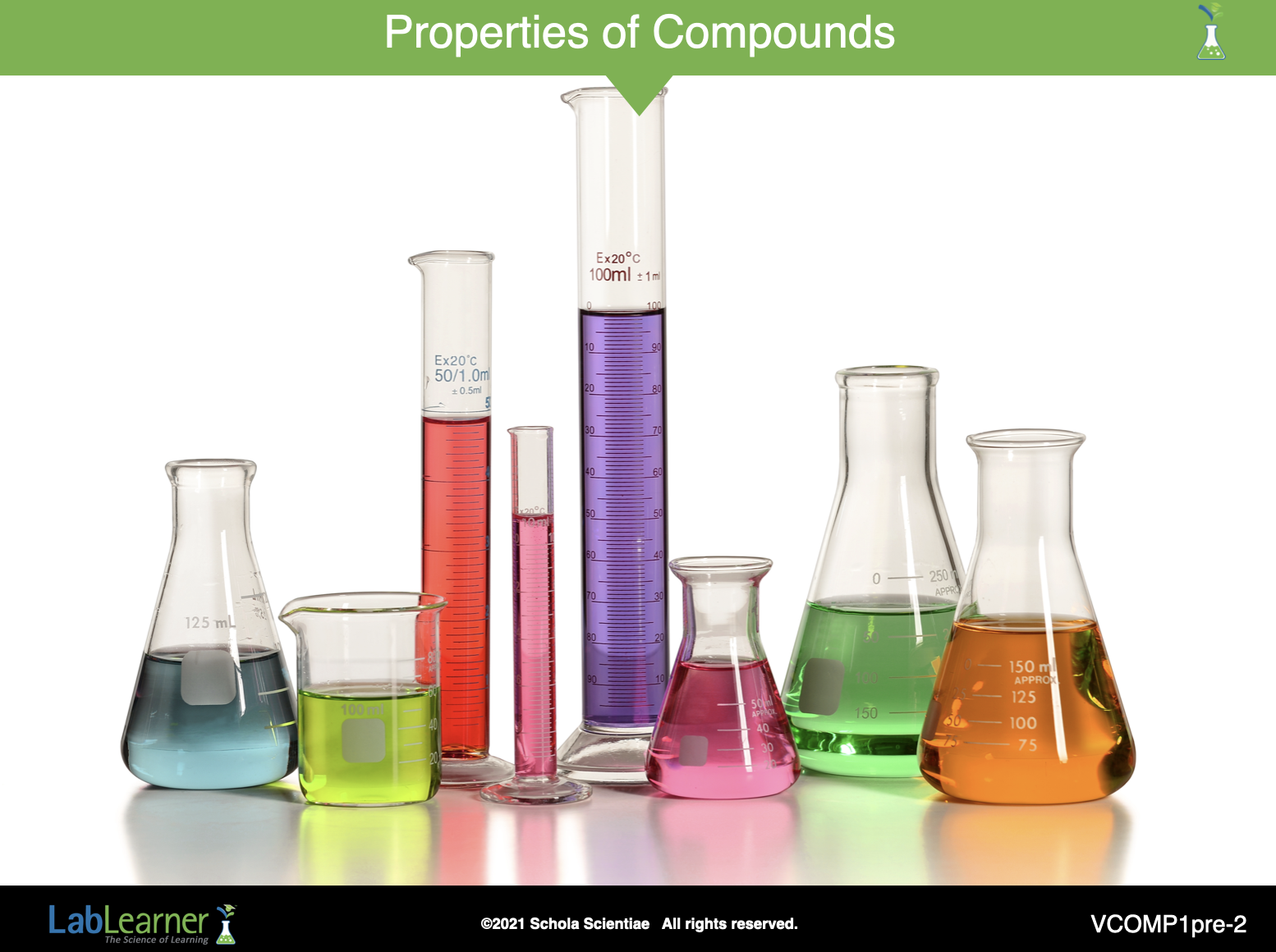
A. Begin this Investigation by explaining the focus of the CELL to students.
1. This CELL is designed to explore compounds and their physical and chemical structures. During the Investigations, students will examine several compounds’ qualitative and quantitative properties.
2. Tell students that after they conclude their Investigations, they will be asked to use the knowledge they have acquired during the CELL to determine the identity of two unknown compounds. They must understand the concepts introduced during this CELL to perform this assessment.
______________________________________________
SLIDE VCOMP1-pre-3
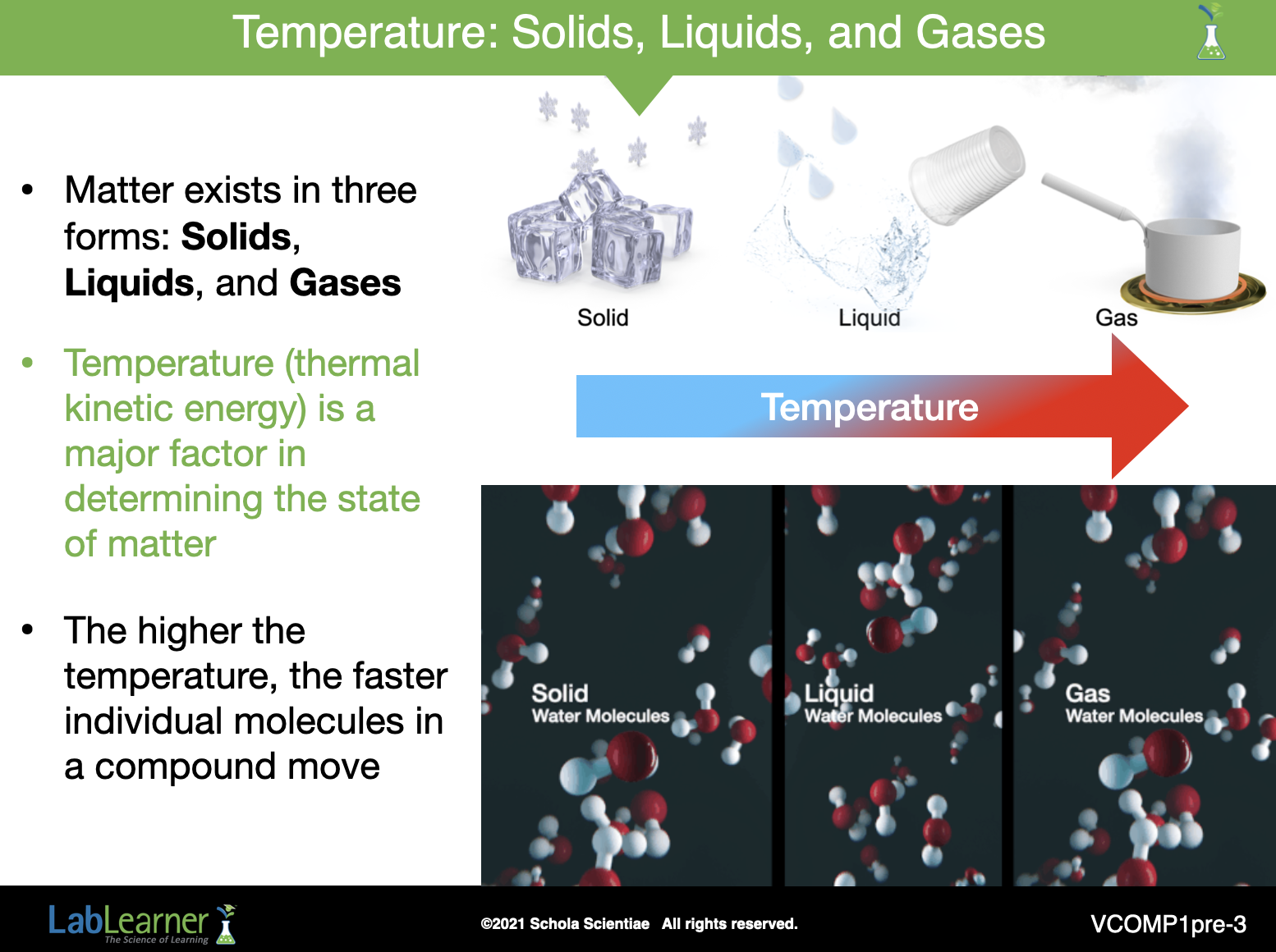
B. Review the term matter with students. Remind students that all things in the Universe are made up of matter and that all matter does not look the same.
1. Ask students: Do you know what matter is? Student answers may vary. Matter is material that has mass and takes up space.
2. Ask students: Do you know the three types of matter? Students may or may not indicate that the three types of matter are solids, liquids, and gases.
3. Ask students: Can you give an example of each of the three states of matter? Student answers may vary. Sample answers include: a book and a tree are examples of a solid, water and milk are examples of a liquid, and oxygen and helium are examples of a gas.
4. Explain to students that defining matter as solids, liquids, or gases is one way scientists classify matter. Tell students that scientists can also describe differences in matter by using terms such as compounds, elements, molecules, atoms, and ions.
Temperature’s influence on matter:
Explain that, under normal conditions, the state or phase of matter (solid, liquid, or gas) is related to temperature. In a solid, molecules do not move very fast, so the compound (water in this case) is solid ice. As the temperature increases and the water molecules move more quickly, the ice melts, and a liquid forms. Increasing temperature further causes the molecules to race so rapidly; with so much thermal energy, the energetic molecules begin to leave the liquid to form the gas phase of water – steam.
Explain that in this CELL, students will learn about the category of matter called compounds and some properties of compounds. Compounds can be solids, liquids, or gases. Examples of solid compounds are salt and sugar. An example of a liquid compound is vinegar. Carbon dioxide is an example of a gaseous compound.
______________________________________________
SLIDE VCOMP1-pre-4
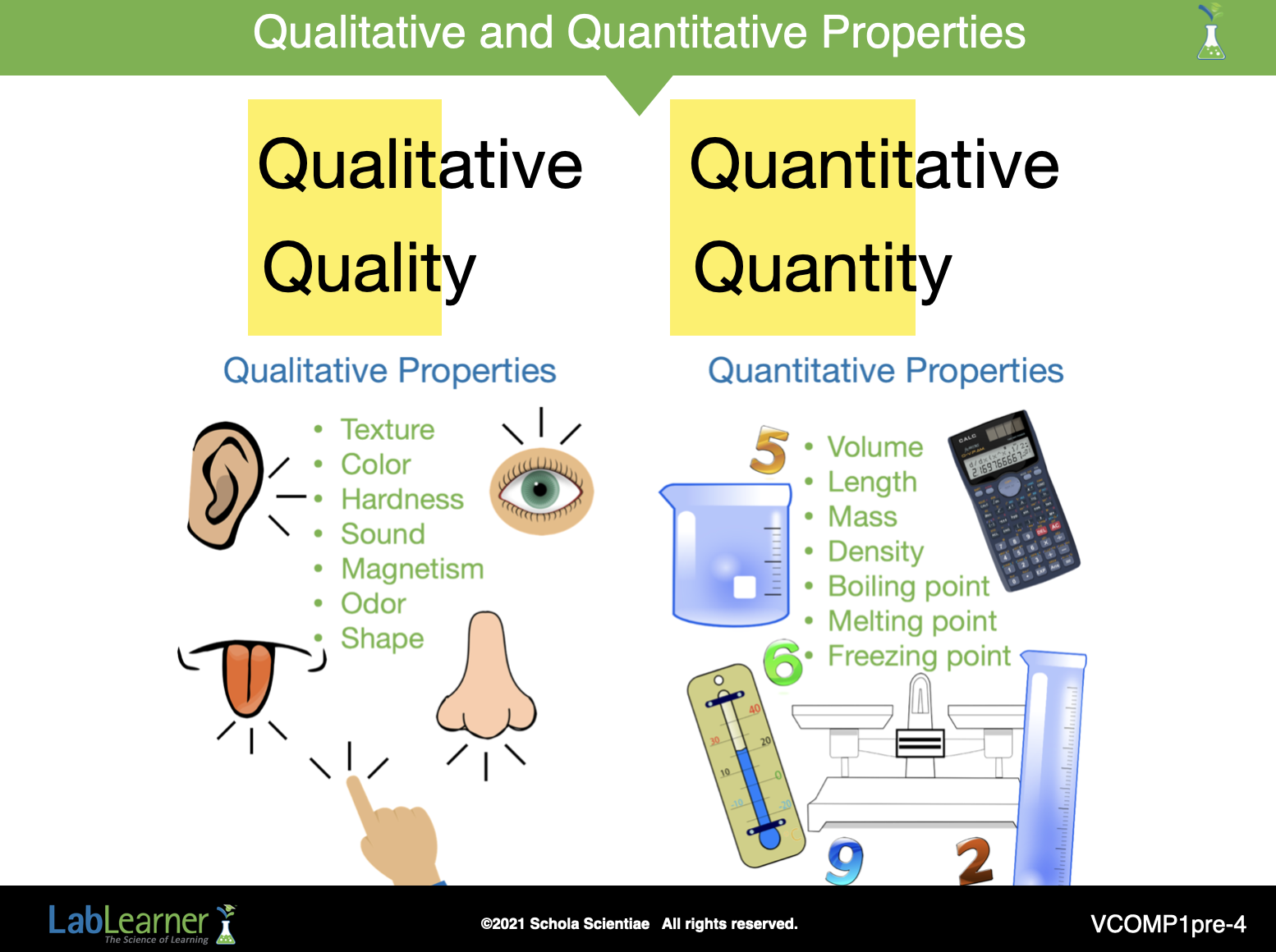
C. While performing their experiments in the lab, students will examine some of the qualitative and quantitative properties of different compounds. To help students recall what qualitative properties and quantitative properties are, engage them in the following activity:
1. Divide students into cooperative groups. Explain that they will investigate some properties of matter. Direct students to sit in a circle and to place one of their feet towards the center of the circle. Encourage students to record their answers to the following questions on paper.
2. Ask students: How many shoes are in the center of the circle? Student answers will vary based on the number of students in the group.
3. Ask students: How can you tell your shoes apart? Student answers will vary but most likely focus on color, shape, composition, length, mass, and type of shoe.
4. Direct students’ attention to the terms qualitative and quantitative properties in their Scientist’s Glossary. Students may or may not have been exposed to the words qualitative and quantitative before. Use the following activity to help students understand these terms:
a. Point out the terms qualitative and quantitative on the slide.
b. Ask students: What are the root words of qualitative and quantitative? The root word of qualitative is quality. Write the word quality under qualitative. The root word of quantitative is quantity. Write the word quantity under quantitative.
c. Cover the endings on quality and qualitative to demonstrate that the roots of the two words are the same. Repeat with the terms quantity and quantitative.
d. Ask students: What does quantity mean? Student answers may vary. Quantity is something that can be evaluated mathematically or with numbers.
e. Ask students: What does quality mean? Student answers may vary. A quality is a characteristic that can be evaluated with one of the five senses but may be difficult to measure or describe with numbers.
f. Ask students: You recorded the number of shoes at the circle’s center. Do you think the number of shoes is a qualitative or quantitative property of the shoes? Why? Students should indicate that they are describing the shoes in terms of a number or a property that can be measured. Therefore, the number of shoes is a quantitative property.
g. Ask students: What other properties do you use to describe your shoes and to tell your shoes apart? Students should indicate that they described properties such as color, shape, type of shoes, type of material, weight, and length of the shoes.
h. Ask students: Which of these would be considered qualitative properties of the shoes? Which would be considered quantitative? Why? Shoe color, shape, or type of shoe and material would be qualitative properties because they are generally described with words—and are not measured or counted. However, the lengths and weights of the shoes can be measured. Therefore length and weight are quantitative properties.
______________________________________________
SLIDE VCOMP1-pre-5
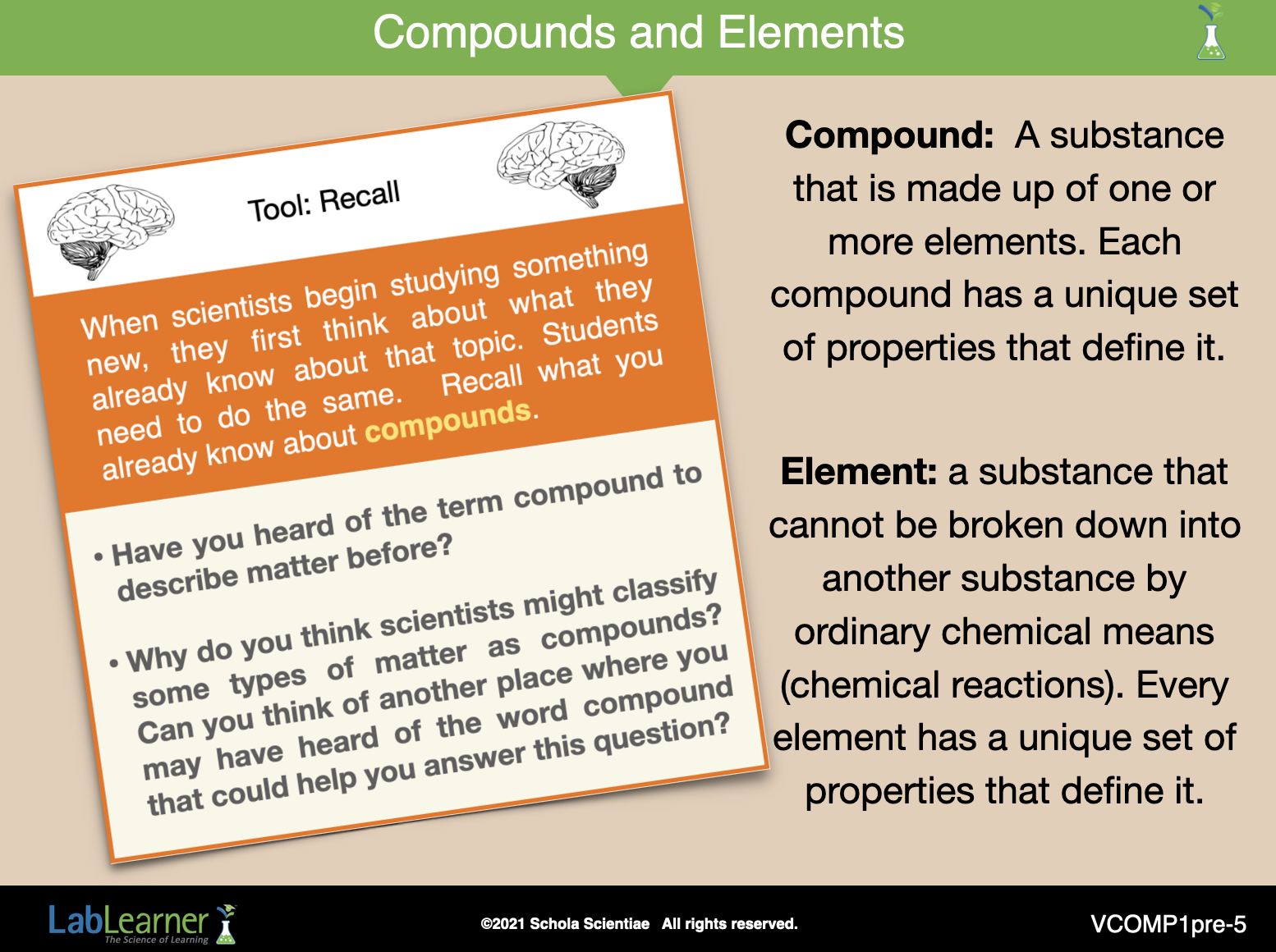
D. Students will continue their investigation of compounds by discussing the composition of compounds and by examining the Periodic Table. The following activity has been designed to help students understand the relationship between compounds and elements and how elements are organized.
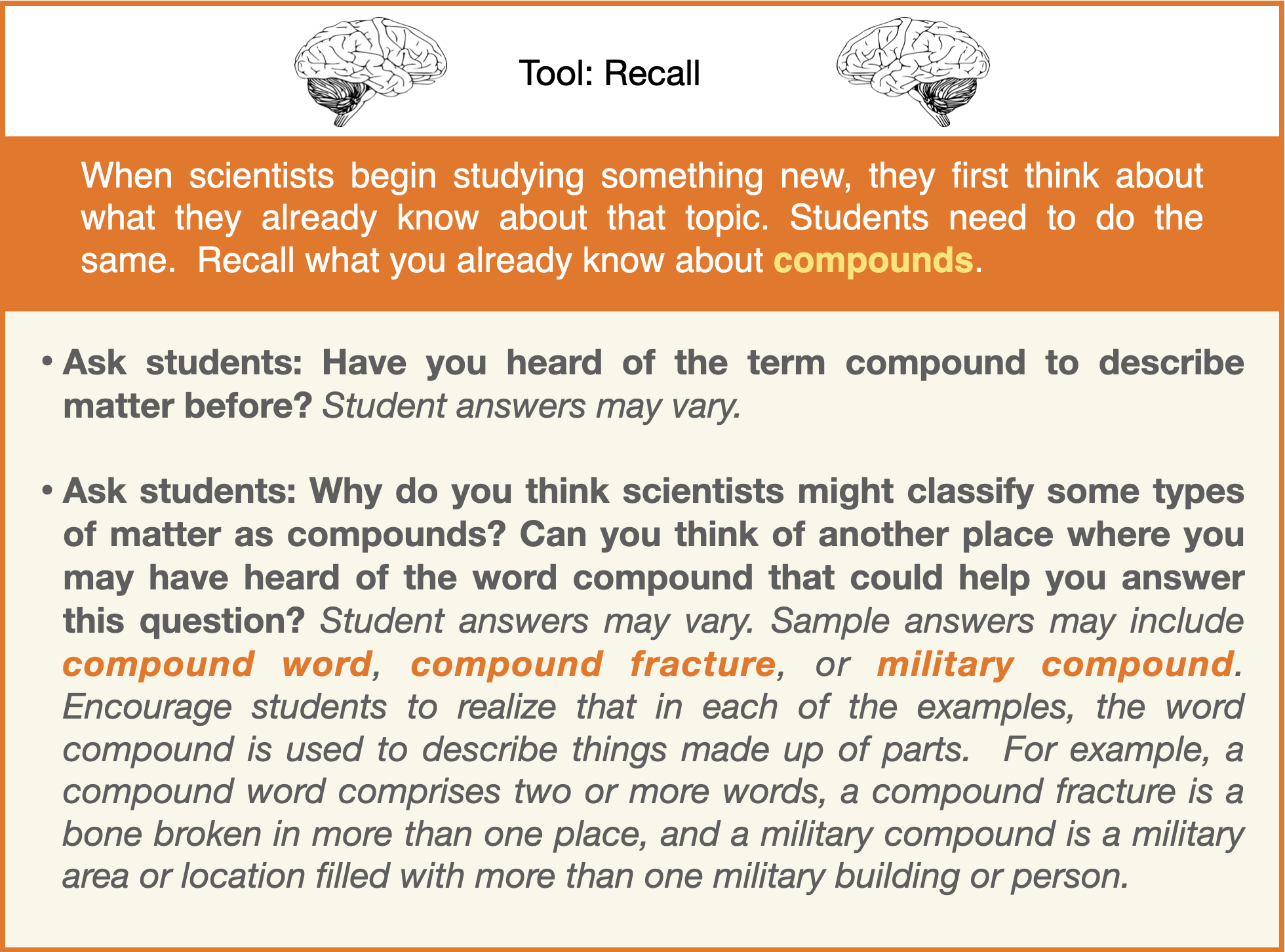
1. Ask a student volunteer to read aloud the definition of compound from the Scientist’s Glossary (also on this slide).
2. Encourage students to realize that compounds are substances made up of one or more elements. Each compound has a unique set of properties that define it.
3. Explain to students that to understand compounds better, it is important to understand some information about elements. Ask students to find the term element in their Scientist’s Glossary (also on this slide). An element is a substance that cannot be broken down into another substance by ordinary chemical means (chemical reactions). Every element has a unique set of properties that define it.
______________________________________________
SLIDE VCOMP1-pre-6
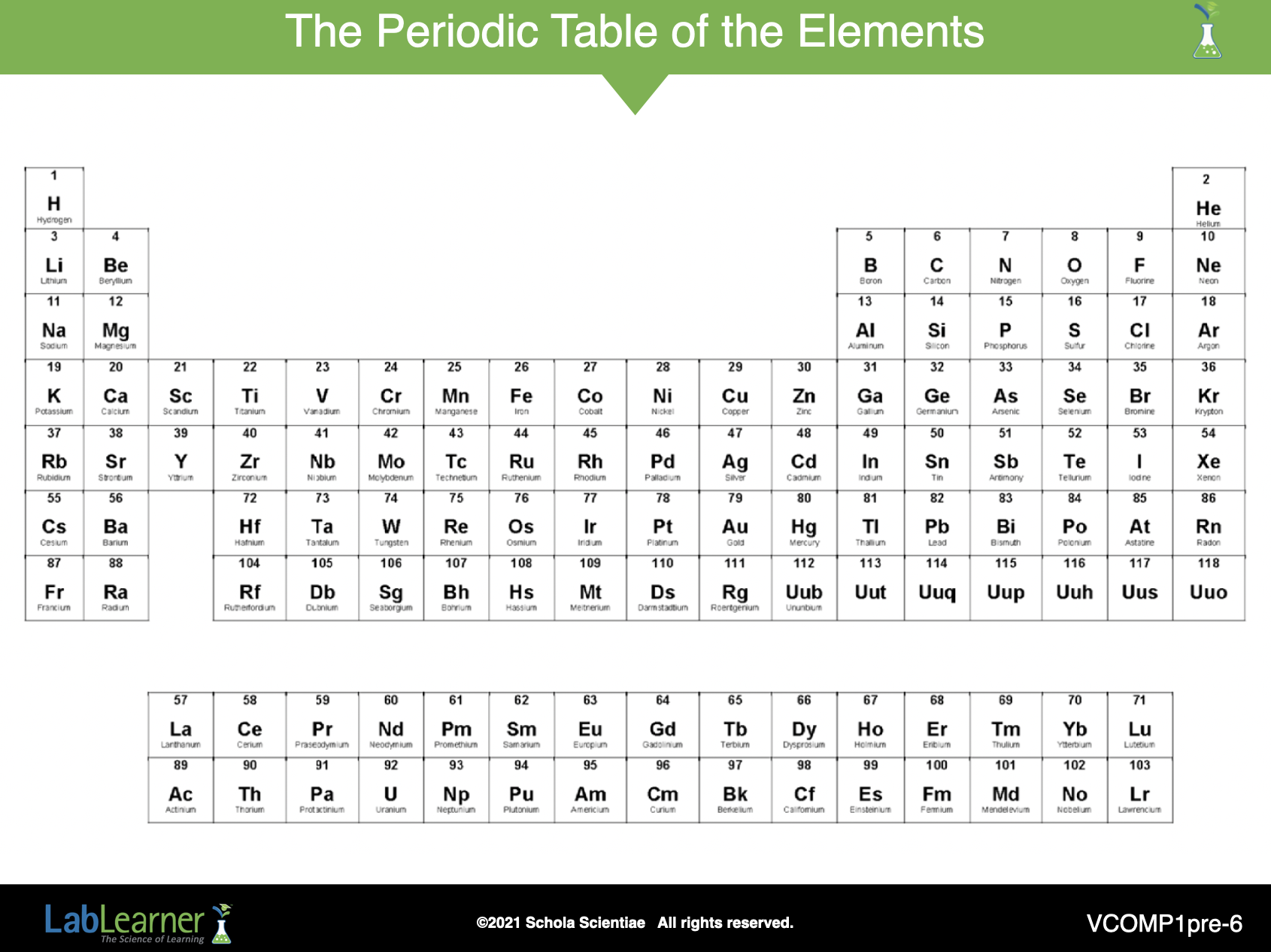
4. Tell students that there are 118 elements found on Earth.
Ask students: How do you think scientists remember all the 118 elements? Do you think that the elements are organized in a special way? Student answers may vary.
5. Engage students in the following activity. It has been designed to help students understand that The Periodic Table of the Elements is organized according to the unique properties of each of the elements. [Requires a deck of playing cards]
a. Distribute all playing cards to the students, ensuring each student has at least one card.
b. Direct students to place the cards face up on their desks.
c. Ask students: What is a property? Students should indicate that a property is a characteristic of an object or substance that can be seen or measured.
d. Ask students: Look at the cards on your desk. What are some of the characteristics or properties of your cards? Student answers may vary. Sample answers include color (red or black), suit (heart, diamond, spade, or club), face card or number card, rectangular, flat, and bendable, etc.
e. Explain to students that they will organize the cards on a table. The table will be organized based on some of the properties of the cards.
______________________________________________
SLIDE VCOMP1-pre-7
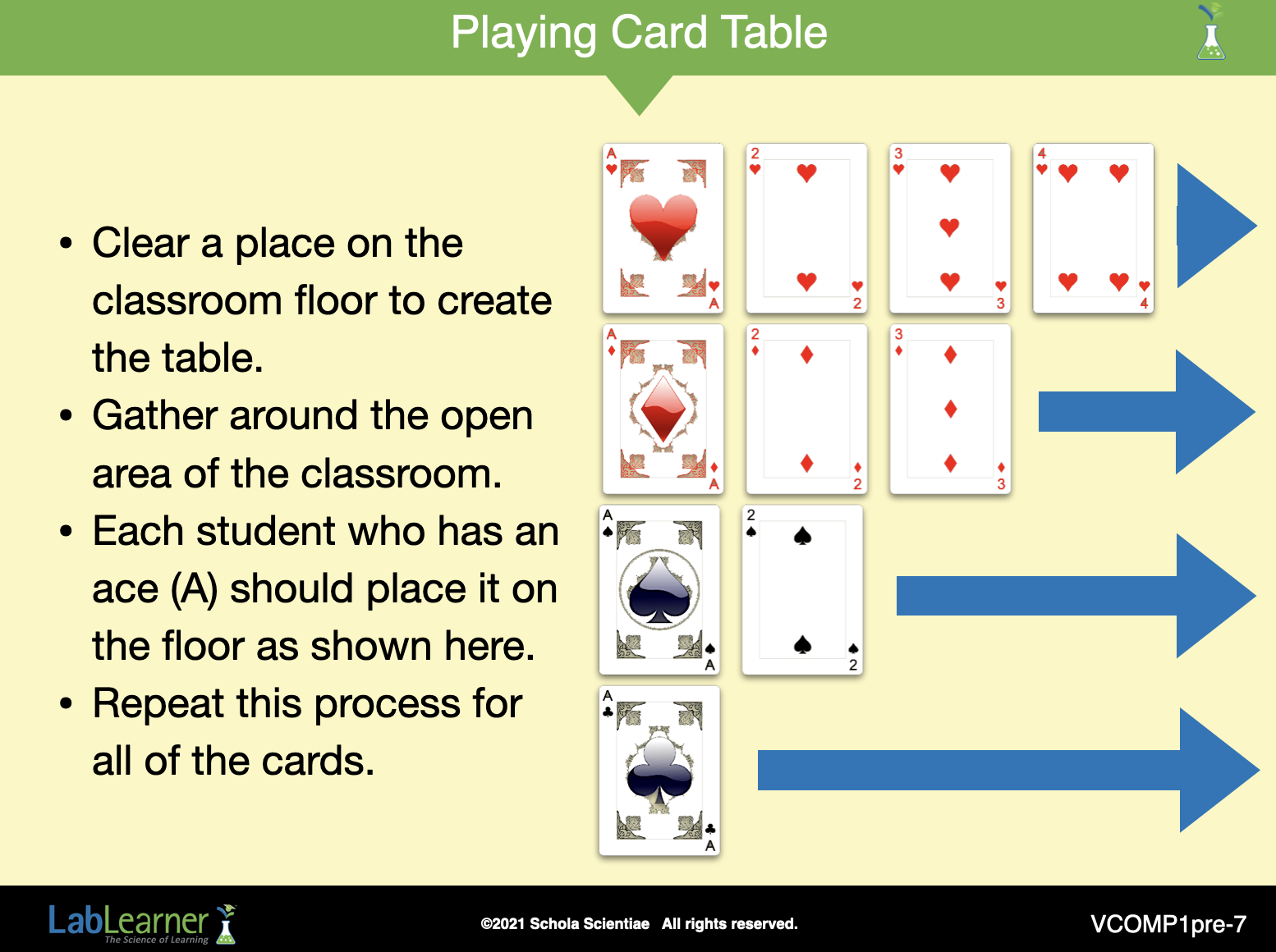
f. Ask students: Which properties should be used to organize the cards into a table? How should they be organized? Allow time for students to suggest various possibilities. Student answers may vary. Sample answers include: make four rows, each with a different suit and organize the cards from ace to king, make thirteen rows, each with a different number or face, or make two rows organized by color.
g. Using the example of four rows (suits) by 13 columns (numbers and faces), walk students through the creation of the table.
• Clear a place on the classroom floor to create the table.
• Ask the class to gather around the open area of the classroom.
• Instruct each student who has an ace (A) to come near the open space on the floor.
Once all 52 cards are placed on the floor:
• Ask students: In which column and row is the six of spades located? Students should indicate that the six of spades is located in column 6, row 3.
• Ask students: Would you have been able to find the card as quickly if the table was not organized? Students should indicate that they would not have been able to find the card as quickly.
______________________________________________
SLIDE VCOMP1-pre-8
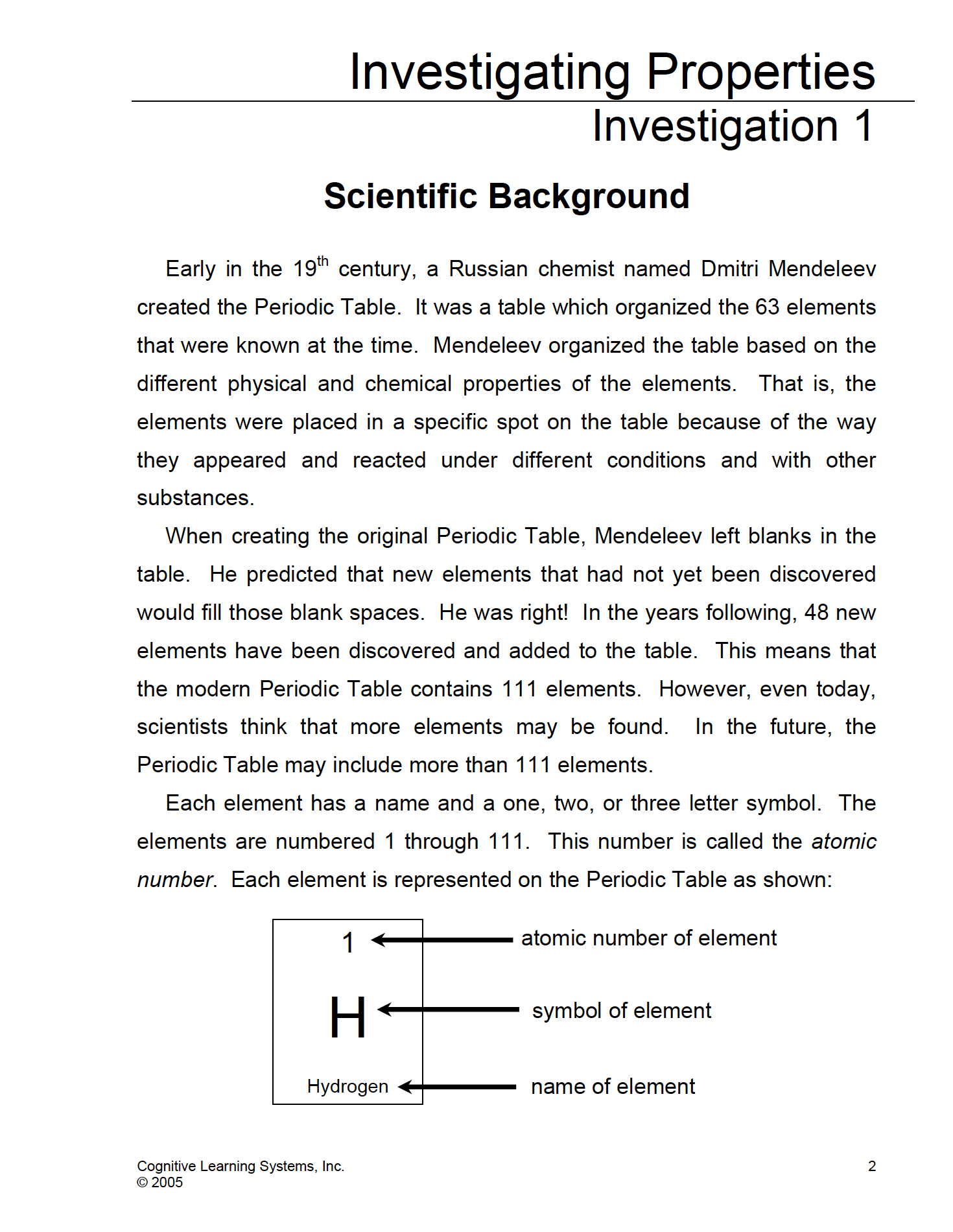
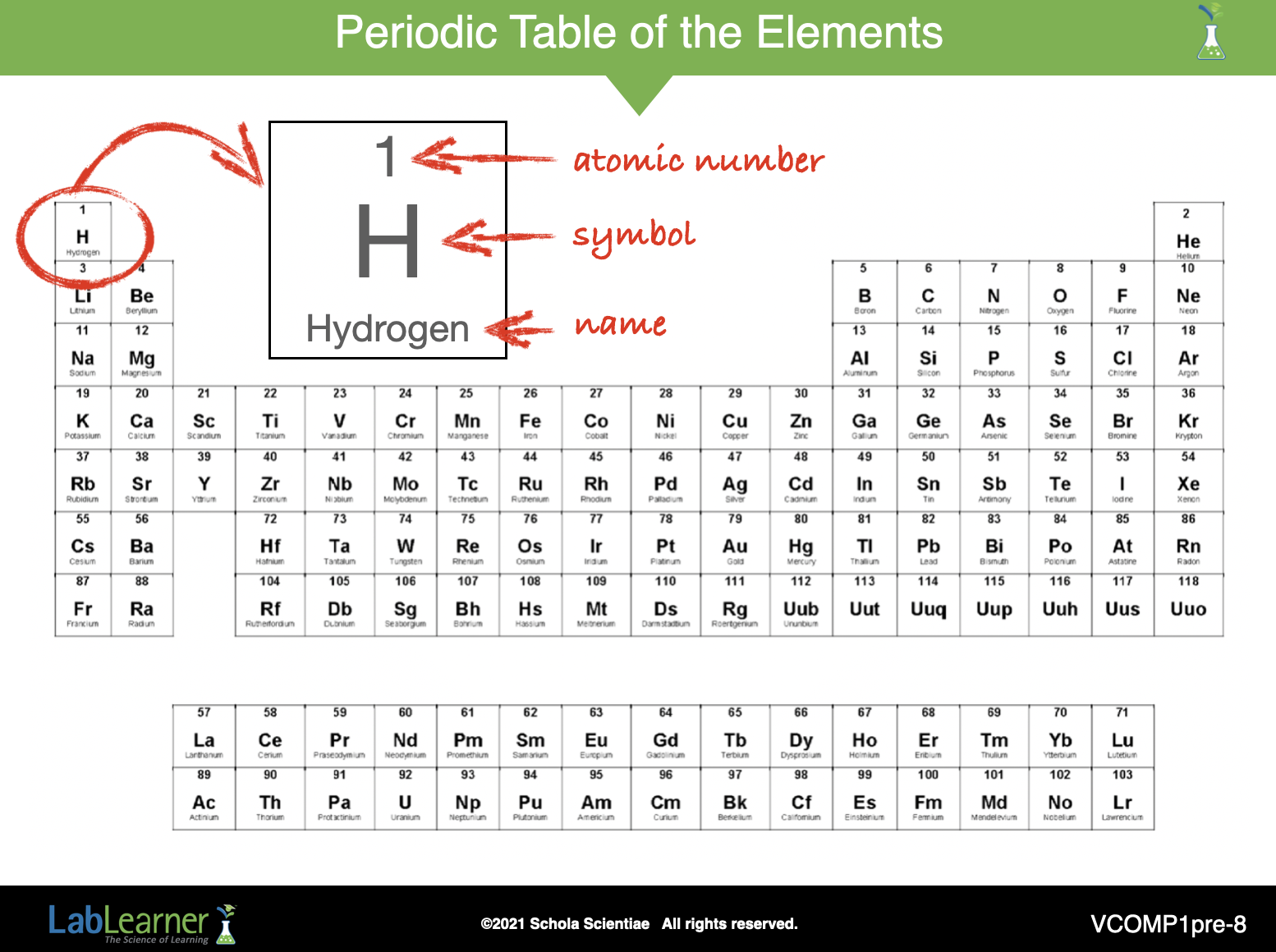
 E. Explain to students that scientists use a table to organize the elements. Elements cannot be broken down into other substances by ordinary chemical means or reactions. The table that organizes the elements is called the Periodic Table of the Elements or the Periodic Table.
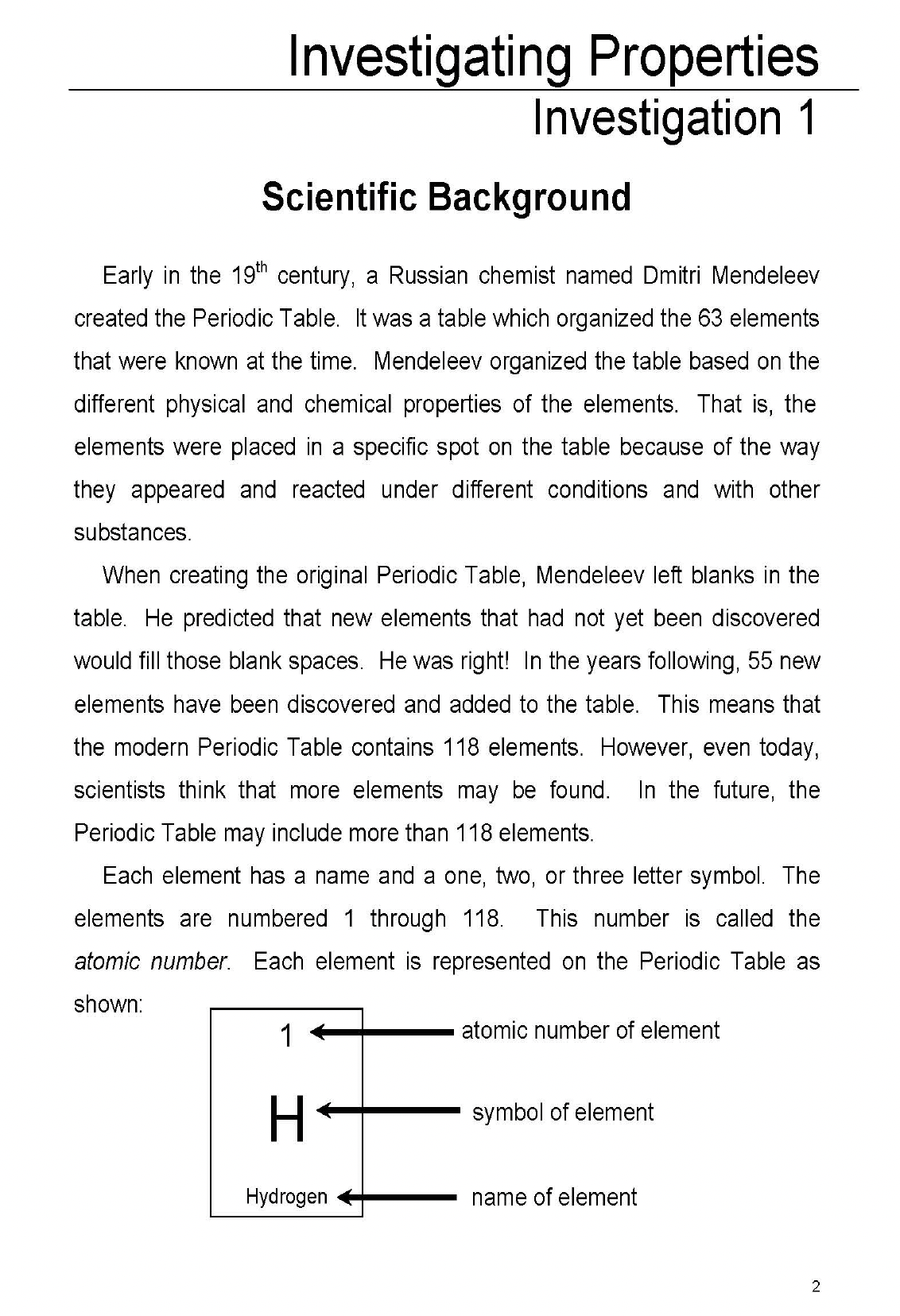
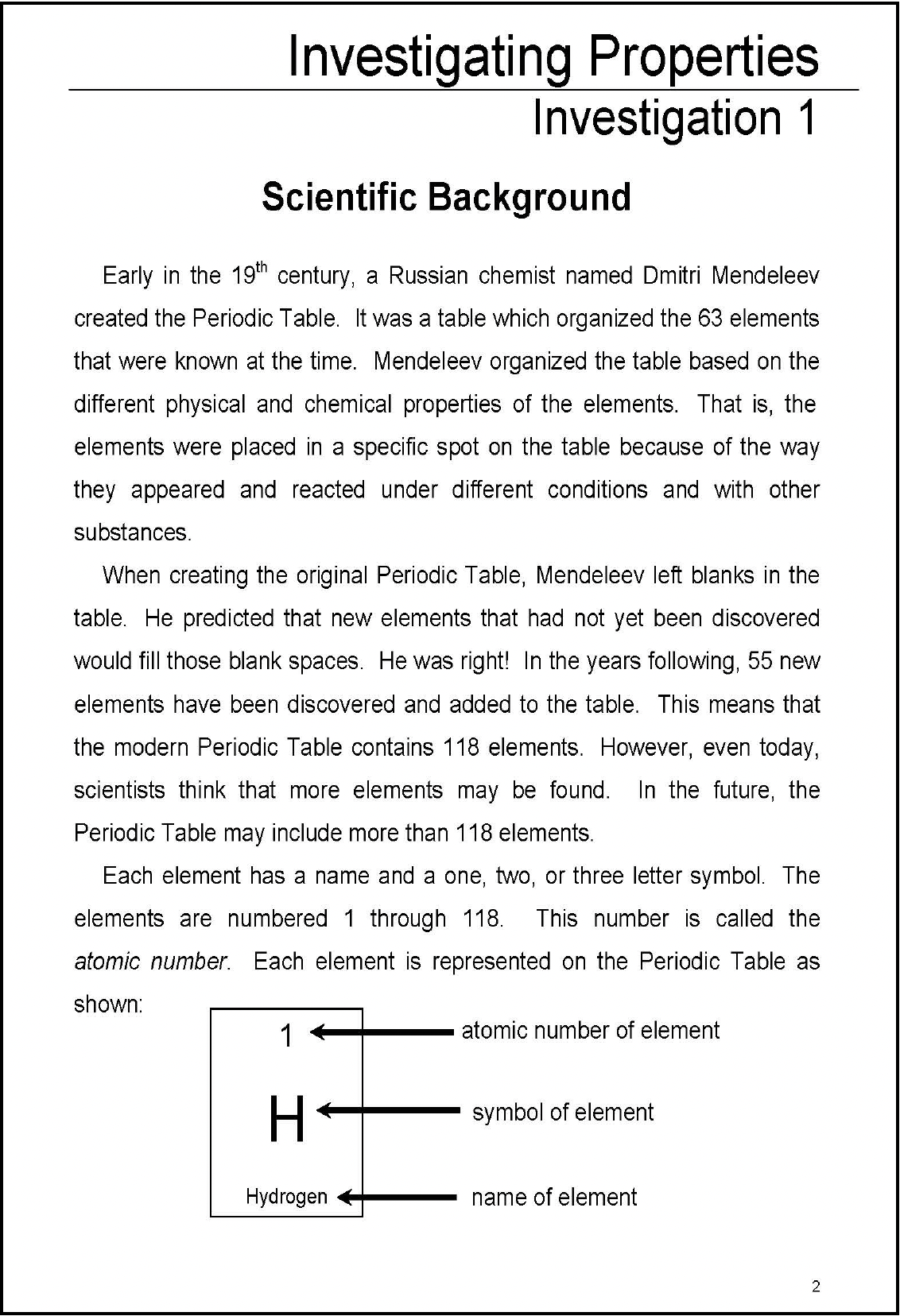
1. Encourage students to locate this information in the Scientific Background section of their Student Data Record. As a class, read the Scientific Background about the Periodic Table.
2. Ask students: How are the elements organized on the Periodic Table of the Elements? Students should indicate that the Periodic Table of the Elements is organized based on the physical and chemical properties of the elements. Elements are also assigned a number in the Periodic Table of the Elements.
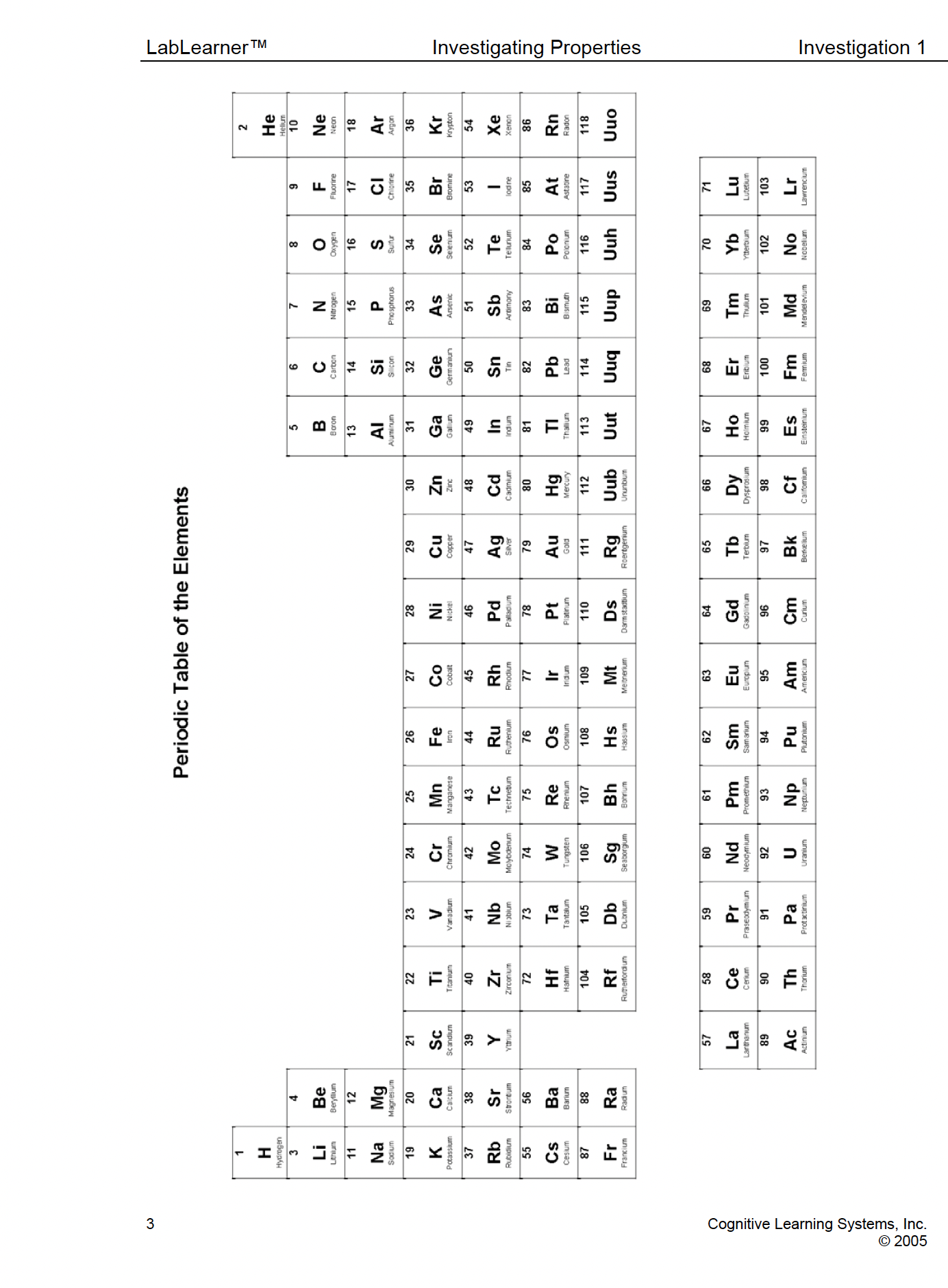
3. Refer to the Periodic Table of the Elements on this slide and direct students to locate their Periodic Table in the Scientific Background of their Student Data Record.
4. Engage students in the following question and answer session to encourage them to use their Periodic Table of the Elements. This activity should demonstrate to students that the organization and structure of the Periodic Table of the Elements allow them to quickly and efficiently locate the information that they need.
a. Ask students: What is the symbol for element 28? Students should indicate that the symbol of element 28 is Ni. This element is nickel.
b. Ask students: What is the name of the element Au (element 79)? Students should indicate that the name of the element Au is gold.
c. Ask students: How quickly were you able to find the answers to these questions? Why? Students should indicate that they were able to find the answers quickly because the table is well organized.
______________________________________________
SLIDE VCOMP1-pre-9
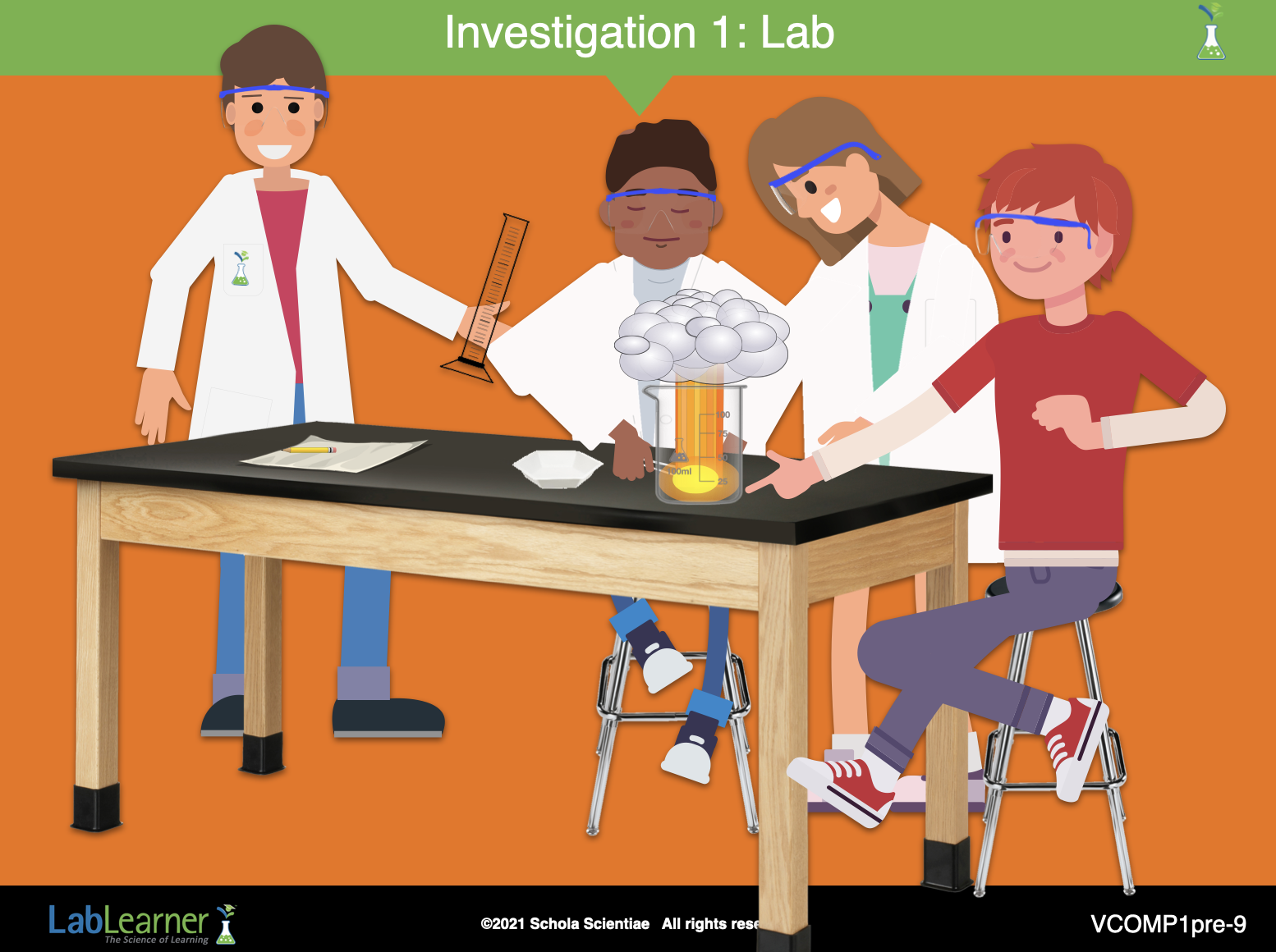
F. Explain that students may need to refer to their Periodic Table during the experiments in the lab as they will be testing the properties of different compounds. As they test each compound, it will be important for them to know the elements that are found in each compound. Tell students that by performing their lab experiments, they will begin to answer the following questions:
• How can qualitative and quantitative properties be determined?
• How many properties distinguish one compound from another?
• Do compounds that have similar elements have similar properties?
• Do compounds that have different elements have different properties?
• Can compounds that have different elements have similar properties?
KEYS