
Teacher Portal:
Science and Art
Investigation 2
Investigation Two: Perspective and Dimensions
In Investigation One, students learned how the human eye and brain perceive depth. They also explored how artists use vanishing point and manipulation of an object’s width to portray depth in a two-dimensional medium. Investigation Two continues students’ exploration into perspective by focusing on the dimension of height and its relationship to depth and vanishing point. As with width, the height of an object changes as it moves farther from the eye. The closer to the eye, the taller an object is, and the farther from the eye, the shorter. One way to think about this is to relate the object’s height to the field of view. When the object is closer to the eye, it encompasses more of the field of view. When it is farther, it encompasses less of the field of view. Another way that scientists often use to describe these differences is through something called the visual angle.
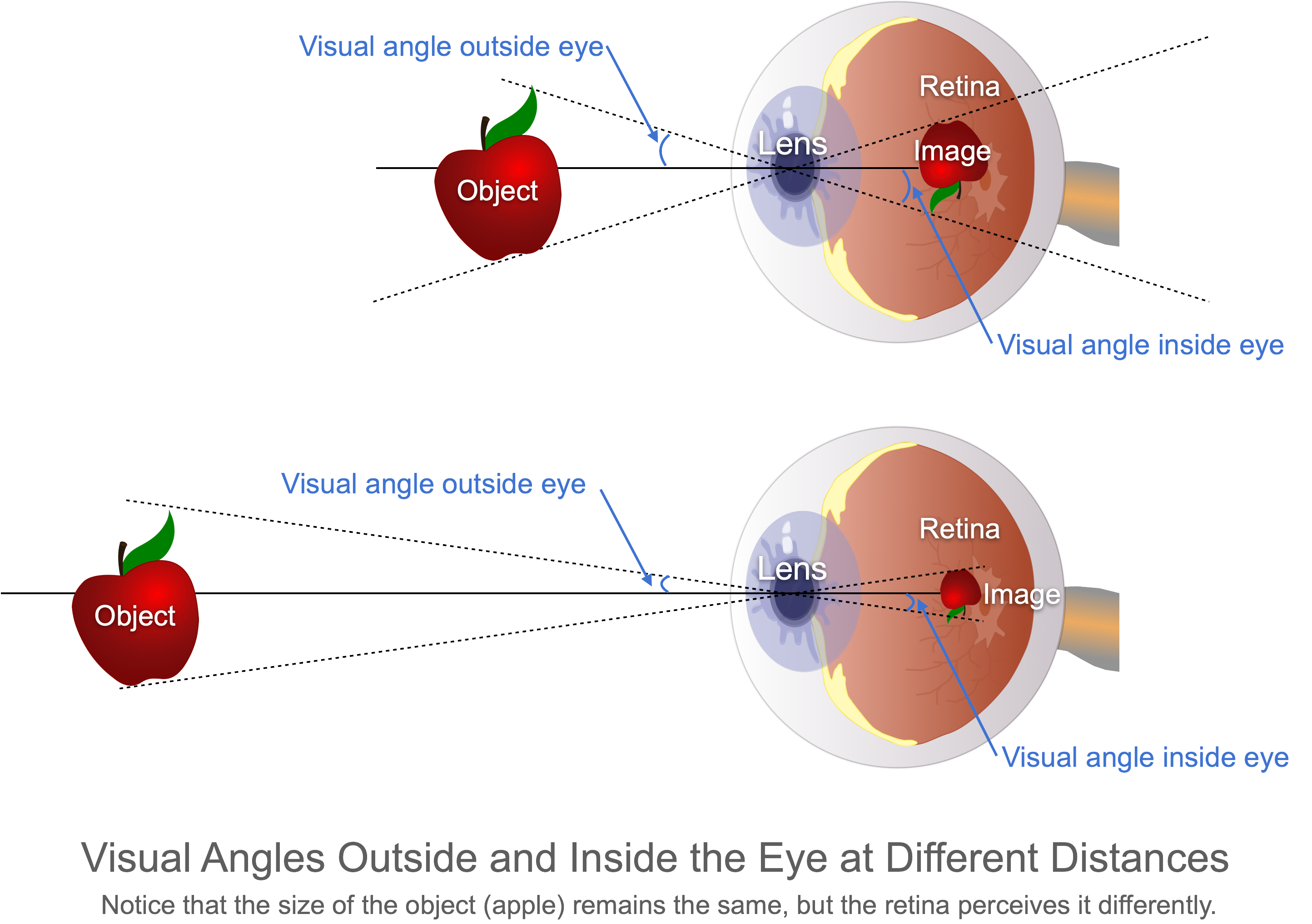
The visual angle is a term that applies to BOTH the angle at which light enters the eye and the angle at which light passing through the eye’s lens hits the retina or back of the eye. Because it is easier to measure visual angle than the field of view, differences in how objects appear on the retina are generally described in terms of visual angles. Therefore, as students continue to investigate perspective, their explorations include observing and measuring visual angles. During this Investigation, students measure the visual angles at which light enters the eye as an object moves farther from the eye. Students also measure the height and width of that object as it moves farther from the eye.
 During their analysis, students should learn that in addition to changes in the object’s width, there are changes in the height of the object as its distance from the eye increases. Moreover, the object’s height and width change are proportional. In other words, the dimensions of the object change together. As a result, the overall proportions of the object remain similar as the object moves farther from the eye. This phenomenon allows us still to identify the object at different distances from the eye. Thus, we see a car as a car rather than another shaped object, whether close to us or twenty meters down the road. Imagine what life would be like if this were NOT true: a square-shaped object may look like a square up close but like a rectangle farther away! Identification of objects would be difficult.
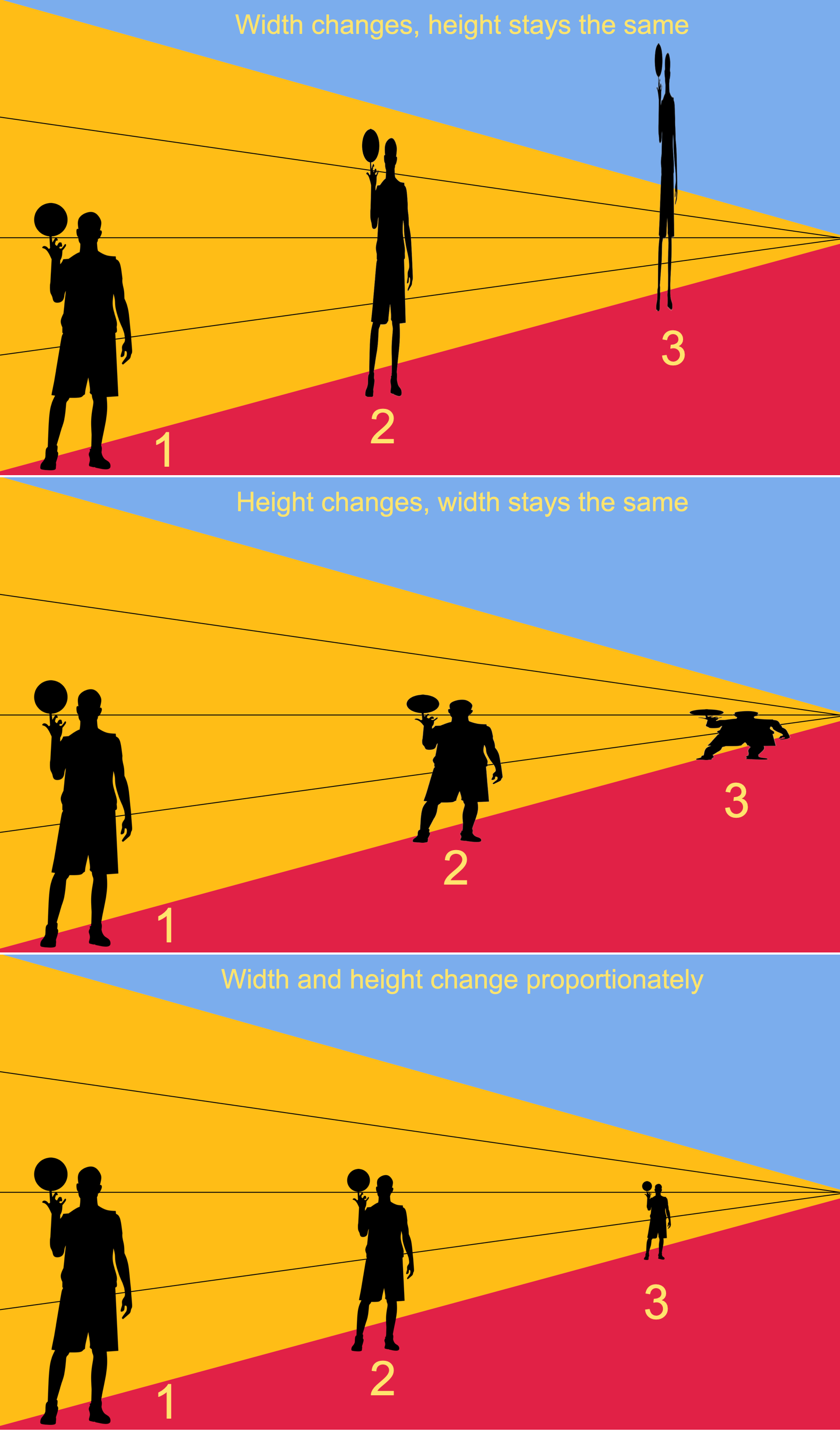
Look at the perspective drawings below. The top illustration shows the result of the width changing with distance while the player’s height stays the same. Simply reducing the width with distance to create an illusion of distance distorts the player, making him ridiculously thin and tall. The middle illustration shows the result of reducing the height with distance but keeping the width the same. This causes the player to appear artificially short and stubby. Finally, in the bottom illustration, the height and width are decreased proportionately with distance. In this case, the illusion of depth and distance is established while maintaining the natural proportions of the subject. This skill became fully developed during the renaissance.
In addition to their discoveries about objects’ dimensions, students will learn that as an object’s distance from the eye increases, its visual angle decreases. As a result, its image on the retina also decreases in size. Understanding this concept is important to understanding perspective and depth perception and how and why tools such as microscopes and telescopes are used. Both of these scientific tools work by increasing the visual angle that is presented to the eye. As a result, objects that are too small to see with the unassisted eye can be viewed because a larger image is presented to the eye. The larger image makes a larger visual angle on the eye and the retina, allowing the object to be seen.
As in Investigation One, students will relate what they have learned about the mechanics of depth perception to how artists use the same principles to create the appearance of three dimensions on a flat, two-dimensional surface.
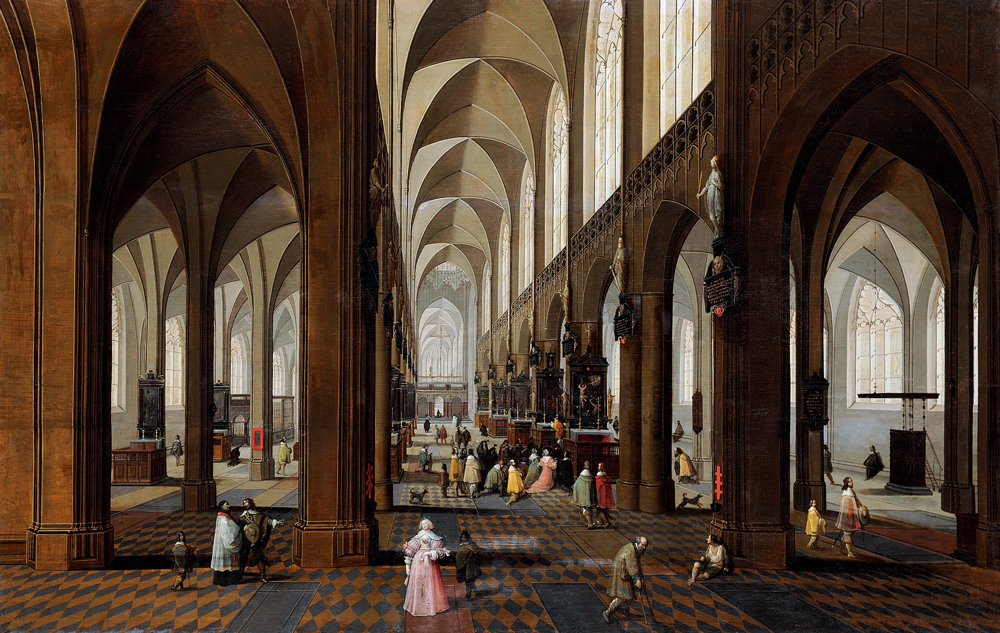
The painting above was made in 1620 by the Flemish painter Pieter Neefs the Younger. Notice how the people, columns, arches, and even the pattern on the floor get shorter and narrower as they fade into the distance. By maintaining correct proportions, a very realistic image is formed.
Science and Art: Investigation 2-Mathematics Concepts
Prelab
- distance
- comparison
- greater than, less than, equal to
- length in cm
- width
- measurement
- angles
- ratio
- expressions/equations
- subtraction
- multiplication
Lab
- geometry
- height
- width
- distance
- measurement
- length in cm
- greater than, less than, equal to
- data table
- comparison
- angles
- (in)direct relationships
- estimation
- line graph
Postlab
- geometry
- width
- height
- measurement
- distance
- length in cm
- (in)direct relationships
- angles
- line graph
- greater than, less than, equal to
- comparison
- parallel lines
- ratio
- data table
- multiplication
Science and Art: Investigation 2 - Procedural Tools

Science and Art: Investigation 2 - Cognitive Tools

Science and Art:
Investigation 2 Quiz

