Teacher Portal:
Exploring Density
Investigation 5 – PostLab
 PRINT IT
Use your browser to download a printable PDF as help during the slide presentation and to make additional notes. In your browser, go to File > Print and then choose to save as PDF.
NAVIGATE IT
Once the slide presentation is launched
- use your left and right arrows to advance or go back in the slide presentation, and
- hover your mouse over the left edge of the presentation to get a view of the thumbnails for all the slides so that you can quickly move anywhere in the presentation.
- Click HERE to launch the slide presentation for the CELL.
SHARE IT

SLIDE VDEN5-post-1
This is the fifth and final regular Investigation of the LabLearner CELL Density. In this Investigation, students explored the density changes of solutions of different salt concentrations.
______________________________________________
SLIDE VDEN5-post-2
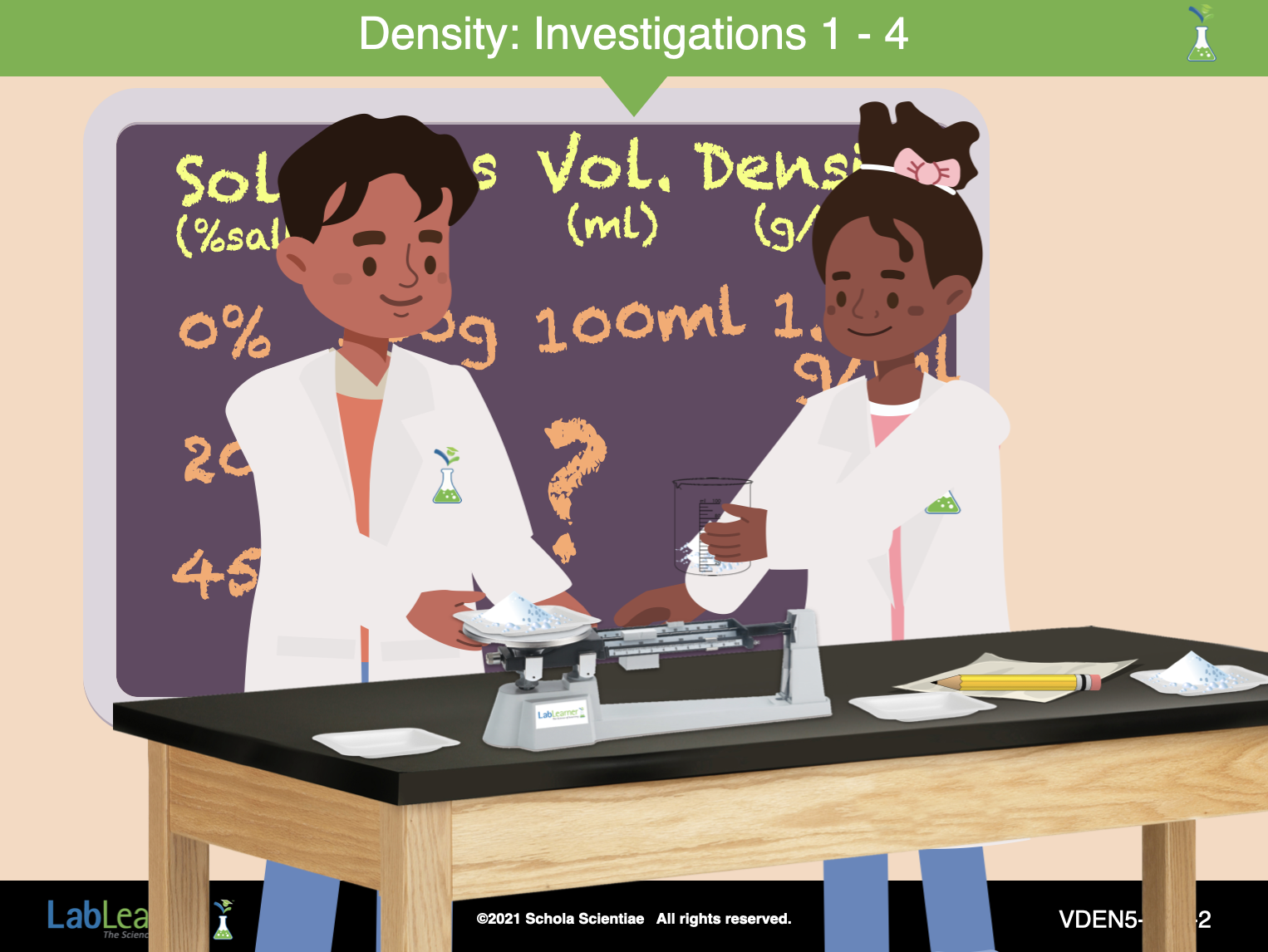
A. Begin this part of the Investigation by reviewing the experiments performed in the lab. Ask the following questions to promote discussion of the experiments:
1. Ask students: What were the main questions that were answered in this lab? The following questions were answered: What happens to the density of water when a solute is added? How can you determine the density of a solution? How does the density of a solution compare with the density of a solid?
2. This experiment was designed to compare the densities of different solutions.
Ask students: How did you do this? Students should indicate that they measured the mass and volume of each of the three solutions (0% salt solution, 20% salt solution, and 45% salt solution). They then used these values to calculate the density of each solution using the formula, density = mass ÷ volume. Students also tested whether an acrylic cylinder would float or sink in each solution.
3. Ask students: What was the difference between the solutions used in Trial 2 (20% salt solution) and Trial 3 (45% salt solution)? Students should indicate that the solution used in Trial 2 was made by dissolving 20 g of salt into 100 ml of water. The solution used in Trial 3 was made by dissolving 45 g of salt into 100 ml of water.
4. Ask students: Think about the solutions in Trials 2 and 3. What was the solute in these solutions? What was the solvent? Students should indicate that the solute was salt and the solvent was water in both Trials.
______________________________________________
SLIDE VDEN5-post-3
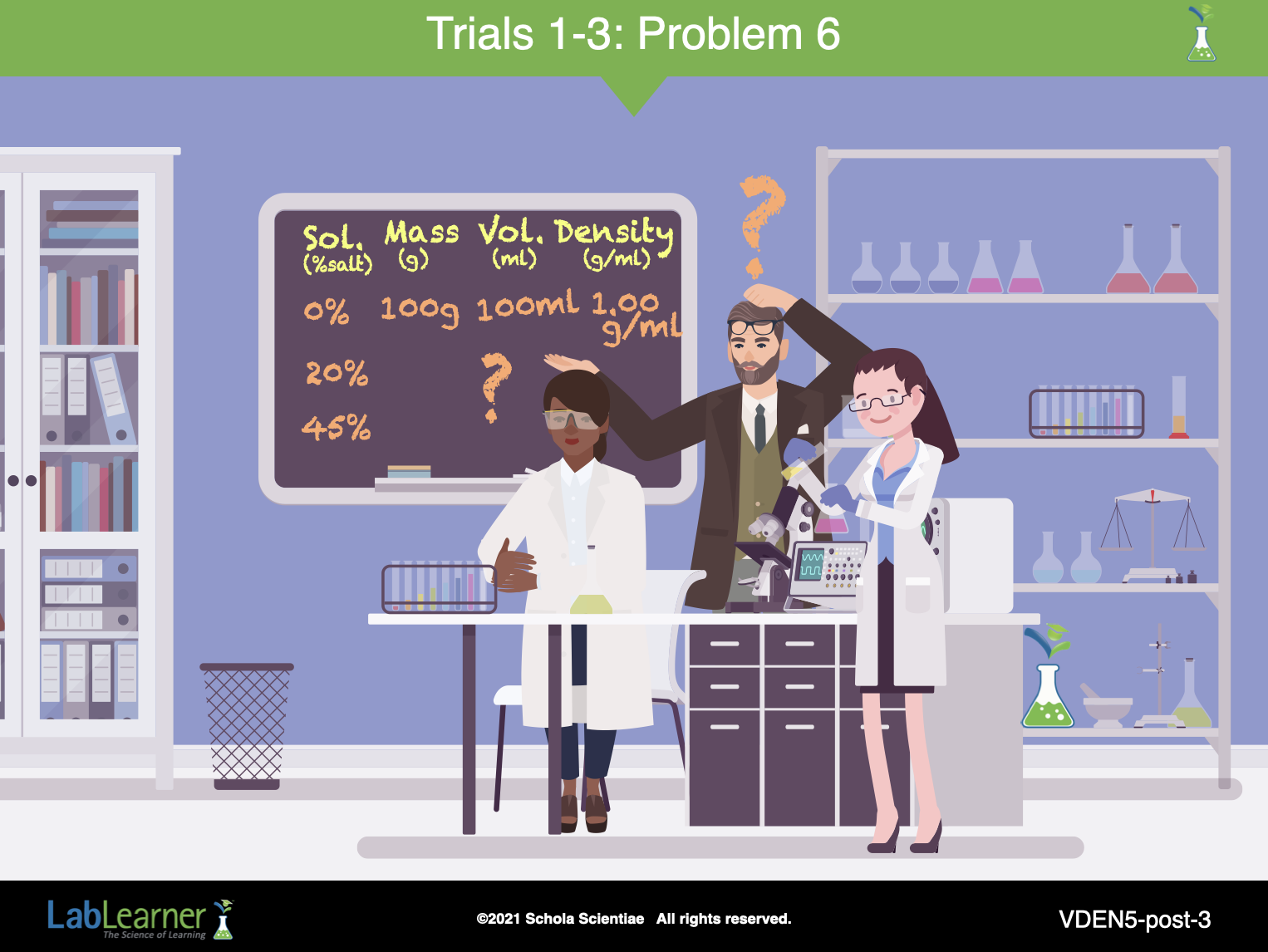
B. Tell students that in order to analyze the data they collected in Trials 1 – 3, they must first compile the collected data.
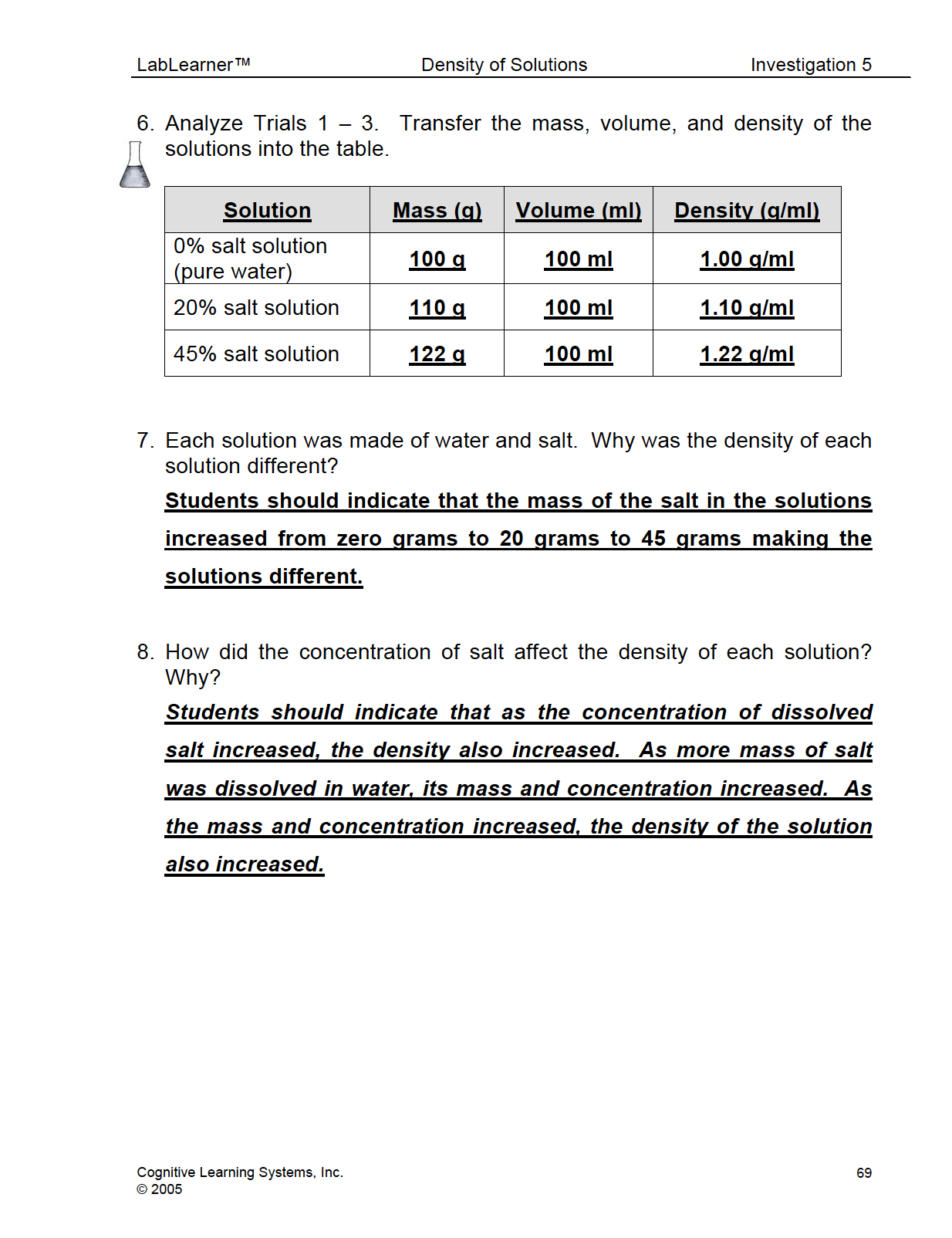
1. Direct students to locate the Table in Problem 6 of their Student Data Record. Students will transfer the mass, volume, and density of each solution onto this Table. Allow students sufficient time to transfer the data.
a. Ask students: What was the calculated density of the 0% salt solution (water)? Students should indicate that the density of the water was approximately 1.0 g/ml.
b. Ask students: What was the calculated density of the 20% salt solution? Student answers may vary. Students should indicate that the density of the 20% salt solution was approximately 1.10 g/ml.
c. Ask students: Why do you think the density of the 20% salt solution increased compared to water? Student answers may vary. Students should indicate that the density of the solution increased due to the addition of the solute.
d. Ask students: What was the calculated density of the 45% salt solution? Student answers may vary. Students should indicate that the density of the 45% salt solution was approximately 1.22 g/ml.
e. Ask students: Why do you think the density of the 45% salt solution increased compared to 20% salt solution and the water? Student answers may vary. Students should indicate that the density of the solution increased due to the addition of additional solute.
f. Ask students: Look at your data. Why do you think the densities of each solution changed since each solution was made of salt and water? Students should indicate that the mass of the salt in the solutions increased from zero grams to 20 grams to 45 grams making the solutions different.
Encourage students to realize that another way to describe the difference between the solutions is that the concentration of the salt increased. Encourage students to record their answers in Problem 7 of their Student Data Record.
______________________________________________
SLIDE VDEN5-post-4
2. Ask a student volunteer to read the definition of concentration in their Scientist’s Glossary.
Concentration: The amount of one substance in a specific volume of another substance; it is usually described as grams per milliliters.
a. Present students with the following scenario: In order to make a powdered juice drink, you must dissolve 1 packet (20 g) of mix into 3 liters of water.
b. Ask students: How could you increase the concentration of the juice? Student answers may vary. Students should indicate that the concentration of the juice could be increased by adding 2 packets of mix into 3 liters of water. The juice would then have 40 g of mix in 3 liters of water.
c. Ask students: How could you decrease the concentration of the juice? Student answers may vary. Students should indicate that the concentration of the juice could be decreased by adding ½ of a packet of mix into 3 liters of water. The juice would then have 10 g of mix in 3 liters of water.
d. Ask students: Think about your trials. Which solution had the highest concentration of salt? Why? Students should indicate that the solution with the highest concentration of salt was the 45% salt solution. It had the highest concentration because it contained 45 g of dissolved salt in 100 ml, whereas the other solutions contained less salt per 100 ml.
e. Ask students: How would you describe the concentration of salt in pure water? Why? Students should indicate that the concentration of salt in the water was zero. This was because no salt was dissolved in the water.
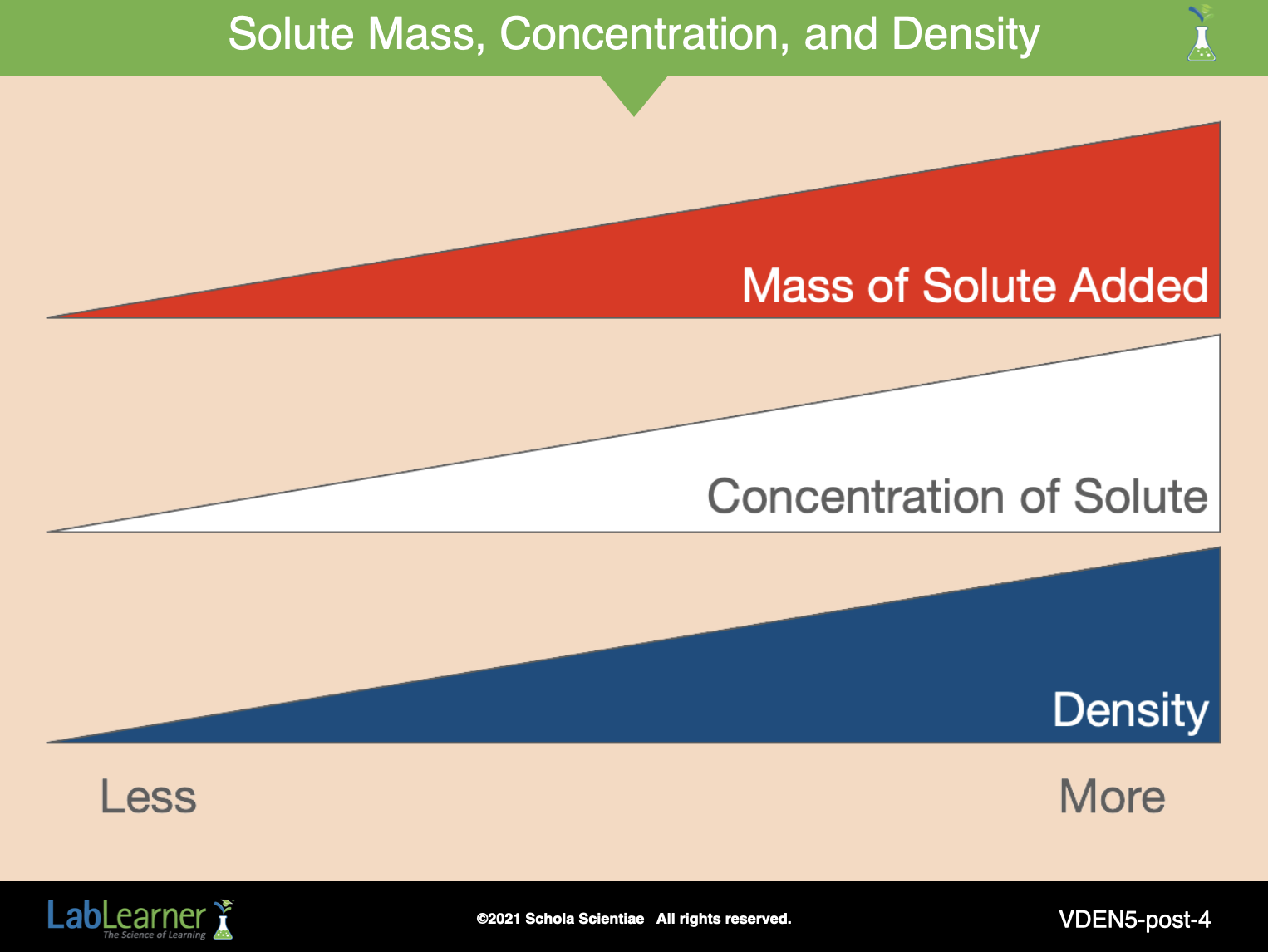
f. Ask students: How did the concentration of salt affect the density of each liquid? Why?
Encourage students to record their answers in Problem 8 of their Student Data Record.
Students should indicate that as the concentration of dissolved salt increased, the density also increased. As more salt was dissolved in the water, its mass and concentration increased.As the mass and concentration increased, the density of the solution also increased.
______________________________________________
SLIDE VDEN5-post-5
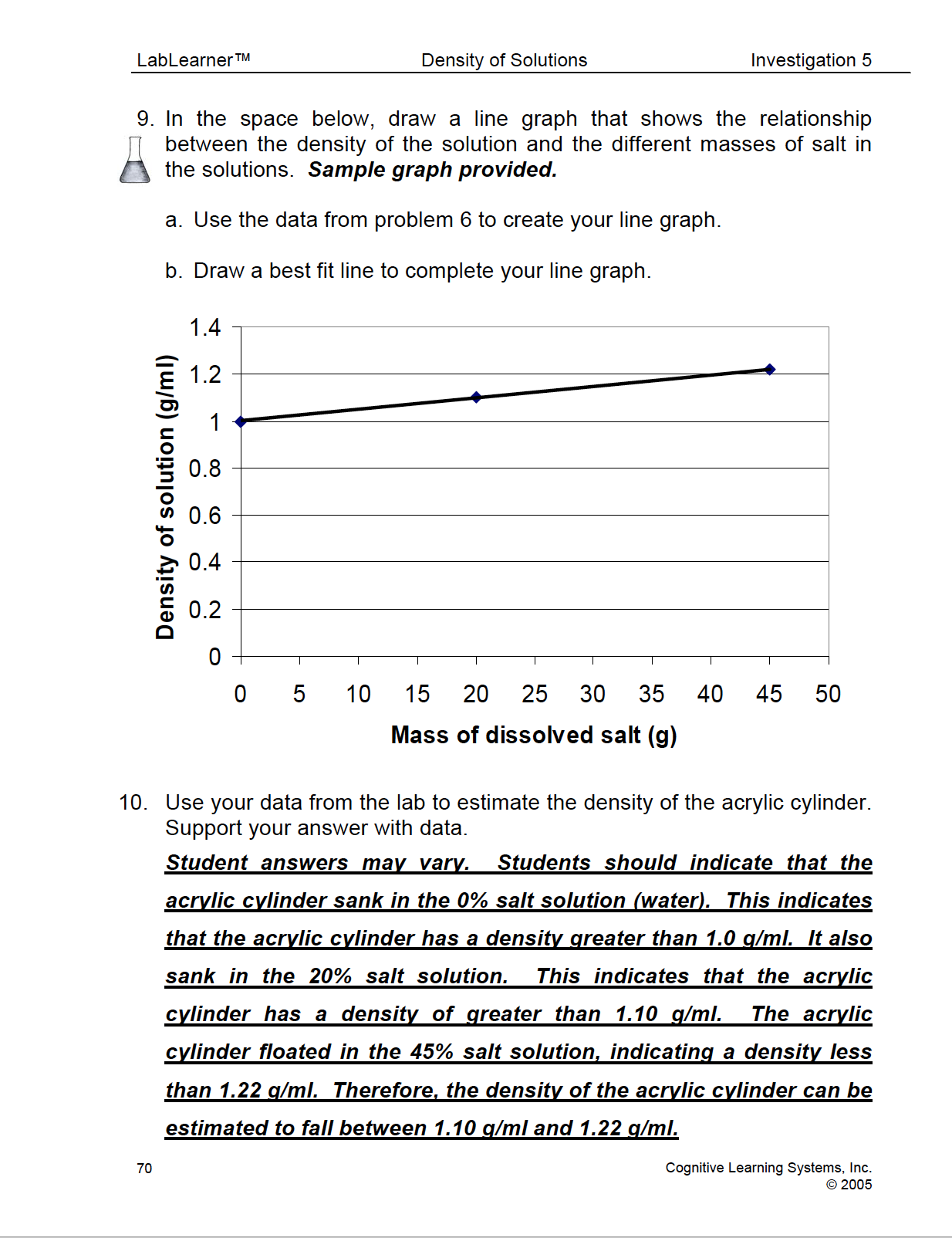
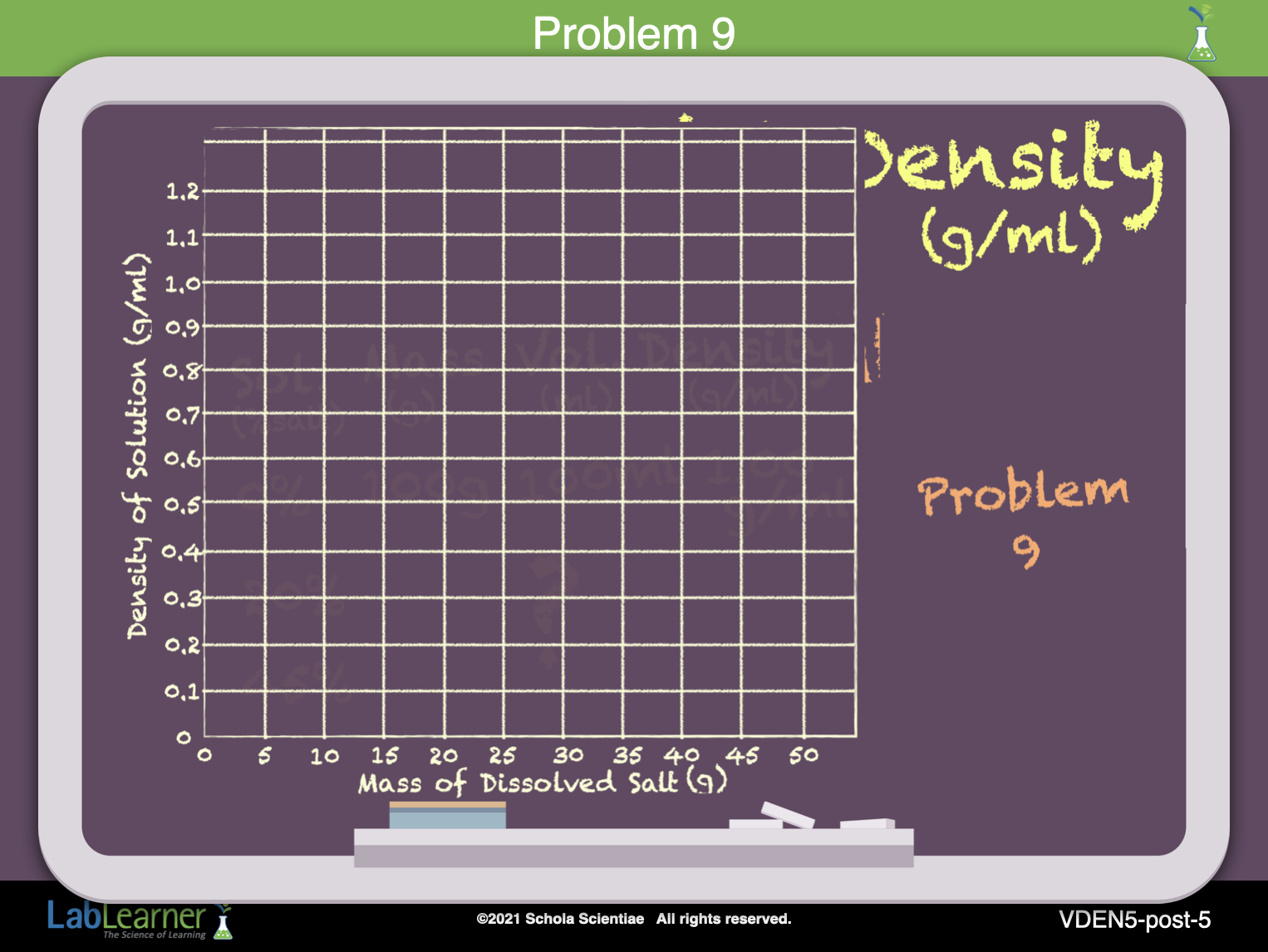
C. Tell students that will create a line graph to represent the relationship between the densities of the three liquids and the mass of dissolved salt.
Note to Teacher: The following completed line graph and Best Fit Line is not included in the Student Portal.
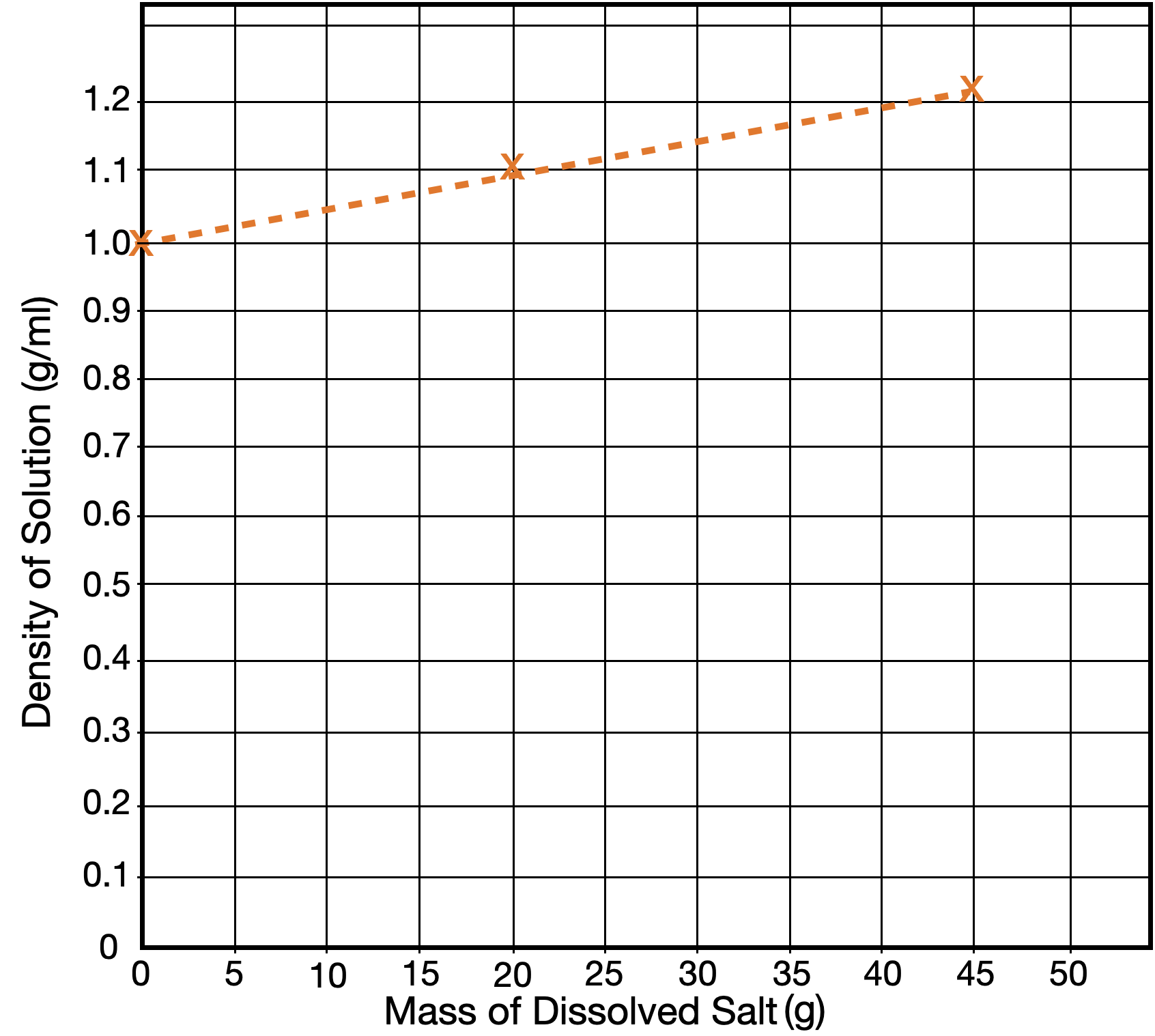
1. Direct students to create and complete a line graph that illustrates the relationship between density and the different masses of slat in the liquids. Refer students to their Procedural Toolbox if they need assistance in constructing their graphs. Provide sufficient time for students to compete their graphs. Students should use the space in Problem 9 of their Student Data Record to create the line graph. If necessary, remind students of some of the items they may want to consider when constructing their line graphs:
a. Remember to use an x- and y-axis.
b. Think about which variable you will plot along the x-axis and which variable you will plot along the y-axis.
c. Think about the scale you will use on each axis.
d. Encourage students to realize that the mass of salt in the water is zero.
2. Tell students to complete the line graph by drawing a Best Fit Line. The best fit line should be drawn as close to the three data points as possible. Refer students to their Procedural Toolbox if they need assistance in drawing a Best Fit Line.
3. Direct students to study their line graph in Problem 9 of their Student Data Record. Use the following questions to engage students in a discussion of the graph:
a. Ask students: What does your line graph look like? Student answers may vary. Students should indicate that the line is straight and inclining upward to the right.
b. Ask students: As you trace the line from a low mass of salt to a high mass of salt, what happens to the density of the solutions? Student answers may vary. The density of a solution increases as more salt is added.
______________________________________________
SLIDE VDEN5-post-6
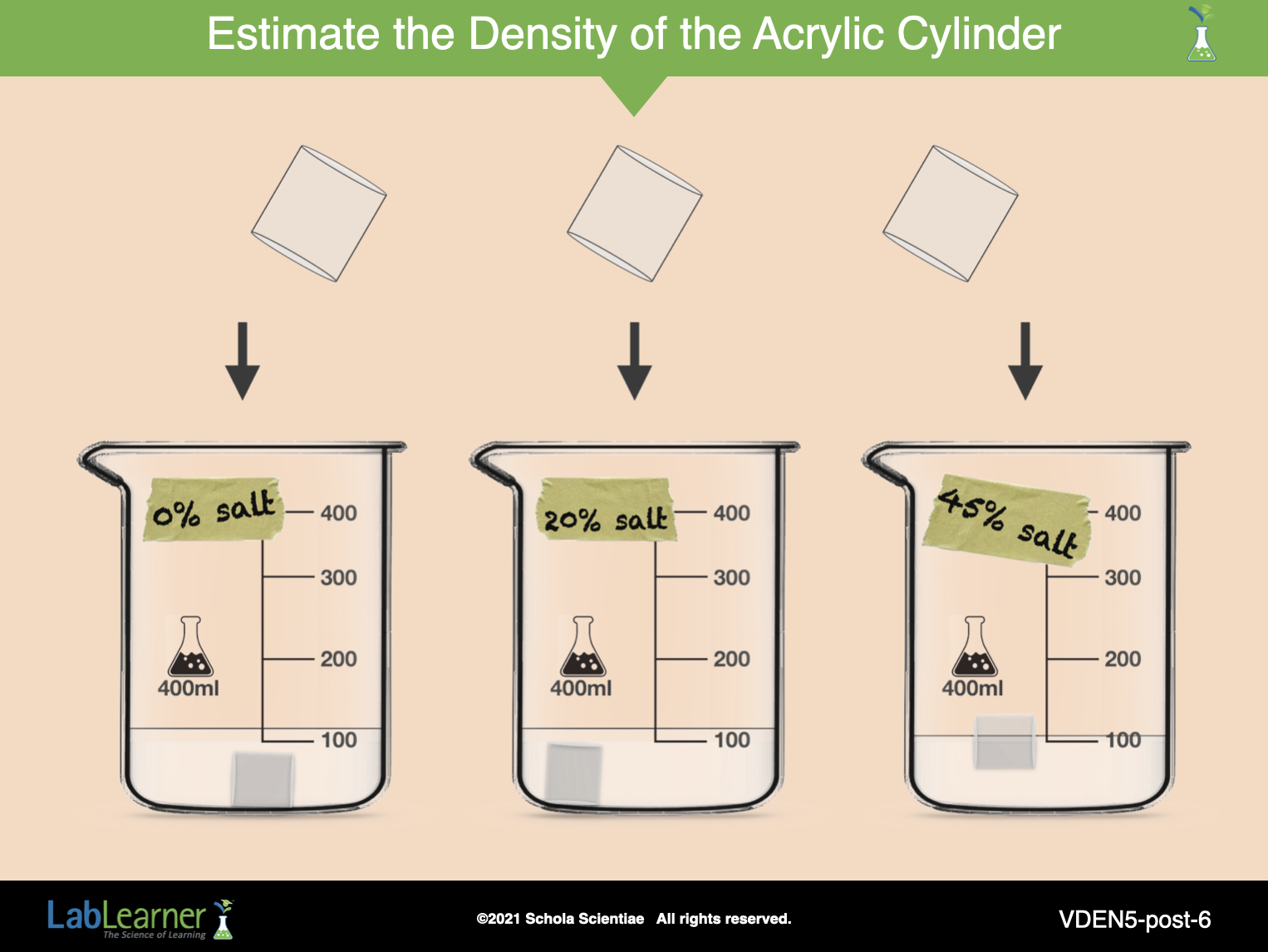
D. Explain to students that they will analyze the behavior of the acrylic cylinder when placed in the three liquids.
1. Divide students into groups of three.
2. Explain that student groups will be comparing the acrylic cylinder with the densities of water and the two solutions.
3. Tell student groups to use the data that they collected in the lab to estimate the density of the acrylic cylinder.
4. Encourage students to record their answers in Problem 10 of their Student Data Record.
5. Allow sufficient time for students to complete this activity.
6. If students are having difficulty completing this activity, use the following questions to help them estimate the density of the acrylic cylinder:
a. Ask students: Did the acrylic cylinder sink or did it float in the beaker of water? Students should indicate that the acrylic cylinder sank in the water.
b. Ask students: Considering that the acrylic cylinder sank, do you think it has a density that is less than or greater than water? Students should indicate that the acrylic cylinder has a density that is greater than water.
c. Ask students: What was the density of water? Students should indicate that the density of water was approximately 1.00 g/ml.
d. Ask students: What do you estimate is the density of the acrylic cylinder? Student answers may vary. The exact density of the cylinder cannot be determined from this Investigation however, based on their observations the density of the cylinder must be greater than 1.00 g/ml.
e. Ask students: Did the acrylic cylinder sink or did it float in the 20% salt solution? Students should indicate that the acrylic cylinder sank in the solution.
f. Ask students: Considering that the acrylic cylinder sank, do you think it has a density that is less than or greater than solution? Students should indicate that the acrylic cylinder has a density that is greater than the solution.
g. Ask students: What was the density of the 20% salt solution? Students should indicate that the density of the solution was approximately 1.10 g/ml.
h. Ask students: What do you estimate is the density of the acrylic cylinder? Student answers may vary. The exact density of the cylinder cannot be determined from this Investigation however, based on their observations the density of the cylinder must be greater than 1.10 g/ml.
i. Ask students: Did the acrylic cylinder sink or did it float in the 45% salt solution? Students should indicate that the acrylic cylinder floated in the solution.
j. Ask students: Considering that the acrylic cylinder floated, do you think it has a density that is less than or greater than solution? Students should indicate that the acrylic cylinder has a density that is less than the solution.
k. Ask students: What was the density of the 45% salt solution? Students should indicate that the density of the solution was approximately 1.22 g/ml.
l. Ask students: What do you estimate is the density of the acrylic cylinder? Student answers may vary. The exact density of the cylinder cannot be determined from this Investigation however, based on their observations the density of the cylinder must be less than 1.22 g/ml.
m. Ask students: From your observations of the behavior of the acrylic cylinder, and knowing the densities of the three liquids, can you estimate the density of the acrylic cylinder? Student answers may vary. The density of the acrylic cylinder is greater than 1.10 and less than 1.22 g/ml.
7. Encourage students to realize that solids are not often less dense than liquids. Usually, solids have greater densities than liquids and liquids are usually denser than gases. Explain to students that the acrylic cylinder is a type of plastic and that many plastics are less dense than water.
______________________________________________
SLIDE VDEN5-post-7
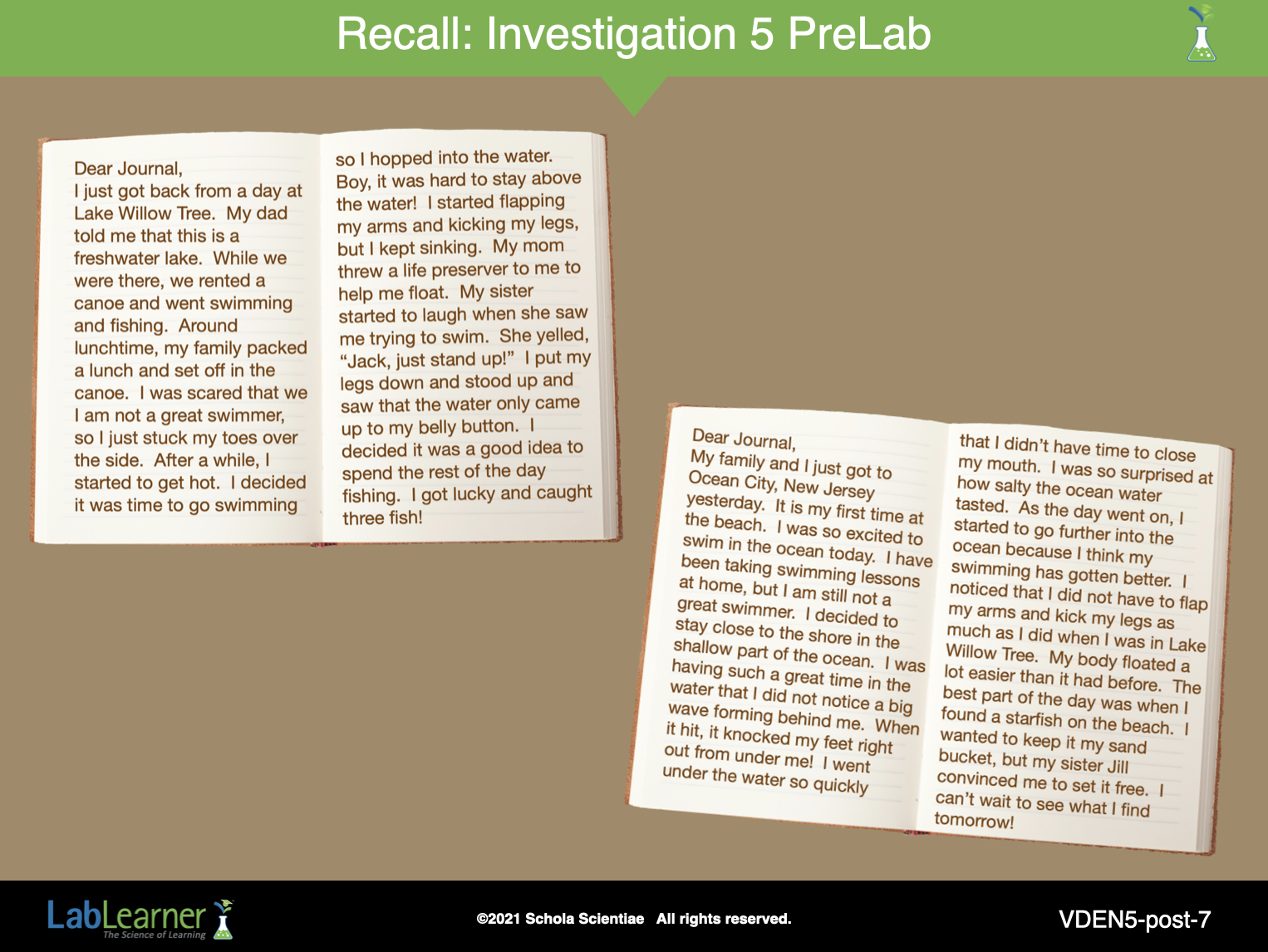
E. As students to recall the journal entries that they read in the PreLab. If students have difficulty recalling the journal entry, you may have to refer students to Problems 1 and 2 and have them reread all or a portion of the journal entries.
1. Refer to the journal entries above to jog students’ memories.
2. After students have recalled the stories, ask them the following questions:
a. Ask students: Why do you think Jack found it easier to float in the ocean than in the fresh water of Lake Willow Tree? Student answers may vary. Students should indicate that the density of the ocean water was greater than the freshwater. Therefore, the density of Jack’s body was only a little greater than the density of the ocean water.
b. Ask students: Do you think the density of ocean water is greater or less than the density of freshwater? Why? Student answers may vary. Students should indicate that the density of the ocean is greater than the density of freshwater. This is because the amount of dissolved salt is greater in ocean water than the amount of dissolved salt in fresh water.
______________________________________________
SLIDE VDEN5-post-8
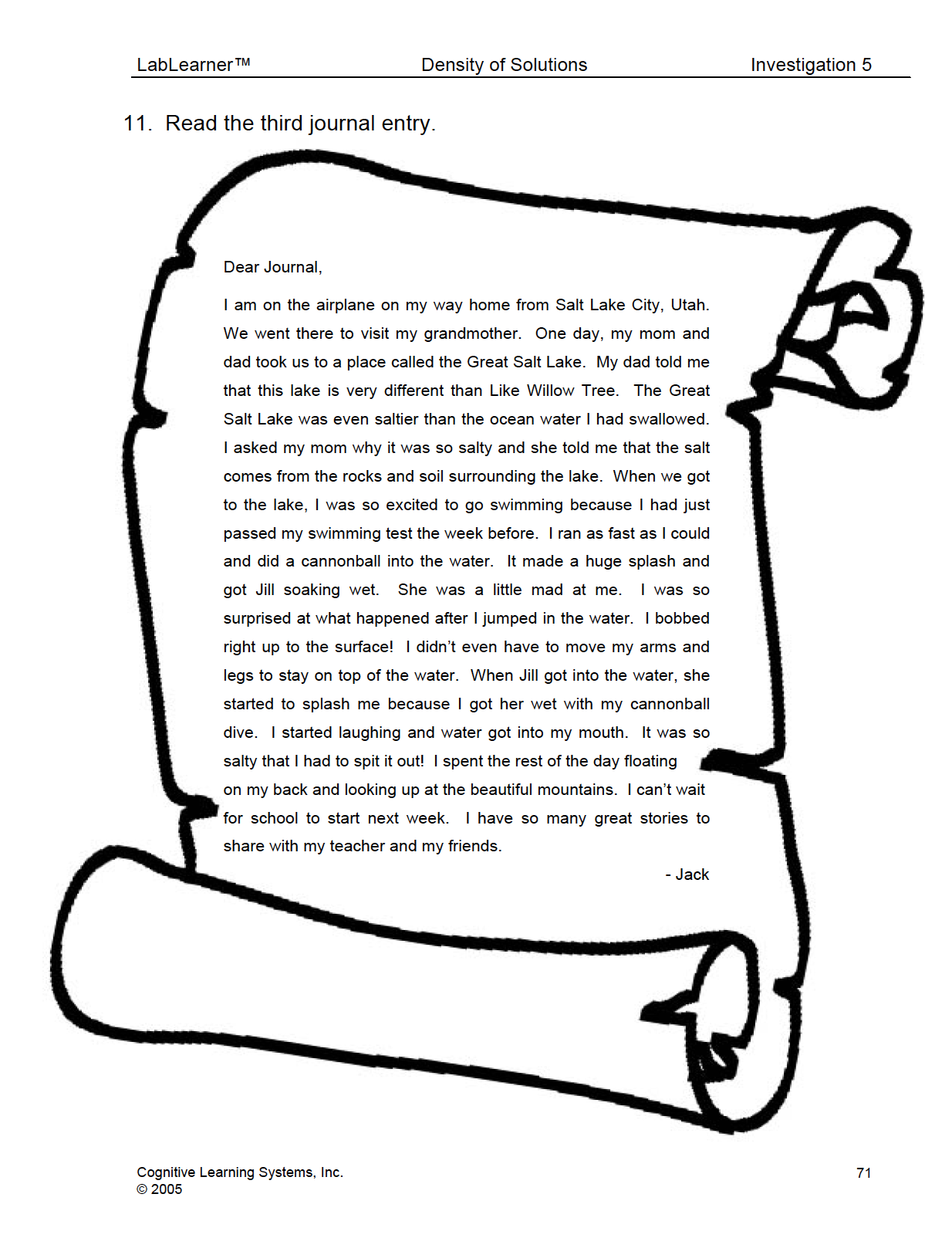
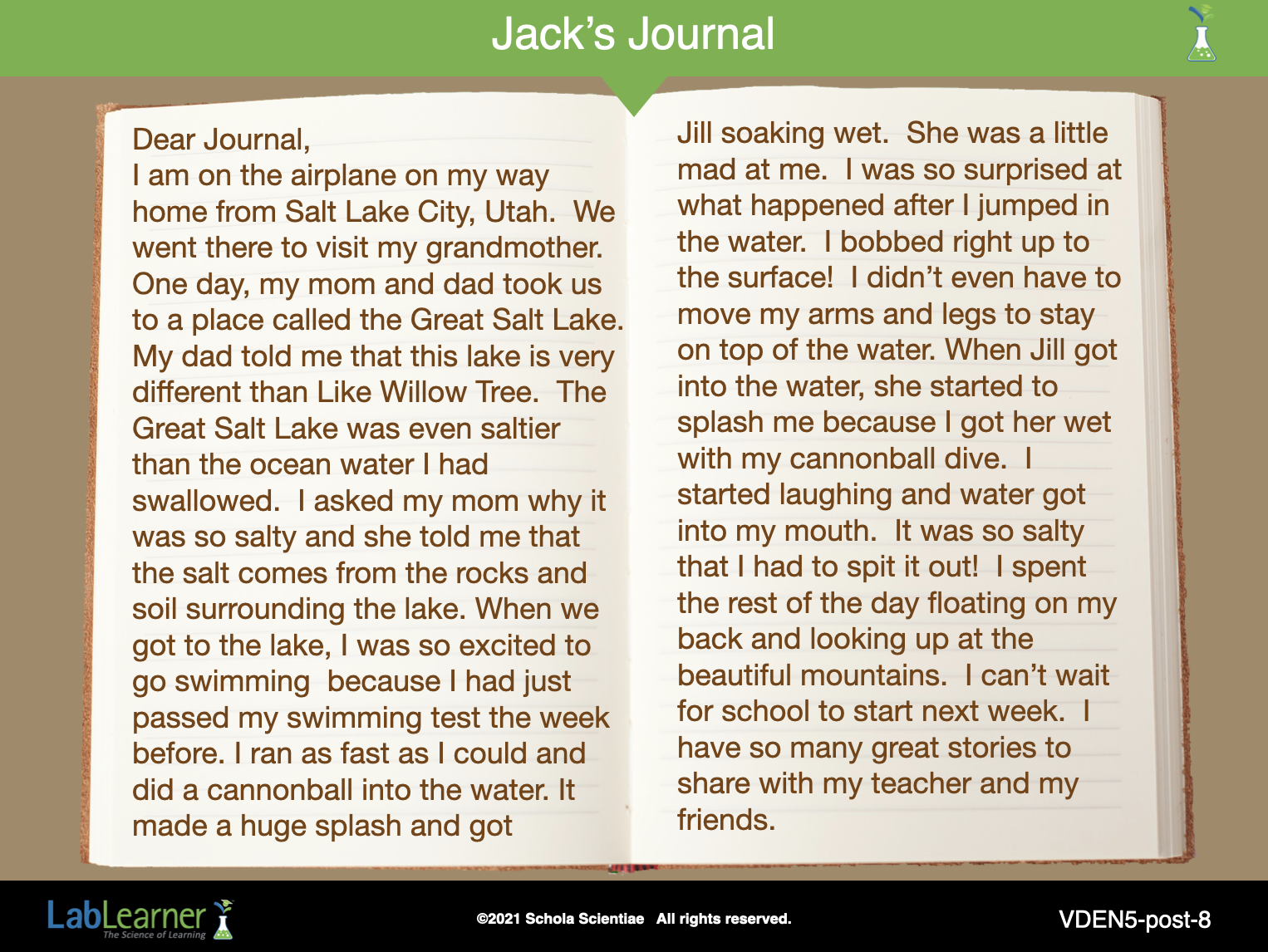
3. Tell students that they are going to now read a final journal entry. Students may read the story independently, in groups of three, or as a class. Instruct students to find the story in Problem 11 of their Student Data Record.
4. Read Jack’s journal entry about his family’s trip to the Great Salt Lake.
5. After students have read the story, ask them the following questions:
a. Ask students: Why do you think that Jack bobbed right to the surface of the Great Salt Lake, but not to the surface of Lake Willow Tree or the ocean? Students should indicate that the density of the water in the Great Salt Lake is greater than the density of fresh water or ocean water. Therefore, the density of Jack’s body was less than the density of the water in the Great Salt Lake.
b. Ask students: Do you think the density of the Great Salt Lake is greater or less than the density of freshwater? Ocean water? Why? Student answers may vary. Students should indicate that the density of Great Salt Lake is greater than the density of the freshwater or the ocean. This is because the amount of dissolved salt is greater in the Great Salt Lake than the amount of dissolved salt in fresh water and the ocean.
______________________________________________
SLIDE VDEN5-post-9
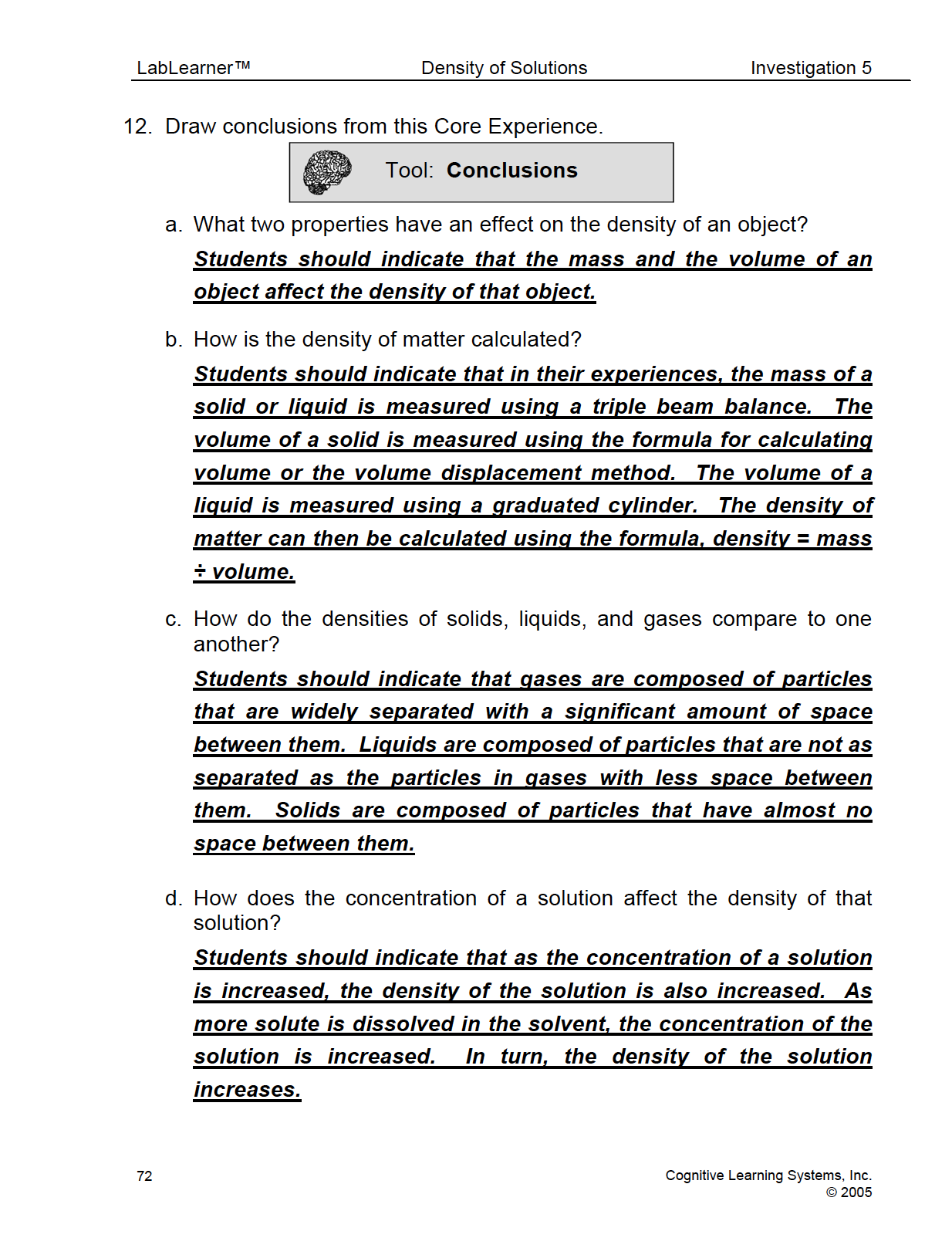
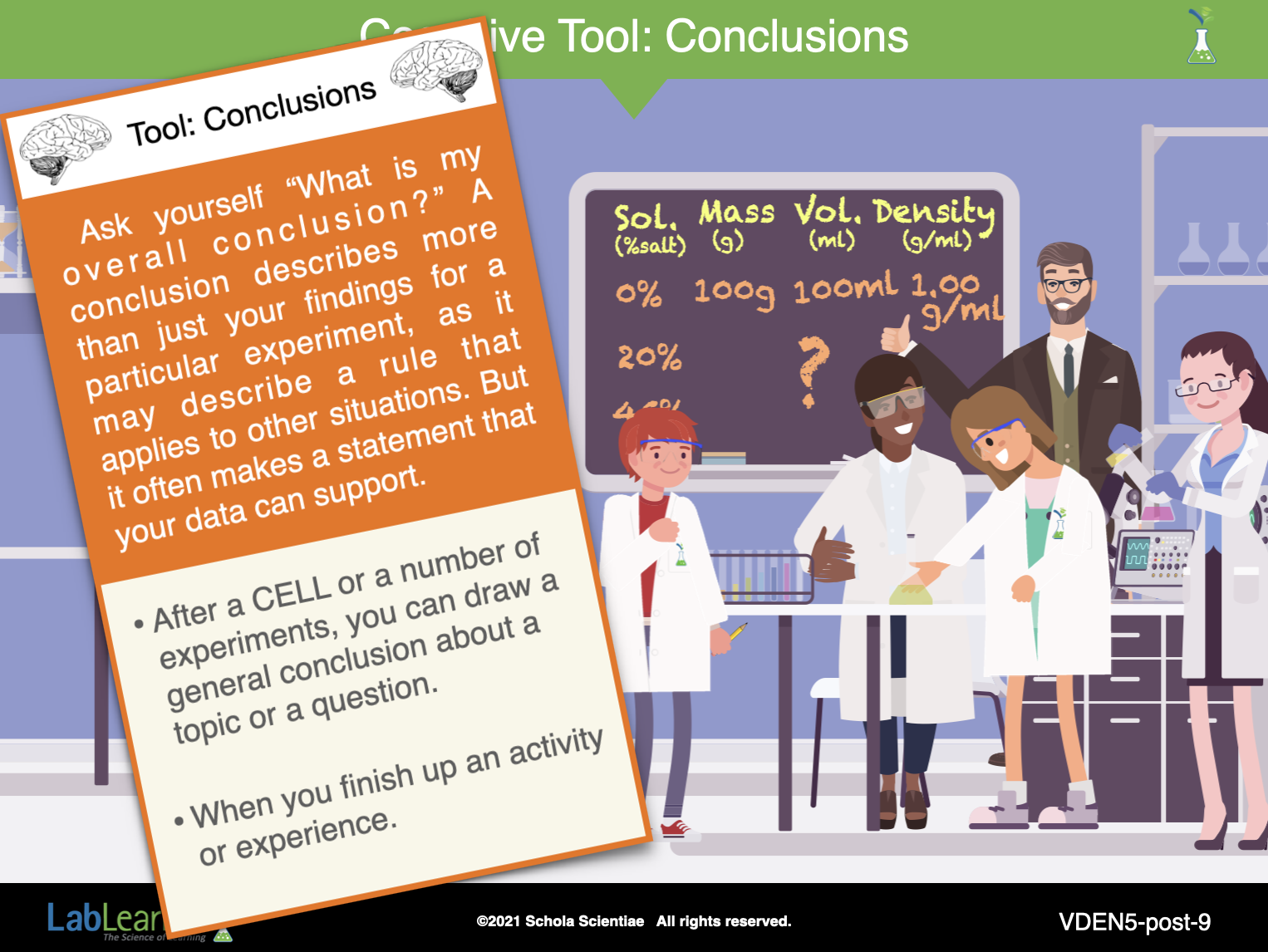
Close this CELL by leading the class in a discussion of their conclusions. Encourage students to record their answers in Problem 12 of their Student Data Record.
1. Ask students: What two properties have an effect on the density of an object? Students should indicate that the mass and the volume of an object affect the density of that object.
2. Ask students: How is the density of matter calculated? Students should indicate that in their experiences, the mass of a solid or liquid is measured using a triple beam balance. The volume of a solid is measured using the formula for calculating volume or the volume displacement method. The volume of a liquid is measured using a graduated cylinder. The density of matter can then be calculated using the formula, density = mass ÷ volume.
3. Ask students: How do the densities of solids, liquids, and gases compare to one another? Students should indicate that gases are composed of particles that are widely separated with a significant amount of space between them. Liquids are composed of particles that are not as separated as the particles in gases with less space between them. Solids are composed of particles that have almost no space between them.
4. Ask students: How does the concentration of a solution affect the density of that solution? Students should indicate that as the concentration of a solution is increased, the density of the solution is also increased. As more solute is dissolved in the solvent, the concentration of the solution is increased. In turn, the density of the solution increases.
KEYS: POSTLAB