
Teacher Portal:
Investigating Heat
Investigation 2 – PreLab
 MINDSET
This Investigation is designed to:
- introduce students to the concept of heat transfer.
- reinforce the concept that heat causes a change in temperature by causing a change in the kinetic energy of molecules.
- introduce students to the concept that the ability to transfer heat is a property of matter, and that materials vary in their ability to conduct heat.
- introduce the students to the concept that heat can be transferred by conduction, convection, and radiation, and that a material may transfer heat by more than one method at a time.
- introduce students to the concept that heat transfer occurs at different rates depending upon the type of substance and the conditions under which the heat transfer occurs, and that the average rate of heat transfer can be used as a tool for comparison.
SCIENTIST’S GLOSSARY
- Conduction: The process of transferring heat from one material to another through the collision of molecules. Conduction occurs between solids and can occur between solids and liquids and between solids and gases as the molecules of each come in contact with one another.
- Conductor: A material that transfers heat easily.
- Convection: The process of heat transfer in fluids such as liquids or gases. During convection, some portions of fluids have greater kinetic energy than others. When this happens, warmer and cooler areas of fluid begin to move and heat is transferred from the warmer to the cooler areas.
- Heat: The energy transferred from one molecule to another because of a difference in kinetic energy between the two molecules. Heat is transferred from molecules with higher kinetic energy to those with lower kinetic energy.
- Insulator: A material that does not transfer heat easily or slows the transfer of heat.
- Kinetic energy: The energy of motion.
- Molecule: A particle of matter.
- Radiation: The process of transferring heat from an object through electromagnetic waves. Examples of electromagnetic waves include ultraviolet (UV), light, and infrared waves. Most of the heat transferred by radiation occurs through electromagnetic waves. Radiation only occurs across a gas or vacuum, not through a solid or liquid.
- Rate of heat transfer: The change in temperature over a specific time period.
BE PREPARED
Watch the Investigation 2 Teacher Video (below) and Student Video (at end of PreLab SHARE IT) to prepare for the PreLab.
SET FOR SUCCESS
- Tell students that they will continue with the Investigating Heat CELL.
- In this Investigation, students will learn how heat is transferred from one place to another and from one object to another.
- Ask students to share the kinds of things they think they might learn in this Investigation.
Begin the PreLab Concept Slides to start students on their learning journey. Then watch the Pre-Lab Student Video as a class.
NAVIGATE IT
Once the slide presentation is launched
- use your left and right arrows to advance or go back in the slide presentation, and
- hover your mouse over the left edge of the presentation to get a view of the thumbnails for all the slides so that you can quickly move anywhere in the presentation.
- Click HERE to launch the slide presentation for the CELL.
SHARE IT
SLIDE VHEAT2-pre-1
A. Begin this part of the Investigation by encouraging students to review the concepts learned in Investigation One.
______________________________________________
SLIDE VHEAT2-pre-2
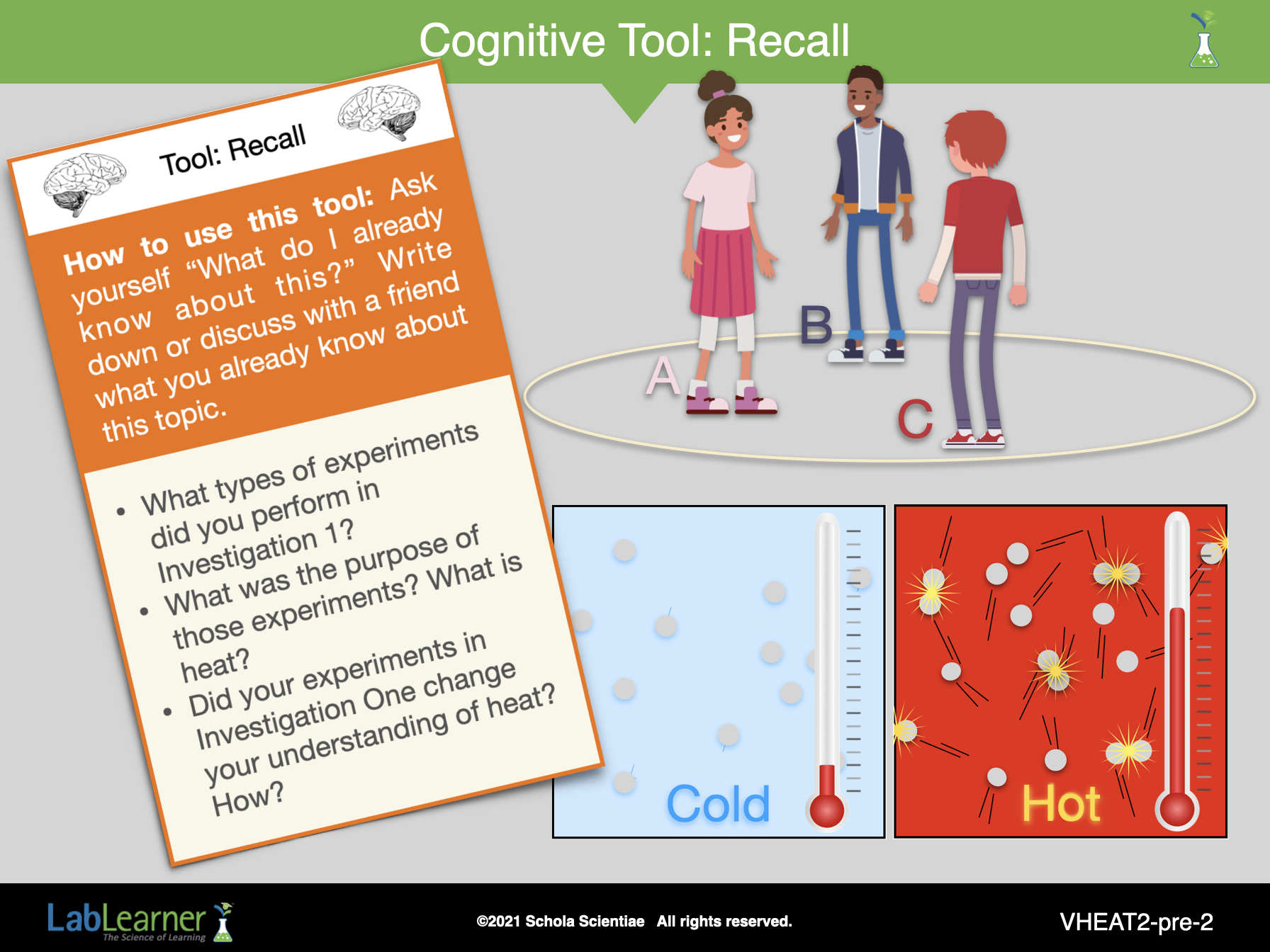
1. Ask students: What types of experiments did you perform in Investigation 1? What was the purpose of those experiments? Students observed a demonstration of a test tube filled with alcohol and capped with a balloon added to a beaker of recently boiled water. This demonstration illustrated how molecules of alcohol respond when energy is transferred from substances of higher temperatures. Students placed thermometers in beakers of hot, warm, and cold water to determine the temperature of the water in each beaker. Students then added food coloring to each beaker to observe the effect of water temperature on the kinetic energy or movement of the molecules of water and food coloring.
2. Ask students: What is heat? Student answers may vary. Heat is defined as the energy transferred between molecules that have different kinetic energies.
3. Ask students: Did your experiments in Investigation One change your understanding of heat? How? Student answers will vary. Encourage students to share their answers. It is likely that students may be unsure of how they perceive or define heat. Alleviate students’ anxiety by explaining that it is natural to have questions and possibly an unclear understanding at this point. Assure students that they will continue to have more opportunities in this Investigation as well as in the CELL to learn more about heat and understand it better.
______________________________________________
SLIDE VHEAT2-pre-3
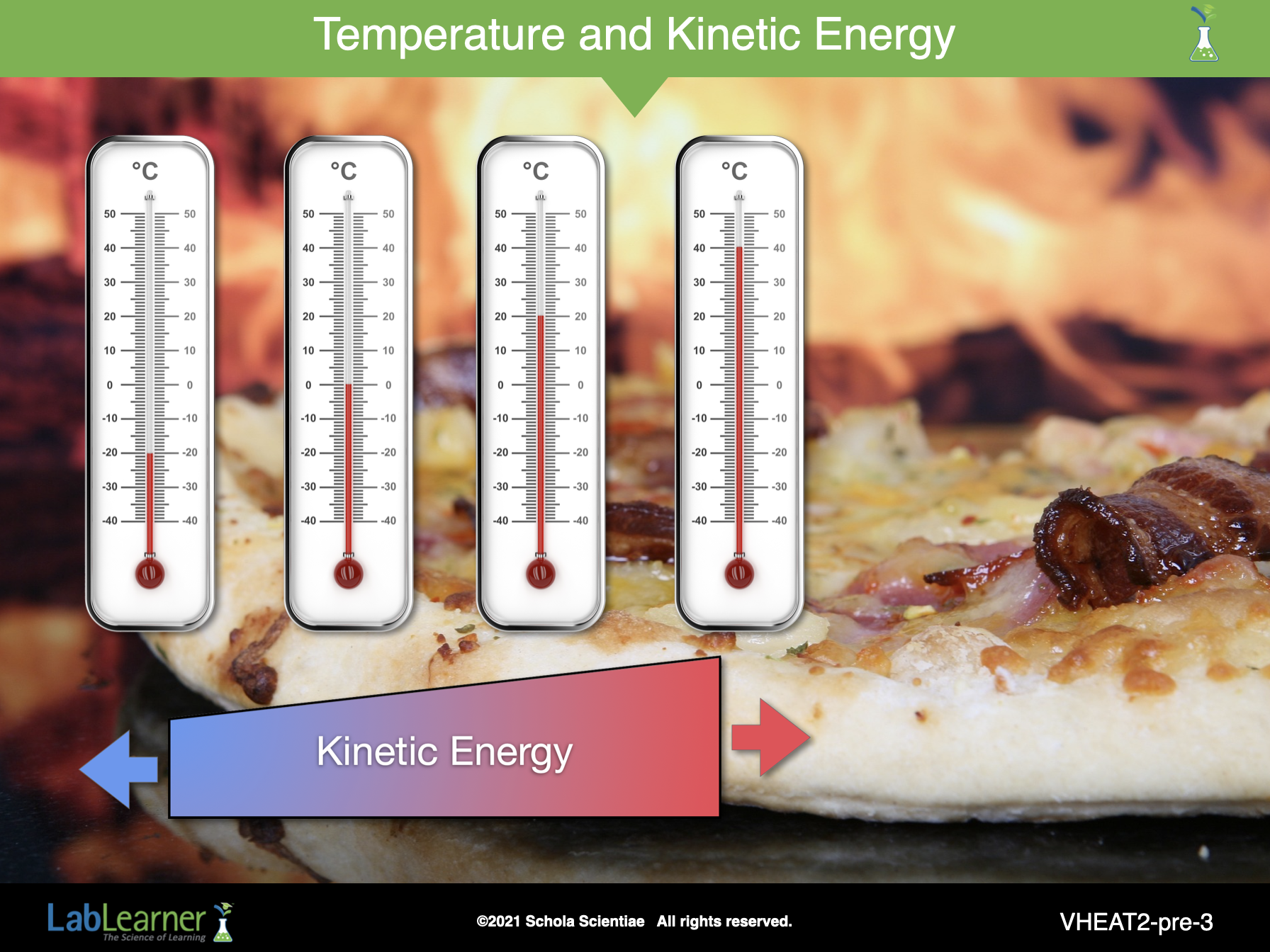
B. Explain to students that in Investigation Two, they will be exploring the different ways heat can be transferred and that the ability to transfer heat is a property of matter. Remind students that in science, heat is the transfer of kinetic energy. The following questions may be useful in helping students to understand the distinction between the scientific meaning of heat, and heat as it is used in everyday language. Encourage students to answer the questions based on their own conceptions of heat then use the sample answers to promote a discussion about how scientists would answer the question.
1. Ask students: When do you think you have observed heat? Student answers will vary. Students may refer to cooking food on a stove, or warm air coming from a heater. Student examples should indicate an understanding that heat comes from a source, but is not made of matter. Another way to explain this is that energy is moving from molecules with more kinetic energy to molecules with lower kinetic energy.
2. Ask students: What do we mean when we say heat is transferred? Student answers may vary. When we say heat is transferred, we mean that kinetic energy is moving from a substance with a higher temperature to a substance with a lower temperature.
3. Ask students: What are we doing when we heat food in an oven? What is the result? When food is heated in an oven, energy is being transferred from the source of heat (either an electric element or gas flame) to the food. This causes the temperature of the food to increase.
4. Ask students: When we say “turn on the heat”, do you think we are referring to the scientific meaning of heat? Why? Student answers may vary. This phrase is an example of heat being used in the everyday sense rather than the scientific sense. When we say “turn on the heat”, we really are saying to turn on a heat source, such as a furnace or heater. The furnace or heater then transfers energy to the air in the room, causing the room to become warmer. Heat is not a form of matter, so it cannot be turned on with a switch like an electrical appliance.
5. Ask students: Can you feel the heat from the furnace? Why? Heat can be felt because energy is transferred from the warm air to the skin, increasing the temperature of the skin.
6. Ask students: How is temperature related to kinetic energy? Temperature is the measure of the kinetic energy of molecules.
______________________________________________
SLIDE VHEAT2-pre-4
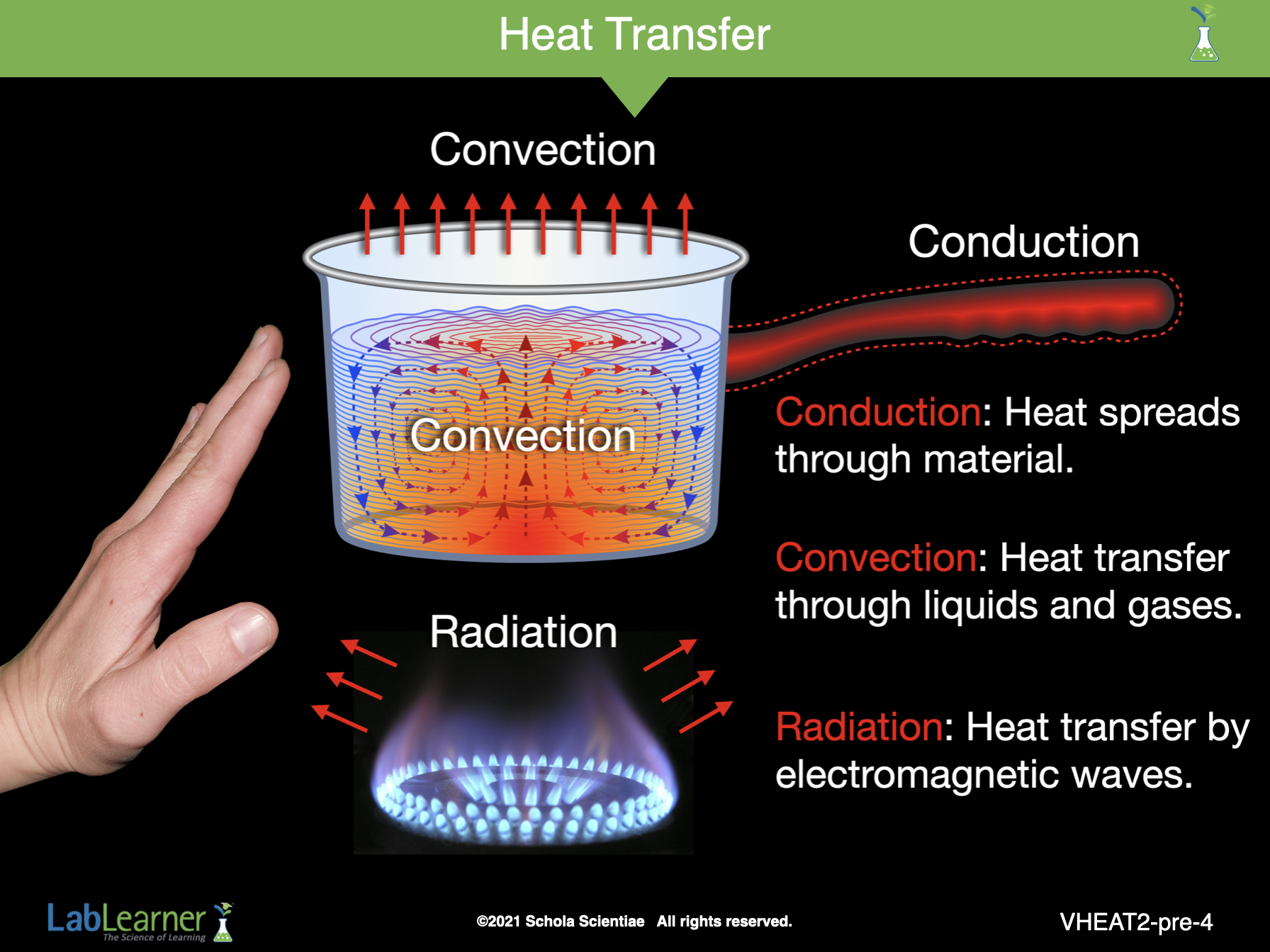
C. Continue the discussion of heat by introducing the different ways in which heat (kinetic energy) can be transferred.
1. Direct students’ attention to their Scientist’s Glossary. Ask students: Which terms refer to processes of heat transfer? Conduction, convection, and radiation are all processes of heat transfer.
2. Divide students into cooperative groups.
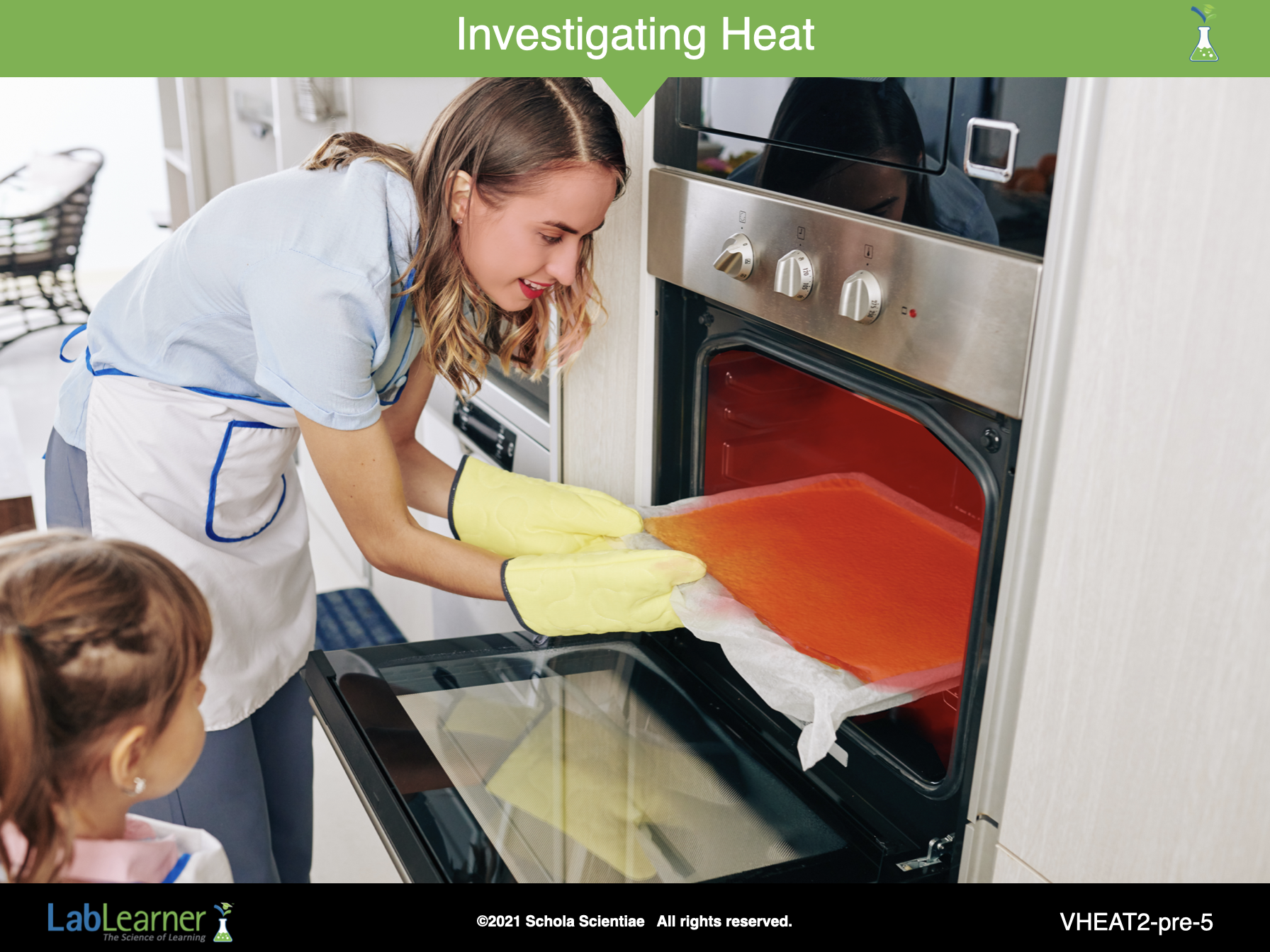
3. Encourage students to imagine standing in front of an oven just before and then after someone removes a pan of cookies.
Ask students: What do you feel before and after the oven door is opened? Student answers will vary.
Before the oven door is opened, heat can be felt near the oven but is not associated with the movement of air. The door is also hot to the touch. When an oven door is opened, the heated air inside the oven moves out of the oven as it rises, creating a brief feeling of a hot breeze. A draft of cool air may also be felt coming toward the oven as cool air moves in to replace the hot air that left the oven. After the initial burst of hot air, heat can be felt coming from the heating element and the walls of the oven.
____________________________
Direct students to discuss the different types of heat transfer and decide what types of heat transfer are occurring in the example of the oven based on the definitions in their Scientist’s Glossary. This activity is designed to provide students an opportunity to work with their peers to interpret the definitions, make some initial predictions about heat transfer, and offer the instructor insight into their current understanding of the terms and heat transfer. It is not necessary or expected that students will be accurate in their analysis.
a. Allow approximately 5 – 10 minutes for group discussion then encourage groups to share their ideas with the class.
b. After students have shared their ideas, review the definitions of conduction, convection, and radiation as a class.
- Conduction is the process of transferring heat from one material to another through the collision of molecules. Conduction occurs between solids and can occur between solids and liquids and between solids and gases as the molecules of each come in contact with one another.
- Convection is the process of heat transfer in fluids such as liquids or gases. During convection, some portions of fluids have greater kinetic energy than others. When this happens, warmer and cooler areas of fluid begin to move and heat is transferred from the warmer to the cooler areas.
- Radiation is the process of transferring heat from an object through electromagnetic waves. Examples of electromagnetic waves include ultraviolet (UV), light, and infrared waves. Most of the heat transferred by radiation occurs through electromagnetic waves. Radiation only occurs across a gas or vacuum, not through a solid or liquid.
______________________________________________
SLIDE VHEAT2-pre-5
c. Use the following questions to help explain and elaborate what is meant by each term, to help students understand differences between the types of heat transfer, and to apply the concept to the example of the oven.
Ask students: Do you think the heat you feel after the oven door is opened is being transferred by conduction? What about before it is opened? Why? Student answers may vary. After the oven door is opened, heat is being transferred by conduction because the molecules of hot air are colliding with the skin and transferring their heat to the skin. This is the direct contact of one molecule with another. Before the oven door is opened, heat is being transferred by conduction between the metal of the door and the skin of the hand if the oven door is touched.
Ask students: Do you think the heat you feel after the oven door is opened is being transferred by convection? What about before the door is opened? Why? Student answers may vary. The heat is also being transferred by convection after the oven door is opened because the molecules of hot air are moving. This is accompanied by the movement of cool air into the oven to replace the warm air that vacated the oven. The rising of hot air and its subsequent replacement with cold air causes a convection current to develop. Heat is not being transferred by convection to the rest of the room before the door is opened unless there is significant movement of air in the area around the oven.
Ask students: Do you think the heat you feel after the oven door is opened is being transferred by radiation? What about before the oven door is opened? Why? Student answers may vary. Heat is also being transferred by radiation before the oven door is opened because the heating element as well as the oven walls are radiating some of the heat that can be felt coming from the oven. However, it may be difficult to distinguish between the radiated heat and the heat that exits the oven by convection. The heat felt before the oven door is opened is being transferred by radiation, because heat can be felt even though there is no movement of air and no contact between the skin and the oven door.
______________________________________________
SLIDE VHEAT2-pre-6
Ask students: How do conduction and convection differ? Student answers may vary.
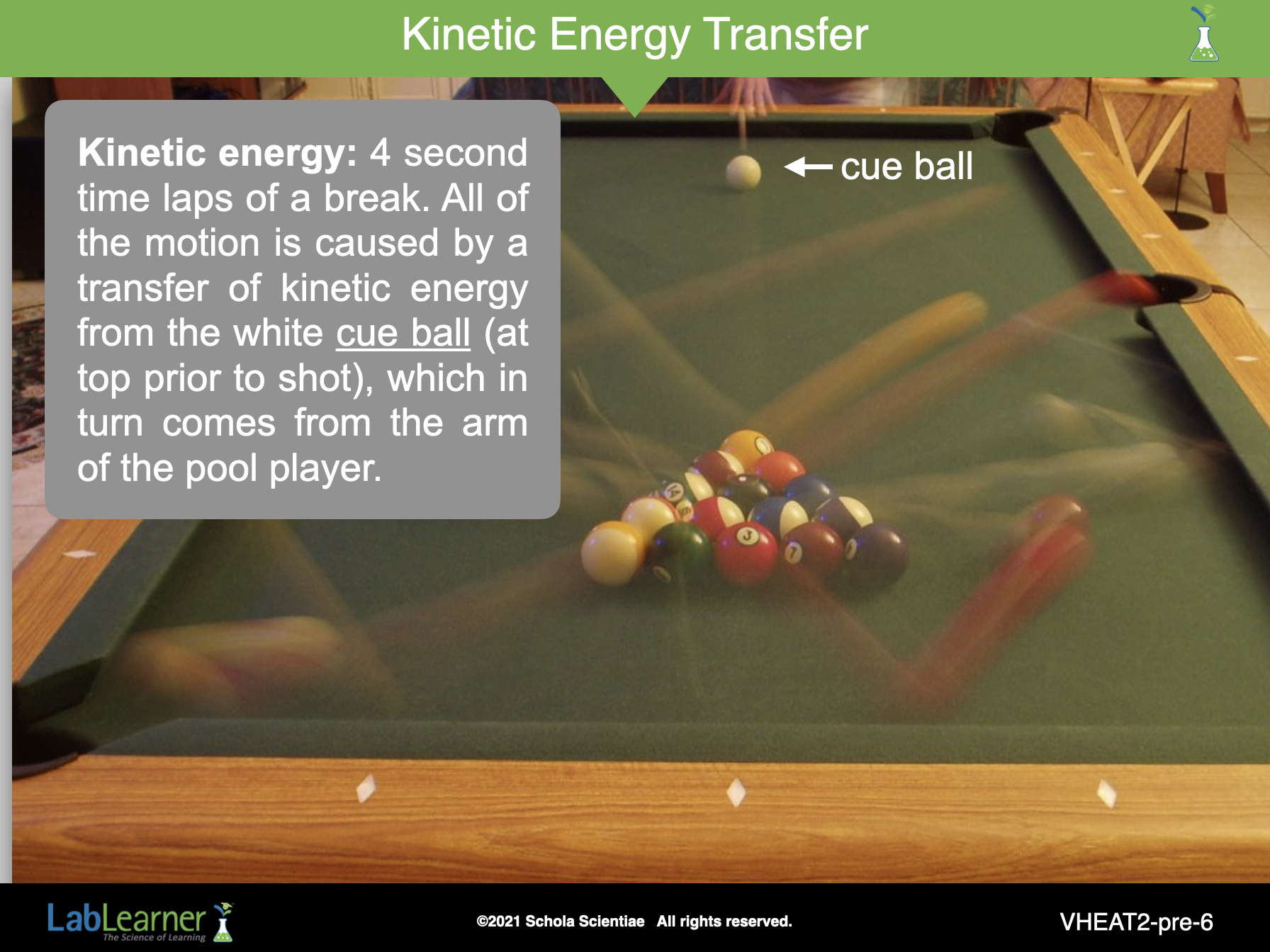
When heat is transferred by conduction, molecules transfer heat by colliding with each other. For example, when a marble rolls into a marble that is sitting still, the first marble transfers its kinetic energy to the second marble. The second marble begins moving as a result of the collision. This is an example of direct contact of objects. The same thing occurs when molecules collide during conduction. An example of heat transfer by conduction is a pot of corn heating on a stove. Heat moves from the bottom of the pot into the corn by conduction.
Convection is the transfer of heat from one point to another by moving gases and liquids. Examples of heat transfer by convection include steam rising from a pot of boiling water. Ocean currents and wind are also examples of heat transfer by convection. Solids cannot transfer heat by convection. Convection only occurs within gases and liquids However, solids can transfer heat to liquids and gases by conduction, and heat can also be transferred by liquids and gases to solids by conduction.
Ask students: How does radiation differ from conduction and convection? Radiation is the result of electromagnetic waves, and unlike conduction and convection, does not involve molecules. Examples of electromagnetic waves are light, UV waves, and infrared waves. UV and infrared waves are similar to light waves. Examples of heat transfer by radiation include heat from the sun warming a rock or the feeling of warmth on the skin when sitting in the sun or next to someone else. It does not involve direct contact with molecules or moving areas of liquids. Because it does not require molecules for transfer, radiation is the only form of heat that can occur through a vacuum.
______________________________________________
SLIDE VHEAT2-pre-7
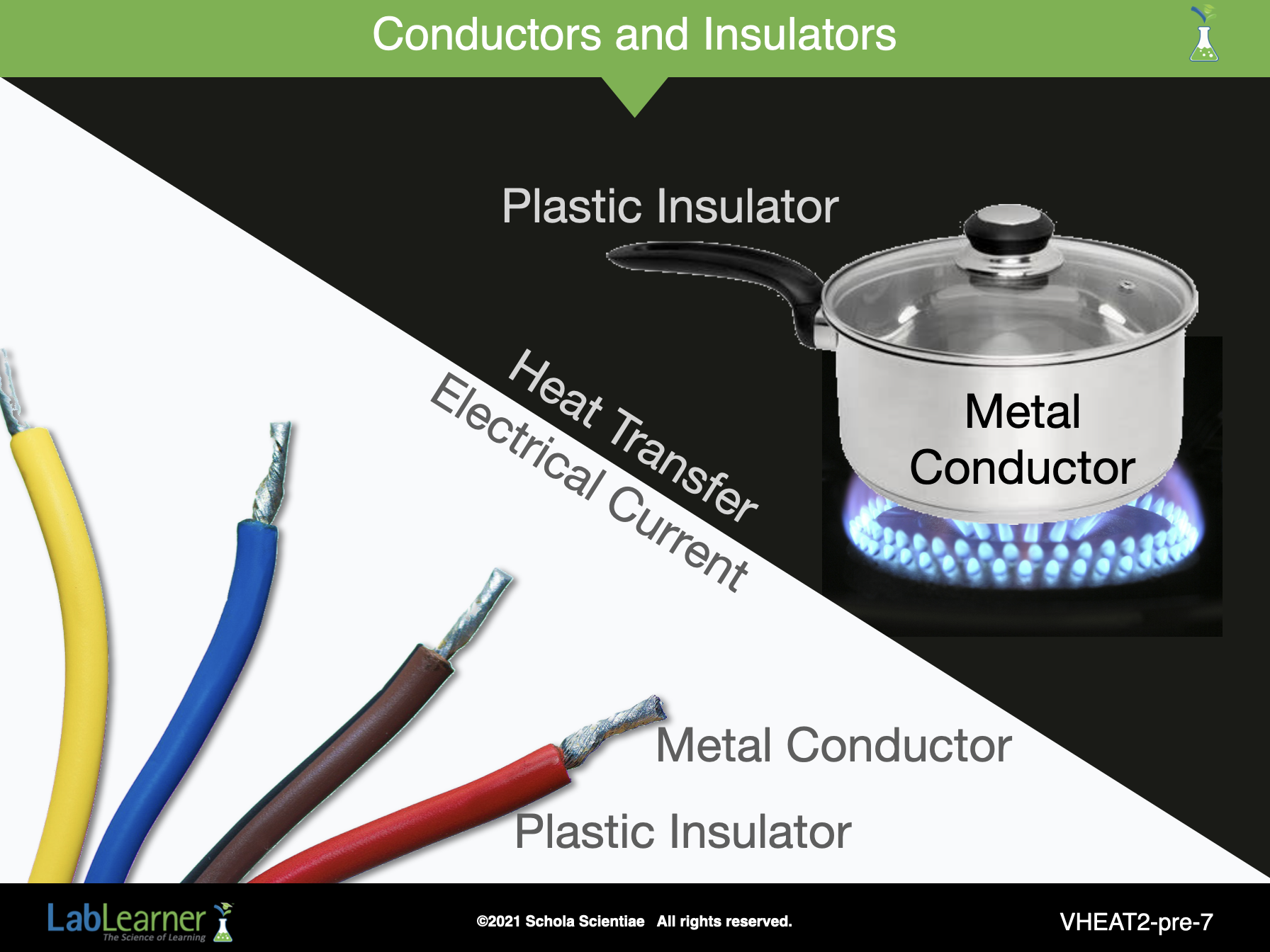
D. Explain to students that just as there are different types of heat transfer some materials can transfer heat better than others. Tell students that because materials have varying abilities to transfer heat, they can be classified on the basis of this ability. The following discussion may be used to assist students in understanding how matter is classified based on how easily heat is transferred:
Heat is not matter, and does not have properties. However, the ability to conduct heat is a property of matter.
1. Direct students’ attention to the terms conductor and insulator in their Scientist’s Glossary. Students will have encountered these terms in conjunction with previous studies of electricity.
2. Help students to Recall the terms’ electrical associations in order to help them understand heat conduction as a property of matter:
Ask students: have you seen these terms before? Where? What were the differences between insulators and conductors of electricity? Students should indicate that these terms were used in their study of current electricity. Insulators did not allow electricity to pass easily through them. Electricity is easily passed through conductors.
3. Ask students: Based on what you already know about what “insulator” and “conductor” of electricity mean, what do you think insulate and conduct mean when studying heat? The word conduct meant pass easily. The word “insulate” meant could not pass easily. Therefore conductors of heat would likely transfer heat easily while heat would not transfer easily through insulators. Students may equate the fact that conductor and conduction share a common root with conductors of heat transferring heat solely through conduction. Explain to students that substances that conduct heat may do so through any of the three types of heat transfer. Conductors of heat are not limited to transferring heat by conduction alone.
4. Ask students: How could you determine if a substance is a good conductor of heat? Student answers will vary.
Tell students they will explore this question in the lab.
______________________________________________
SLIDE VHEAT2-pre-8
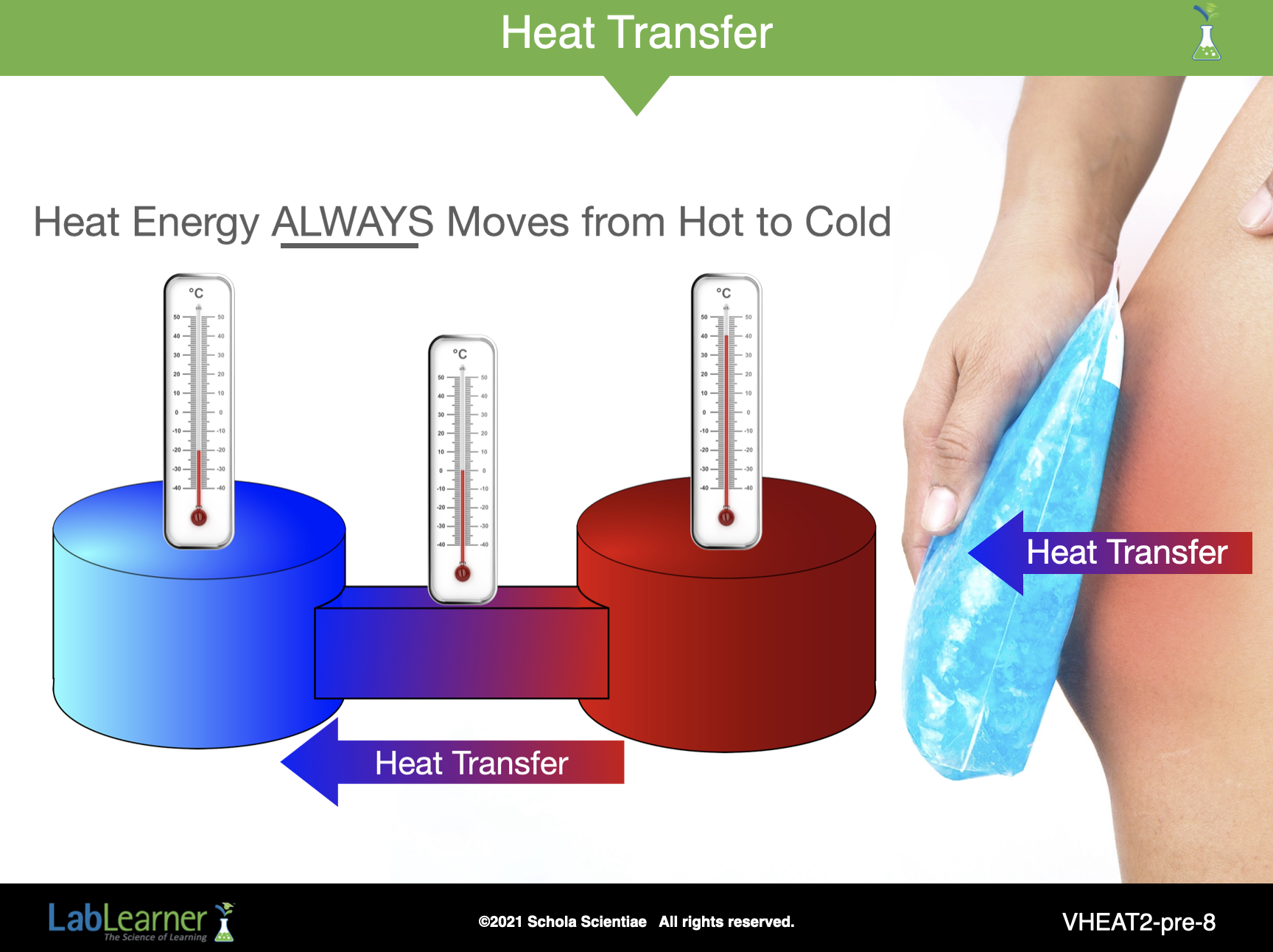
Important Note: This slide makes a very important statement that students should remember. That is, heat energy always moves (is transferred) from areas that are hot to areas that are cooler. It is never the other way around. Even if you place an ice pack on your sore knee, for example, and feel the cold of the ice and your knee is colder to the touch, this is because the heat from your body, your knee, in this case, is actually transferred to the ice pack. That is why the ice pack gets warmer and melts as your knee gets colder.
E. Conclude this part of the investigation by explaining that students will conduct experiments in the Lab to explore the following questions about heat transfer:
- How is heat transferred between different substances?
- How do materials differ in their ability to transfer heat? Which materials are conductors and insulators of heat?
- Can you determine how quickly heat is transferred?
WATCH IT
Play the following Student Video in preparation for the lab. Discuss as necessary to answer student questions.