Teacher Portal:
Investigating Heat
Investigation 2
Investigating Heat: Investigation-2: Transferring Heat
Investigation One introduced students to heat as the transfer of energy. Students learned that heat is not matter but is a property of matter. Students discovered that temperature is a measure of the kinetic energy, or speed, of molecules and that thermometers measure temperature by means of energy transfer between the liquid in the thermometer and the substance outside the bulb of the thermometer. Investigation Two provides students with the opportunity to continue their study of heat as energy by introducing the three methods of heat transfer and distinguishing between conductors and insulators of heat.
Conduction
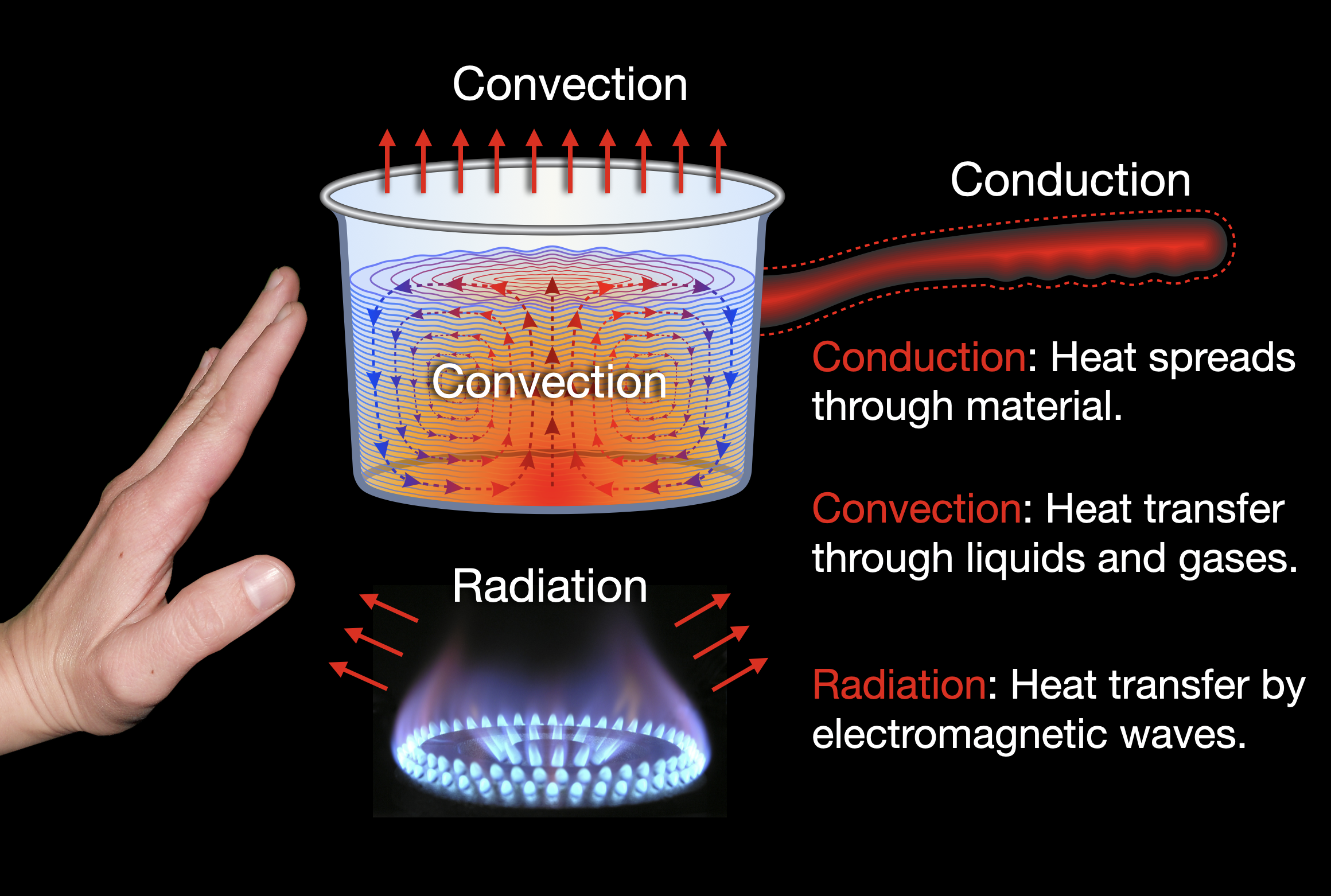
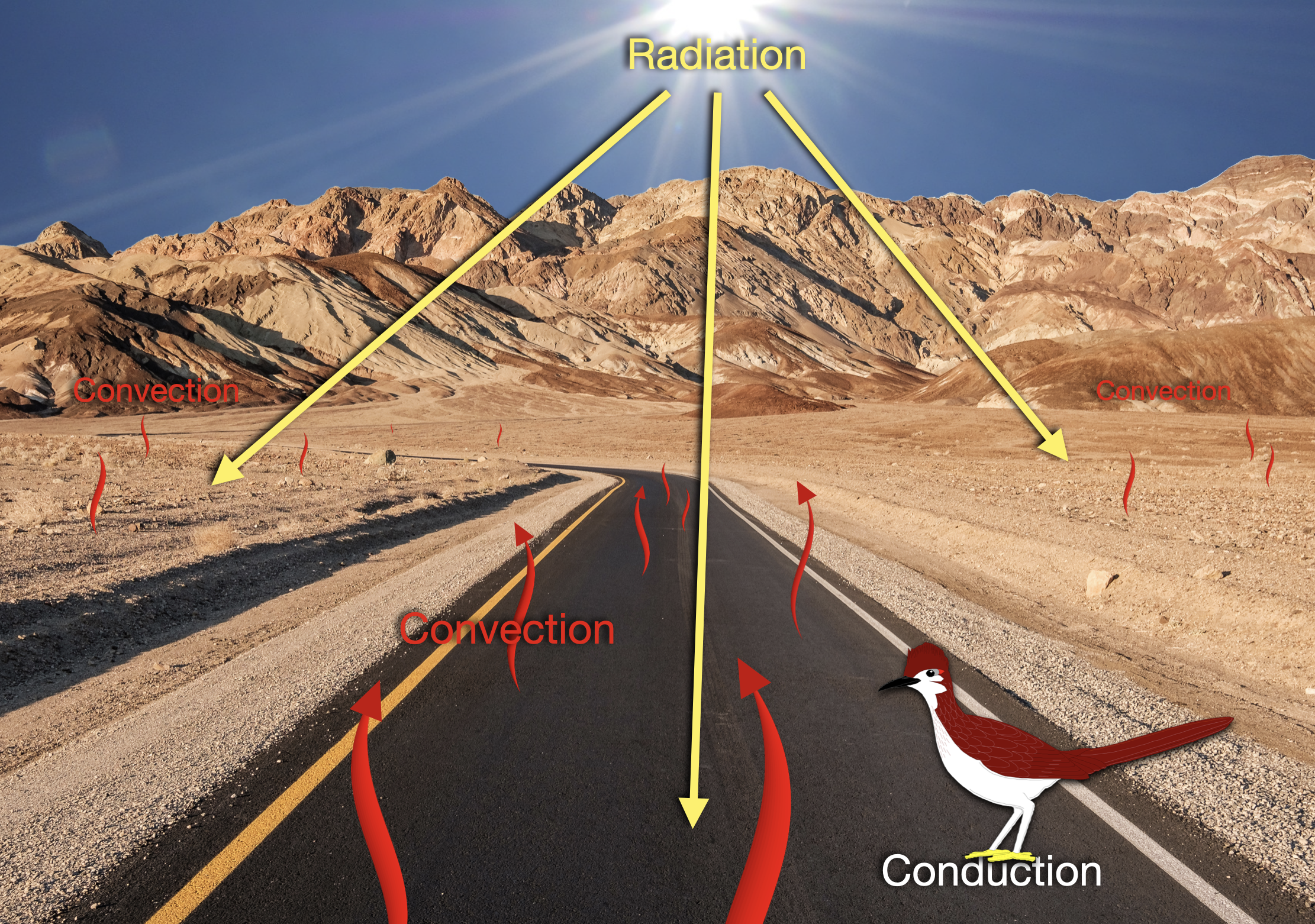
Heat transfer occurs by one of three methods: conduction, convection, and radiation. Conduction can occur between solids, between solids and liquids, and between solids and gases. Conduction also occurs within a solid. Conduction occurs when molecules or other particles of matter such as ions collide, transferring energy from the molecule (particle) with the higher energy to the molecule (particle) with the lower energy. In other words, conduction requires direct contact between molecules (particles). Conduction causes heat to move from areas of higher kinetic energy to areas of lower kinetic energy. Heat moves through a pot handle through conduction. In the picture of the desert below, heat will be transferred from the hot pavement surface to the roadrunner’s feet!
Convection
 Convection occurs in gases and liquids and does not involve the direct collision of molecules or particles. Instead, convection occurs when some areas of a liquid or gas have greater kinetic energy than other areas. The increase in kinetic energy causes the molecules to spread apart, and the liquid or gas becomes less dense. This causes the molecules in the area of greater kinetic energy to rise. As these molecules rise, slower, denser molecules replace them. This can be easily seen when oil is heated in a pan (see top illustration above). As the oil becomes warm, the kinetic energy of the molecules of the oil closest to the bottom of the pan (and thus the heat source) increases, causing the oil molecules to move faster and farther. As these molecules spread out, they begin to rise and colder oil falls to the bottom of the pan. This establishes a convection current and is observed in the oil as a shimmering movement. Convection currents occur anywhere warm or hot liquid or gas molecules rise and are replaced by colder molecules. Ocean currents, wind, and heat waves observed over hot pavement on a summer day are all examples of heat transfer by convection.
In the picture of the desert below, convection occurs as the Sun heats the desert floor and the black asphalt road. Surrounding air molecules near the road surface are heated by the road and begin to rise in convection currents. On a hot road, such conduction currents may actually be visualized as a mirage, where the ground in the distance can have a wet/watery appearance (shown in the image below).

Radiation
Unlike convection and conduction, heat transfer by radiation is not associated with the movement or collision of molecules. Heat transfer by radiation is the result of electromagnetic (light) waves that are emitted by an object or substance. The electromagnetic waves involved in heat transfer by radiation are in the ultraviolet (UV), visible, and infrared wavelengths of light. Radiant heat moves through gases and is the only form of heat transfer that can occur through a vacuum (an area of space lacking matter). The classic example of radiant heat is the heat from the Sun. Electromagnetic waves from the Sun travel across space and are absorbed by objects on the Earth, as well as the Earth itself. Sources of radiant heat are called emitters. We use radiant heat to cook food and heat our homes. Examples of sources of radiant heat include electric stove burners and steam radiators.
It should be pointed out that heat transfer by radiation should not be confused with nuclear radiation, and objects that emit radiant heat are not radioactive. Nuclear radiation involves the emission of high-energy particles from the nucleus of an atom. These particles form when an unstable nucleus in an atom decays, thus the name nuclear radiation. It can occur naturally, as in uranium ore, or can be produced artificially as the result of nuclear reactions. Students are not expected to understand the concept of nuclear radiation, and this information is intended only for clarification purposes. However, some students may express concern over the term radiation, and these students should be reassured that the heat transfer by radiation from objects in their surroundings is harmless and is in no way related to nuclear radiation.
Conductors and Insulators
Matter differs in its ability to transfer heat. Therefore, materials can be classified as conductors or non-conductors (insulators) of heat. These terms may be familiar to students from the Exploring Electricity CELL, and have similar connotations in heat as they do in electricity. A conductor of heat is a material or  substance through which heat is easily transferred. An insulator of heat is a material or substance through which heat is not easily transferred.
Materials that make good conductors of electricity generally make good conductors of heat. Similarly, materials that tend to be insulators of electricity also tend to be insulators of heat, with some exceptions. Glass is a poor conductor of electricity, but its ability to conduct heat evenly while withstanding high temperatures makes it a popular material for cookware and laboratory vessels. Materials labeled as heatproof are insulators of heat. Materials that are conductors of heat are not limited to heat transfer by conduction. They may also conduct heat through convection or radiation.
In this Investigation, students will learn through experimentation how to differentiate between conductors and insulators of heat and explore how materials vary in their ability to conduct, or transfer, heat. Students will apply the knowledge gained from their experiments with insulators and conductors by constructing a thermos and discover that insulating materials slow the transfer of heat to ice water from its surroundings. Students will also learn to use a formula to calculate the rate of heat transfer as a method of comparing how quickly heat is transferred to and from various substances.
Investigating Heat: Investigation 2 - Mathematics Concepts
Prelab
- counting whole numbers
- comparing (non)measurable characteristics
- time in seconds
- greater than/less than /equal to
- (in)direct relationships
Lab
- volume in mL
- time in seconds/minutes
- comparing (non)measurable characteristics
- data table
- grouping/classifying
- temperature in Celsius
- problem-solving
- models
Postlab
- grouping/classifying
- patterns/trends
- problem-solving
- calculating average rate of heat transfer
- subtraction
- division
- fractions and decimal equivalent
- adding fractions
- greater than/less than/equal to
- decimals to the nearest tenth
- comparing values
Investigating Heat: Investigation 2 - Procedural Tools

Investigating Heat: Investigation 2 - Cognitive Tools

Investigating Heat:
Investigation 2 Quiz

