
Teacher Portal:
Weathering and Erosion
Investigation 3 – Lab

ZERO-IN
Italicized font represents information to be shared orally or physically completed with the students at this time.
The non-italicized font represents additional information included to support the teacher’s understanding of the content being introduced within the CELL.
MINDSET
This Investigation is designed to demonstrate to students that:
- soil is composed of different types of components,
- different components of soil are composed of different sizes,
- differently sized particles of some components are a consequence of different rates of weathering of rocks,
- these components can be separated according to their size differences, and
- each component is composed of a range of different sized particles.
BE PREPARED
Teacher Preparation for the Investigation includes the following. This preparation should be done prior to students arriving in the lab.
- Bend the sides of each of the wire mesh squares, so each vertical side is approximately 1.5 cm high.
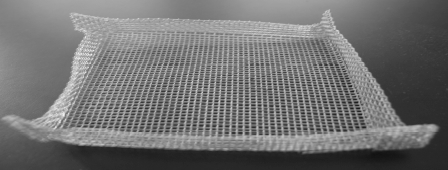
Note: Care should be taken since the wire ends can be sharp. Gloves should be worn or the sides can be conveniently bent on the edge of one of the lab tables.
- Place masking tape over the edges of the mesh.
Note: Each lab group will need (1) square of mesh with large openings and (1) square of mesh with small openings.
- For each group, fill (1) 50 ml beaker with approximately 10g of gravel.
- For each group, fill (1) 50 ml beaker with approximately 10g of potting soil (organic).
- For each group, fill (1) 50 ml beaker with approximately 10g of sand.
Note: The mass of each can be approximated by filling each beaker to the 25ml mark.
Note: Depending on the makeup of the soil the quantity may need to be adjusted.
- Put all materials at the distribution center.
- Divide the students into five cooperative groups.
Student Preparation for the Investigation includes having students gather the following materials. This preparation takes place on lab day after student lab groups have settled at their assigned lab tables.
Note: The materials are listed in students’ SDRs. They are also listed below for your reference.
- (1) triple beam balance
- (1) lab scoop
- (3) weigh dishes
- (1) 50ml beaker containing gravel
- (1) 50ml beaker containing potting soil
- (1) 50ml beaker containing sand
- (1) 400 ml beaker
- (1) square of wire mesh with large openings
- (1) square of wire mesh with small openings
- (1) shoebox container
- (1) hand lens
Direct one student from each lab group to collect the materials listed in their SDRs.
INVESTIGATE
- Explain to students that they will be conducting two trials in which they investigate the different components of soil.
- Encourage students to reflect on the PreLab video as they move through the procedural steps.
- Explain to students that during the Experiment, every procedural step is important. If one step is skipped, data can become invalid. To help students keep on track, direct them to read each step thoroughly, complete the step, then check it off (Read it – Do it – Check it off).
- Direct students to complete the procedural steps in their SDRs.
Note: The procedural steps are listed below for your reference. Teacher “Notes” are inserted, as needed, to help facilitate the lab.
Trial 1
- In this Trial, you will analyze the appearance of the components of a soil sample.
- Use the masking tape and marker to label one of the weigh dishes “gravel.”
- Use the triple beam balance to measure the mass of the weighing dish.
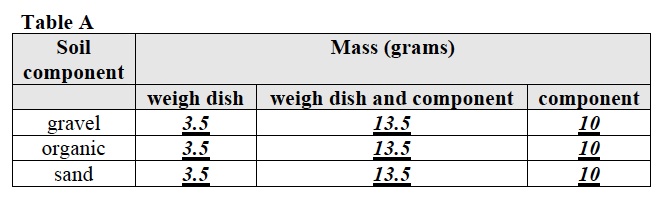
- Record the mass of the weighing dish in the second column of Table A.
- Use the triple beam balance and the weigh dish to measure 10g of gravel.
- Enter the mass of the weighing dish and the component in the third column of Table A.
- Enter the mass of the component alone in the last column of Table A.
- Use the masking tape and marker to label a second weigh dish “organic.”
- Repeat steps 2a through 2e for this component. Record your data in Table A.
- Use the masking tape and marker to label a third weigh dish “sand.”
- Repeat steps 2a through 2e for this component. Record your data in Table A.
- Examine each of the three components with the hand lens and then answer the questions.
Trial 2
- In this Trial, you will separate three different soil components using two sieves with different-sized openings.
- Pour all three soil components from the weigh dishes into the beaker. Stir the mixture with the lab scoop to completely mix the components and to break up any lumps of the organic component.
- Place the sieve with the larger openings in the bottom of the container and pour the mixture into the sieve.
- Without spilling any of the mixture, shake the sieve back and forth in the container until no more material falls into the container.
- Carefully pour the material that did not fall through the sieve into the weighing dish labeled “gravel.”
- Carefully pour the material in the container that fell through the sieve back into the beaker.
- Place the sieve with the smaller openings in the bottom of the container and pour the mixture from the beaker into the sieve.
- Without spilling any of the mixture, shake the sieve back and forth in the container until no more material falls into the container.
- Carefully pour the material that did not fall through the sieve into the weighing dish labeled “organic.”
- Carefully pour the material in the container that fell through the sieve into the weighing dish labeled “sand.”
CLEAN UP
Let students know your expectations for clean up. Ask them to clean up.