
Teacher Portal:
Space
Investigation 4 – PostLab
ZERO-IN
Italicized font represents information to be shared orally or physically completed with the students at this time.
The non-italicized font represents additional information included to support the teacher’s understanding of the content being introduced within the CELL.
ANALYZE IT
Instruct students to complete the Analysis Questions in their SDRs then discuss them as a class. Use the suggested responses below to guide students’ answers.
Note: Questions marked with a triangle (∆) are included to enrich students’ understanding. These questions do not appear in students’ SDRs but should be used as additional discussion points during the PostLab.
- ∆ What did the ping pong ball and each part of the flour model represent? The model represented the motion of a planet or the Moon if suddenly the force of gravity was no longer exerted on it. The ping pong ball represented a planet or the Moon, the circle in the flour represented the orbit of the planet or Moon, and the string represented the force of gravity on the planet or Moon. The release of the string represented a discontinuation of the force of gravity acting on the planet or Moon.
- ∆ What did the model with the scooter represent? The model represented the motion of a planet or the Moon if suddenly the force of gravity was no longer exerted on it. The scooter represented a planet or the Moon in orbit, the middle student represented the Sun or the Earth around which the scooter orbited, and the rope represented the force of gravity on the planet or Moon. The release of the rope represented a discontinuation of the force of gravity acting on the planet or Moon.
- ∆ What happened to the scooter when it was pushed in a straight line? Why? The scooter circled around the student until friction caused it to stop. The release of the rope represented a discontinuation of the force of gravity acting on the planet or Moon.
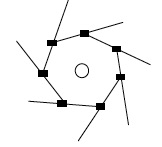
- How does your drawing of the tape and string explain why the ping pong ball and the scooter continued in a straight line after the force of gravity was eliminated? The circular path created as students circled the stool is actually a series of lengths of linear motion. Similarly, as the Earth orbits the Sun, it travels with forward linear motion. At any given point, the force of gravity from the Sun pulls the Earth into the Sun, changing the Earth’s direction. The elliptical orbit of the Earth is actually a series of very small lengths of linear motion constantly changing direction as a result of the force of gravity. Similarly, the orbit of the Moon around the Earth is a series of lengths of linear motion.
- Describe the path of the scooter when the Sun’s gravitational pull became much greater. The scooter is pulled toward the Sun.
- In the Sun’s gravitational pull model, what does the quick pull of the rope represent? The quick pull on the rope represents a great increase in the force of gravity.
- Why is the combination of forward motion and gravity important in maintaining the orbit of the planets and the Moon? The combination of forward motion and gravity causes the planets to orbit the Sun and the Moon to orbit the Earth. Without this precise amount of gravity, planets would either fly out of orbit in a straight line or they would be pulled toward the Sun.
- ∆ What did you learn from the models of planets in their orbits? Students learned that without the force of gravity, planets would leave their orbits in a straight line due to their forward motion. Students also learned that if the Sun provided more gravitational pull, the planets would leave their orbits and come racing toward the Sun.
- ∆ Why is gravity important in the orbits of planets and moons in our solar system? Without gravity, the orbits of planets and moons would not be maintained.
- ∆ How does Newton’s First Law of Motion explain the orbit of planets or the Moon? Newton’s First Law of Motion states that an object in a uniform state of motion stays in that state unless acted upon by an outside force. Earth, other planets, and the Moon have a forward motion. They would follow in that direction except that the force of gravity acts on the motion, causing it to change direction. The result is the revolution of Earth or planets around the Sun and the revolution of the Moon around the Earth.
GET FOCUSED
Instruct students to complete the Focus Question in their SDRs then discuss it as a class. Use the suggested response below to guide students’ answers.
- What causes the orbit of the planets around the Sun and the Moon around the Earth? Why are they important in maintaining the orbit of the planets and the Moon? The combination of forward motion and gravity causes the planets to orbit the Sun and the Moon to orbit the Earth. Without this precise amount of gravity, planets would either fly out of orbit in a straight line or they would be pulled toward the Sun.
Note: The Focus Question for Investigation Three and Four is the same. Students explored the orbit of the planets through both investigations.
COMPREHENSION CHECK
The Comprehension Check is designed to summarize the CELL and provide the teacher with an informal way to assess students’ understanding of the big ideas.
If time permits, ask your students to answer each question below. Use the suggested responses below to guide students’ answers.
- What causes the seasons? The tilt of the Earth alters how directly the light shines on the Earth during different points in its revolution. This causes some areas of the Earth to experience changes in season. For example, summer in the northern hemisphere occurs because the light from the Sun shines more directly on the northern hemisphere at that point in the Earth’s revolution than any other. At the same time, because of the tilt of the Earth’s axis, the light that the southern hemisphere receives is more indirect than at any other time of year. Thus, the southern hemisphere experiences winter.
- What causes day and night? The rotation of the earth. When a side of the Earth is not facing the Sun it is night, while the opposite side of the Earth experiences day because it is facing the Sun.
- What causes the moon phases? The position of the Sun, Earth and Moon cause the phases of the moon. When the Moon is between the Earth and the Sun, the Sun shines on the side of the Moon that is not facing the Earth. In this position, we on the Earth cannot see the Moon, since the side near us is not illuminated. When the Moon is opposite the Earth from the Sun, the Sun shines directly on the Moon, enabling us to see the entire surface of the Moon which is facing us. In this position, the Moon looks like a full circle. In all other positions of the Moon, the Sun shines on some portion of the surface of the Moon which faces the Earth. In these positions, the Moon appears not as a full circle but as a portion of a circle. Different patterns of a circle appear to be illuminated at different times because of the combined revolution of the Moon around the Sun and our perspective from the Earth.
- What causes the orbit of the planets around the Sun and the Moon around the Earth? The forward motion of the planets and the force of gravity between the Sun and the planets or the Earth and the Moon causes the planets to orbit the Sun and the Moon to orbit the Earth.
- How are forces and changes in motion responsible for many of the phenomena we observe in our solar system? Rotation and revolution are types of motion. Rotation of the Earth, combined with the tilt of the axis, results in changes in temperature and seasons. If the current motions of rotation and revolution of the Earth were to change, we would experience a change in night and day and a change in seasons. It is also likely that we would observe differences in the phases of the moon if the revolution of the moon or Earth changed. Forces such as gravity combined with the forward motion of the planets or moon are all responsible for the orbit of the planets and moons. If either the forward motion of the planets or moon changed or if gravity changed, the orbit of planets and moon would be affected.