
Teacher Portal:
Space
Investigation 4 – Lab
ZERO-IN
Italicized font represents information to be shared orally or physically completed with the students at this time.
The non-italicized font represents additional information included to support the teacher’s understanding of the content being introduced within the CELL.
MINDSET
This Investigation is designed to:
- illustrate to students that without the force of gravity, planets and the Moon would leave their orbits at a tangential line of motion, and
- illustrate to students that if the force of gravity was increased, the planets would move toward the Sun and the Moon would move toward the Earth.
BE PREPARED
Teacher Preparation for the Investigation includes the following. This preparation should be done prior to students arriving in the lab.
- Fill one 400 ml beaker with flour.
- Place all materials at a central location.
Note: Each student group will need access to 13 m of string.
Note: Each student lab group will need the materials listed below.
- Divide students into cooperative groups of five students.
Student Preparation for the Investigation includes having students gather the following materials. This preparation takes place on lab day after student lab groups have settled at their assigned lab tables.
Note: The materials are listed in students’ SDRs. They are also listed below for your reference.
- (1) scooter
- (1) piece of rope, 3 m in length
- (1) ping pong ball
- (1) roll of masking tape
- Instruct another two students from each group to work together to cut twelve (12) lengths of string, each 1 meter long, and one (1) piece of string, 20 cm long.
- Tell another student from the group to fill one 50 ml beaker to the 10 ml line with flour.
- Direct one student from each lab group to collect the materials listed in their SDRs.
Note: After the first class cuts their lengths of string, the next classes may skip this step and re-use the first group’s pieces of string.
INVESTIGATE
- Encourage students to reflect on the PreLab video as they move through the procedural steps.
- Explain to students that during the Experiment, every procedural step is important. If one step is skipped, data can become invalid. To help students keep on track, direct them to read each step thoroughly, complete the step, then check it off (Read it – Do it – Check it off).
- Direct students to complete the procedural steps in their SDRs.
Note: The procedural steps are listed below for your reference. Teacher “Notes” are inserted, as needed, to help facilitate the lab.
Note: For Investigation Four, students will need a substantial amount of space to perform the experiments. Each group of students will need an area approximately four meters by four meters. If possible, this space could be found in an unused gymnasium, auditorium, cafeteria, or other large room. If such a space is not available, a wide hallway would suffice. If even a wide hallways is unavailable, the lesson may have to be adapted as a class Investigation rather than small group activities.
Trial 1: Model what happens to the orbit of an object when gravity no longer exists
- Attach the 20 cm piece of string to the ping pong ball using a piece of masking tape.
- Pour the flour on the lab table and spread it evenly over the surface.
- Predict what will happen if you were to let go of the string. Student answers will vary.
- Hold the string approximately 5 cm above the surface of
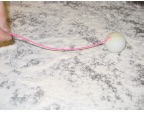 the table and rest the ping pong ball on the table.
A. Spin the ball so that you trace a circle in the flour.
B. The circle represents the orbit of the planets around the Sun or the Moon around the Earth.
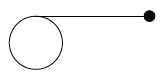
5. Spin the ball and release the string as you are spinning. Observe the path of the ping pong ball outlined in the flour. Describe or draw the path of the ball in the space below.
- Smooth the flour on the table and repeat the experiment to verify your results.
- Discuss the model with your group. What does the model represent, and what does each part of the model represent? Include the ping pong ball, the circle in the flour, and the string. The model represents the motion of a planet or the Moon if suddenly the force of gravity was no longer exerted on it. The ping pong ball represents a planet or the Moon, the circle in the flour represents the orbit of the planet or Moon, and the string represents the force of gravity on the planet or Moon. The release of the string represents a discontinuation of the force of gravity acting on the planet or Moon.
- Ask students whether they think that the results of their simulation would be replicated if they perform another simulation. Student answers will vary.
Trial 2: Perform a model of the orbit of planets around the Sun and the Moon around the Earth, using the scooter.
- Find a clear floor area. You will need two student volunteers for this model. First, read the directions, then perform the simulation.
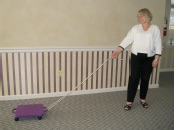
A. Student #1: Stand in the middle of your work area. Loop the rope through the handle on the scooter and hold both ends of the rope.
B. Student #2: Place the scooter as far away from Student #1 as the rope allows. Stand behind the scooter, ready to give the scooter one push and then release. You will try to push the scooter in a straight line past Student #1. When you are ready, push the scooter.
- Record: Describe the pathway of the scooter. The scooter circled around Student #1 until the force of friction caused the scooter to slow to a stop.
- This time model the path of a planet that is not influenced by the force of gravity. First, read the directions, then perform the simulation.
A. Student #2: Again place the scooter as far away from Student #1 as the rope allows. Stand behind the scooter, ready to give the scooter one gentle push and then release. You will try to push the scooter in a straight line past Student #1.
B. Student #1: After Student #2 pushes the scooter, release the rope.
4. When both students are ready, perform the simulation. Notice the direction in which the scooter moves. Describe or draw the path of the scooter in the space below.
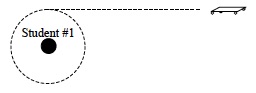
- Ask students why the ping pong ball and the scooter continued in a straight line. Student answers will vary. Tell students that the next Investigation begins to answer this question.
Trial 3: Eliminating the force of gravity
- Tear twelve small pieces of tape from the rope of masking tape and attach them to a nearby surface so that they can be used quickly.
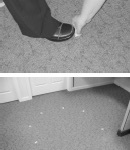
A. Place a lab stool in the center of your work area. One student in your group should place a hand on the stool and walk slowly in a circle around the stool.
B. As the student is walking, place one small piece of tape in front of his or her foot as each step is completed. Stop after one complete revolution is completed.
- Record: Look at the pieces of tape around the stool. What shape do the pieces of tape form? The pieces of tape form a circle around the stool.
- Locate the meter lengths of string.
A. Place one end of a piece of string on the 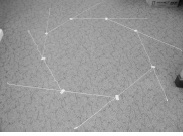 first piece of tape. Stretch the string until it makes a straight line through the second piece of tape.
B. Take another piece of string and connect the second piece of tape to the third. Continue this process until all of the pieces of tape have two pieces of string running through or touching them.
4. Draw the image created by connecting the pieces of tape with the pieces of string.
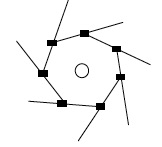
- How does this drawing explain why the ping pong ball and the scooter continued in a straight line after the force of gravity was eliminated? The circular path created as students circled the stool is actually a series of lengths of linear motion. Similarly, as the Earth orbits the Sun, it travels with forward linear motion. At any given point, the force of gravity from the Sun pulls the Earth into the Sun, changing the Earth’s direction. The elliptical orbit of the Earth is actually a series of very small lengths of linear motion constantly changing direction as a result of the force of gravity.
- You have now examined the effect of gravity on forward motion. Now imagine the path of a planet if the Sun’s gravitational pull suddenly became much greater. For this model, you will need two volunteers. First read the directions, then perform the simulation.
Student #1: Stand in the middle of your work area. Loop the rope through the handle of the scooter and hold on to both ends of the rope.
Student #2: Place the scooter as far away from Student #1 as the rope allows. Stand behind the scooter, ready to push it in a straight line past Student #1. When you and Student #1 are ready, push the scooter.
Student #1: After Student #2 pushes the scooter, quickly pull on the rope. 7.
- Record: Describe the path of the scooter. The scooter is pulled toward the Sun.
- In this model, what does the quick pull of the rope represent? The quick pull on the rope represents a great increase in the force of gravity.
- Why is the combination of forward motion and gravity important in maintaining the orbit of the planets and the Moon? The combination of forward motion and gravity causes the planets to orbit the Sun and the Moon to orbit the Earth. Without this precise amount of gravity, planets would either fly out of orbit in a straight line or they would be pulled toward the Sun.
CLEAN UP
Let students know your expectations for clean up. Ask them to clean up.