
Teacher Portal:
Space
Investigation 4 – Concept Day
ZERO-IN
Italicized font represents information to be shared orally or physically completed with the students at this time.
The non-italicized font represents additional information included to support the teacher’s understanding of the content being introduced within the CELL.
ASK WHY
Explain to students that space exploration provides us with knowledge about the origins of our solar system, planet Earth, and human origins. Exploration within our solar system is important because it provides us with an opportunity to make advancements in science and technology which can be a benefit to all of humankind, such as in the areas of communications and remote sensing. Cellular technology, for example, is dependent on satellite communications. Satellites are also used to monitor changes in Earth’s climate and ocean circulation, for weather forecasting, in aviation and marine navigation, and for military reconnaissance.
BRANCH OUT
Explain to students that astronomers investigate how galaxies are formed and if supermassive black holes live at their centers. They determine the composition of a planet, its atmosphere, and its moons and also help plan voyages to other planets or the moon and explain the missions to the public.
PRINT IT
Use your browser to download a printable PDF as a help during the slide presentation and to make additional notes. In your browser, go to File > Print and then choose to save as PDF.
NAVIGATE IT
Once the slide presentation is launched
- use your left and right arrows to advance or go back in the slide presentation, and
- hover your mouse over the left edge of the presentation to get a view of the thumbnails for all the slides so that you can quickly move anywhere in the presentation.
- Click HERE to launch the slide presentation for the CELL.
SHARE IT

SLIDE SPACE-4-1
In this final Investigation in the Space CELL, we begin with a brief discussion of what galaxies are.
We will then turn our attention to the factors that influence the force of gravity. This will be important as we continue our Lab experiments involving orbits.
______________________________________________

SLIDE SPACE-4-2
Note: This slide is animated. The teacher may wish to practice the animations before using the presentation to lead student discussion.
- This slide gives a very quick overview of the most relevant aspects of galaxies. As described in the first short paragraph, galaxies were the first complex systems to form after the Big Bang. Even so, it was about 1 billion years after the Big Bang that the first galaxies formed. This makes the oldest galaxies in the Universe over 12 billion years old.
- As noted in the second paragraph, galaxies range in size anywhere from containing 10 million stars to over 10 trillion stars. There are approximately 300 billion stars in our own galaxy, the Milky Way Galaxy.
- The image on this slide was obtained by the Hubble Space Telescope. Edwin Hubble was an American astronomer who is known, along with the Belgian priest/astronomer, Georges Lemaitre, for work suggesting that the Universe has been expanding since the Big Bang and continues to expand.
- The final paragraph on this slide points out that the high-resolution image shown here from the Hubble Space Telescope contains at least 3,000 distant galaxies. The further a galaxy is from us, the longer it takes light from it to reach Earth. The light from the most distant galaxies that can be seen on this image left those galaxies some 12 billion-plus years ago.
______________________________________________

SLIDE SPACE-4-3
Note: This slide is animated. The teacher may wish to practice the animations before using the presentation to lead student discussion.
- This slide shows an illustration of our own galaxy, the Milky Way Galaxy. There is, of course, no way currently available to take a real picture of the Milky Way Galaxy, as we would have to leave it and look back to take such a picture. Since the size of the Milky Way Galaxy is about 100,000 to 120,000 light-years across, it would take us thousands of years to get far enough away to take such a picture… even IF we could travel at the speed of light… which we can’t!
- Our galaxy is about 13.2 billion years old so it formed soon after the Big Bang (about 1 billion years after the Big Bang) along with billions of other galaxies that exist in the Universe. While many galaxies are ancient, like our own Milky Way Galaxy, new galaxies are thought to still be forming today.
- Finally, the arrow that appears in animation points roughly to the position of our Sun. There are some 300 billion stars in the Milky Way Galaxy and it is by no means near the largest galaxy we know of. In fact, some galaxies contain in excess of 10 trillion stars. Such a galaxy would be over thirty times as large as ours, perhaps some 3.6 million light-years across.
______________________________________________

SLIDE SPACE-4-4
- This simple slide shows an illustration of the Hubble Space Telescope. The Hubble has given us some of the best, high-resolution images of our Universe. Because it is orbiting the Earth, outside its atmosphere, it is capable of getting images of immense quality and clarity. NASA launched the Hubble Space Telescope into space. It is a scientific accomplishment that we can all be very proud of.
- The Hubble Space Telescope was launched 23 years ago and has been working well all this time. It was originally expected to last until 2015 but now it is expected to last perhaps another 6 years (until perhaps 2019). Plans for more powerful and higher resolution space telescopes to replace the Hubble are underway.
______________________________________________

SLIDE SPACE-4-5
Note: This slide is animated. The teacher may wish to practice the animations before using the presentation to lead student discussion.
- This slide is included for two reasons. First, it is an image captured by the Hubble Space Telescope that we have just discussed. It is of a cluster of gas clouds and dust from the Eagle Nebula. The Eagle Nebula is in our own galaxy, the Milky Way Galaxy. Actually, it is only a small but highly recognizable section of the nebula known as the Pillars of Creation, three cloud-like projections, light-years in size are shown in this magnificent Hubble image. The Pillars of Creation are thought to be the ideal environment for the formation of new stars.
- The second reason for including this slide is discussed in the second and third of the animated paragraphs. There is evidence that these three pillars were destroyed thousands of years ago and therefore no longer really exist. And yet, through Hubble, we can still see them. This is because it takes 7,000 years for light from the Pillars of Creation to reach Earth. That is, we see what existed 7,000 years ago. In a sense, we are looking into the ancient past. We will continue to see the three Pillars of Creation from Earth for another thousand years or so. Only then will astronomers see their destruction and disappearance.
- We are hopeful that this story of the Three Pillars of Creation in the Eagle Nebula will impress upon students the vast, unimaginable magnitude and dimensions of space. We also hope that even sixth-grade students begin to see the connection between time and space by these basic discussions. They will be able to process this information with greater meaning as they continue through LabLearner and life.
______________________________________________

SLIDE SPACE-4-6
- With this slide, we return back to Earth. The Lab for Investigation 4 continues to involve the concept of orbits.
- When discussing astronomical orbits, we have to consider both Newton’s First Law of Motion as well as his concept of gravity. The pull of gravity is the external force that stops a body, like the Moon, from continuing on a perfectly straight course forever. When a smaller astronomical body like a moon nears a planet like Earth, the force of gravity acts on it and alters its course.
- In this slide, we present the equation for gravitational force. The challenge for sixth-grade teachers will perhaps be a mathematical one, depending on their students’ familiarity with simple algebraic equations. Consider the equation for the force of gravity:
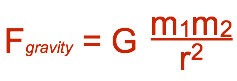
- G is the gravitational constant, which is 6.67384 x 10⁻¹¹m3kg-1s-2. This constant would, of course, be extremely important if we were considering how close an asteroid will pass by Earth. However, here we need not be concerned with this constant in this discussion because it is unchanging and we will be most interested in two other variables in this equation, namely mass (m) and distance (r). You can simply disregard G in this discussion.
- Essentially, what this equation tells us is that as the product of the masses of two astronomical bodies increases, the gravitational force between them will also increase. This is because, if the numerator increases in this equation with a constant distance (r), the force of gravity will increase. Also, if the denominator in the equation increases (r), and the product of the masses (m1m2) remains constant, the force of gravity will decrease (dividing m1m2 by a larger number).
- Considering Newton’s First Law of Motion and his gravitational equation, we must give Newton credit for the immensity of his contribution to science.
- The next two slides are aimed at illustrating to students the importance, in real-life-terms, of Newton’s gravitational force equation.
______________________________________________

SLIDE SPACE-4-7
- This simple slide emphasizes the m1m2, or mass component of the gravitational force equation.
- To the very left, we see an astronaut who weighs 50 kg (110 pounds) on Earth. If she travels to the Moon, which has significantly less mass than Earth, she would weigh only 8.3 kg, or about 18.2 pounds.
- To the far right, the same astronaut standing on the surface of Jupiter, which has a mass much larger than Earth’s, would weigh 118.2kg (260 pounds). Thus, in the Newtonian gravitational force equation:
- The numerator (m1m2) is the variable that changes in these scenarios.
______________________________________________

SLIDE SPACE-4-8
- This slide emphasizes the r2, or distance component of the gravitational force equation. Since the astronauts in this picture are very far from Earth, Earth’s gravitational pull on them has been diminished. Thus, in the Newtonian gravitational force equation:
- The denominator (r2) is the variable that changes. It increases so that m1m2/r2 results in a lower Fgravity. At this distance, the astronauts have essentially become “weightless”.
______________________________________________

SLIDE SPACE-4-9
Note: This slide is animated. The teacher may wish to practice the animations before using the presentation to lead student discussion.
Note: This slide directly addresses the experiments that students will perform in Investigation 4 Lab. This example shows the orbit of our Moon around Earth.
- As one body orbits another, it has two vector forces acting upon it. The first, based on Newton’s First Law of Motion, is the force to continue in a straight line. The second force is that of gravity by the larger body that is orbiting.
- At any point in its orbit, the Moon must move forward in a straight line. At any point in the Moon’s rotation, it would continue on this straight trajectory if not for the influence of the much larger mass of Earth.
- In this animation, two clicks show that the path of the Moon orbits Earth in a geometric circle. The Moon’s forward force, combined with the external force of gravity of Earth, causes it to circle, or orbit, the Earth. The Moon has been orbiting the Earth for about 4.47 billion years.
______________________________________________

SLIDE SPACE-4-10
- This slide shows what would happen if the force of gravity that the Earth exerts on the Moon suddenly disappeared.
- The Moon orbits Earth in a counter-clockwise direction. At 3 o’clock, we see the red bar signifying the gravitational pull of Earth on the Moon, keeping it in orbit around us.
- After 6 o’clock, the gravitational pull of Earth on the Moon is obliterated. As can be seen, the Moon, under these fictitious circumstances, would continue moving on into space at a perfectly straight line, tangent to Earth.
Note: A common misconception of many students is that, if the Moon is released from its Earthly orbit, it would leave Earth’s orbit is a spiral. The image below demonstrates this misconception and is included as a reference for the teacher. The image is NOT visible to students during the slide show.
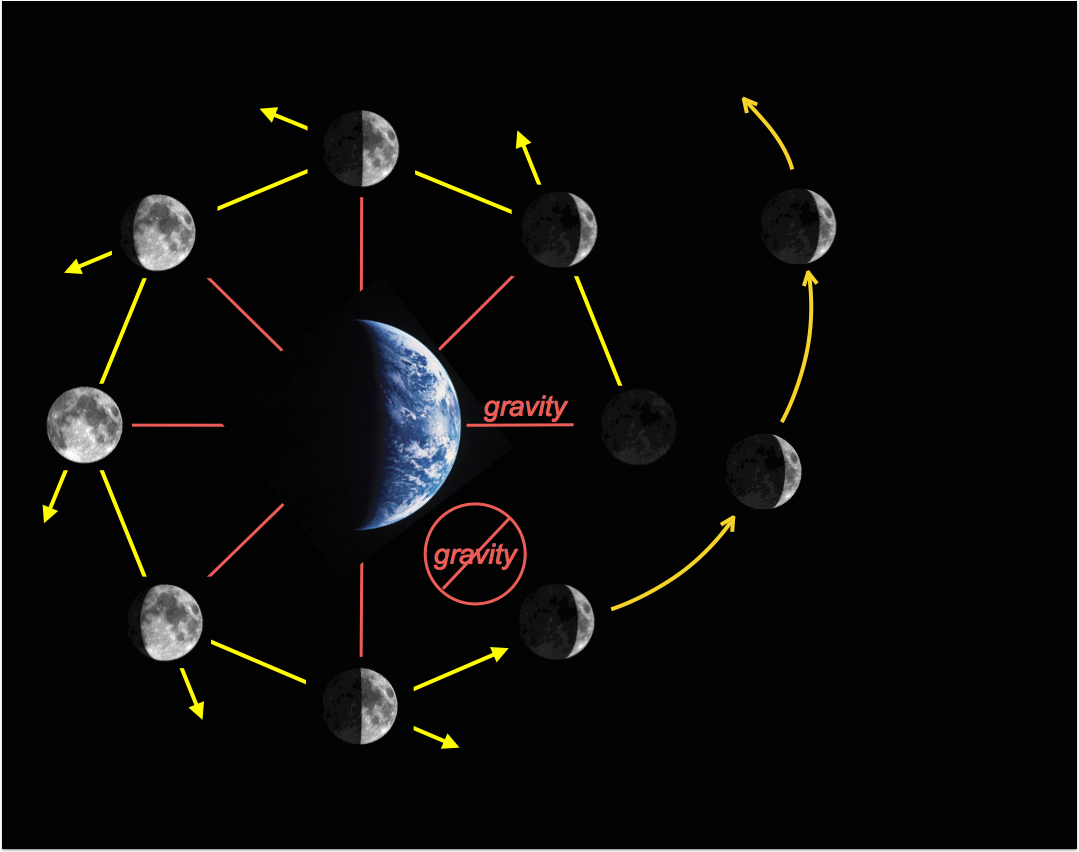
- This, of course, could never happen because once the Moon leaves Earth’s orbit, Earth’s gravitational pull on it would disappear and there would only be one force acting on it, it’s original propensity, according to Newton’s First Law of Motion, to move in a straight line.
Note: Students will prove this theoretical possibility directly in Investigation 4 Lab.
______________________________________________