
Teacher Portal:
Space
Investigation 3 – Lab
ZERO-IN
Italicized font represents information to be shared orally or physically completed with the students at this time.
The non-italicized font represents additional information included to support the teacher’s understanding of the content being introduced within the CELL.
MINDSET
This Investigation is designed to:
- illustrate that an object in motion remains in motion unless an outside force acts on the object, and
- show students that planetary orbits are governed by the forward motion of planets and the gravitational pull of the Sun
BE PREPARED
Teacher Preparation for the Investigation includes the following. This preparation should be done prior to students arriving in the lab.
- Make five copies of the Student Role Resource Page. Cut each page in half so that Student #1 Role and Student #2 Role are separate.
- Cut five lengths of rope, each 3 m long.
- Place all materials at a central location.
Note: Each student lab group will need the materials listed below.
- Divide students into cooperative groups of five students.
Student Preparation for the Investigation includes having students gather the following materials. This preparation takes place on lab day after student lab groups have settled at their assigned lab tables.
Note: The materials are listed in students’ SDRs. They are also listed below for your reference.
- (1) scooter
- (1) piece of rope
Direct one student from each lab group to collect the materials listed in their SDRs.
INVESTIGATE
- Tell students that a scientist named Sir Isaac Newton described the motion of objects in three statements called Newton’s Three Laws of Motion.
- Tell students that, during this investigation, they will investigate the first statement, or the first law of motion, which reads as follows: An object in a state of uniform motion stays in that state unless acted upon by an outside force.
- Encourage students to reflect on the PreLab video as they move through the procedural steps.
- Explain to students that during the Experiment, every procedural step is important. If one step is skipped, data can become invalid. To help students keep on track, direct them to read each step thoroughly, complete the step, then check it off (Read it – Do it – Check it off).
- Direct students to complete the procedural steps in their SDRs.
Note: The procedural steps are listed below for your reference. Teacher “Notes” are inserted, as needed, to help facilitate the lab.
Note: For Investigations Three and Four, students will need a substantial amount of space to perform the experiments. Each group of students will need an area approximately four meters by four meters. If possible, this space could be found in an unused gymnasium, auditorium, cafeteria, or other large room. If such a space is not available, a wide hallway would suffice. If even a wide hallways is unavailable, the lesson may have to be adapted as a class Investigation rather than small group activities.
Trial 1: Model the movement of the planets
- Choose one student in your group to sit on the scooter
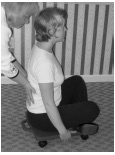 (student #1) and one student to push the student on the scooter (student #2).
 - Student #1 – sit on the scooter so that no part of your body is touching the floor.
- Student #2 – push the student sitting on the scooter. When pushing, push firmly, but carefully, on the middle of student #1’s lower back. Give one firm push and then release.
- What acted upon the scooter to cause it to move from a state of rest? A force was applied in the form of a push.
- After it was in motion, what was the movement of the scooter? The scooter traveled in a straight line until it came to a stop.
- After it was in motion, why did the scooter come to a stop? Describe your answer in terms of Newton’s First Law of Motion. Newton’s First Law of Motion states that an object in a state of motion will stay in that state until a force acts on it. The scooter began at rest. A student exerted a force on the scooter and set the scooter into motion. Then the force of friction acted on the scooter, causing it to slow and come to a stop, changing its state of motion.
- Imagine that the scooter was put in motion and that no outside force acted on it to stop its motion. Draw the path of the scooter if no outside force acted on it.

Note: Allow students to switch roles and to experience the Investigation as time allows.
Trial 2: Model the forces that keep objects in orbit
- Tell students that just as the scooter had forward motion, so do the planets and the Moon. Each planet (including Earth) and the Moon are experiencing forward motion. Tell students that through performing the next two models, students will determine why the planets have an elliptical orbit around the Sun rather than traveling in a straight line past the Sun.
- Distribute the Student #1 and #2 Role pages to each group of students. Instruct the students to read their papers to determine their role in the experiment.
Note: The Student #1 and #2 Role Page information is listed below for reference.
Model A
- The first model will require two students from your group to perform and the rest of your group to observe. First, read the directions, then perform the model.
- All planets have a forward motion. Model the forward motion of the planets.
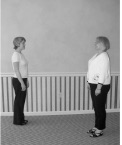
A. Student #1: Stand in the middle of your group’s work area.
B. Student #2: Walk in a straight line past Student #1. You should walk approximately 1 m from Student #1.
- Record: Describe the movement of Student #2. Student #2 moved in a straight line past Student #1.
- Next model the forward motion of the planets and the gravitational pull of the Sun. Follow the directions on the Role Pages from your teacher.
- Record: Describe the movement of Student #2. Student #2 circled Student #1 as a result of the forward motion of Student #2 and the pull of Student #1.
Note: You may need to explain to the class why student #1 should not know the role of student #2 and vice versa. Ideally, the simulation should be successful regardless of whether or not each student knows the other’s goal. However, it could be difficult not to inadvertently skew the results of the simulation. For instance, if student #2 knows that student #1 will try to grasp his or her arm, student #2 may unconsciously either reach toward student #1 to help or move away from student #1 to keep from being grasped. Such movement could diminish the significance of the simulation. This part of the investigation is designed to illustrate that the application of a force can change the motion of an object. In this case, the forward motion of student #2 is changed as a force is applied to student #2 by student #1. The result is student #2 now moves in a circular motion.
Model B
- Place the scooter at the starting position of Student #2 in Model A. Pick three students to perform Model B.
- Model the forward motion of the planets. First, read the directions, then perform the model.
A. Student #1: Stand in the middle of your group’s work area.
B. Student #2: Sit on the scooter.
C. Student #3: Push the student who is sitting on the scooter, on the lower-middle of his or her back, in a straight line past Student #1.
- Record: Describe the movement of Student #2. Student #2 moved in a straight line past Student #1.
- Read the directions that follow then perform the model.
A. Student #1: Loop the rope through the handle on 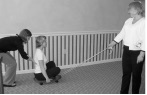 the scooter. Hold both ends of the rope tightly so that the rope does not slide from your hands.
B. Student #2: Sit on the scooter.
C. Student #3: Attempt to push the student who is sitting on the scooter, in the middle of his/her lower back, in a straight line.
- Record: Describe the movement of student #2 and why it occurred. Student #2 circled Student #1 as a result of the forward motion of Student #2 and the pull of Student #1.
- Refer to Model A and Model B. What did the models represent? The models represented the movement of the planets around the Sun and the Moon around the Earth.
Note: Allow students to switch roles and to experience the Investigation as time allows.
_____________________________________
Student Role Resource Page
Student #1
Your task is to stand in the middle of your work area. When your partner walks toward you, reach out and grasp his or her wrist firmly but not aggressively. Your partner will continue walking, but you must not let go of his or her wrist. You also may not move from the center of your area. This will likely require that you turn in place as your partner walks. This will cause your partner to walk in a circle.
It is important that you act responsibly throughout this experiment. To properly model motion, you must act deliberately but carefully. Avoid moving suddenly so that you and your group remain safe. Have fun!
Student #2
Your task is to again walk in a straight line past your partner. However, this time your job may be more difficult. If your partner somehow keeps you from accomplishing your goal, simply try to maintain forward motion. Keep walking.
It is important that you act responsibly throughout this experiment. To properly model motion, you must act deliberately but carefully. Avoid moving suddenly so that you and your group remain safe. Have fun!
CLEAN UP
Let students know your expectations for clean up. Ask them to clean up.