
Teacher Portal:
Space
Investigation 3 – Concept Day
ZERO-IN
Italicized font represents information to be shared orally or physically completed with the students at this time.
The non-italicized font represents additional information included to support the teacher’s understanding of the content being introduced within the CELL.
ASK WHY
Remind students that space exploration provides us with knowledge about the origins of our solar system, planet Earth, and human origins. Exploration within our solar system is important because it provides us with an opportunity to make advancements in science and technology which can be a benefit to all of humankind, such as in the areas of communications and remote sensing. Cellular technology, for example, is dependent on satellite communications. Satellites are also used to monitor changes in Earth’s climate and ocean circulation, for weather forecasting, in aviation and marine navigation, and for military reconnaissance.
BRANCH OUT
Explain to students that cosmologists conduct observational and theoretical research to broaden their understanding of energy, matter, and natural processes throughout the universe, particularly beyond Earth. They also study distant galaxies and the birth and death of stars that live many light-years away. This helps explain how old our universe is in relation to other galaxies. Every day, cosmologists are discovering something new about our universe!
PRINT IT
Use your browser to download a printable PDF as a help during the slide presentation and to make additional notes. In your browser, go to File > Print and then choose to save as PDF.
NAVIGATE IT
Once the slide presentation is launched
- use your left and right arrows to advance or go back in the slide presentation, and
- hover your mouse over the left edge of the presentation to get a view of the thumbnails for all the slides so that you can quickly move anywhere in the presentation.
- Click HERE to launch the slide presentation for the CELL.
SHARE IT

SLIDE SPACE-3-1
This is a relatively short Investigation and Lab. We will discuss the Sun and how it is able to keep burning, producing energy and light for billions of years.
We will also begin a discussion of planetary orbits. This will necessitate a preliminary discussion of Newton’s First Law of Motion: An object either remains at rest or continues to move at a constant velocity unless acted upon by an external force.
We will discuss how the tremendous gravity of a star may act on a planet, causing it to orbit the star.
______________________________________________

SLIDE SPACE-3-2
- In this slide, we begin our discussion of the Sun. The Sun, of course, is our closest star. However, it is certainly not that large of a star compared to the millions of other stars we can see in the night sky, it simply appears so large and powerful because we are so close to it. We are about 8 light minutes from the Sun, that is, it takes light leaving the Sun about 8 minutes to reach the Earth’s surface. That is about 149,600,000 kilometers (92,960,000 miles).
- The surface temperature of the Sun is about 6,000oC, however it is much hotter than this near its center where, under extreme pressure caused by gravity, the temperature can exceed 15,000,000oC.
- The Sun is composed of a number of elements but by far the major components are hydrogen (75% of total mass) and helium (25% of total mass). In the next slide, we will see why such high temperatures and pressure, along with the presence of so much hydrogen, is so important.
Note: This slide is animated. The teacher may wish to practice the click moves in advance.
______________________________________________

SLIDE SPACE-3-3
- What causes the Sun to keep burning? How does it produce so much heat and light? As we discussed in Investigation 1, the Sun has been burning for about 4.6 billion years, since the beginning of the Solar System, how much longer can it keep it up?
- In this slide, we introduce the concept of nuclear fusion. It is called nuclear fusion because four hydrogen atoms actually come together with such force that their nuclei fuse. This only occurs near the center of the Sun, where the temperature and pressure are the most intense.
- Since hydrogen atoms are composed of a single proton in their nuclei, sometimes they are simply referred to as “protons” and so the Sun’s nuclear fusion reaction is sometimes called proton-proton fusion. The reaction we show here is somewhat oversimplified as it omits some intermediate steps in the proton-proton fusion reaction but it is detailed enough for most sixth-grade students. We will return to it in greater detail when we study the CELLs Light and Photosynthesis in grade 8.
- This slide shows a graphic that depicts 4 hydrogen atoms (protons) colliding with each other. This collision results in the formation of one helium atom and also the release of energy in the form of a photon. Photons are often depicted by the lower case Greek letter gamma and a squiggle line arrow.
are hydrogen (75% of total mass) and helium (25% of total mass). In the next slide, we will see why such high temperatures and pressure, along with the presence of so much hydrogen, is so important.
Note: This slide is animated. The teacher may wish to practice the click moves in advance.
______________________________________________

SLIDE SPACE-3-4
- This slide explains the overall reaction of nuclear fusion in greater detail. The Periodic Table of the Elements is included in the upper left simply to remind students that all known atoms can be found on the Table. In this case, we will focus on element number 1 (H, hydrogen) and number 2 (He, helium), and these elements are enlarged in the figure on the upper right-hand side of the slide.
Note: The following calculations explain where the energy comes from in a nuclear fusion reaction. It also emphasizes the useful information found in the Periodic Table of the Elements.
- According to the Periodic Table, hydrogen has a molecular mass of 1.0079. Since 4 hydrogen atoms are involved in the fusion reaction, we multiply this number by 4 and get an atomic mass of 4.0316. The helium atom has a molecular mass of 4.0026 according to the Periodic Table. So, 4 hydrogen atoms with a total mass of 4.0316 are converted to a single helium atom with a mass of 4.0026. This leads to the simple subtraction shown on the lower left side of the slide:

- Oh my… we have lost matter! We end up with less mass than we started with. The Law of Conservation of Matter says that matter cannot be destroyed or created. (LabLearner students should know this from elementary school.) What happened? This is what makes nuclear fusion reactions so powerful. The mass was converted to energy! This is what stars do. They convert mass to energy. The energy released is in the form of light energy, a photon.
- On the next slide, we will see just how much energy the Sun can produce through nuclear fusion.
______________________________________________

SLIDE SPACE-3-5
- As the illustration on the lower left of this slide indicates, the relation between energy (E), mass (m), and light (c) is according to Einstein’s famous equation E=mc2. Students need not consider this equation in further detail at this time. However, it gives them one example of the importance of this equation, one they will see in more advanced physics.
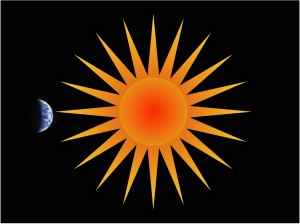
- On the right-hand side of this slide, we see numbers that explain why the fusion reaction leads to the production of so much energy in the Sun. The Sun converts 4 billion kilograms (about 8.8 billion pounds) of matter into energy per second. Once again, it is hard to comprehend the magnitude of such numbers.
- One may wish to think of the Sun’s energy production from a different perspective. The Sun’s nuclear fusion reaction, converting hydrogen into helium has been the sole source of energy for life on Earth for the past 3.5 billion years and could do so for another 4 billion years. Then consider that the Sun radiates such massive amounts of energy in all directions, not just toward the Earth… amazing!
Note: The image below is NOT visible to students during the slide presentation.
______________________________________________

SLIDE SPACE-3-6
- This is a simple introductory slide to switch concepts from the Sun’s nuclear fusion reaction to the principle of planetary orbits.
Note: In Investigation 3 Lab, students will perform a series of fun experiments with scooters and ropes. We want them to consider the background theory as they do the experiments.
- As we discuss planetary orbits and the role gravity plays in the process, keep in mind the same principles are involved in any orbit relationship between astronomical bodies, whether planets orbiting the Sun, moons orbiting planets, or whole galaxies whirling around each other.
______________________________________________

SLIDE SPACE-3-7
- Sir Isaac Newton was one of the most influential scientists who ever lived. As a review, his three Laws of Motion are as follows:
- First Law: An object either remains at rest or continues to move at a constant velocity unless acted upon by an external force.
- Second Law: F = ma. The force (F) on an object is equal to the mass (m) of that object multiplied by the acceleration (a) of the object.
- Third Law: When one body exerts a force on another body, the second body simultaneously exerts an equal force on the first body in the opposite direction. That is, for every action, there is an equal and opposite reaction.
- Newton’s First Law of Motion is at the heart of explaining how orbits are dictated by gravity and mass, as we will discuss on the following two slides.
______________________________________________

SLIDE SPACE-3-8
- As shown in the top illustration on this slide, without the pull of gravity on a planet, it would simply move in a straight line by the star (the Sun for example) and continue on its way.
- According to Newton’s First Law of Motion, the path of the planet can be changed from a straight line IF an external force acts upon it (lower illustration). Newton showed us that gravity is such an external force that can have a profound influence on the motion of astronomical bodies.
Note: Students may justifiably ask, “What makes the planet move in the first place?” Everybody in the Universe was set into motion by the Big Bang. Even though this occurred nearly 14 billion years ago, recall that Newton’s First Law of Motion states that an object will continue moving in a straight line unless acted upon by an external force. In the molecule-free environment of space, not even friction exists as a force to slow down a planet’s forward motion.
Note: Students may also ask, “Once in orbit, what keeps the planet in continual motion around the star/Sun?” We once again return to Newton’s First Law to answer this very good question. The pull of gravity from the Sun changes the planet’s direction but does not slow it down, which would take a force acting in the opposite direction to the planet’s movement. Planets orbit in the vacuum of space where there are no molecules to cause frictional force to slow down the planet. Therefore, the planet continues moving in orbit.
______________________________________________

SLIDE SPACE-3-9
- This final slide simply shows the circumstances that must be overcome to arrive at a sustained orbit. In the illustration to the left of this slide, the gravitational force of the star is not enough to pull the planet into orbit. This may be because the star is not large/massive enough to exert enough gravitational force on the planet, or because the planet is not passing close enough to the star. Notice, however, that passing so near to the star has nonetheless changed the planet’s trajectory or path. The planet will continue on from here in a straight line and at the same velocity forever unless another external force acts upon it.
- The lower illustration on this slide shows a result of a planet that comes too near a star that has too much gravitational force. Remember, the principles we are discussing here apply to all astronomical bodies.
- Asteroid analogy: Imagine that the star in this slide is the Earth and that the planet is an asteroid. Whether or not the asteroid crashes into the Earth depends on the same two factors as for stars and planets: the Earth’s gravitational pull and how close the asteroid comes to the Earth. Under one set of circumstances, a passing asteroid that comes close to the Earth may have its path altered by the Earth’s gravitational force but not enough to be pulled into the Earth’s orbit or surface. However, under another set of circumstances, the asteroid may come too close to the Earth and be pulled into the Earth’s surface by the Earth’s gravitational force. Examples of both types of scenarios have repeatedly occurred in Earth’s history and both scenarios will certainly occur again at some point in the Earth’s future