
Teacher Portal:
Space
Investigation 2 – Lab
ZERO-IN
Italicized font represents information to be shared orally or physically completed with the students at this time.
The non-italicized font represents additional information included to support the teacher’s understanding of the content being introduced within the CELL.
MINDSET
This Investigation is designed to:
- contribute to students’ visual understanding of the phases of the Moon,
- illustrate the effect the rotation of the Earth has on the phases of the Moon,
- illustrate the effect of the revolution of the Moon on the phases of the Moon, and
- allow students to form a mental model of the position of the Sun in relation to the Earth and the Moon.
BE PREPARED
Teacher Preparation for the Investigation includes the following. This preparation should be done prior to students arriving in the lab.
- Place all materials at a central location.
Note: Each student lab group will need the materials listed below.
- Divide students into cooperative groups of five students.
Student Preparation for the Investigation includes having students gather the following materials. This preparation takes place on lab day after student lab groups have settled at their assigned lab tables.
Note: The materials are listed in students’ SDRs. They are also listed below for your reference.
- (1) moon ball
- (1) student globe
- (1) meter stick
- (1) flashlight
- (5) pieces of tape, approximately 3 cm in length
Direct one student from each lab group to collect the materials listed in their SDRs.
INVESTIGATE
- Tell students that during this investigation they will create a model of the Earth, Sun, and Moon to determine why we observe different phases of the Moon and to determine whether our observations are related to the motion of the Moon, the Sun, or the planets.
- Encourage students to reflect on the PreLab video as they move through the procedural steps.
- Explain to students that during the Experiment, every procedural step is important. If one step is skipped, data can become invalid. To help students keep on track, direct them to read each step thoroughly, complete the step, then check it off (Read it – Do it – Check it off).
- Direct students to complete the procedural steps in their SDRs.
Note: The procedural steps are listed below for your reference. Teacher “Notes” are inserted, as needed, to help facilitate the lab.
- In this investigation, the movement of the Moon’s phases will be modeled. One student in the group will represent the Earth, one will represent the Moon, and one will represent the Sun.
- Why can the different phases of the moon be observed from the Earth? Record your hypothesis. Student answers may vary.
- The student representing the Moon should hold the moon ball
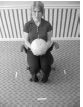 directly in front of his/her torso, the student representing the Sun should hold the flashlight, and the student representing the Earth should hold the globe.
 - Place a stool in the center of a small area in your classroom. The student representing the Earth should sit on the stool, holding the globe.
Note: Remember that although the Earth is located in the center of your model, the Sun is at the center of the solar system. If the model involved the complete movement of the Moon, Sun, and Earth, the Sun would be located in the center. Remember that the Earth rotates on its axis constantly and continuously revolves around the Sun.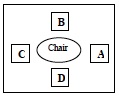
- Place four pieces of tape on the floor, each approximately 0.5 m from the chair. Label the four pieces of tape, consecutively A, B, C and D. Place the tape in a circle around the chair, counterclockwise in order from A through D.
- The student representing the Moon should stand on the piece of tape facing toward the Earth, labeled A. The person
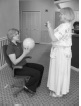 representing the Sun will join later.
 - Place the fifth piece of tape on the side of the moon ball facing the Earth. This marks the near side of the Moon.
Trial 1: Model the rotation of the Earth and the revolutions of the Moon
- The student representing the Earth should rotate on the stool seven times.
- As the Earth performs its seven rotations, the student representing the Moon should slowly move counterclockwise toward the tape B. The tape on the moon ball should always face toward the Earth.
- By the time the Earth finishes its seventh rotation, the Moon should be standing on the tape B, having completed one-quarter of a revolution.
- Repeat steps 7 through 9 until the student representing the Moon is standing on tape D.
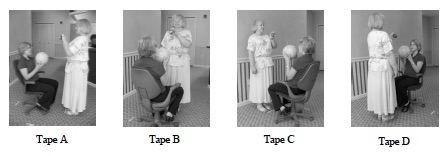
- How much time passes as the Earth completes one full rotation in our solar system? One day, or 24 hours, passes during one complete rotation of the Earth.
- How much time passes as the Moon completes one-quarter of a revolution around the Earth? Seven days pass while the Moon completes one-quarter of a revolution around the Earth.
Trial 2: Model how the Sun affects the Moon’s appearance
- The student representing the Sun should move to stand directly
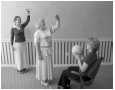 behind the Moon and opposite the Earth, directing the flashlight toward the Moon.
 - Observe how the light from the flashlight shines on the Moon and how the Moon would appear from the Earth. Repeat these steps at each Tape position.
Note: The students will start in the position that models the new Moon, or the position in which no Moon is visible from Earth. In this position, the flashlight will shine on the back of the student representing the Moon, and the lit face of the Moon will not be visible to the student who represents Earth.
Note: The student representing the Earth may need to explain to the group what he/she observes.
Note: Students should record their observations in Table A of their Investigation Two Data Sheet. Explain to students as they record their observations they should color in the area of the moon with their pencil that represents the light from the Sun.

CLEAN UP
Let students know your expectations for clean up. Ask them to clean up.