
Teacher Portal:
Space
Investigation 2 – Concept Day
ZERO-IN
Italicized font represents information to be shared orally or physically completed with the students at this time.
The non-italicized font represents additional information included to support the teacher’s understanding of the content being introduced within the CELL.
ASK WHY
Remind students that space exploration provides us with knowledge about the origins of our solar system, planet Earth, and human origins. Exploration within our solar system is important because it provides us with an opportunity to make advancements in science and technology which can be a benefit to all of humankind, such as in the areas of communications and remote sensing. Cellular technology, for example, is dependent on satellite communications. Satellites are also used to monitor changes in Earth’s climate and ocean circulation, for weather forecasting, in aviation and marine navigation, and for military reconnaissance.
BRANCH OUT
Explain to students that astrophysicists apply the laws of physics and chemistry to explain the birth, life, and death of stars, planets, galaxies, nebulae, and other objects in the universe.
PRINT IT
Use your browser to download a printable PDF as a help during the slide presentation and to make additional notes. In your browser, go to File > Print and then choose to save as PDF.
NAVIGATE IT
Once the slide presentation is launched
- use your left and right arrows to advance or go back in the slide presentation, and
- hover your mouse over the left edge of the presentation to get a view of the thumbnails for all the slides so that you can quickly move anywhere in the presentation.
- Click HERE to launch the slide presentation for the CELL.
SHARE IT
SLIDE SPACE-2-1
In this Investigation, we will briefly review the planets of our Solar System. We will also discuss asteroids, comets, and meteoroids.
We will then discuss moons in the Solar System and finally, discuss Earth’s Moon and the phases of the Moon as seen from Earth.
______________________________________________
SLIDE SPACE-2-2
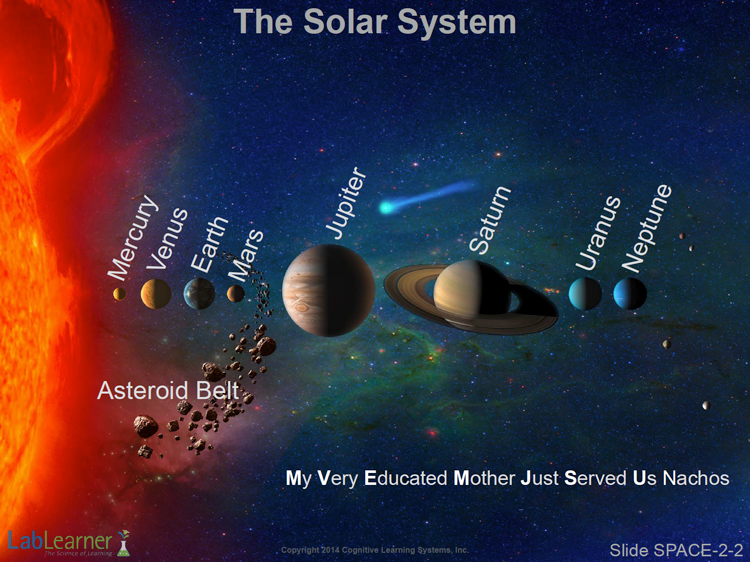
- In this slide, a NASA illustration of the eight planets of the Solar System is presented. The slide is animated and contains no labels until the first click. You will see that the asteroid belt between Mars and Jupiter is included in this drawing. Reference to the asteroid belt will be made in later slides.
- While an attempt is made in this and other illustrations of the Solar System to show the relative size of the eight planets, one rarely sees depictions of the Solar System in which the distances between planets is to scale. This is because the distances are simply too great to easily show graphically.
Note: The insert below is not visible to the students as part of the slide show. In this depiction, Mercury cannot be seen because it is both too close to the Sun and too small at this scale:

- A final animation introduces the mnemonic to help remember the order of the planets: My Very Educated Mother Just Served Us Nachos. The teacher may use her/his discretion whether to share this memory device with the students.
______________________________________________
SLIDE SPACE-2-3
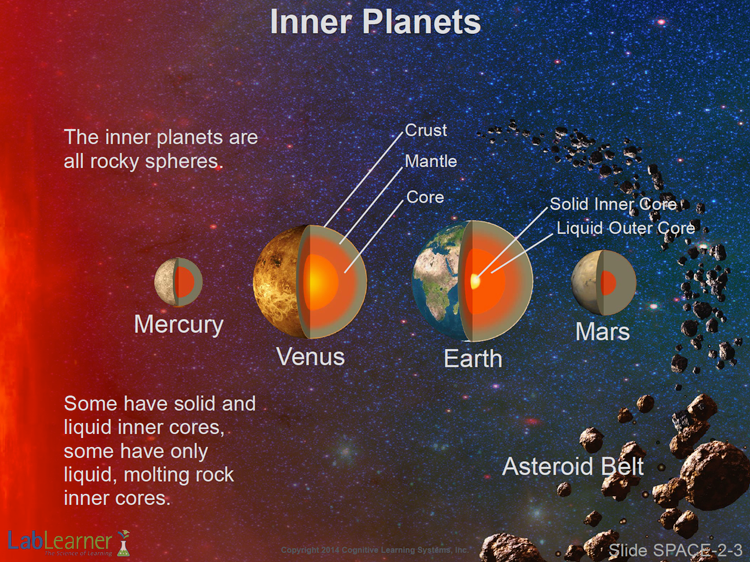
- In this slide, the inner planets of the Solar System are shown. As noted, the inner planets are all rocky spheres with solid crust. Once again, the asteroid belt is included on this slide to show its close proximity to Earth.
Note: This slide is animated. The first click introduces the cut-away sections of the inner planets, revealing the core, mantle, and crust. Students should be familiar with these terms regarding the Earth from their recent experience with the CELL Weathering & Erosion.
______________________________________________
SLIDE SPACE-2-4
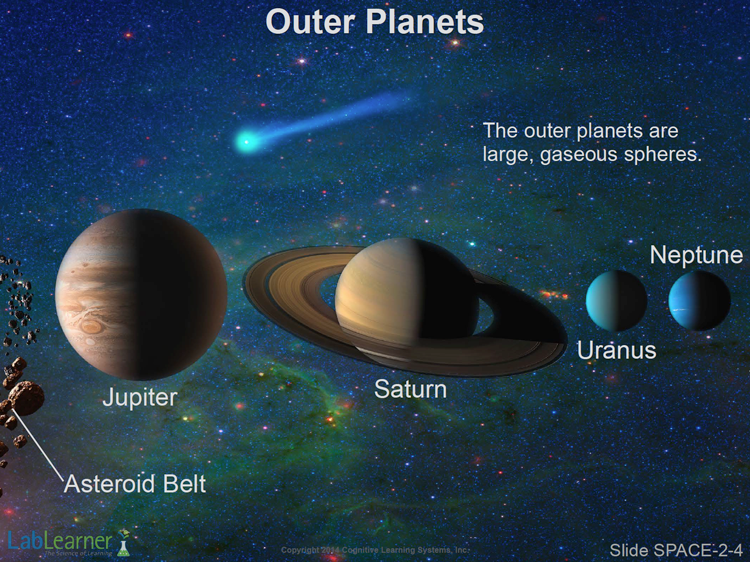
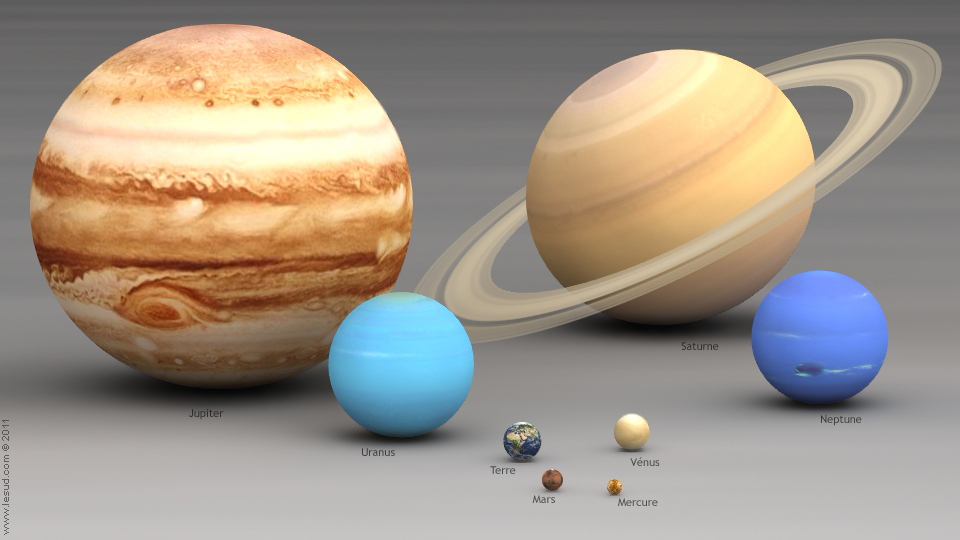
- In this slide, the Outer Planets of the Solar System are shown. As noted, the outer planets are large, gaseous spheres. Although they may look solid, one could not land a spacecraft on any of the outer planets, as they have no solid surface. Also, the outer planets are much bigger than the inner planets.
Note: Although the following insert is not visible to students during the slide presentation, it is included to show the size relationship between planets.
______________________________________________
SLIDE SPACE-2-5
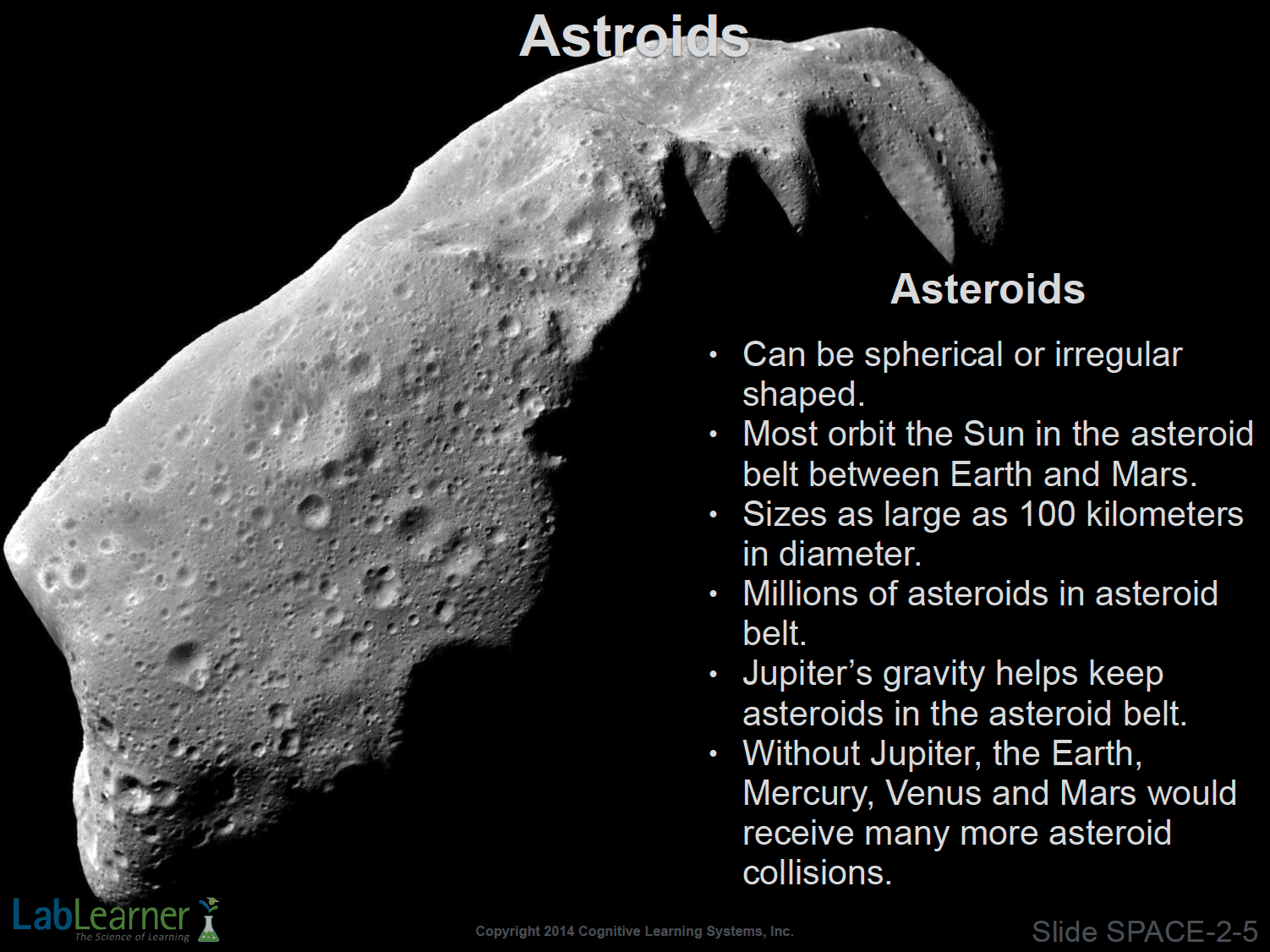
Note: In this slide, asteroids are introduced. Students will have varying familiarities with asteroids, as they have been the topic of several top box-office hit movies in recent years.
- There is no doubt that asteroids have hit the Earth in the past. The extinction of the dinosaurs some 65 million years ago is thought to have involved an asteroid impact. There is no doubt that asteroids will impact Earth again in the future.
- While most asteroids in the Solar System orbit around the Sun in the asteroid belt, some asteroids have circular orbits that pass among the outer planets. Others have elliptical orbits that pass within the orbit of Earth and Mercury.
______________________________________________
SLIDE SPACE-2-6
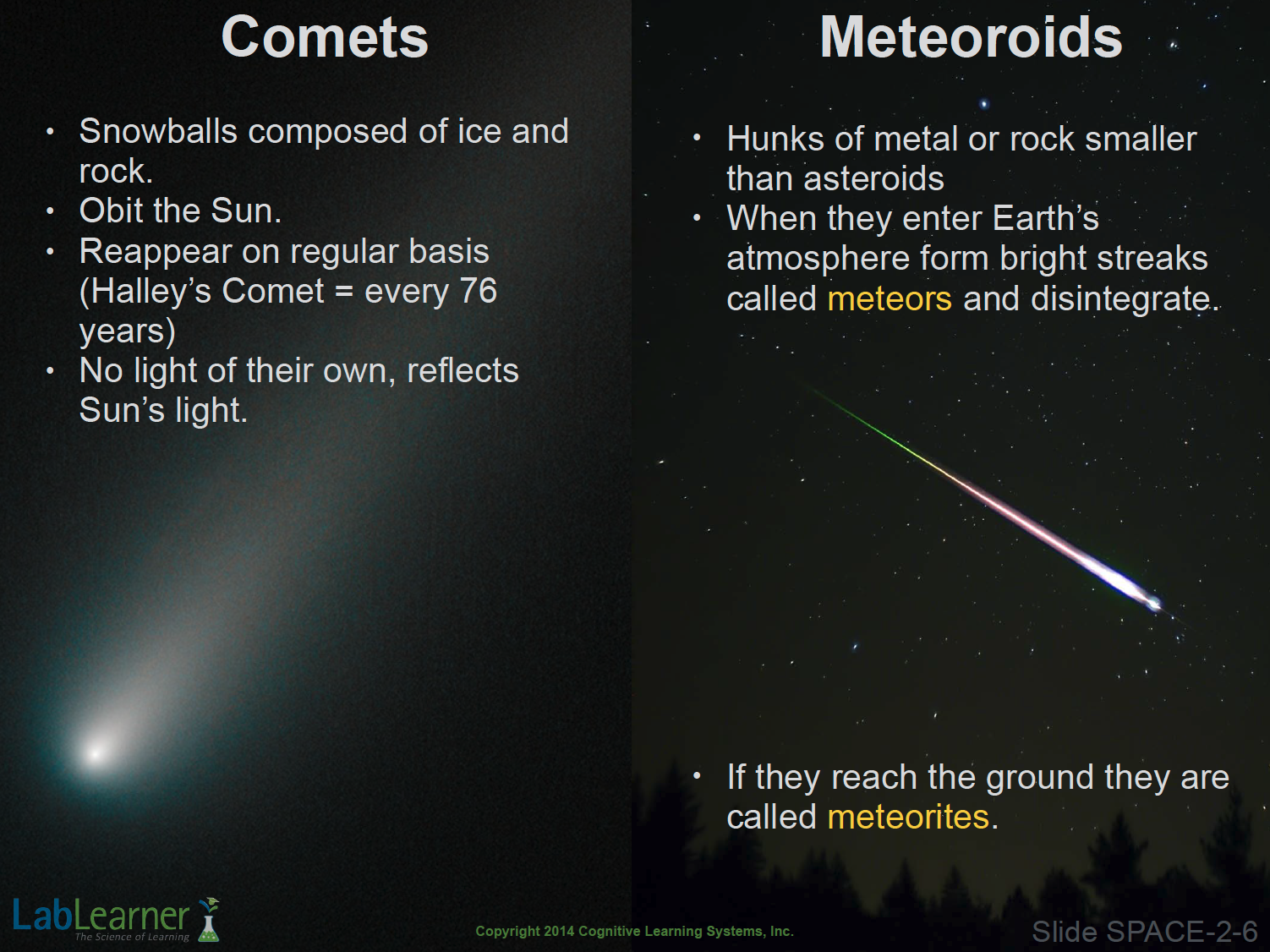
- This slide gives a very brief introduction to comets and meteoroids.
- As noted, comets are composed of ice and rock and do not give off their own light. Just like other luminous objects in the Solar System, their light is reflected from the Sun.
- A meteoroid is the name for the family of smaller than asteroid rock and metal fragments that sometimes enters the Earth’s atmosphere. The nomenclature is worth review:
- Meteoroid: Metal or rock fragments in the Solar System that are mainly derived by the collision of asteroids in the asteroid belt.
- Meteor: A meteoroid that enters the Earth’s atmosphere. Oxygen in the atmosphere ignites the meteor and it streaks through the sky. Most meteors burn up entirely and disintegrate before reaching the Earth’s surface.
- Meteorite: A meteor that reaches the Earth’s surface and strikes the ground.
______________________________________________
SLIDE SPACE-2-7
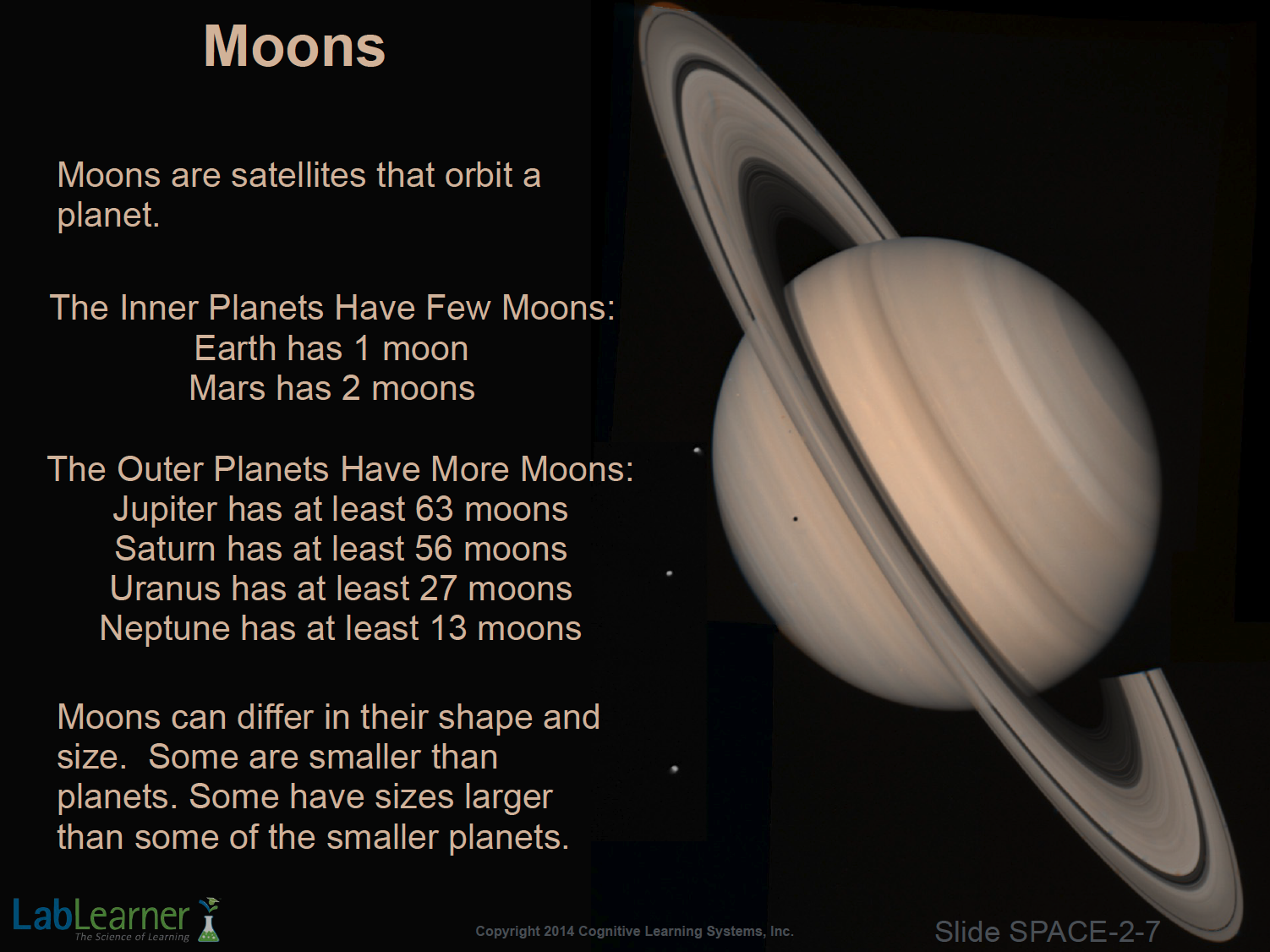
- This slide gives a simple overview of the moons of the Solar System. Notice a moon is a satellite that orbits a planet. Therefore, a comet is not a moon since it orbits the Sun. In this slide, three of Saturn’s moons are seen.
Note: Many students will be surprised at the large number of moons there are in the Solar System. We are not sure exactly how many moons there are around the outer planets and new ones are likely to be discovered in our students’ lifetimes.
______________________________________________
SLIDE SPACE-2-8
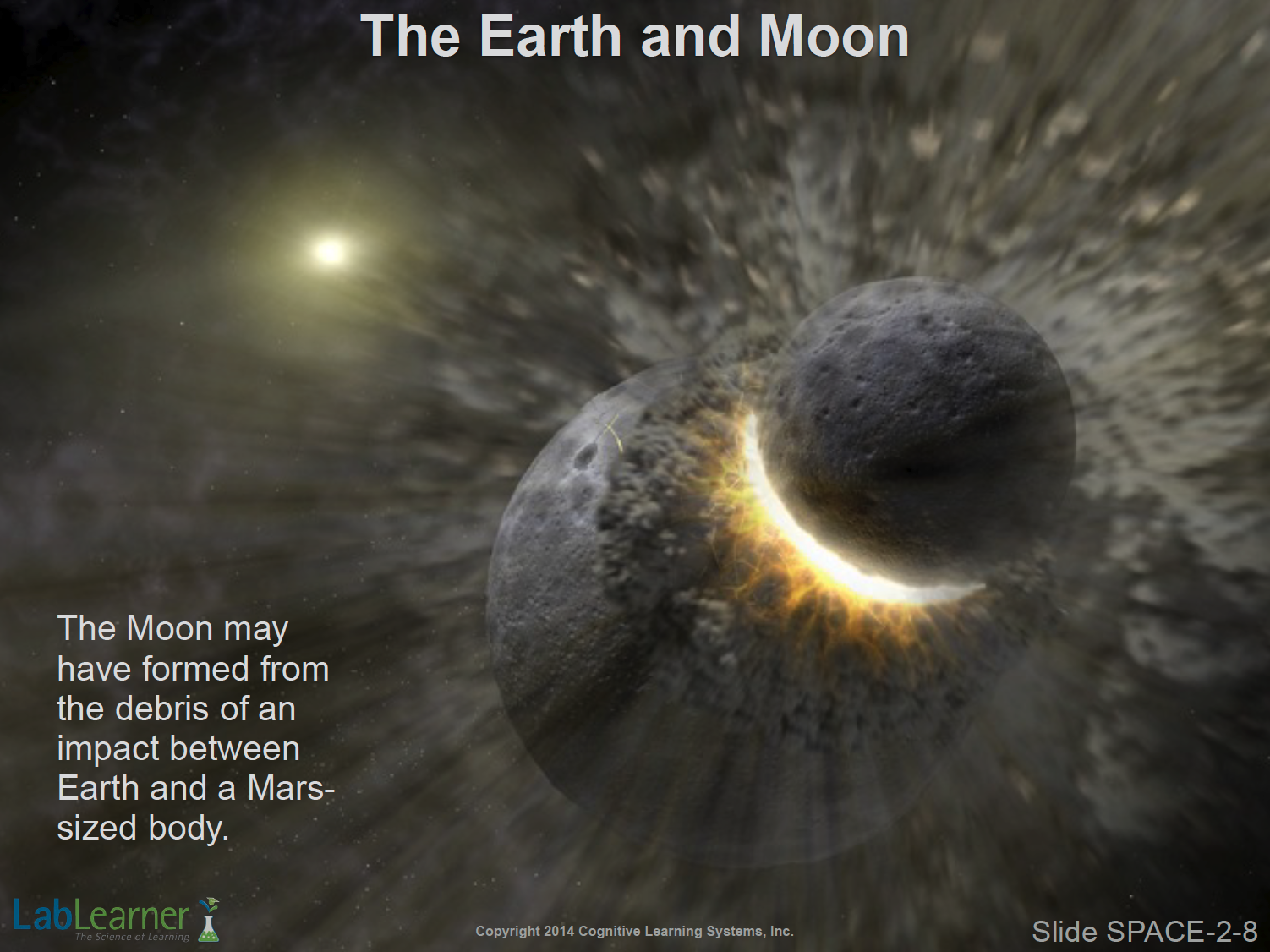
- This slide shows a rather dramatic event. According to the “Big Splash” hypothesis, about 4.5 billion years ago, a Mars-sized body sometimes called Theia impacted the newly formed Earth.
- A massive amount of debris was expelled into space. Some of this debris gravitated together, forming the Moon, which in turn was captured by Earth’s gravitational field and has been in orbit around our planet ever since. This hypothesis of the Moon’s origin has very recently received supportive evidence as non-Earth-derived materials have been identified in Moon rock samples.
- This type of moon formation is probably very common around the galaxy and Universe.
______________________________________________
SLIDE SPACE-2-9
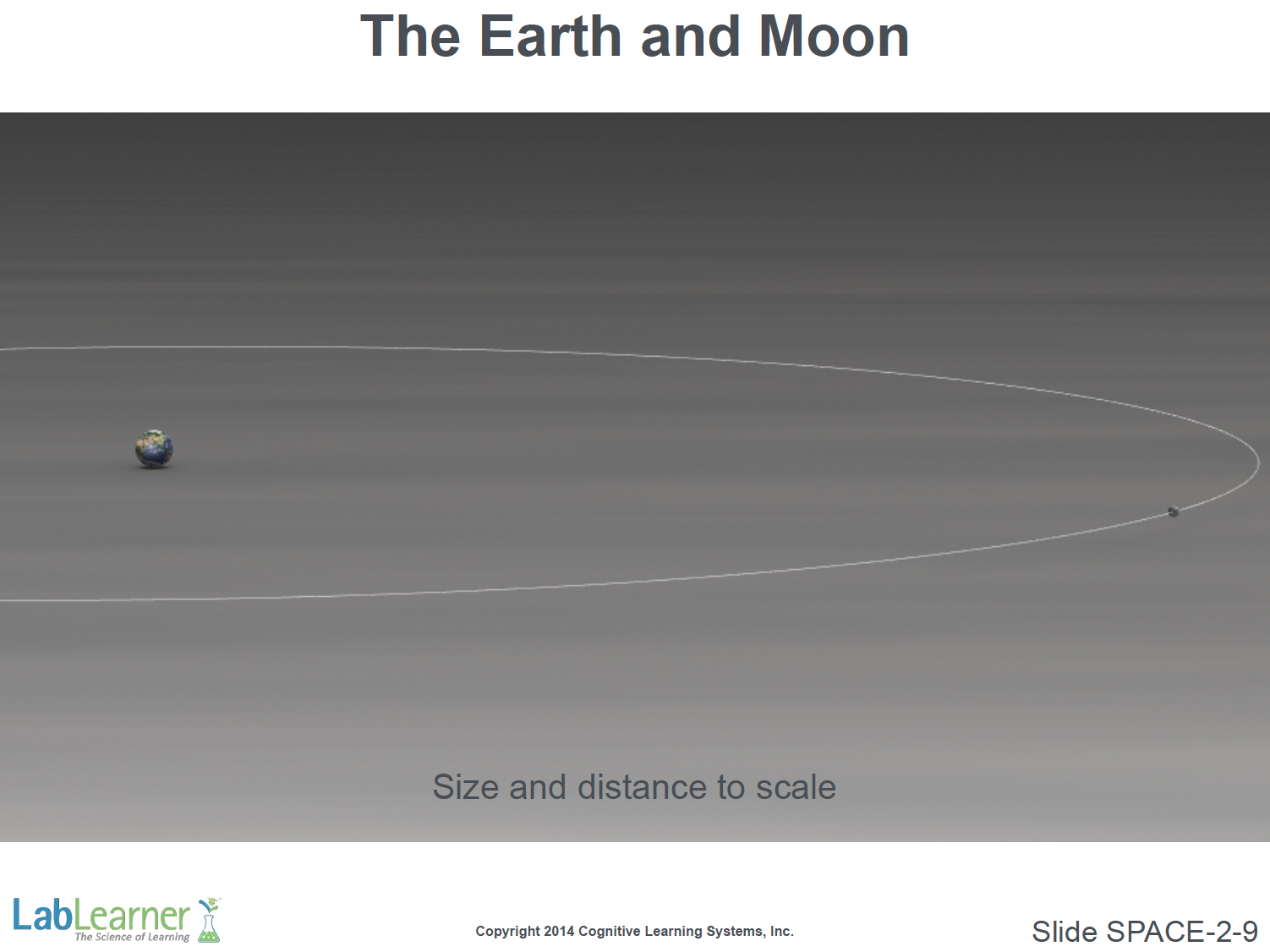
- This very simple slide shows the relative size and distance scale of Earth and its Moon. When looking at this image it is hard to imagine that the gravitational pull of the Moon on the Earth is still great enough to cause the tides of the oceans!
______________________________________________
SLIDE SPACE-2-10
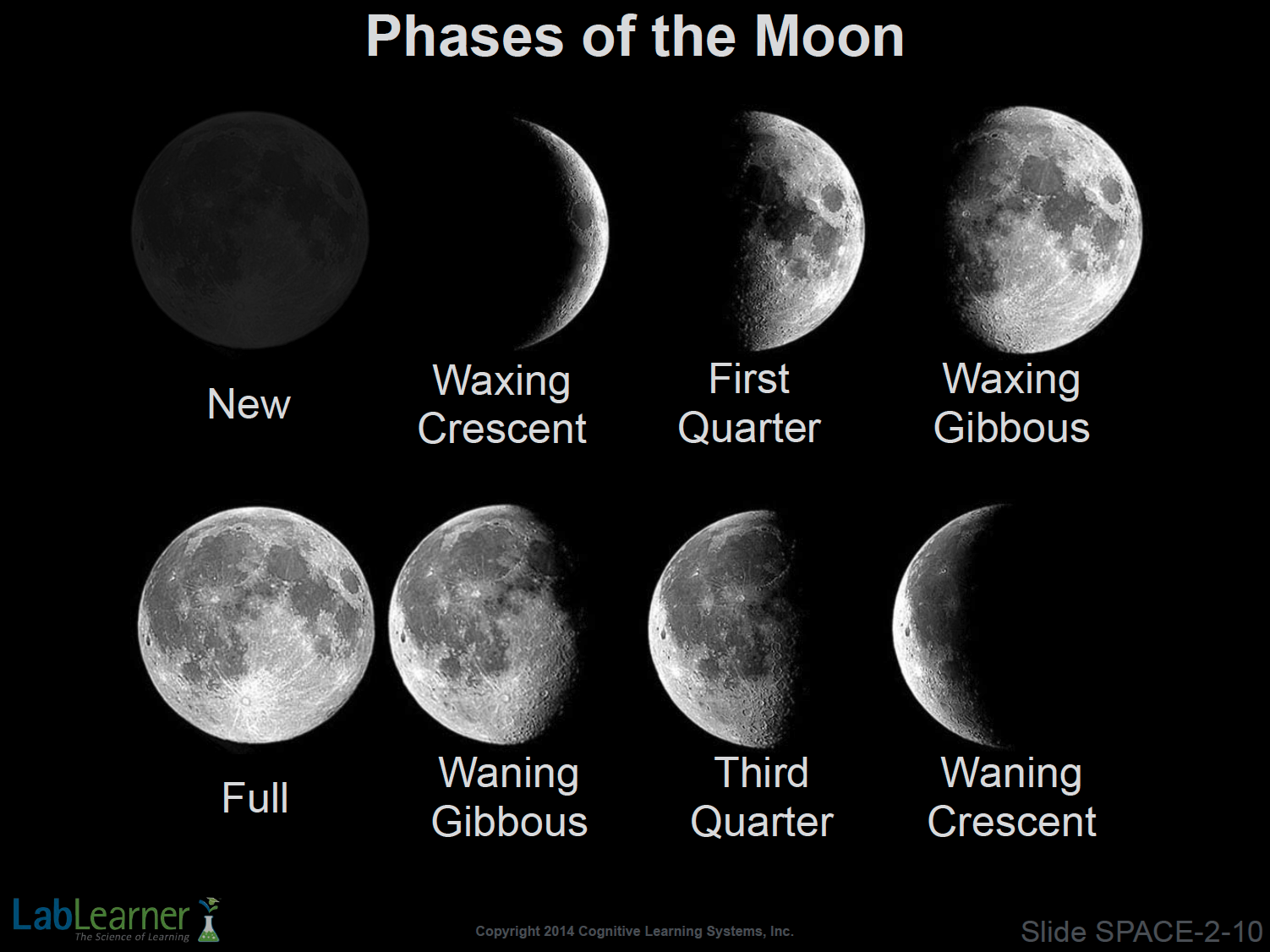
- This slide is a composite image of the phases of the Moon. It also highlights the nomenclature given for each of the Moon’s phases.
- In practice, the New Moon may be difficult to see. “Waxing” in the context of Moon phases means “growing in size”. The lightened surface of the Moon is thus waxing between the New and the Full Moon. The “crescent” is when less than half of the surface of the Moon we see is illuminated. “Gibbous” is when illumination is greater than half of the surface that we can see from Earth.
- Thus, after the New Moon, we see a Waxing Crescent Moon where the crescent is lit on the right side of the Moon as we view it. That is, the crescent opens to the left. The First Quarter Moon is when the right half of the Moon we see is illuminated. The Full Moon is when the entire surface of the Moon appears to be illuminated.
Note: We need always keep in mind that since the Moon is a sphere, we only ever see half of it. Thus, on a “Full” Moon, we really only see half of the Moon. That is why we refer to a “Quarter Moon” even though half of the part of the Moon we can see from Earth is illuminated.
- As the Moon goes from Full to New, it is said to be “Waning”. A waning moon appears to be illuminated on the left, while a waxing Moon appears to be illuminated on the right. The Third Quarter Moon comes between the Waning Gibbous and Waning Crescent phase. Interestingly, while we refer to a First Quarter and Third Quarter Moon, we do not use the term “second quarter” Moon. This, of course, is what is referred to as a “Full” Moon.
Note: Students will perform experiments in Investigation 2 Lab that will make the phases of the Moon more clear to them.