
Teacher Portal:
Space
Investigation 1 – PostLab
ZERO-IN
Italicized font represents information to be shared orally or physically completed with the students at this time.
The non-italicized font represents additional information included to support the teacher’s understanding of the content being introduced within the CELL.
ANALYZE IT
Instruct students to complete the Analysis Questions in their SDRs then discuss them as a class. Use the suggested responses below to guide students’ answers.
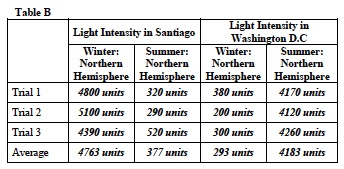
- How did the intensity of light that a city received differ based upon the position of the globe? Student answers may vary. The amount of light differed greatly depending on the position of the globe. During the Northern Hemisphere’s winter season, the light reaching Santiago was much more intense than that reaching Washington DC. However, during the Northern Hemisphere’s summer season, the light reaching Washington DC was much more intense than the light reaching Santiago.
- If the Sun’s light travels almost the same distance to reach Santiago as it does Washington DC, why was there a large difference in the intensity of light reaching the two cities? Student answers may vary. The intensity of light that the cities received differed greatly due to whether the light received was direct or indirect. When light reaching a city was direct, the number of light units was significantly greater than when the city received indirect light. For example, when the globe was positioned so that direct light reached Washington DC and indirect light reached Santiago, the intensity of light was much greater in DC. This occurrence corresponds to summer in the Northern Hemisphere (Washington DC) and winter in the Southern Hemisphere (Santiago).
GET FOCUSED
Instruct students to complete the Focus Questions in their SDRs then discuss them as a class. Use the suggested responses below to guide students’ answers.
- What causes the changes in day and night on the Earth? The movement of the Earth as it rotates on its axis causes different parts of the Earth to be turned toward the Sun, which causes day, and away from the Sun, which causes night.
- What causes the change in seasons in the Northern and Southern Hemispheres? The tilt of the Earth alters how directly the light shines on the Earth during different points in its revolution. This causes some areas of the Earth to experience seasonal changes. For example, summer in the Northern Hemisphere occurs because light received from the Sun is more direct (and therefore more intense) on the northern hemisphere at that point in the Earth’s revolution than at any other. At the same time of the year, due to the tilt of the Earth’s axis, the light received at the Southern Hemisphere is more indirect (and therefore less intense) than at any other time of year.