
Teacher Portal:
Space
Investigation 1 – Concept Day
ZERO-IN
Italicized font represents information to be shared orally or physically completed with the students at this time.
The non-italicized font represents additional information included to support the teacher’s understanding of the content being introduced within the CELL.
ASK WHY
Explain to students that space exploration provides us with knowledge about the origins of our solar system, planet Earth, and human origins. Exploration within our solar system is important because it provides us with an opportunity to make advancements in science and technology which can be a benefit to all of humankind, such as in the areas of communications and remote sensing. Cellular technology, for example, is dependent on satellite communications. Satellites are also used to monitor changes in Earth’s climate and ocean circulation, for weather forecasting, in aviation and marine navigation, and for military reconnaissance.
BRANCH OUT
Explain to students that aerospace engineers build satellites and defense systems. They make airplanes faster and safer, design spacecraft, space stations, and explorer robots like the Mars-roving Spirit.
PRINT IT
Use your browser to download a printable PDF as a help during the slide presentation and to make additional notes. In your browser, go to File > Print and then choose to save as PDF.
NAVIGATE IT
Once the slide presentation is launched
- use your left and right arrows to advance or go back in the slide presentation, and
- hover your mouse over the left edge of the presentation to get a view of the thumbnails for all the slides so that you can quickly move anywhere in the presentation.
- Click HERE to launch the slide presentation for the CELL.
SHARE IT
SLIDE SPACE-1-1
With this Investigation, we begin the four Investigation CELL on Space. In this first Investigation, we introduce the concepts of the Big Bang origin of the Universe, as well as the formation of our Solar System.
In addition, we will discuss the Earth’s rotation on its axis which gives rise to night and day on our planet. Finally, we will discuss the Earth’s annual orbit around the Sun and how the orbit, along with the Earth’s 23.5o tilt on its axis leads to the seasons of the year in the northern and southern hemispheres.
______________________________________________
SLIDE SPACE-1-2
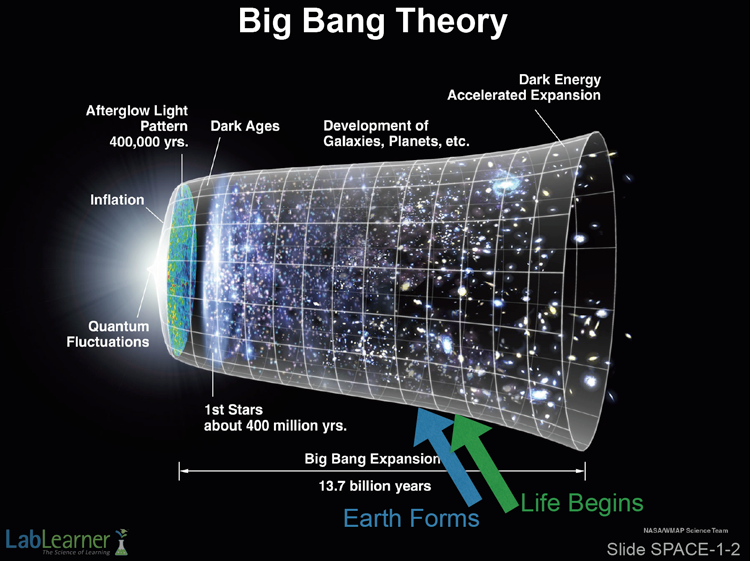
- In this slide, we introduce the Big Bang Theory. According to the theory, about 13.7 billion years ago all of the energy and matter that would eventually fill the Universe was concentrated into an extremely small point. At the time of the Big Bang, the intensely condensed energy exploded, creating both time and space.
- For nearly 400 million years, there was not even a single star formed. During these “Dark Ages”, atoms began to form. Once the first stars came into existence, more complex atoms were made in their hot, dense interiors. This, in turn, led to the development of more and more stars and eventually countless galaxies and more and more complex atoms and molecules.
- Over the past billions of years, the Universe has continued to expand as additional galaxies formed along with planets, moons, asteroids and comets.
- Now, as stars still form in galaxies throughout the Universe, the Universe continues to be a very dynamic and active place. It continues to expand and galaxies keep getting further and further apart from each other.
- About 4.6 billion years ago, the Earth formed along with our Solar System and Sun (more about this on a later slide). The Earth was originally very hot and liquid. As it cooled and solidified, it came to look more and more like it does today. Some 3.6 billion years ago, simple forms of cellular life appeared on Earth.
______________________________________________
SLIDE SPACE-1-3
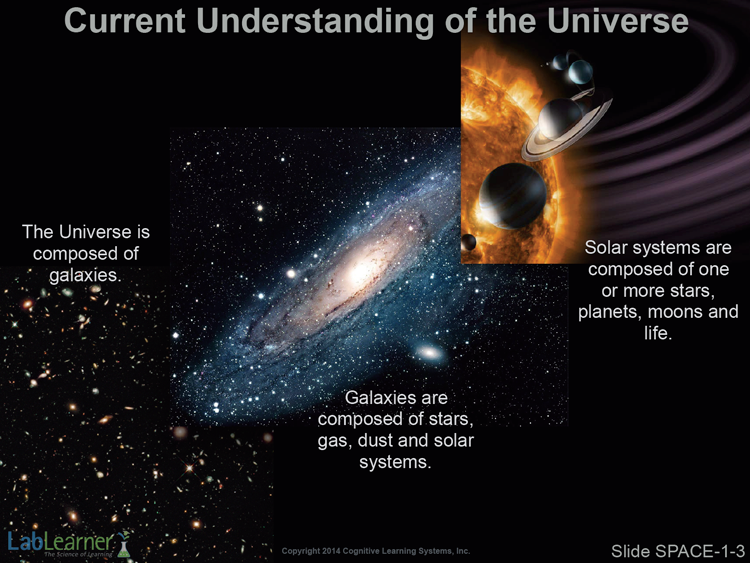
- In this slide, we give a quick overview of the components and organization of the Universe.
- The Universe is filled with many galaxies. Galaxies are composed of billions of stars, as well as enormous qualities of gas and dust. New stars and Solar Systems continually form within galaxies. We live in the Milky Way galaxy. It is only one of perhaps as many as 500 billion other galaxies in the Universe!
- In addition to billions of stars, galaxies contain many more millions of planets, moons, asteroids, comets, and miscellaneous gas and dust bodies.
- The estimated size of the Milky Way galaxy is approximately 100,000 -120,000 light-years across. A light-year is the distance light can travel in one Earth year moving at 299,792,458 meters per second (the speed of light). As a comparison, and a way of appreciating the extreme size of the Milky Way, it takes light only 8 minutes to travel from the Sun to the Earth’s surface. That is, our galaxy is in the neighborhood of 7.2 billion times larger than the distance from the Earth to the Sun.
- And that is just the size of our own galaxy, the Milky Way. As we said above, there are up to 500 billion other galaxies in the Universe. The actual size of the Universe itself is at least 92,000,000,000 (92 billion) light-years across compared to the slight 100,000 to 120,000 light year size of our Milky Way.
- Relax if these large numbers dazzle you. The extreme size and age of the Universe is essentially unfathomable, not only to students but also to every human being who has pondered them, scientists included.
______________________________________________
SLIDE SPACE-1-4
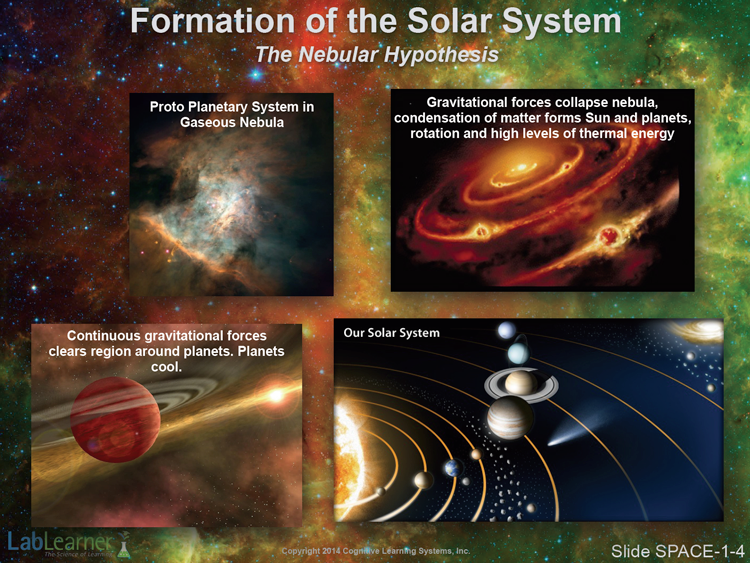
- This slide addresses a hypothesis that suggests how our Solar System (and other Solar Systems) formed. It is referred to as the Nebular Hypothesis. A nebula (upper left) is an interstellar cloud of dust, hydrogen, helium, and other gases where stars and planets form.
- The nebular hypothesis suggests that the nebula begins to collapse upon itself because of gravity. During the collapse, the matter in the nebula begins to rotate around a central mass, which may become the central Sun. Temperatures increase as gravity pulls matter into forming bodies which become denser and denser. As planets form from the swilling dust and gases, their gravitational force pulls in more and more surrounding matter and grow.
- Eventually, the Sun and planets clear much of the space between themselves of debris, and with time the planets begin to cool. It is thought that this type of formation took place about 4.6 billion years ago for our own Solar System.
- As with many hypotheses, not all astronomers and astrophysicists agree with the nebular hypothesis. Nonetheless, it is probably the most widely accepted notion of how our Solar System formed. Perhaps our students will be able to check the accuracy of this hypothesis someday!
______________________________________________
SLIDE SPACE-1-5
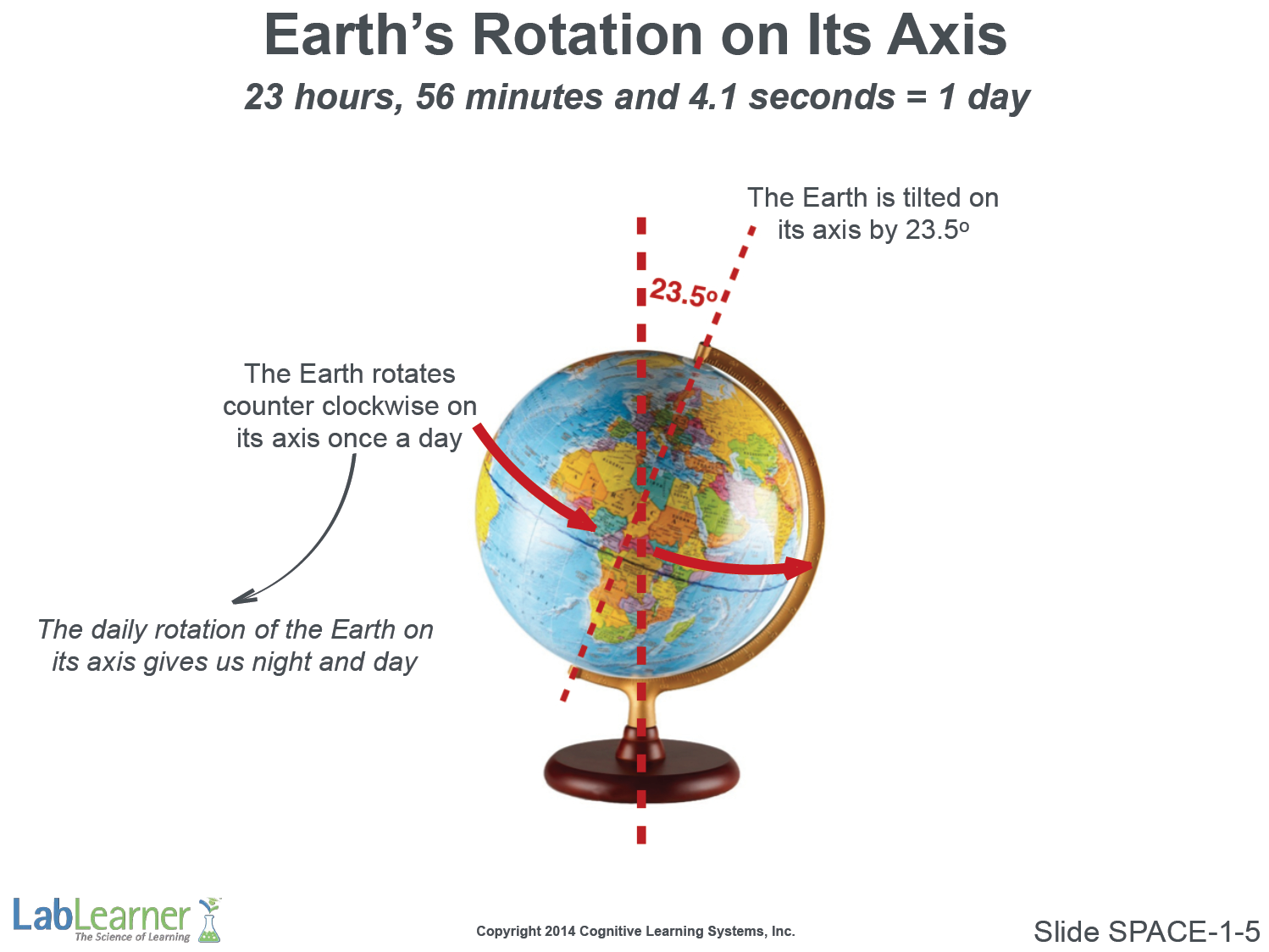
This slide brings us literally back down to Earth and back to our own time. Perhaps you have wondered why most globes you have ever seen are mounted on an angle. Globes are not mounted so that their axis of rotation is perpendicular to the surface. In fact, a good globe will always be tilted off-axis by exactly 23.5o. This is because the Earth is tilted by this degree in space. We will see later how this tilt has a tremendous impact on the seasons of the year later.
- The Earth rotates on its axis in a counterclockwise direction when viewed looking down on the North Pole. That is, it revolves in a western to eastern direction. It takes one day for the Earth to make one complete rotation on its axis. This rate of rotation does not vary with the time of year.
- For convenience, we estimate the length of the day at 24 hours. However, the actual day is 23 hours, 56 minutes and 4.1 seconds. In a period of 365 days (1 year) this adds up to over a 1,460 minute or about 24.3-hour discrepancy. Consequently, once every four years, we add an extra day to the calendar to keep synchronized. On Leap Year, we add one day to the end of February. Thus, once every four years February has 29 rather than 28 days.
- As the Earth rotates on its axis, it constantly exposes new parts of its surface to the Sun. It is this turning in relation to the Sun that gives us night and day on Earth. Obviously, one surface of the Earth is always pointed at the Sun. It is always daylight somewhere on Earth and always nighttime somewhere on Earth at exactly the same time. The difference in hours of daylight at any location on Earth at different times of the year is a function of the 23.5o tilt of the Earth on its axis, as are our seasons.
______________________________________________
SLIDE SPACE-1-6
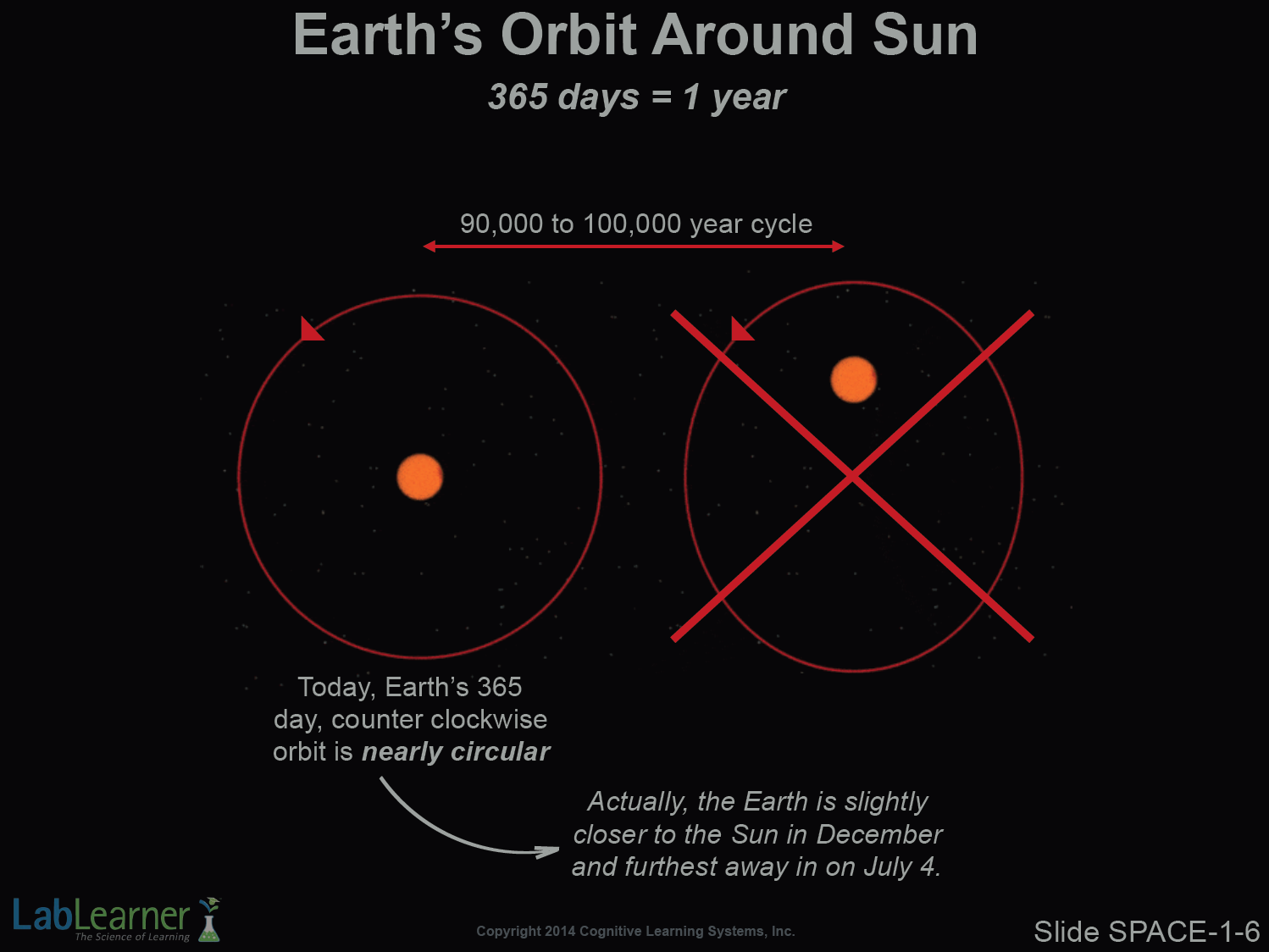
- This simple slide is included to dispel a misconception that many students have. When looking at drawings of the Solar System, the conclusion that the Earth’s orbit around the Sun is very elliptical in nature is often drawn (see below).
- However, as shown on the left of this slide, the Earth’s orbit around the Sun is very nearly circular. As shown, the degree of orbital “eccentricity” varies quite a bit on a 90,000 to 100,000-year cycle. Today, the Earth’s orbit around the Sun is about 6% off from being perfectly circular.
- One reason a misconception regarding the eccentricity of the Earth’s orbit can cause problems for students is that they may mistakingly believe that the Earth may be a great deal closer to the Sun at certain times of the year than at others. Following this thinking, it can falsely be concluded that it is this varying distance from the Sun that results in the season. One may think, for example, that when the Earth is closer to the Sun it is summer and when it is farthest from the sun it is winter. Actually, the Sun is farthest from the Earth on July 4th. Also, if the cause of the seasons was due simply to the distance of the Earth from the Sun, winter and summer in the northern and southern hemisphere would occur at the same time… and we know that doesn’t happen!
______________________________________________
SLIDE SPACE-1-7
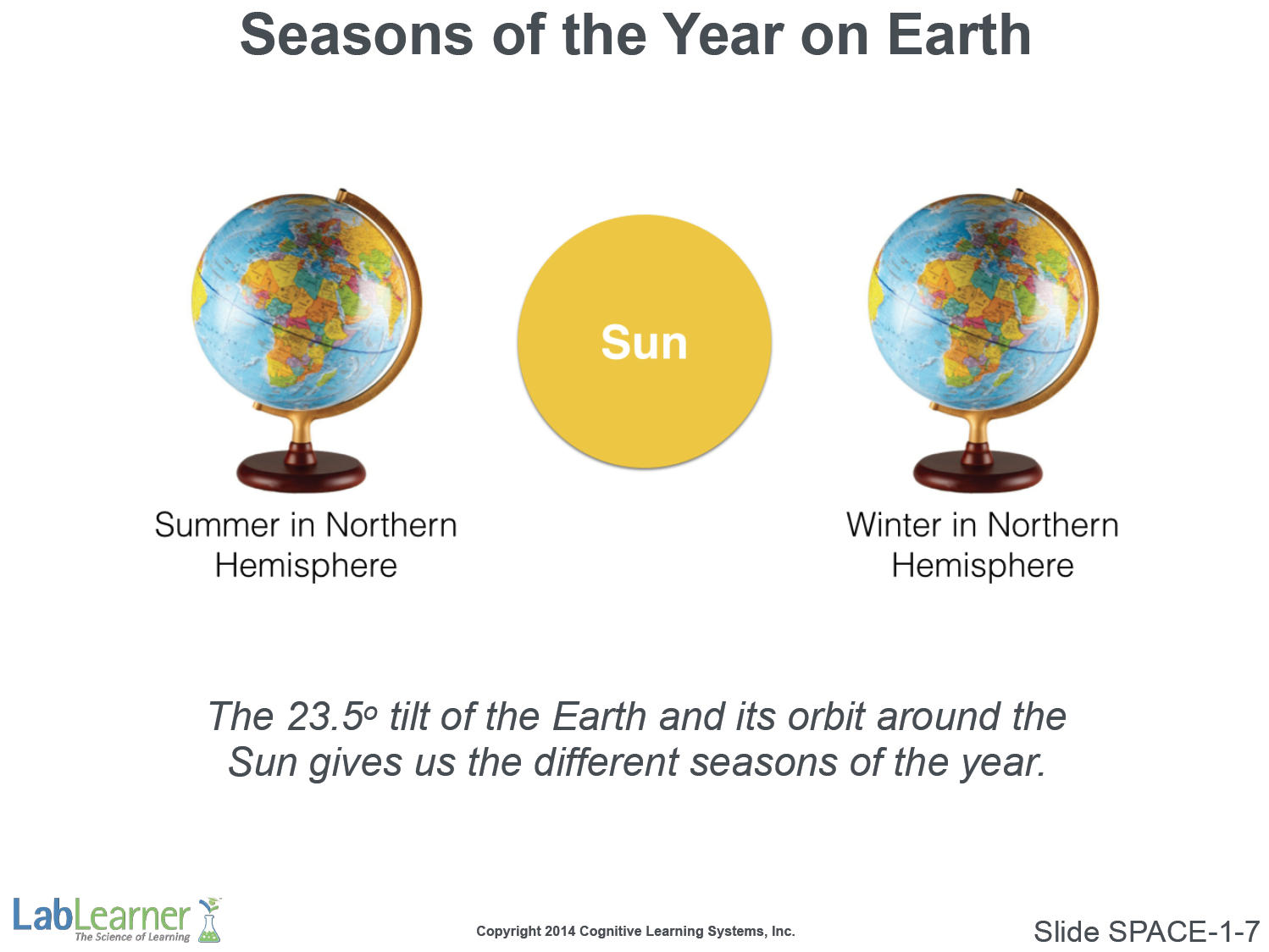
- This slide finally address how the tilt of the Earth is responsible for the seasons of the year. The key factor in appreciating the importance of the Earth’s tilt in determining the seasons is that the tilt is maintained throughout the Earth’s entire orbit around the Sun. That is, its northern pole points directly at the northern star, Polaris, throughout its entire orbit. Given the maintenance of this orientation, it means that at a certain point in the annual revolution around the Sun, the Earth is tilted toward the Sun as shown at the left of this slide. This is the position and tilt of the Earth in the northern hemisphere summer. In this position, the light rays from the Sun strike the surface of the Earth more directly in the northern hemisphere than in the southern hemisphere, where it strikes the Earth surface at much more of a glancing angle. The more direct, more perpendicular delivery of solar energy causes greater amounts of heat and radiation to be absorbed in the northern hemisphere at this time. In fact, it is winter in the southern hemisphere when the Earth is in this position.
- The difference between the angle at which sunlight reaches the Earth’s surface in the summer and winter is somewhat analogous to the light of the Sun at different times during the course of an individual day. Although the Sun may be visible all day, the hours from about 10 am to 2 pm receive the most solar energy per hour because the Sun is more directly overhead. In the earlier morning and later afternoon, the Sun still strikes the Earth, but at a more glancing angle, and not as much solar energy is delivered per unit of Earth’s surface.
- When the North Pole points away from the Sun in winter months, as the globe on the right does, the southern hemisphere receives more direct solar energy than the northern hemisphere. In this position the northern hemisphere experiences winter, while the southern hemisphere experiences summer.
______________________________________________
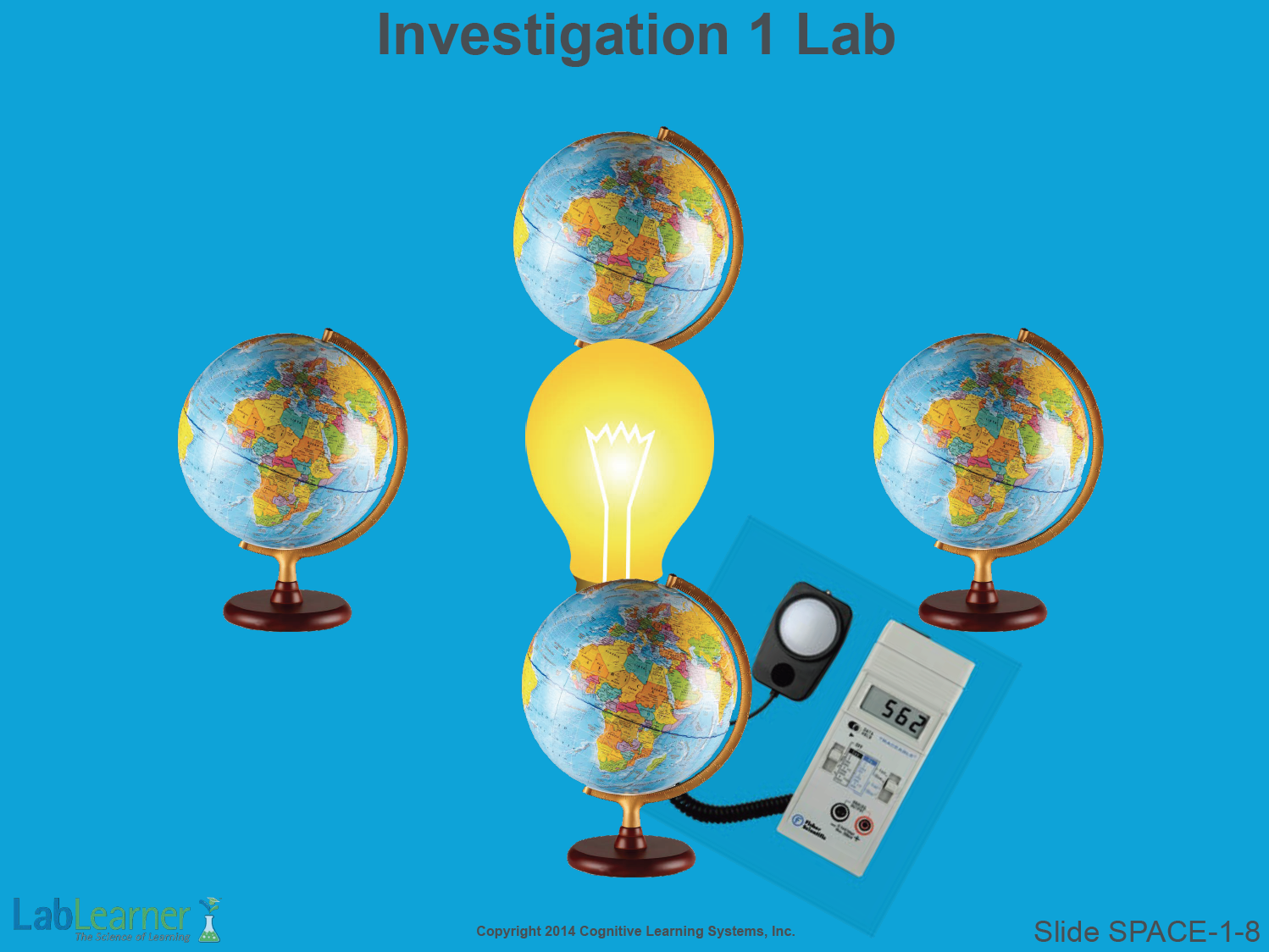
SLIDE SPACE-1-8
- This final slide depicts the experimental setup for Investigation 1 Lab.
Note: Students will directly measure the amount of light that strikes the northern and southern hemispheres of the globe at different points in the Earth’s revolution around the Sun. They will use a light meter to collect their data. The teacher may wish to use this slide in discussing the upcoming Lab.