
Teacher Portal:
Sound Waves and Pressure
Investigation 3 – PostLab
ZERO-IN
Italicized font represents information to be shared orally or physically completed with the students at this time.
The non-italicized font represents additional information included to support the teacher’s understanding of the content being introduced within the CELL.
ANALYZE IT
Instruct students to complete the Analysis Questions in their SDRs then discuss them as a class. Use the suggested responses below to guide students’ answers.
- Write your calculated speeds of sound for each type of matter in Table B.
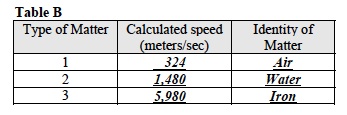
- Refer to the first Background. Based on the Background and your calculated speeds, identify each of the three types of matter as air, water, or iron.
- In the last column record the identity of each type of matter.
- Use axes below to make a bar graph that compares the speed of sound in air, water, and iron.
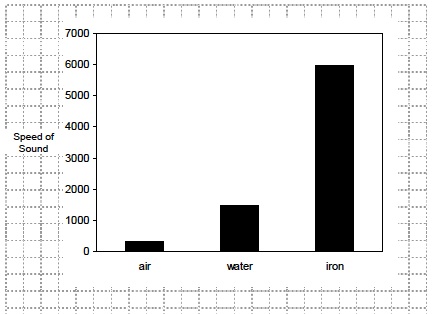
- Order the three types of matter from the lowest speed of sound to the highest speed of sound. The speed of sound is lowest in air and the speed of sound is fastest in iron. The speed of sound in water is intermediate between the speed of sound in air and iron.
- Which of the three types of matter would have the greatest amount of attraction between its atoms or molecules? Iron would have the greatest amount of attraction between its atoms or molecules.
- Which of the three types of matter would have the least amount of attraction between its atoms or molecules? Air would have the least amount of attraction between its atoms or molecules.
GET FOCUSED
Instruct students to complete the Focus Question in their SDRs then discuss it as a class. Use the suggested response below to guide students’ answers.
- How do different types of matter affect the speed, the wavelength and the frequency of sound? The speed of sound changes depending on the type of matter. Matter that exhibits more attraction between its atoms or molecules will allow sound to travel at greater speeds. . Matter that exhibits less attraction between its atoms or molecules will allow sound to travel at lower speeds. Different types of matter will cause a change in the wavelength of a sound wave but the frequency of the sound wave will not change.
COMPREHENSION CHECK
The Comprehension Check is designed to summarize the Core Experience Learning Lab and provide the teacher with an informal way to assess students’ understanding of the big ideas.
If time permits, ask your students to answer each Focus Question below. Use the suggested responses below to guide students’ answers.
- How are sounds produced? Sounds are produced when matter in the form of a solid, liquid or gas vibrates.
- How is sound transferred from one object or substance to another? The vibrations of one object or substance cause pressure waves to impact a neighboring object or substance. These pressure waves cause the second object or substance to start vibrating.
- What is the relationship between the wavelength and frequency of a standing wave and the sound it produces? There is an inverse relationship between wavelength and frequency. A wave with a high frequency has a short wavelength and a wave with a low frequency has a long wavelength.
- What is the speed of sound in air? The speed of sound in air is approximately 324 meters per second.
- In the same type of matter, is the speed of sound different for different frequencies and wavelengths? In the same type of matter, the speed of sound does not change if two sounds have different frequencies or different wavelengths.
- What is the relationship between the wavelength and frequency of a standing wave and the sound it produces? There is an inverse relationship between wavelength and frequency. A wave with a high frequency has a short wavelength and a wave with a low frequency has a long wavelength.
- How do different types of matter affect the speed, the wavelength, and the frequency of sound? The speed of sound changes depending on the type of matter. Matter that exhibits more attraction between its atoms or molecules will allow sound to travel at greater speeds. Matter that exhibits less attraction between its atoms or molecules will allow sound to travel at lower speeds. Different types of matter will cause a change in the wavelength of a sound wave but the frequency of the sound wave will not change.