
Teacher Portal:
Sound Waves and Pressure
Investigation 2 – PostLab

ZERO-IN
Italicized font represents information to be shared orally or physically completed with the students at this time.
The non-italicized font represents additional information included to support the teacher’s understanding of the content being introduced within the CELL.
ANALYZE IT
Instruct students to complete the Analysis Questions in their SDRs then discuss them as a class. Use the suggested responses below to guide students’ answers.
Note: Explain that the wavelength for each tuning fork needs to be calculated based on the length of PVC pipe that extended out of the water. Since the wavelength includes the complete standing wave from one ending node to another ending node, students must multiply the measured length by 4 to calculate the wavelength. After performing this calculation, students can then calculate the speed of sound in air for each of the frequencies tested with the tuning forks.
- Calculate the wavelength of the standing wave for each Trial by multiplying the measured length in meters by 4. Record the wavelength of the standing wave for each Trial in Table A. Use the space below for your calculations.
0.317 m x 4 = 1.27 m
0.207 m x 4 = 0.828 m
0.155 m x 4 = 0.620 m
- Calculate: For each Trial, calculate the speed of sound produced by the standing wave using the following equation:
Speed = wavelength x frequency
- Multiply the frequency of the tuning fork by the calculated wavelength to calculate the speed of sound. Record the speed for each Trial in Table A. Use the space below for your calculations.
256 Hz x 1.27 m = 324.4
392 Hz x 0.828 m = 324.4
523.3 Hz x 0.620 m = 324.4
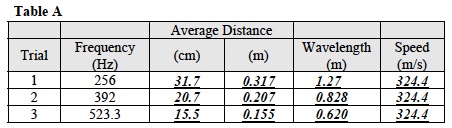
- Was the speed of sound in the air in the PVC pipe the same or similar for each of the three tuning forks? Student answers will vary. The speed of sound for each of the tuning forks should be the same or similar.
- As the frequency of the tuning forks increased, how did the wavelengths of the standing waves change? As the frequency of the tuning forks increased, the wavelengths of the standing waves decreased.
- Do you think that the speed of sound would be the same or different in another type of matter? Why? The speed of sound would be different in different types of matter. The amount of attraction between the particles or molecules of different types of matter is different. A greater amount of attraction allows sound to travel at a faster speed.
GET FOCUSED
Instruct students to complete the Focus Questions in their SDRs then discuss them as a class. Use the suggested responses below to guide students’ answers.
- What is the speed of sound in air? The speed of sound in air is approximately 324 meters per second.
- In the same type of matter, is the speed of sound different for different frequencies and wavelengths? In the same type of matter, the speed of sound does not change if two sounds have different frequencies or different wavelengths.
- What is the relationship between the wavelength and frequency of a standing wave and the sound it produces? There is an inverse relationship between wavelength and frequency. A wave with a high frequency has a short wavelength and a wave with a low frequency has a long wavelength.