
Teacher Portal:
Simple Machines
Investigation 3 – PostLab
 ZERO-IN
 ZERO-IN
Italicized font represents information to be shared orally or physically completed with the students at this time.
The non-italicized font represents additional information included to support the teacher’s understanding of the content being introduced within the CELL.
ANALYZE IT
Instruct students to complete the Analysis Questions in their SDRs then discuss them as a class. Use the suggested responses below to guide students’ answers
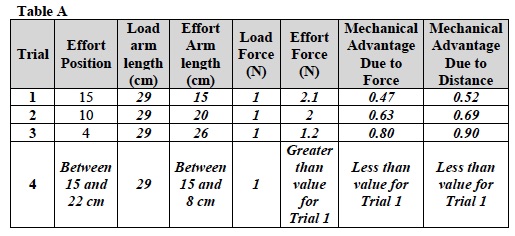
Note: The following Analysis Questions are for Trials 1-3. Table A is located below for reference.
- Calculate: Determine the mechanical advantage using force and distance for each position of the fulcrum on the third class lever and record your results in table A.
Mechanical Advantage = Load Force ÷ Effort Force
Mechanical Advantage = Effort Arm Length ÷ Load Arm Length
MA(force) of Trial 1= 1 N/ 2.1 N= 0.47
MA(force) of Trial 2= 1 N/ 1.6 N= 0.63
MA(force) of Trial 3= 1 N/ 1.2 N= 0.80
MA(distance) of Trial 1= 15 cm/ 29 cm= 0.52
MA(distance) of Trial 2= 20 cm/ 29 cm= 0.69
MA(distance) of Trial 3= 26 cm/ 29 cm= 0.90
- How did the changes in the position of the spring scale affect the length of the effort arm and load arm? As the effort was moved from the 15 cm mark to the 4 cm mark, it was moved closer to the load. As this happened, the length of the effort arm increased but the length of the load arm remained the same.
- How did the change in the position of the spring scale, and so the length of the effort arm, affect the load force? The change in the position of the effort changed the length of the effort arm. As the effort arm length increased, the distance over which the force was applied increased. However, this did not change the load force. The force of gravity on the load was approximately 2 N at each position of the fulcrum. Instead, the effect was to decrease effort force as the length of the effort arm increased.
4. How did the change in the position of the effort affect the effort force? As the effort moved closer to the load, the effort force decreased.
________________________________________
Note: The following Analysis Questions are for Trial 4. Table A is located below for reference.
- Compare the effort required to lift the load in this trial to Trials 1, 2, and 3. Did it feel easier or harder to lift the load in this trial? Why? It felt harder to lift the load in this trial as compared to Trials 1, 2, and 3 because the effort force was greater than the load force. The effort force increased because the length of the effort arm decreased.
- In the third class lever, how did the change in the position of the effort affect mechanical advantage? Why? Explain the answer using the terms effort arm, load arm, effort force, and load force. A third-class lever will never give a mechanical advantage greater than 1. However, as the effort moved closer to the load, the mechanical advantage of the lever increased. As the effort moved closer to the load, the effort force to lift the load decreased because the distance over which the effort was applied increased—the length of the effort arm increased. The change in the effort force as compared to the load force and the change in the length of the effort arm in comparison to the length of the load arm increased the mechanical advantage of the lever.
________________________________________
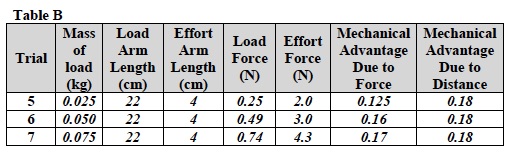
Note: The following Analysis Questions are for Trials 5-7. Table B is located below for reference.
- Determine the mechanical advantage due to force and distance for each load added to the “arm.” Record the results in Table B. Sample data is shown below.
Mechanical Advantage = Load Force ÷ Effort Force
Mechanical Advantage = Effort Arm Length ÷ Load Arm Length
MA(force) of Trial 5 = 0.25 N/ 2.0 N= 0.125
MA(force) of Trial 6 = 0.49 N/ 3.0 N= 0.16
MA(force) of Trial 7 = 0.74 N/ 4.3 N= 0.17
MA(distance) of Trial 5 = 4 cm / 22 cm = 0.18
MA(distance) of Trial 6 = 4 cm / 22 cm = 0.18
MA(distance) of Trial 7 = 4 cm / 22 cm = 0.18
- Did changing the mass of the load affect the load force and effort force? How? Increasing the mass of the load caused both the load force and the effort force to increase.
- In Trials 5 through 7, the mass of the load changed but the lengths of the load and effort arms remained the same. How did each of these two factors affect the mechanical advantage of the arm, a third-class lever? Changing the mass of the load did not affect the mechanical advantage due to force because the increase in mass resulted in increases in the load force and the effort force that did not change the ratio of load force to effort force. Changing the mass of the load did not affect the mechanical advantage due to distance because mechanical advantage due to distance is determined by the lengths of the load and effort arms, which did not change in these three trials.
- How does the position of the biceps affect the force required to lift an object? The arm is an example of a third-class lever. The biceps are attached between the fulcrum and load which means that the effort arm is always shorter than the load arm. Therefore the effort force to lift a load will always be greater than the force of the load.
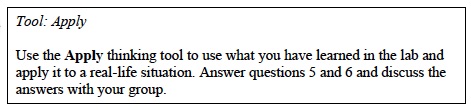
- If a person carries a bag of books on his or her arm, will the person need to apply a force greater or less than the force of the load? Why? Use your results to support your answer. The person will need to apply a force greater than the force of the load. In this Investigation, the mechanical advantage due to force was always less than 1 because the effort force was always greater than the load force. In addition, the mechanical advantage due to distance was always less than one because the length of the load arm was always greater than the length of the effort arm. For example, in the forearm model, the effort arm was always 4 cm and the load arm was always 22 cm.
- How could the effort force needed to carry the bag of books in question 5 be decreased and the mechanical advantage of the arm be increased? If a person carries the books closer to his elbow, the length of the load arm would decrease compared to if the books were carried with the arm held out. The decrease in the load arm would decrease the distance over which the load is lifted and would therefore decrease the effort force needed to carry the books.
GET FOCUSED
Instruct students to complete the Focus Questions in their SDRs then discuss them as a class. Use the suggested responses below to guide students’ answers.
Note: Remind students that the focus questions in this Investigation are the same as the focus questions in Investigation Two. Encourage students to think about how the results in this Investigation affect their answers to the questions compared to the answers they gave when using their results with first-class and second-class levers. Remind students to answer the questions based on their results from this Investigation.
- How can simple machines change the force needed to lift a load? In a third-class lever, as the length of the effort arm is changed, the distance over which the effort must be applied also changes. Because the distance over which this force is applied changes, the effort force also changes.
- How does the relationship between the fulcrum, effort, and load affect the force needed to lift a load? Changing the position of the fulcrum, effort, and load in relation to one another changes the distance over which a load is lifted and effort is applied. The result is a change in the effort force depending upon the lengths of the effort and load arms and position of the fulcrum, load, and effort. When the effort is between the fulcrum and the load, the load arm is always longer than the effort arm. As a result the effort force always exceeds the load force. The closer the effort moves to the load, the longer the effort arm becomes, the less the effort force becomes, and the closer the effort force is to matching the load force.
- How does mechanical advantage relate to effort and load forces and the lengths of effort and load arms? Mechanical advantage is equal to 1 when the load and effort force are equal and the length of the load arm and effort arm are equal. As the effort force decreases below that of the load force, mechanical advantage becomes greater than 1. As the effort force increases above that of the load force, mechanical advantage becomes less than 1. As the effort arm becomes longer than the load arm, mechanical advantage becomes greater than 1. As the effort arm becomes shorter than the load arm, mechanical advantage becomes less than 1.
COMPREHENSION CHECK
The Comprehension Check is designed to summarize the Core Experience Learning Lab and provide the teacher with an informal way to assess students’ understanding of the big ideas.
If time permits, ask your students to answer each Focus Question below. Use the suggested responses below to guide students’ answers.
- How can simple machines change the force needed to lift a load? Simple machines can change the force needed to lift a load by offering a mechanical advantage. In Investigation One, students investigated one and two pulley systems. In a one pulley system, the effort force required to lift the load is identical to the load force. Thus, there is no mechanical advantage in a onepulley system. However, in a two pulley system, the effort force is less than the load force since it requires approximately half the amount of force to lift the load. Thus, a two pulley system has a mechanical advantage of 2. This is offset, however, by the fact that in a two-pulley system the distance over which the effort is applied is greater than the distance over which the effort is applied in a single pulley system. In Investigation Two, students used first and second class levers to illustrate how effort force can be changed by a simple machine. In a first and second class lever, if the length of the effort or the load arm is changed the effort force must also change. In Investigation Three, as the length of the effort arm of a third class lever is changed, the distance over which the effort must be applied changes. Because the distance over which this force changes, the effort force must also change.
- How does mechanical advantage relate to effort and load forces? Mechanical advantage is the ratio of load force to effort force. If the effort force is less than the load force, then there will be a mechanical advantage to using the machine. In Investigation One, the work done on the load was the same for both the one and two pulley systems, because the load was lifted to the same height. However, in the two pulley system the effort force decreased to one-half of the load force while the distance over which the effort was applied doubled. Work is a measure of force multiplied over a distance. Therefore although less force was used to lift the load with the two pulley system, it was applied over a greater distance. The result was the same amount of work. The work “felt easier” because less force was applied.
- How does the relationship between the fulcrum, effort and load affect the force needed to lift a load? In Investigation Two, students examined the relationship between the fulcrum, the effort and load and how they affect the effort force needed to lift a load. Changing the position of the fulcrum, effort or load in relation to one another changes the distance over which a load is lifted and effort is applied. The result is a change in the effort force depending upon the lengths of the effort and load arms and the position of the fulcrum, load and effort. When the fulcrum is placed between the load and effort, the effort force may equal the load force if the load and effort arms are equal. The effort force may be greater than the load force if the effort arm is shorter than the load arm. The effort force may be less than the load force if the effort arm is longer than the load arm. As the fulcrum moves closer to the load, the effort arm becomes longer and the load arm shorter and the effort force decrease below that of the load force. At some point, the fulcrum may move past the load, and the “first class lever” is now classified as a “second class lever.” In Investigation Three, the positions of the fulcrum, effort and load were changed in relation to one another by changing the distance over which a load is lifted and effort is applied. The result is a change in the effort force depending upon the lengths of the effort and load arms and position of the fulcrum, load and effort. When the effort is between the fulcrum and the load, the load arm is always longer than the effort arm. As a result, the effort force always exceeds the load force. The closer the effort moves to the load, the longer the effort arm becomes, the less the effort force becomes and the closer the effort force is to matching the load force.
- How does mechanical advantage relate to effort and load forces and the length of effort and load arms? Using first and second class levers, students investigated mechanical advantage in Investigation Two. Mechanical advantage is equal to 1 when the load and effort force are equal and the length of the load arm and effort arm are equal. As the effort force decreases below that of the load force, mechanical advantage becomes greater than 1. As the effort force increases above that of the load force, mechanical advantage becomes less than 1. As the effort arm becomes longer than then the load arm, mechanical advantage becomes greater than 1. As the effort arm becomes shorter than the load arm, mechanical advantage becomes less than 1. In Investigation Three, a third class lever was constructed by placing the effort between the load and the fulcrum. In the case of a third-class lever, the effort arm is always shorter than the load arm, and thus the mechanical advantage is always less than 1.