Teacher Portal
Simple Machines
Investigation 2 – PreLab
ZERO-IN
Italicized font represents information to be shared orally or physically completed with the students at this time.
The non-italicized font represents additional information included to support the teacher’s understanding of the content being introduced within the CELL.
ASK WHY
Remind students that as they look about, they probably see half a dozen machines that they don’t recognize as such. Ordinarily, people think of a machine as a complex device-a gasoline engine or a washing machine. They are machines; but so are a hammer, a screwdriver, a bike’s wheel. A machine is any device that helps you to do work.
BRANCH OUT
Remind students that automobile engineers use a variety of simple machines to create cars. Cars are actually considered complex machines because they have motors and are composed of several simple machines to help make them run.
GET FOCUSED
Inform students that the Investigation is designed to help them to answer the following Focus Questions:
- How can simple machines change the force needed to lift a load? In a first and second class lever, as the length of the effort arm or load arm is changed, the distance over which the effort must be applied or the load must be lifted changes. Because the distance over which these forces are applied changes, the effort force also changes.
- How does the relationship between the fulcrum, effort, and load affect the force needed to lift a load? Changing the position of the fulcrum, effort, and load in relation to one another changes the distance over which a load is lifted and effort is applied. The result is a change in the effort force depending upon the lengths of the effort and load arms and position of the fulcrum, load, and effort.
- How does mechanical advantage relate to effort and load forces and the lengths of effort and load arms? Mechanical advantage is equal to 1 when the load and effort force are equal and the length of the load arm and effort arm are equal. As the effort force decreases below that of the load force, mechanical advantage becomes greater than 1. As the effort force increases above that of the load force, mechanical advantage becomes less than 1. As the effort arm becomes longer than the load arm, mechanical advantage becomes greater than 1. As the effort arm becomes shorter than the load arm, mechanical advantage becomes less than 1.
Note: These questions are located in students’ SDRs at the beginning and end of the Investigation.
Note: These are succinct responses to the Focus Questions and are placed here for your reference at this time. Fully developed responses to the Focus Questions can be found on the PostLab page.
GO DEEPER
As a class, read the Background(s) in the Investigation. Have students read the information aloud or silently to themselves. When students have finished, discuss the following concept as a class:
- A lever is another example of a simple machine.
- Examples of levers include scissors, see-saws, and wheelbarrows.
- Like pulleys, levers may make a task “feel easier.”
- Three types, or classes, of levers exist: first-class, second-class, and third-class levers.
- All levers consist of three parts: the load arm, the effort arm, and the fulcrum.
- In a first-class lever, the fulcrum is in the middle and the load and effort are on opposite sides of the fulcrum.
- Mechanical advantage describes the relationship between the effort force or force needed to lift the load and the force of gravity on the load, or the load force.
- Mechanical advantage can be calculated by comparing the effort arm length and load arm length using the following equation:
Mechanical Advantage = Effort Arm Length ÷ Load Arm Length
- A second-class lever is a lever in which the fulcrum is on one end of the arm, the effort is on the other end, and the load is between the effort and fulcrum.
Note: These concepts are integrated into the Background(s) and are used to deepen students’ comprehension of the big ideas.
LEARN THE LabLearner LINGO
- effort arm
- load arm
Note: Definitions of these terms can be found on the Introduction page to the CELL.
Note: Additional words may be bolded within the Background(s). These words are not Key Terms and are strictly emphasized for exposure at this time.
SET FOR SUCCESS
- Ask students to summarize what they learned about effort force, load force, work, and mechanical advantage in a single-pulley system.
Note: Student answers may vary. In a single-pulley system, the magnitude of the effort force is equal to the load force, and the work done on the load distance is equal to the work done on the effort distance. A single pulley system offers a mechanical advantage of 1 because there is no difference between the effort and load forces.
- Ask students to summarize what they learned about effort force, load force, work, and mechanical advantage in a two-pulley system.
Note: Student answers may vary. In a two-pulley system, the effort force is one half of the load force, but the work done on the effort distance was equal to the work done on the load distance. A two-pulley system offers a mechanical advantage of 2 because the effort force is one-half the magnitude of the load force.
- Remind students that the work done on the effort distances were the same for both pulley systems. Ask students how this can be true if the effort force in the single-pulley system was different from the effort force in the two-pulley system.
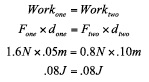
Note: Work is calculated as force times distance. The effort force in the two-pulley system was one-half the effort force of the single pulley system. However, the distance over which the effort force was applied in the two-pulley system was double the distance over which the effort force was applied in the single-pulley system. When work is calculated, the difference in the two effort forces is canceled out by the difference in the effort distances; thus, the work done on the effort distance for both pulley systems was the same. The following equation illustrates this mathematically:
- Direct students to complete the Recall section in their SDRs. Student answers may vary.
- What are some everyday examples of levers? How do they differ from one another?
- What are the different types of levers?
- Do all levers give the same mechanical advantage?
- How is energy conserved when using simple machines?
- Play the video below. Stop to ask students questions or answer students’ questions when necessary. Remind students to follow along with their SDRs and make any notes that they think might be helpful.
- After the video, direct students to divide into their lab groups to discuss their strategy for the lab. For example, they may assign certain group members to perform specific functions during the lab.
Note: The purpose of the video is to allow students to anticipate the laboratory experience they will soon encounter. Students should leave this PreLab session with a firm idea of what to expect and how to perform in the lab.
Note: Homework is posted below the video.
HOMEWORK
Tell students that they should review the Investigation in preparation for the Lab.