
Teacher Portal:
Simple Machines
Investigation 2 – PostLab

ZERO-IN
Italicized font represents information to be shared orally or physically completed with the students at this time.
The non-italicized font represents additional information included to support the teacher’s understanding of the content being introduced within the CELL.
ANALYZE IT
Instruct students to complete the Analysis Questions in their SDRs then discuss them as a class. Use the suggested responses below to guide students’ answers.
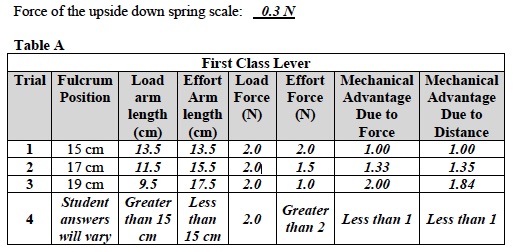
Note: The following Analysis Questions are for Trials 1-3. Table A is located below for reference.
- Calculate: Determine the mechanical advantage due to force for each position of the fulcrum on the first-class lever.
- Recall the equation for mechanical advantage:
- Use a calculator and the data from Table A to calculate the mechanical advantage.
Mechanical Advantage = Load Force ÷ Effort Force
Trial 1: MA = N/ 2 N= 1
Trial 2: MA = 2 N/ 1.5 N= 1.33
Trial 3: MA = 2 N/ 1 N= 2
- Record the mechanical advantage due to force in Table A for each position of the fulcrum.
- Describe how the changes in the position of the fulcrum affected the length of the effort arm and load arm. As the fulcrum was moved from the 15 cm mark to the 19 cm mark, it was moved closer to the load. Moving the fulcrum caused the effort arm length to increase and the load arm length to decrease.
- How did the change in the position of the fulcrum affect the load force? The change in the fulcrum position did not change the load force. The force of gravity on the load was approximately 2 N at each position of the fulcrum.
- How did the change in the position of the fulcrum affect the effort force? As the fulcrum moved closer to the load and farther from the effort, the effort force decreased.
- How did the change in length of the effort arm affect the effort force? The effort arm length is the distance over which the effort force is applied. Increases in the effort arm length decrease the effort that is needed to lift a load.
- How did the change in the length of the load arm affect the effort force? The load arm is the distance over which the load force is applied or lifted. As the length of the load arm decreased, the distance over which the load was lifted decreased. The result was a decrease in the effort force.
- Calculate: Determine the mechanical advantage due to the lengths of the effort arm and load arm and record them in Table A. Use the following formula:
Mechanical Advantage = Effort Arm Length ÷ Load Arm Length
Trial 1: MA = 13.5 cm / 13.5 cm = 1.0
Trial 2: MA = 15.5 cm / 11.5 cm = 1.35
Trial 3: MA = 17.5 cm / 9.5 cm = 1.84
- Compare the mechanical advantage due to distance to the mechanical advantage due to force. Were they the same? Why or why not? Student answers will vary. In the sample data, MA was the same for both distance and force when the fulcrum was positioned at the center of the ruler (15 cm mark). However, there were slight differences between MA when the fulcrum was moved closer to the load. Students should remember that other forces are acting on the ruler besides load and effort force. When the arms of the lever are unequal in length, these additional forces have a greater effect on the effort force needed to lift the load. These additional forces have a greater impact when load masses are relatively small.
Note: The following Analysis Questions are for Trials 5-8. Table B is located below for reference.
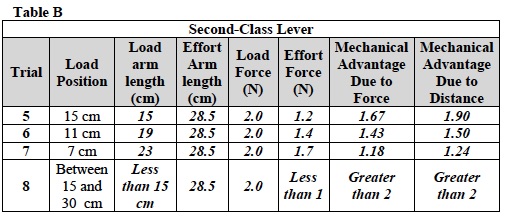
- Calculate: Determine the mechanical advantage for force and distance for each position of the fulcrum on the second class lever. Record your results in Table B.
Mechanical Advantage = Load Force ÷ Effort Force
Mechanical Advantage = Effort Arm Length ÷ Load Arm Length
MA(force) of Trial 5= 2 N/ 1.2 N= 1.67
MA(force) of Trial 6= 2 N/ 1.4 N= 1.43
MA(force) of Trial 7= 2 N/ 1.7 N= 1.18
MA(distance) of Trial 5= 28.5 cm/ 15 cm = 1.90
MA(distance) of Trial 6= 28.5 cm/ 19 cm = 1.50
MA(distance) of Trial 7= 28.5 cm/ 23 cm =1.24
- How did the changes in the position of the load affect the length of the effort arm and load arm? As the load was moved from the 15 cm mark to the 11 cm mark, it was moved closer to the effort. As this happened, the length of the load arm increased but the length of the effort arm remained the same.
- How did the change in the position of the load affect the load force and effort force? The change in the fulcrum position did not change the load force. The force of gravity on the load was approximately 2 N at each position of the fulcrum. However, as the load moved closer to the effort, the effort force increased.

- Compare the effort required to lift the load in this trial to Trials 5, 6, and 7. Did it feel easier or harder to lift the load in this trial? Why? It felt easier to lift the load in this trial as compared to Trials 5, 6, and 7 because the effort force was less than the load force. The effort force decreased because the length of the load arm decreased and the distance over which the load needed to be lifted was reduced.
- Study the data in Table A. How did changing the position of the fulcrum affect mechanical advantage? Why? Explain the answer using the terms, effort arm, load arm, effort force, and load force. As the fulcrum moved closer to the load, the mechanical advantage of the lever increased. As the fulcrum moved closer to the load, the effort force to lift the load decreased because it was applied over a longer effort arm whereas the load force was lifted over a shorter load arm. The change in the effort force and the distance over which it was applied as compared to the load force and the distance over which the load was lifted increased the mechanical advantage of the lever.
- Study the data in Table B. How did changing the position of the load affect mechanical advantage? Why? Explain the answer using the terms, effort arm, load arm, effort force, and load force. As the load moved closer to the effort, the mechanical advantage of the lever decreased. As the load moved closer to the effort, the effort force needed to lift the load increased because the load needed to be lifted over a longer load arm. The change in the effort force as compared to the load force and the change in the length of the load arm compared to the length of the effort arm decreased the mechanical advantage of the lever.
- Do all levers give the same mechanical advantage? Use your data to support your answer. No. The first-class lever may give a mechanical advantage that is less than 1 or greater than 1. If the fulcrum is moved very close to the load, the mechanical advantage of the first-class lever may be close to 2. However, the mechanical advantage of the first-class lever cannot be increased above 2 if the fulcrum is to remain between the load and the effort. A second class lever does not afford a mechanical advantage that is less than 1 if the load remains between the fulcrum and effort. It can give a mechanical advantage that is greater than 2 as the load is moved further from the effort and closer to the fulcrum.
GET FOCUSED
Instruct students to complete the Focus Questions in their SDRs then discuss them as a class. Use the suggested responses below to guide students’ answers.
- How can simple machines change the force needed to lift a load? In a first and second class lever, as the length of the effort arm or load arm is changed, the distance over which the effort must be applied or the load must be lifted changes. Because the distance over which these forces are applied changes, the effort force also changes.
- How does the relationship between the fulcrum, effort, and load affect the force needed to lift a load? Changing the position of the fulcrum, effort, and load in relation to one another changes the distance over which a load is lifted and effort is applied. The result is a change in the effort force depending upon the lengths of the effort and load arms and position of the fulcrum, load, and effort. When the fulcrum is between the load and effort, the effort force may equal the load force if the load and effort arms are equal. The effort force may be greater than the load force if the effort arm is shorter than the load arm. The effort force may be less than the load force if the effort arm is longer than the load arm. As the fulcrum moves closer to the load, the effort arm becomes longer and the load arm shorter, and the effort force decreases below that of the load force. At some point, the fulcrum may move past the load, and the “first-class lever” is now classified as a “second class lever.”
- How does mechanical advantage relate to effort and load forces and the lengths of effort and load arms? Mechanical advantage is equal to 1 when the load and effort force are equal and the length of the load arm and effort arm are equal. As the effort force decreases below that of the load force, mechanical advantage becomes greater than 1. As the effort force increases above that of the load force, mechanical advantage becomes less than 1. As the effort arm becomes longer than the load arm, mechanical advantage becomes greater than 1. As the effort arm becomes shorter than the load arm, mechanical advantage becomes less than 1.