
Teacher Portal:
Simple Machines
Investigation 1 – PostLab

ZERO-IN
Italicized font represents information to be shared orally or physically completed with the students at this time.
The non-italicized font represents additional information included to support the teacher’s understanding of the content being introduced within the CELL.
ANALYZE IT
- Instruct students to complete the Analysis Questions in their SDRs then discuss them as a class. Use the suggested responses below to guide students’ answers.Note: The following Analysis Questions are for Trial 1. Table A is located below for reference.
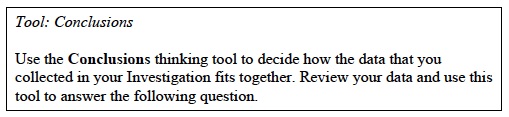
- Calculate: Determine the work done on the load distance of the pulley for each load and record it in Table A. Use the data in Table A and the formula: Work (J) = load force (N) x distance load was lifted (m) Student answers will vary depending on their reading of the spring scale. Sample data is provided in Table A.
- Calculate: Determine the work done on the effort distance of the pulley when lifting each load and record it in Table A. Use the data in Table A and the formula: Work (J) = effort (N) x distance effort was applied (m) Student answers will vary. Sample data is provided in Table A.
- What happened to the load force, effort force, and work as the mass of the load increased? Explain. Every time the mass of the load increased the load force increased. The effort force consequently also increased. The increased force also correlates with an increase in work.
- Compare load force to the effort force for each load. Was there a difference between the load force and effort force? Explain. No. There was no difference between the load force and the effort force for any of the loads lifted. The force to lift the load (effort force) was the same as the force of gravity on the load (load force).
- Compare the distance the load was lifted and the distance over which the effort was applied for each load. Was there a difference between these distances? Explain. No. There was no difference between the distance the load was lifted and the distance over which the effort was applied for any of the loads lifted.
- Compare the work done on the load distance and the work done on the effort distance for each load. Was the amount of work different? Why or why not? The amount of work done on the load distance and the effort distance was the same. Work is a measure of force exerted over a distance. For each load tested, the effort force equaled the load force and the distance the load was lifted was the same as the distance over which the effort was applied. Because the force and distance on both the load and effort distances of the pulley were the same, the work done on both sides of the pulley was the same. However, student answers will not be exact and the effort force will likely be greater than the load force due to friction on the string. Student answers will vary. Machines are inefficient due to friction and the inability to create work within themselves (which would be a violation of the Law of Conservation of Energy because work is a transfer of energy). Therefore, all students should theoretically discover that work input is greater than work output. However, some students may discover that the work values are the same for both input and output based on their calculations. This may be due to rounding differences, experimental error, or due to limitations of the spring scale as a result of the lightness of the loads tested. Students who indicate that the amount of work differed between the load distance and the effort distance should indicate that the inequality was due to a difference between the effort force and the load force, as the distance was the same for both the load and the effort. Students who indicate that the amount of work is the same for both distances of the pulley system should explain that the lack of difference was due to equal forces and equal distances on both sides.
- What was the mechanical advantage of lifting each load with the single pulley in your experiment? Use the following formula for the calculations. Record your answers in Table A.
Mechanical Advantage = Load Force ÷ Effort Force
MA of Bucket + 100 gram load= 1.6 N/ 1.6 N= 1
MA of Bucket + 200 gram load= 2.6 N/2.6 N= 1
MA of Bucket + 300 gram load= 3.6 N/ 3.6 N= 1
- Theoretically, the effort force and load force are equal in a single pulley system because it has a mechanical advantage of 1. What then is the benefit of using a single pulley to lift a load? The pulley allows a person to lift a load by applying a downward rather than an upward force. This allows a person to pull with gravity rather than lifting against the force of gravity. Consequently, lifting objects with a pulley often feels easier because of the direction of the effort.

- Make a prediction. What effect will using a two-pulley system have on the amount of effort force needed to lift a load? Student answers will vary.
- Transfer the load force for each of the following loads into Table B of the Student Data Record.
Bucket + 100 grams
Bucket + 200 grams
Bucket + 300 grams
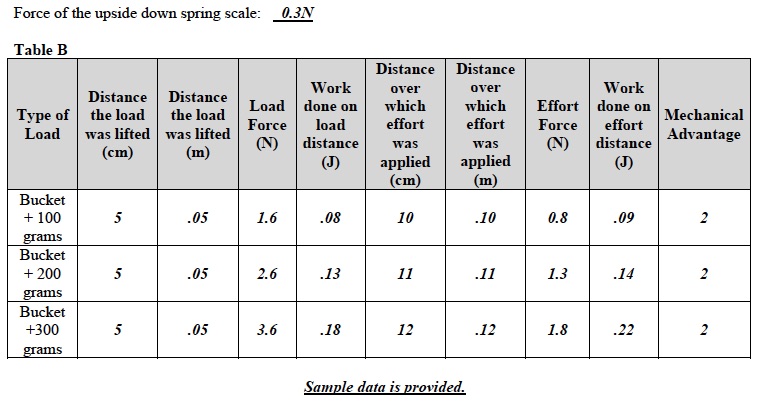
Note: The following Analysis Questions are for Trial 2. Table B is located below for reference.
- Compare load force to the effort force for each load. Was there a difference in the load force and effort force? Explain. Yes. The effort force was one half the amount of the load force.
- Compare the distance the load was lifted and the distance over which the effort was applied for each load. Was there a difference in these distances? Explain. Yes, the distance over which the effort was applied was two times greater than the distance the load was lifted.
- Compare the work done on the load and the work done on the effort. Was the amount of work different? Why or why not? Student answers may vary. The work should be equal. In the two pulley system, the effort force decreased but the distance over which the effort was applied increased. The decrease in the effort force is the reciprocal of the increase in the distance over which the effort was applied.
- What is the mechanical advantage of each of the loads lifted using two pulley system? Use the following formula for the calculations. Record your answers in Table B.
Mechanical Advantage = Load Force ÷ Effort Force
MA of Bucket + 100 gram load= 1.6 N/ 0.8 N= 2
MA of Bucket + 200 gram load= 2.6 N/1.3 N= 2
MA of Bucket + 300 gram load= 3.6 N/ 1.8 N= 2
- Think about the mechanical advantage of the two pulley system. Does the two pulley system allow a person to apply less force to lift a load than the force of gravity on the load? Use your data to support your answer. Yes. The two pulley offers a mechanical advantage so a person can apply less force to lift a load. For example, an effort force of .8 N was needed to lift the bucket and the 100-gram weight with two pulleys, while with a single pulley the effort force needed was 1.6 N. However, the person will have to lift that load over a greater distance.
- How does the effort force in the two pulley system compare to that in the one pulley system? The effort force in the two pulley system was one half the amount of the effort force in the one pulley system.
- How does the distance over which the effort was applied compare in the two different pulley systems? The distance over which the effort was applied in the two-pulley was two times the distance in the one pulley system. )”
- Compare the work done to lift the load in the one pulley and two pulley systems. Why is the work similar if the effort force is different for both systems? Why might the work “feel easier” with the two pulley system? The work done on the load was the same for both systems because the load was lifted to the same height. However, in the two pulley system, the effort force decreased to one-half of the load force while the distance over which the effort was applied doubled in magnitude. Work is a measure of force multiplied over a distance. Therefore although less force was used to lift the load with the two pulley system, it was applied over a greater distance. The result was the same amount of work. The work “felt easier” because less force was applied.
GET FOCUSED
Instruct students to complete the Focus Questions in their SDRs then discuss them as a class. Use the suggested responses below to guide students’ answers.
- How can simple machines change the force needed to lift a load? Simple machines can change the force needed to lift a load by offering a mechanical advantage. In a one pulley system, the effort force required to lift the load is identical to the load force. Thus, there is no mechanical advantage in a one-pulley system. However, in a two pulley system, the effort force is less than the load force. It takes roughly half the amount of force to lift the load. Thus, a two pulley system has a mechanical advantage of 2. This is offset by the fact that in a two-pulley system the distance over which the effort is applied is greater than the distance over which the effort is applied in a single pulley system.
- How does mechanical advantage relate to effort and load forces? Mechanical advantage is the ratio of load force to effort force. If the load force is much greater than the effort force, then there will be a mechanical advantage.