
Teacher Portal:
Photosynthesis
Investigation 4 – PostLab
ZERO-IN
Italicized font represents information to be shared orally or physically completed with the students at this time.
The non-italicized font represents additional information included to support the teacher’s understanding of the content being introduced within the CELL.
ANALYZE IT
Instruct students to complete the Analysis Questions in their SDRs then discuss them as a class. Use the suggested responses below to guide students’ answers.
- Why did you use iodine to measure photosynthesis? In iodine, the starch in the leaf turned a dark bluish-black. Although starch is not a direct product of photosynthesis, sugar is. After the sugar is produced, some of it is quickly converted into starch. Therefore, although starch is not a direct product of photosynthesis, we can use it as an indicator of photosynthetic activity.
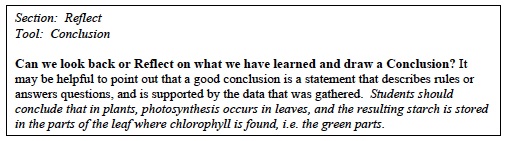
- What did your observations of the presence of starch indicate concerning photosynthesis? Students should have observed that starch was present in the areas of the leaf that were originally green. The areas of the plant which were originally close to white in color did not contain as much starch. The areas of the plant which were green contained chlorophyll, which absorbed light. The white areas of the leaf contained little chlorophyll and reflected most of the light. Therefore, photosynthesis did not occur in the white areas of the leaf.
Note: Questions marked with a triangle (∆) are included to enrich students’ understanding. These questions do not appear in students’ SDRs but should be used as additional discussion points during the PostLab.
- ∆ In which parts of the plants does photosynthesis take place? The experiment illustrated that photosynthesis takes place in the chloroplasts, the parts of the plants which contain chlorophyll, often indicated by their green color. Instruct students to record their answers in their Investigation Four Data Record.
- ∆ Can you suggest other tools we might use and other data we could collect that would either support or refute this conclusion? Students answers may vary. Students may suggest making a wet mount slide of the Coleus leaf in order to obtain microscopic data that links the location of the chloroplasts within the variegated leaf to the colors of the leaf.
GET FOCUSED
Instruct students to complete the Focus Questions in their SDRs then discuss them as a class. Use the suggested responses below to guide students’ answers.
- In which parts of a Coleus leaf does photosynthesis occur? The experiment illustrated that photosynthesis takes place in the chloroplasts, the parts of the leaves which contain chlorophyll, often indicated by their green color.
- Which pigment is required for photosynthesis? The green pigment chlorophyll is required for photosynthesis.
COMPREHENSION CHECK
The Comprehension Check is designed to summarize the CELL and provide the teacher with an informal way to assess students’ understanding of the big ideas.
If time permits, ask your students to answer each question below. Use the suggested responses below to guide students’ answers.
- What factors affect the photosynthetic process? Through this Core Experience Learning Lab, students collected data which provided evidence that light and chlorophyll are important for photosynthesis. By observing changes in dissolved oxygen concentration, students showed that photosynthesis produces oxygen and that this production of oxygen is dependent on the presence of light. Students also discovered that carbon dioxide is involved in the photosynthesis process. By observing a change in pH in a test tube with photosynthesizing Elodea, students found that carbon dioxide is consumed during photosynthesis. Using paper chromatography, students found that leaves are made of various pigments, one of which is chlorophyll. Chlorophyll, contained in the chloroplasts, is present in plants that experience photosynthesis. Thus students may have inferred that chlorophyll is necessary for photosynthesis and is often observed in the green parts of the plants. In summary, students found that carbon dioxide, water, light, and chlorophyll affect photosynthesis.
- What cellular structures or substances are involved in photosynthesis? Through paper chromatography, students found that the color in green plants consists of several pigments, including chlorophyll. Chlorophyll is contained in chloroplasts, an organelle which students observed using a microscope and slides of an Elodea leaf and stem. Students also found that sugar from photosynthesis is converted to starch, which is stored in chloroplasts. Thus chloroplasts are vital to photosynthesis because of their connection to chlorophyll, the pigment, necessary for photosynthesis.
- Why is photosynthesis important to our environment? Student answers will vary. Photosynthesis provides the energy by which plants live. These plants are important in the lives of many animals, including humans. Without photosynthesis, our environment would not have plant life. Without plant life, the needs of our environment would not be met.