
Teacher Portal:
Photosynthesis
Investigation 4 – Concept Day
ZERO-IN
Italicized font represents information to be shared orally or physically completed with the students at this time.
The non-italicized font represents additional information included to support the teacher’s understanding of the content being introduced within the CELL.
ASK WHY
Remind students that plants are all around us. We tend to take them for granted, but imagine a world without lush green grasses and trees – a planet blanketed in desert. Could we survive? Plants are an integral part of our environment and provide the food, oxygen, and fibers we depend on for survival. And their ability to photosynthesize is one of nature’s most amazing and essential phenomenons.
BRANCH OUT
Explain to students that plant physiologists carry out experiments to reveal how plants respond to pathogens and insect pests or to environmental stresses like drought, salinity, pollutants, and high and low temperatures.
PRINT IT
Use your browser to download a printable PDF as a help during the slide presentation and to make additional notes. In your browser, go to File > Print and then choose to save as PDF.
NAVIGATE IT
Once the slide presentation is launched
- use your left and right arrows to advance or go back in the slide presentation, and
- hover your mouse over the left edge of the presentation to get a view of the thumbnails for all the slides so that you can quickly move anywhere in the presentation.
- Click HERE to launch the slide presentation for the CELL.
SHARE IT

SLIDE PHOTO-4-1
In this relatively short Investigation, we will finish our study of photosynthesis. We will address the component of the photosynthesis reaction we have not yet discussed; the production of product glucose.
We will also provide students with an overall review of the photosynthesis reaction and how they studied it in the lab.
Finally, we will end with a slide that attempts to give students an appreciation of the flow of solar energy from the Sun through processes on Earth.
______________________________________________

SLIDE PHOTO-4-2
- This is a review slide that asks the important question “How can we determine if the sugar glucose (C6H12O6) is formed by photosynthesis?” Glucose is the only component of the photosynthesis reaction that we have yet to consider.
______________________________________________

SLIDE PHOTO-4-3
- This slide shows that the glucose molecules produced in plants by photosynthesis are stored in the leaf not as the sugar itself, but as a “polymer” of glucose molecules know as starch.
- As depicted, individual glucose molecules bind to each other in a very specific way to form long chains. In the starch molecule shown here, there are three glucose subunits. However, notice the brackets around the central subunit and the subscript circled in red. This subscript means that the chain of glucose subunits ranges anywhere from about 300 to 600 glucose subunits! Thus, the starch molecule is rather large.
- Cells cannot directly use starch for energy. Starch is therefore a stored form of chemical energy derived through photosynthesis from the energy photons from the Sun. As stated in this slide, when additional free glucose is needed by the plant cell, enzymes break down the starch molecule into its constituent glucose molecules for immediate utilization by the cell.
- Finally, the last bullet on this slide states that starch molecules can be detected by reaction with iodine. In Investigation 4 lab, students will use iodine staining to localize the distribution of stored starch in the leaf of the Coleus plant.
______________________________________________

SLIDE PHOTO-4-4
- This slide depicts Coleus leaves at the upper right. Coleus leaves are used in the experiment in Investigation 4 because the chloroplasts (and therefore chlorophyll) are not evenly distributed. The lack of green chlorophyll in the central regions of Coleus leaves tells us that photosynthesis does not take place in these regions.
Note: In Investigation 4 lab, students will follow an interesting multistep procedure to first extract the pigments from a Coleus leaf and then stain the resulting leaf with an iodine solution to determine the distribution of starch molecules in it. This experiment helps demonstrate that starch, and therefore glucose, is a product of photosynthesis.
______________________________________________

SLIDE PHOTO-4-5
- This slide provides an overview of the entire photosynthesis reaction once again. At the bottom of the slide, the question is asked, “how did we assess the involvement of the various components of the photosynthesis reaction in the lab?”
Note: It is intended that this slide will not only serve as a good review of the photosynthesis reaction itself but that it will also stimulate discussion that correlates the lab procedures and experiments performed during the course of this CELL with the basic chemistry of the photosynthesis reaction.
______________________________________________

SLIDE PHOTO-4-6
Note: This slide is animated. The teacher may wish to practice the animation prior to classroom presentation.
Note: This slide may be used in combination with the previous slide in the discussion of laboratory procedures and findings that students used to explore photosynthesis.
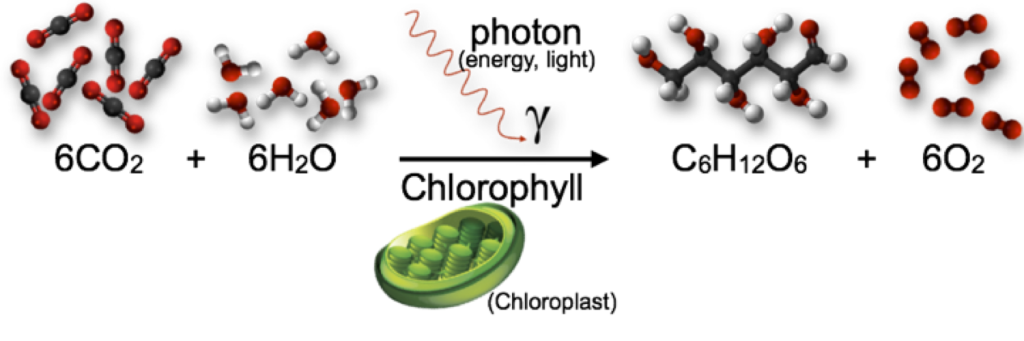
- Let’s identify the lab procedures on this slide by referring to the components of the photosynthesis reaction in order from left to right. [Each mouse click will label individual parts of the slide]
- Carbon dioxide formation: Students used the pH indicator phenol red to detect CO2 depletion caused by Elodea plants in Investigation 2.
- Chloroplasts: The phenol red Elodea experiment mentioned above suggested that plant tissue was required for photosynthesis. However, the wet mount of an Elodea leaf in Investigation 3 localized the site of photosynthesis to the chloroplast.
- Chlorophyll: In Investigation 1, students performed paper chromatography on a bright green extract from spinach leaves. This green pigment was, of course, chlorophyll.
- Photons (light): In Investigations 2 and 3, students followed the photosynthesis reaction in the presence and absence of light and found that light (photons) are required for photosynthesis to occur.
- Glucose: In Investigation 4, students localized the glucose polymer, starch, to the precise areas of the Coleus leaf where photosynthesis occurs, namely, the green areas containing chloroplasts and chlorophyll.
- Oxygen: Finally, the oxygen meter and probe were used in Investigations 2 and 3 to directly measure O2 production by photosynthesis in the presence and absence of light in the aquatic plant Elodea.
______________________________________________

SLIDE PHOTO-4-7
- This final slide shows the overall flow of solar energy from the Sun through various processes on Earth.
- Photon production is achieved in the center of the Sun where conditions permit nuclear fusion. In the fusion process, the nuclei of 4 hydrogen atoms are fused to form one helium atom. In the fusion process, a photon of energy is released.
- Once a photon leaves the surface of the Sun, it takes about 8 minutes to arrive at Earth. Some photons strike the leaves of plants and cause photosynthesis to occur. In the process of photosynthesis, the energy of the photon is captured and converted to potential chemical energy in the glucose molecule.
- The potential chemical energy of glucose and starch is stored and utilized by plants to increase their tissue biomass. Wood harvested from trees contains large amounts of stored potential chemical energy.
- Finally, at the lower left, when wood is burned in the “combustion” reaction of fire, the bonds storing potential chemical energy from the tree are broken and the potential chemical energy is converted and released as the kinetic energy of light (photons) as well as kinetic radiant energy (heat).
- Obviously, the scenario shown in this slide represents only one of many energy pathways. For example, potential chemical energy stored by trees through photosynthesis that occurred millions of years ago can be converted into coal and oil over time. When these fuels are burned, this ancient stored and highly concentrated potential chemical energy is released in various kinetic energy forms and can be used for heat and to do work.
- Alternatively, the stored potential chemical energy of plants may be consumed by animals and transferred to kinetic energy of heat, growth, and movement. In the next CELL, Ecosystems, we will return to the concept of energy flow from the Sun through ecosystems on Earth.