
Teacher Portal:
Photosynthesis
Investigation 3 – Concept Day
ZERO-IN
Italicized font represents information to be shared orally or physically completed with the students at this time.
The non-italicized font represents additional information included to support the teacher’s understanding of the content being introduced within the CELL.
ASK WHY
Remind students that plants are all around us. We tend to take them for granted, but imagine a world without lush green grasses and trees – a planet blanketed in desert. Could we survive? Plants are an integral part of our environment, and provide the food, oxygen and fibers we depend on for survival. And their ability to photosynthesize is one of nature’s most amazing and essential phenomenons.
BRANCH OUT
Explain to students that molecular plant geneticists track down genes to discover their functions and identify genes useful for creating improved plants. Their goal is to improve the production and quality of food and fiber. The genes they identify can be used in different ways, sometimes to create traits completely new to the species and other times to enhance traits that plants already have.
PRINT IT
Use your browser to download a printable PDF as a help during the slide presentation and to make additional notes. In your browser, go to File > Print and then choose to save as PDF.
NAVIGATE IT
Once the slide presentation is launched
- use your left and right arrows to advance or go back in the slide presentation, and
- hover your mouse over the left edge of the presentation to get a view of the thumbnails for all the slides so that you can quickly move anywhere in the presentation.
- Click HERE to launch the slide presentation for the CELL.
SHARE IT
SLIDE PHOTO-3-1
In this Investigation, we will focus on the question of where chlorophyll is located in plant cells. This question is related to the experiments performed with elodea in Investigation 3 lab.
In addition, we will also discuss plant pigments, particularly chlorophyll, which are located in chloroplasts. An extension of this discussion will lead us to answer the question of why leaves in temperate zones turn color in the autumn.
______________________________________________
SLIDE PHOTO-3-2
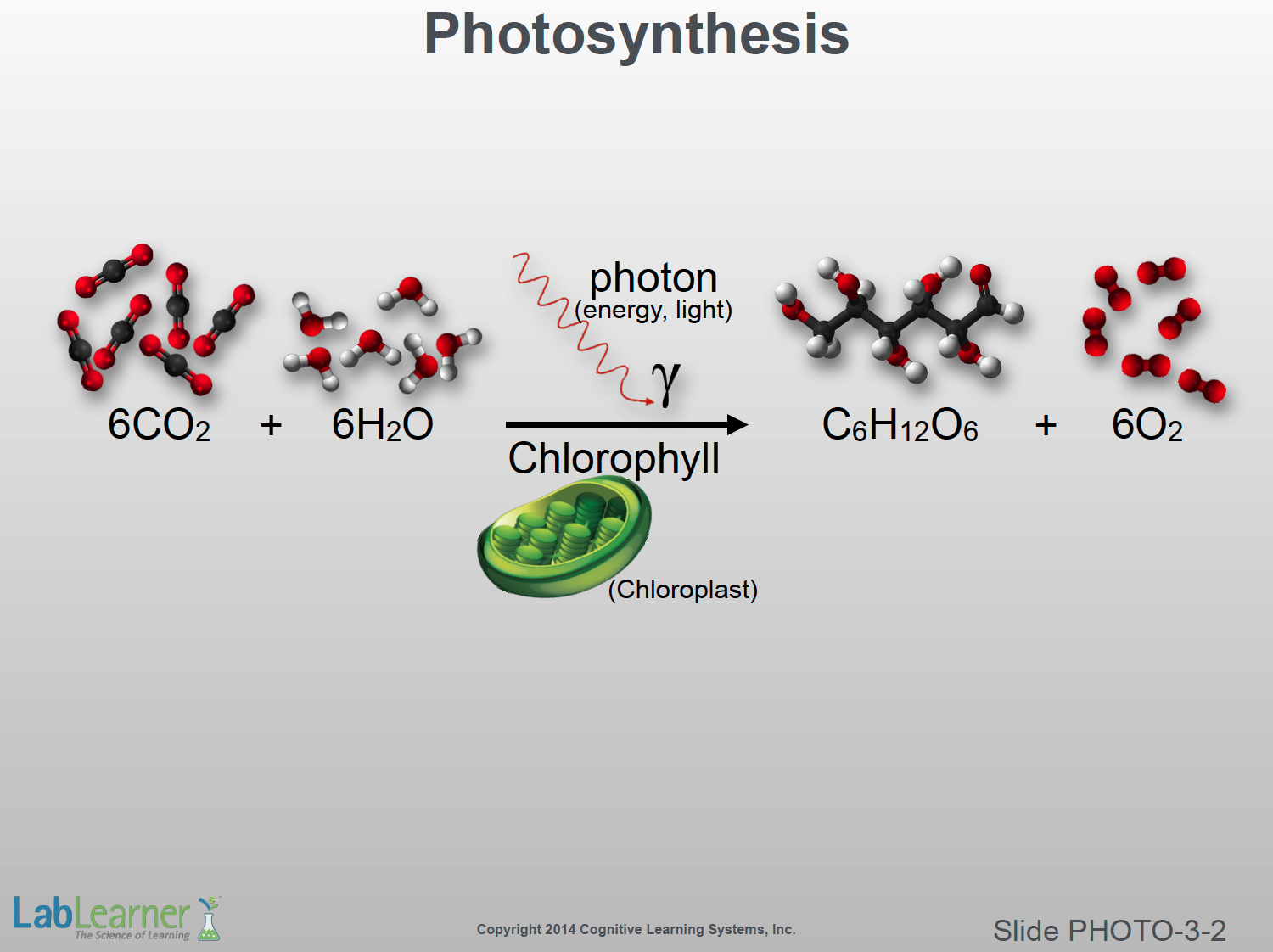
- In this Investigation, we will focus on the question of where chlorophyll is located in plant cells. From Investigation 2 and the first experiment of this Investigation, students will have addressed the involvement of CO2 and O2 in photosynthesis. They will also have demonstrated the importance of light (photons) in the reaction.
- In Investigation 1, students did paper chromatography on an extract of spinach plants and therefore were able to see the separation of chlorophyll from other pigments. Hopefully, they were able to see some yellow carotene pigment separated from chlorophyll by chromatography as well. We will refer to carotene later.
______________________________________________
SLIDE PHOTO-3-3
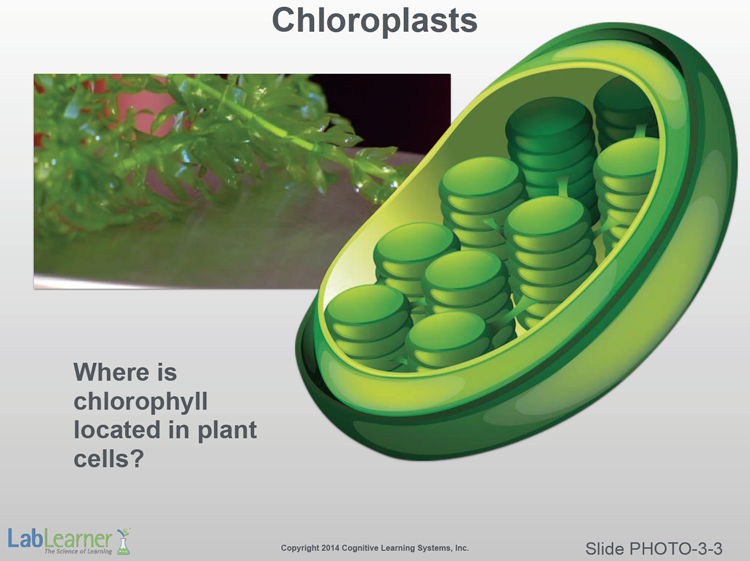
- This slide asks the question “Where is chlorophyll located in plant cells?” In Investigation 3 lab, students will use Elodea sprigs and the compound microscope to answer this question.
______________________________________________
SLIDE PHOTO-3-4
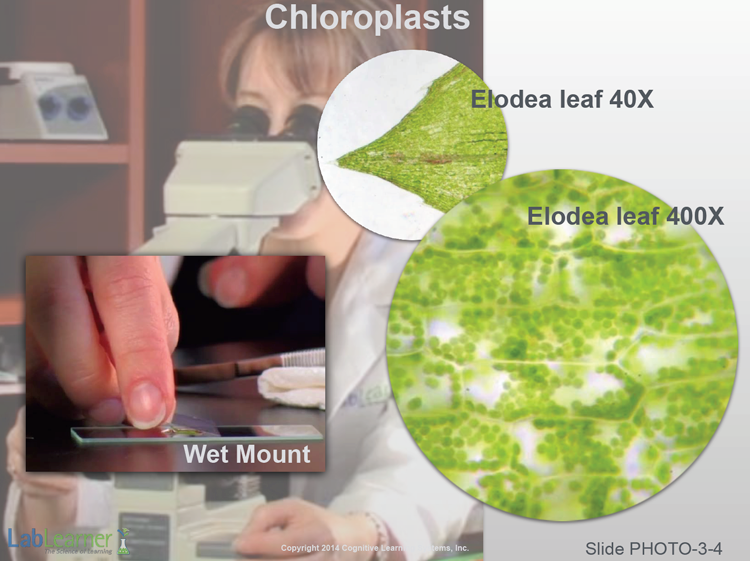
- This slide contains both the procedure and result of the experiments in the second part of Investigation 3 lab.
- Wet mount slides provide a quick way to look at living specimens. In the wet mount of an I leaf (two micrographs on the right), it is clear that the green pigment, chlorophyll, is not randomly distributed in plant cells. It is confined to the small chloroplasts that are easily seen at 400X magnification.
- Thus, chlorophyll is confined very specifically to one particular organelle, the chloroplast, with one very specific function, photosynthesis.
______________________________________________
SLIDE PHOTO-3-5
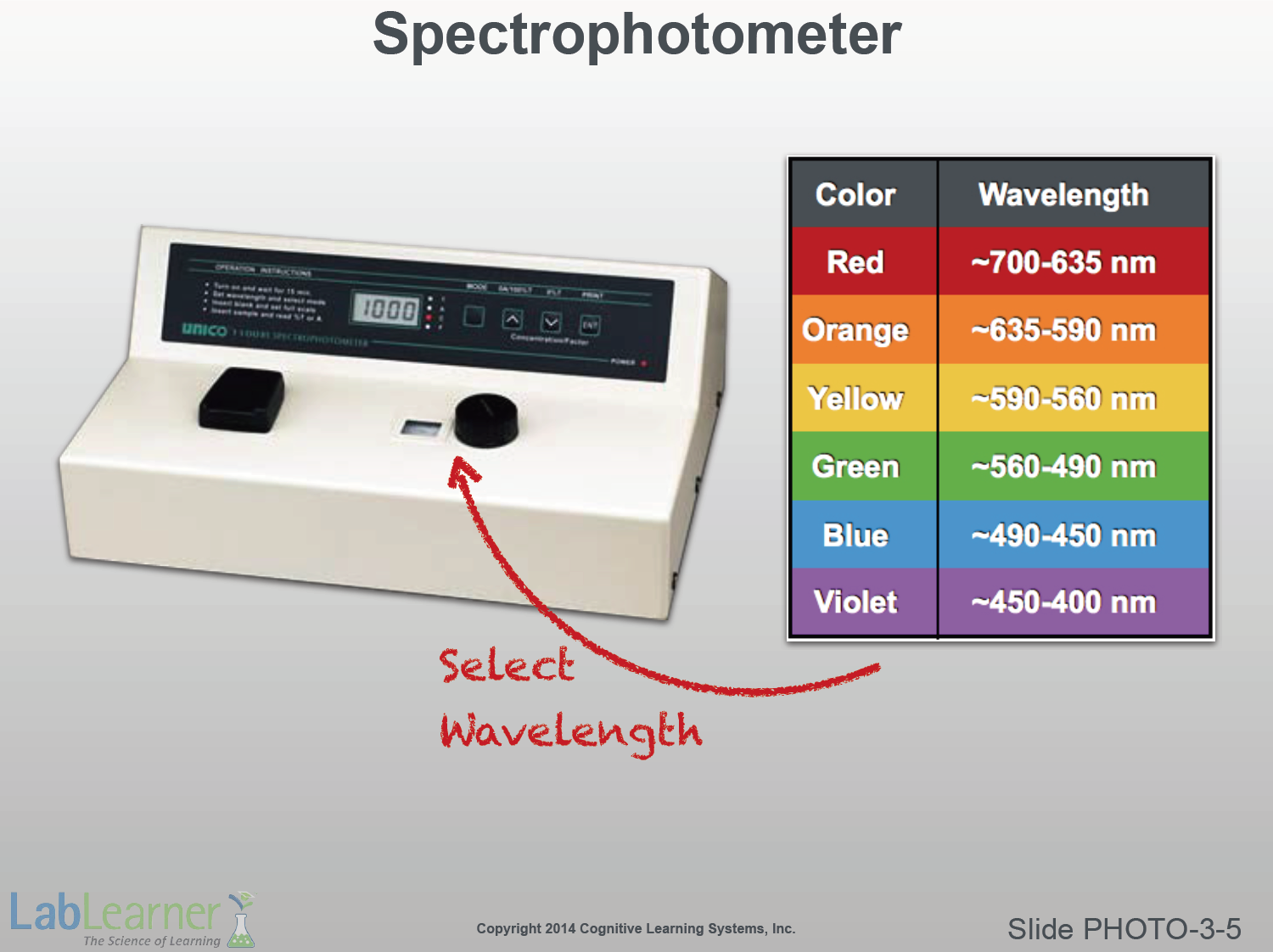
- This slide is included simply to refresh students’ memory of the spectrophotometer.
- Most experiments LabLearner students have performed with the spectrophotometer have involved setting the wavelength of light at one particular wavelength and using that setting for the entire experiment.
- Spectrophotometers can also be used to produce an absorption spectrum of a sample. An absorption spectrum is obtained by taking multiple readings of the same sample at different wavelengths of light. The closer the wavelengths are to each other in the series determines how smooth the final spectrum will look.
______________________________________________
SLIDE PHOTO-3-6
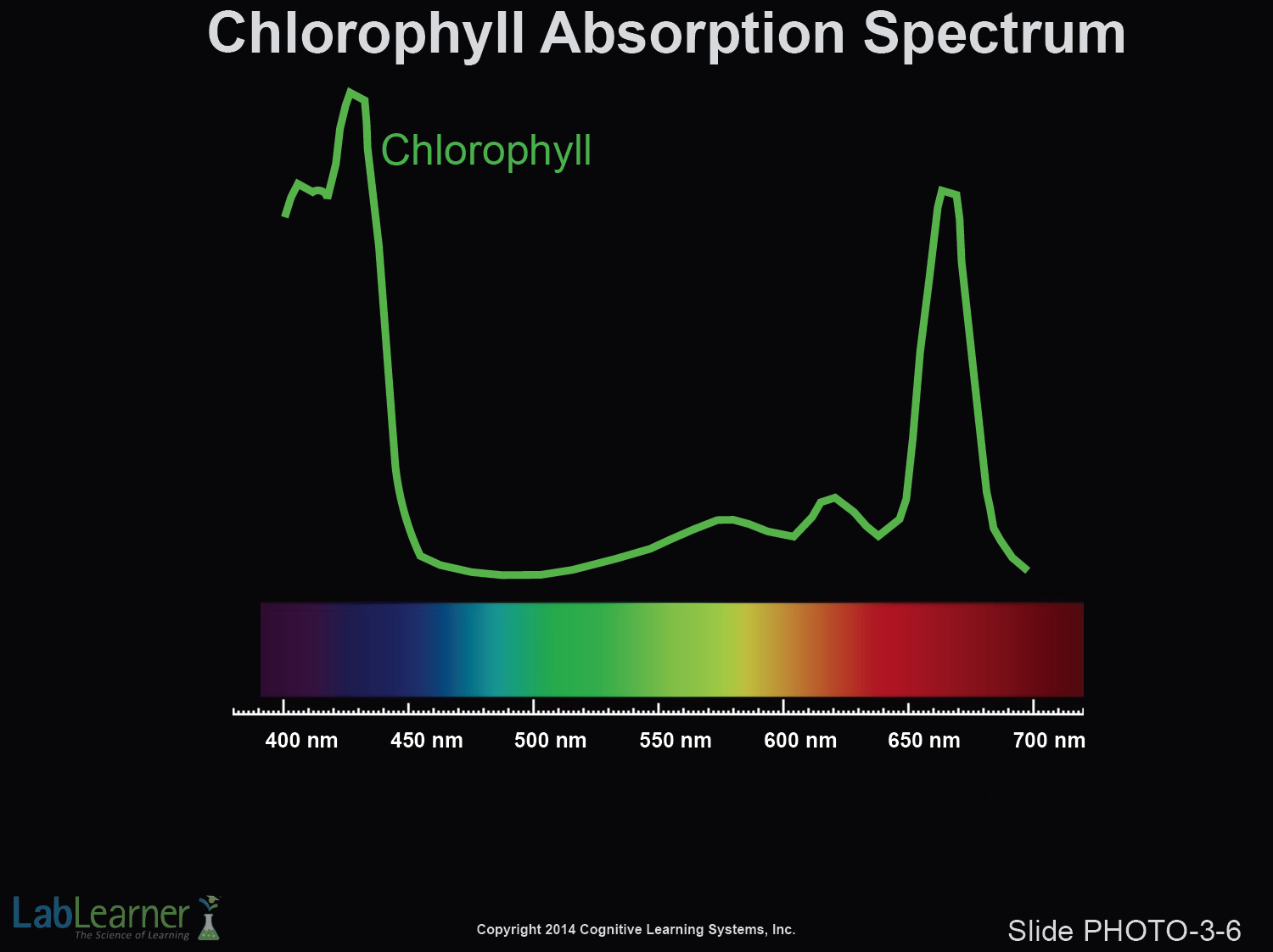
- This slide shows an absorption spectrum of the plant pigment chlorophyll. As can be seen, this spectrum spans the range of wavelengths across the visible spectrum, from about 400nm to 700nm.
- The higher up the y-axis, the more chlorophyll absorbs light at the corresponding wavelength on the x-axis. As students already should know, if light of a particular wavelength is not absorbed, it is reflected. And it is the reflected light that we are able to see.
- As can be seen in this scan, chlorophyll absorbs light at both ends of the spectrum. Therefore, we do not see the purples, blues, oranges, and reds when we look at a sample of chlorophyll. On the other hand, we see mainly the green wavelengths. This answers the question “Why is the grass green?”
______________________________________________
SLIDE PHOTO-3-7
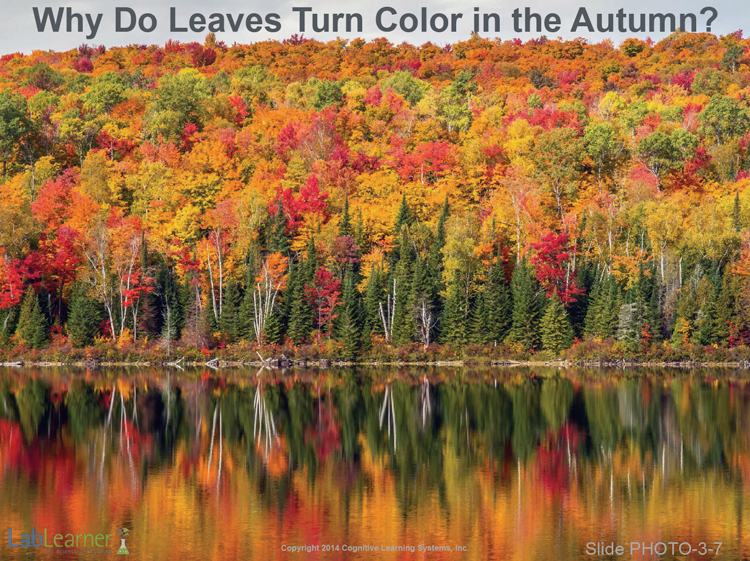
- Given the preceding information, we can now turn to address one of the most common questions that students and the general public ask concerning the color of plants in nature. That is, why do leaves turn color in the autumn?
- This introductory slide simply poses this question and depicts a spectacular array of autumn colors on a lakefront at a temperate latitude.
- Notice that the autumn colors are basically a combination of yellows and reds. Some green still remains at this location at the time the photograph was taken (the scattered green trees mixed in with the yellows and reds).
- Also notice, that the line of fir trees located close to the shoreline is entirely green. Instead of wide leaves, these firs have sharp needles. They will remain green all year long. That is why this class of plants is often referred to as evergreens. Therefore, evergreen plants can perform photosynthesis in the winter at reduced rates.
______________________________________________
SLIDE PHOTO-3-8
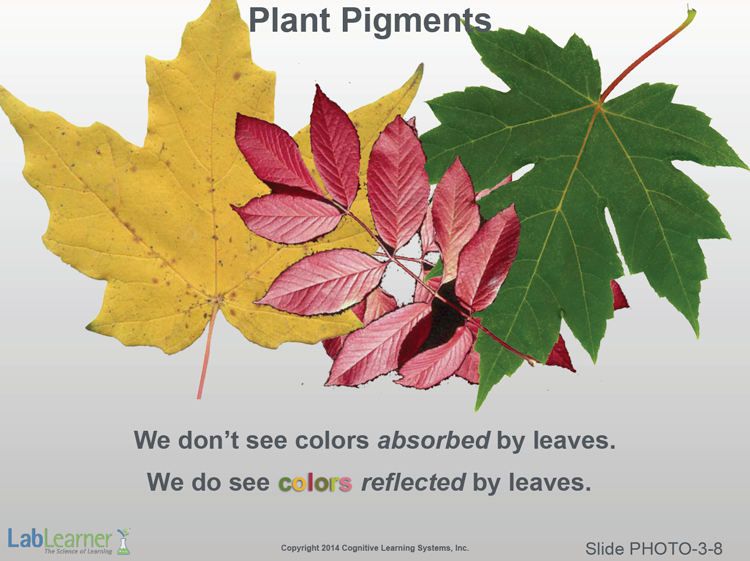
- This introductory slide simply reemphasizes to students that we can only see colors that are reflected off a surface (like a plant leaf), not those that are absorbed by it. It also shows the three colors that we will discuss in the following several slides; green, yellow, and red.
______________________________________________
SLIDE PHOTO-3-9
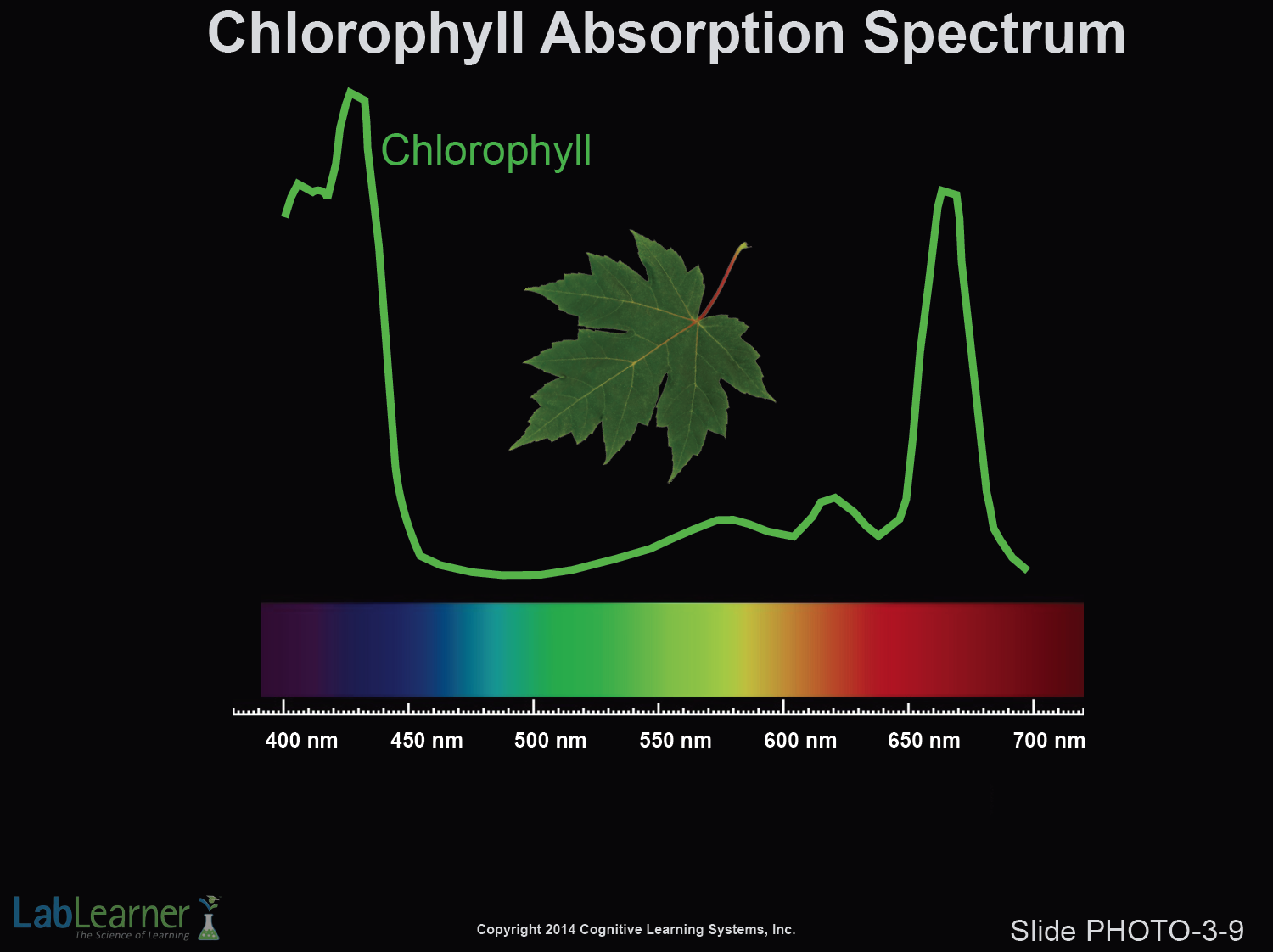
- Here again is the absorption spectrum of the pigment chlorophyll. Remember, green wavelengths of light are reflected by chlorophyll, most other wavelengths are absorbed and we therefore cannot see them.
- A maple leaf is included in this slide. This leaf was photographed in the summer. Notice that, although green dominates, some yellow is also visible in the leaf. In addition, notice that the stem of the leaf appears red. The pigments that produce the yellow and red colors of leaves and stems will be examined in the next two slides.
______________________________________________
SLIDE PHOTO-3-10
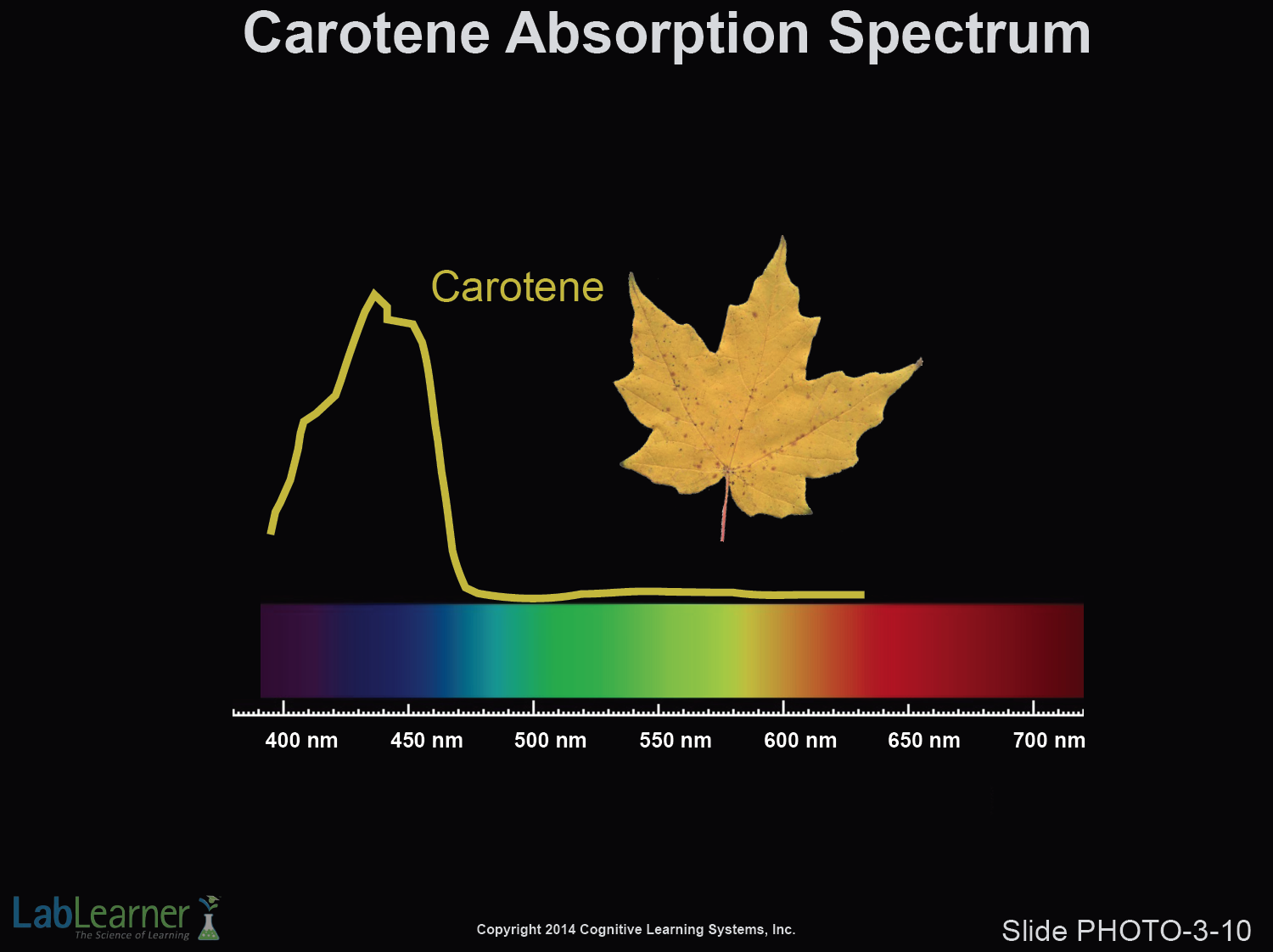
- This is the absorption spectrum of the plant pigment carotene. Carotene reflects light mainly in the yellow/orange range and therefore appears yellow or yellowish-orange to our eyes. This maple leaf was obviously photographed in the autumn. Carotene is also the pigment that gives carrots their color.
- While carotene does not directly participate in the photosynthesis reaction, it can assist chlorophyll and protects plant cells from potentially harmful byproducts of photosynthesis.
- Carotene is present in leaves all summer long but its presence is masked by a great overabundance of chlorophyll at this time of the year.
______________________________________________
SLIDE PHOTO-3-11
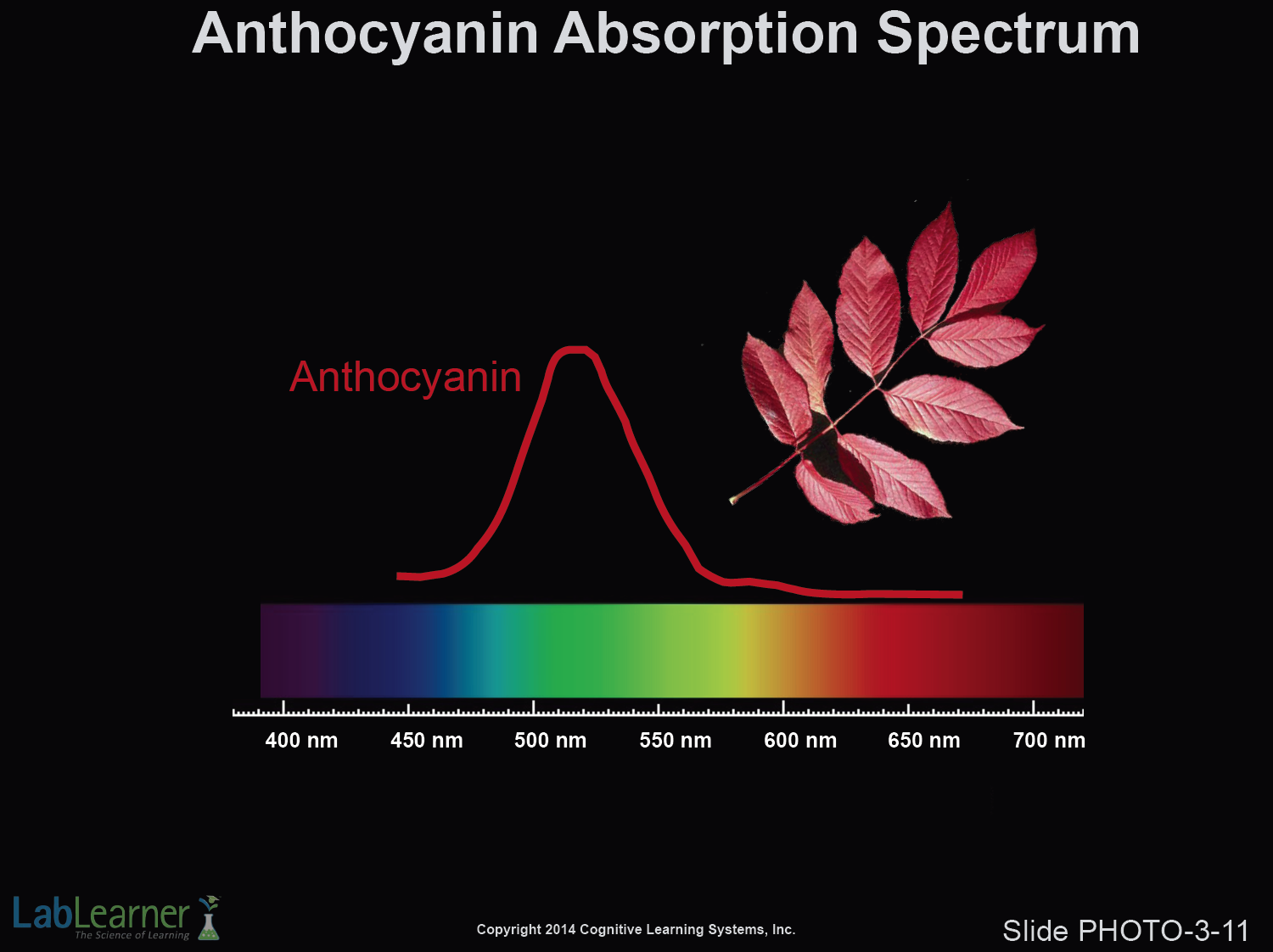
- This is the absorption spectrum of the plant pigment anthocyanin. As can be seen, anthocyanin reflects wavelengths of light in the red range.
- While anthocyanin is produced all summer in plants, including stems and flowers, unlike chlorophyll and carotene, anthocyanin is not produced in large amounts in leaves until autumn. The leaf pictured in this slide is from an ash tree.
______________________________________________
SLIDE PHOTO-3-12
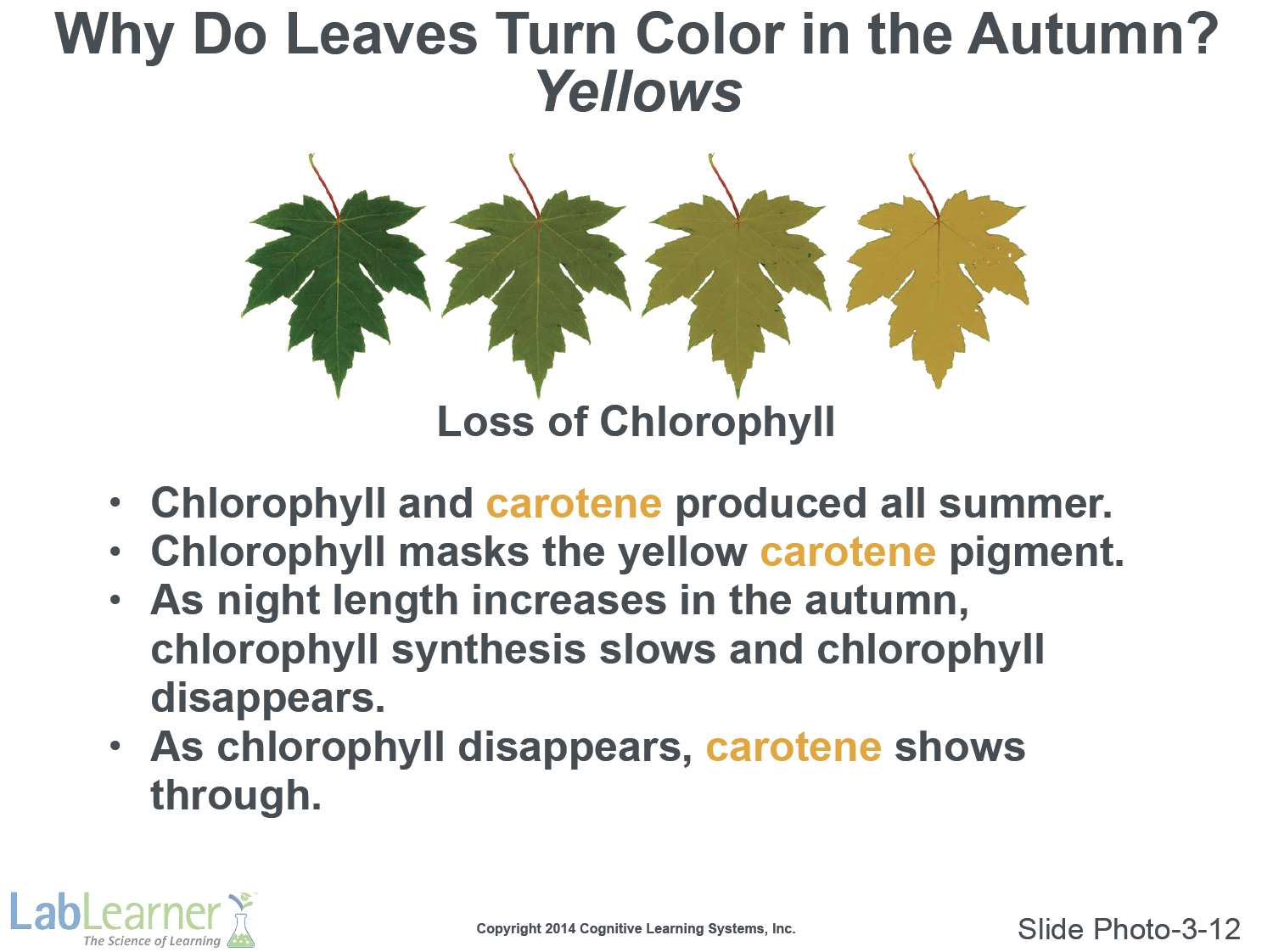
- This slide shows the progression of leaf color with the onset of autumn. As noted, both chlorophyll and carotene are produced in leaves all summer. However, the yellow/orange of carotene is masked throughout the summer by chlorophyll.
- As summer comes to an end and the length of nighttime increases, chlorophyll synthesis slows and stops. With time, the chlorophyll disappears from leaves and the bright yellow carotene pigment can be seen.
______________________________________________
SLIDE PHOTO-3-13
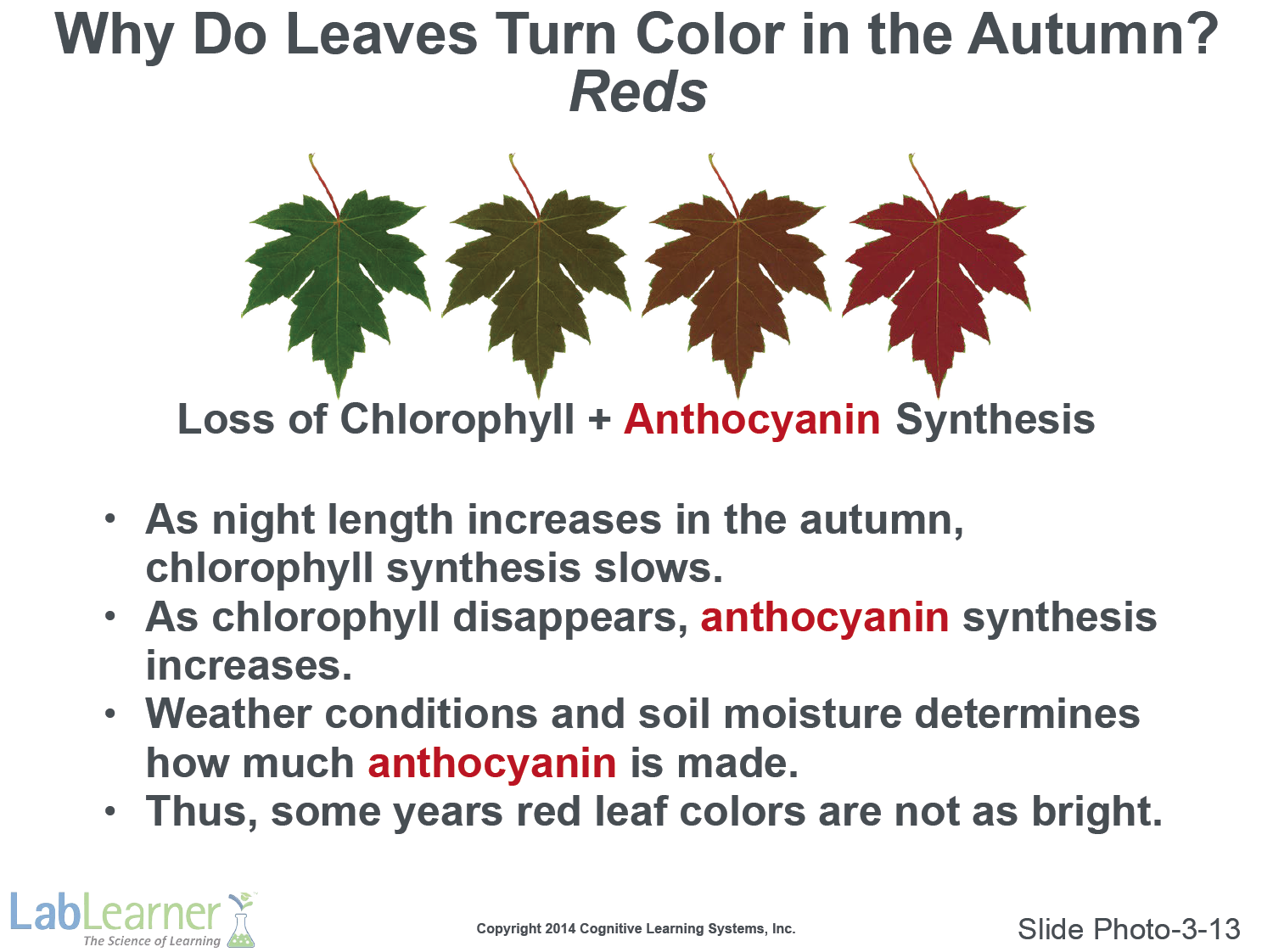
- This slide shows the progression of leaf color with the onset of autumn. Again, as nighttime length increases, chlorophyll synthesis is discontinued and the green chlorophyll pigment disappears.
- With the disappearance of chlorophyll from leaves, anthocyanin synthesis increases and can mask the yellow pigment of carotene.
- As noted, the amount of anthocyanin synthesis is dependent on both weather conditions and soil moisture. If conditions for anthocyanin synthesis are favorable, leaves will display their bright red color. On the other hand, if conditions for anthocyanin synthesis are unfavorable, leaves will display little red color. This helps explain why all autumns do not have the same mix of colors and why some autumns are more magnificent than others.
______________________________________________