
Teacher Portal:
Photosynthesis
Investigation 2 – Concept Day
ZERO-IN
Italicized font represents information to be shared orally or physically completed with the students at this time.
The non-italicized font represents additional information included to support the teacher’s understanding of the content being introduced within the CELL.
ASK WHY
Remind students that plants are all around us. We tend to take them for granted, but imagine a world without lush green grasses and trees – a planet blanketed in desert. Could we survive? Plants are an integral part of our environment and provide the food, oxygen, and fibers we depend on for survival. And their ability to photosynthesize is one of nature’s most amazing and essential phenomenons.
BRANCH OUT
Explain to students that horticulturists improve crop yield, quality, nutritional value, and resistance to insects, diseases, and environmental stresses. They make plants more adaptable to different climates and soils and better fit for food uses or processes. They also grow and improve plants used for medicines or spices.
PRINT IT
Use your browser to download a printable PDF as a help during the slide presentation and to make additional notes. In your browser, go to File > Print and then choose to save as PDF.
NAVIGATE IT
Once the slide presentation is launched
- use your left and right arrows to advance or go back in the slide presentation, and
- hover your mouse over the left edge of the presentation to get a view of the thumbnails for all the slides so that you can quickly move anywhere in the presentation.
- Click HERE to launch the slide presentation for the CELL.
SHARE IT

SLIDE PHOTO-2-1
In this Investigation, we wish to focus on the various components of the photosynthesis reaction.
We will begin by describing one of the classic experiments of all times in plant science, an experiment performed some 400 years ago.
Most of our discussion will pertain directly to Investigation 2 lab. Students will see that they can determine if carbon dioxide is used in photosynthesis and if oxygen is produced. They will also determine the involvement of chlorophyll and photons in the photosynthetic reaction.
______________________________________________

SLIDE PHOTO-2-2
- This is an introductory slide from Investigation 1. It is simply placed here to remind students of the abundance of photosynthesis activity on Earth.
______________________________________________

SLIDE PHOTO-2-3
- This is the first of several slides describing a classic experiment in plant science.
- Jean Baptiste Van Helmont, the great seventeenth-century chemist and physician, wanted to know where the mass comes from when a plant grows. Not knowing about the gases in the air, he supposed the mass must come either from the water that is supplied for growth or from the soil in which the plant grows.
- Ask students to think about Van Helmont’s hypothesis, that the mass of a growing plant either comes from the water added during its growth or the soil in which it is planted. Without a knowledge of photosynthesis or even the knowledge of gases in the air, wouldn’t this be a reasonable hypothesis? After all, the increasing mass of a growing plant can’t come from nowhere, can it?
______________________________________________

SLIDE PHOTO-2-4
- Van Helmont’s experiment was elegant given what was known at the time. He began by determining the mass of a willow sapling to be 2.3kg. He also determined the mass of the dry soil he put in a pot. It was determined to be 90.9kg.
- He planted the willow and allowed it to grow for a period of five years, only providing the plant with water during the course of the experiment.
- After five years, Van Helmont once again determined the mass of the grown willow and the dried soil. These were found to be 77kg and 90.8kg, respectively. In other words, the amount of soil before and after the experiment were nearly identical, even though the mass of the willow increased by over 70kg! So clearly, the increased mass of the willow could not be accounted for by components found in the soil.
_______________________________________

SLIDE PHOTO-2-5
- Van Helmont concluded that all of the mass gained over the five-year period of growth must have come strictly from the water that was added.
- Even though he was incorrect in his conclusions, based on what was known at the time, his thinking and interpretation of his data was reasonable. He simply had no idea that a gas in the air, carbon dioxide, was incorporated into the growing willow’s tissues. Actually, CO2 was not discovered until shortly after Van Helmont’s death. It was discovered by a Scottish chemist and physician named Joseph Black. Oxygen gas was discovered shortly after, in the 1770s.
- In fact, most of a plant’s mass comes from the CO2 in the air, certainly all of its carbon. In Investigation 2 lab, students will follow CO2 utilization and O2 production during photosynthesis. The data that they collect would have been very valuable to Van Helmont!
_______________________________________

SLIDE PHOTO-2-6
Note: With this slide, we begin to discuss the experiments that students will perform in Investigation 2. Some of the questions posed at the bottom of this slide will be further addressed in Investigations 3 and 4.
- On this slide, the photosynthesis reaction is presented and a number of questions about the reaction are posed.
Note: The teacher may wish to ask students to suggest what types of experiments might be done to answer these questions before moving on to the next slides.
_______________________________________

SLIDE PHOTO-2-7
- This slide is included again here to remind students that, in nature, the Sun provides the Earth with a nearly endless supply of photons. Of course, the photons only directly strike the surface of the Earth during daylight hours. Therefore, at any given geographic location, photons for photosynthesis are available for only a portion of a twenty-four-hour day.
_______________________________________

SLIDE PHOTO-2-8
- While photons are provided by the Sun in nature, in their experiments, students will provide photons for photosynthesis by using an incandescent light bulb.
Note: Students first saw a form of this slide in the CELL Electricity and Magnetism and then again in the Light CELL.
- Electrical energy, that is the kinetic energy of moving electrons, enters the light bulb and must pass through a tungsten filament of very high resistance to electron flow. This causes both heat and light to be given off by the filament. The light, of course, is given off in the form of photons. Such photons are the same as those provided by the Sun and can therefore drive photosynthesis. Students will use these photons in the experiments they perform in Investigations 2 and 3.
_______________________________________

SLIDE PHOTO-2-9
- In this slide, we present the basic experimental setup and background for the first experiment of Investigation 2.
- The pH indicator, phenol red, indicates if a solution is neutral, basic or acidic. It turns a different color in these pH ranges. As shown in the table, phenol red is yellow in an acidic solution and red in a basic solution.
- Carbon dioxide interacts with water. When it is present, it causes a water solution to become acidic. Therefore, phenol red will be yellow in its presence. On the other hand, if the water is depleted of CO2, this will cause the solution to become more basic. Students can therefore use phenol red to determine the relative amount of CO2 in water solutions.
- As shown on the left, while both of the test tubes will contain water and phenol red, only one will contain the aquatic plant elodea. Since water has a certain amount of dissolved CO2 in it from the atmosphere, the starting conditions will likely show that both tubes are orange-reddish in color, indicating a somewhat basic pH.
- If CO2 is used up during the photosynthesis reaction, this will cause the solution to become more basic and the phenol red will become a more reddish color and perhaps even turn purple if enough CO2 is depleted.
Note: From this experiment, students should conclude two things. First, CO2 is used in the photosynthesis reaction, and second, plant chloroplasts and chlorophyll are required for the reaction (because one test tube doesn’t have plant tissue and the other one does).
_______________________________________

SLIDE PHOTO-2-10
- This slide shows the experiment setup for the second part of Investigation 2 lab. In this experiment, students will directly measure dissolved O2 with an oxygen meter and probe.
- As the experiment is too long to perform all controls in the same Investigation, students will measure O2 concentration in the presence and absence of light over Investigations 2 and 3 as indicated in this slide.
_______________________________________
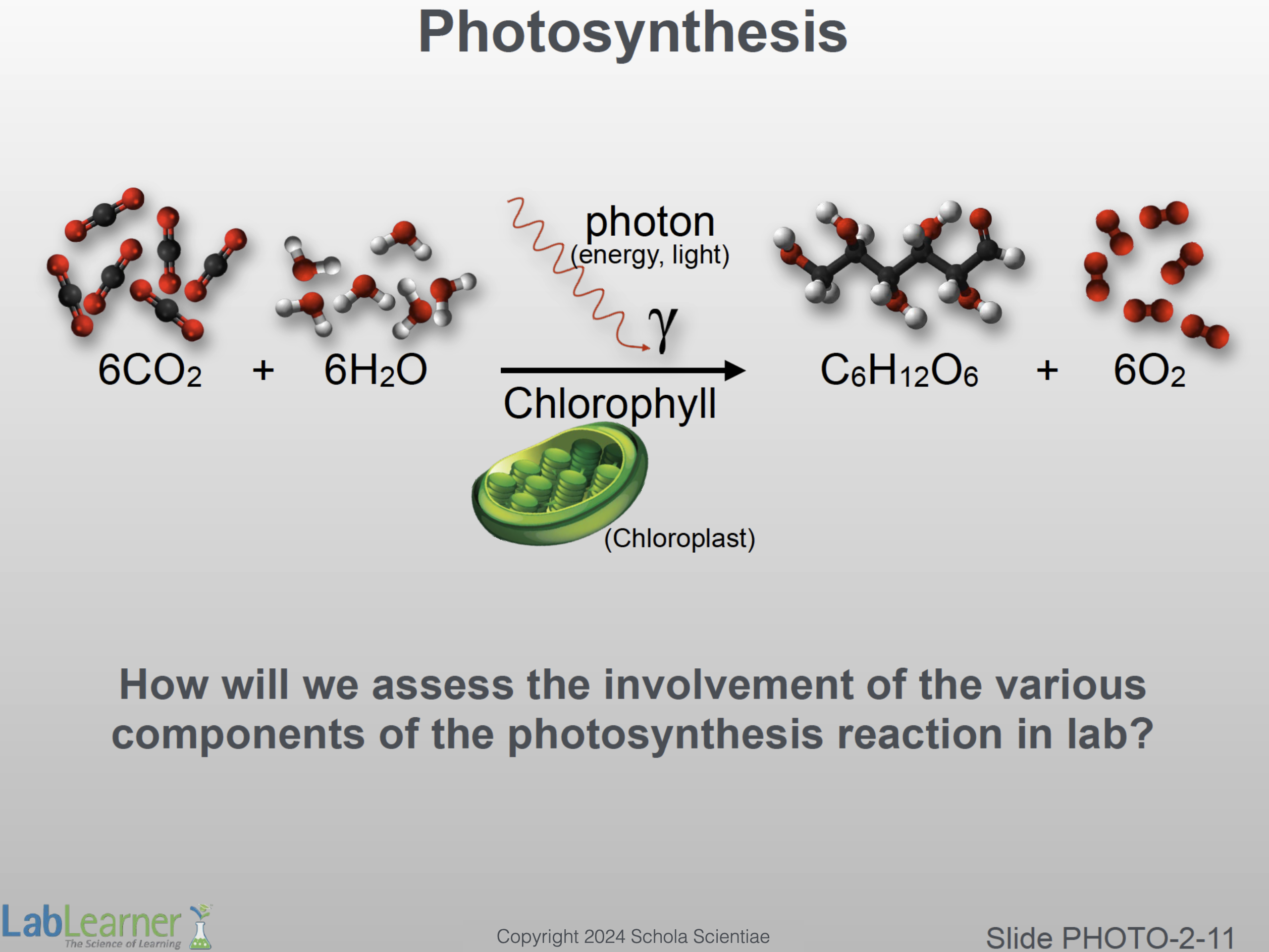
SLIDE PHOTO-2-11
- This final slide revisits the photosynthesis reaction and asks students how they will assess the involvement of the various components of the reaction in the lab.
Note: They should be able to discuss the depletion of CO2, the formation of O2, the requirement of light, and the requirement of plant tissue (chloroplasts and chlorophyll).
Note: The teacher may wish to use this slide in PostLab for Investigation 2.