
Teacher Portal
Photosynthesis
Investigation 1 – PreLab
ZERO-IN
Italicized font represents information to be shared orally or physically completed with the students at this time.
The non-italicized font represents additional information included to support the teacher’s understanding of the content being introduced within the CELL.
ASK WHY
Remind students that plants are all around us. We tend to take them for granted, but imagine a world without lush green grasses and trees – a planet blanketed in desert. Could we survive? Plants are an integral part of our environment and provide the food, oxygen, and fibers we depend on for survival. And their ability to photosynthesize is one of nature’s most amazing and essential phenomenons.
BRANCH OUT
Remind students that botanists study all plant life. They may study the effects of pollution (such as acid rain) on plants and work toward environmental protection, or they may identify new plant species and evaluate their parts and uses. Some botanists produce entire plants from single cells with a technique called tissue culture. Others use biotechnology to develop new or improved plants.
GET FOCUSED
Inform students that the Investigation is designed to help them to answer the following Focus Question:
- Which pigments or colors are present in spinach leaves? The leaves contain yellow and yellow-green pigments.
Note: This question is located in students’ SDRs at the beginning and end of the Investigation.
Note: This is a succinct response to the Focus Questions and is placed here for your reference at this time. Fully developed responses to the Focus Questions can be found on the PostLab page.
GO DEEPER
As a class, read the Background(s) in the Investigation. Have students read the information aloud or silently to themselves. When students have finished, discuss the following concepts as a class:
- Photosynthesis occurs inside the parts of a cell called chloroplasts.
- Chloroplasts contain pigments needed for photosynthesis.
- These pigments include chlorophyll a, chlorophyll b, and the carotenoids.
- Chlorophyll-a is the main pigment needed for photosynthesis.
- The process called chromatography can separate the different pigments.
Note: These concepts are integrated into the Background(s) and are used to deepen students’ comprehension of the big ideas.
LEARN THE LabLearner LINGO
The following list includes Key Terms that the teacher should introduce, as appropriate, within the CELL. These terms should be used, as appropriate, by teachers and students during everyday classroom discourse.
- photosynthesis
- chloroplasts
- chlorophyll
- carbon dioxide
- oxygen
Note: Definitions to these terms can be found on the Introduction page to the CELL.
Note: Additional words may be bolded within the Background(s). These words are not Key Terms and are strictly emphasized for exposure at this time.
SET FOR SUCCESS
- As a class, review photosynthesis. If needed, write the following equation on the board.

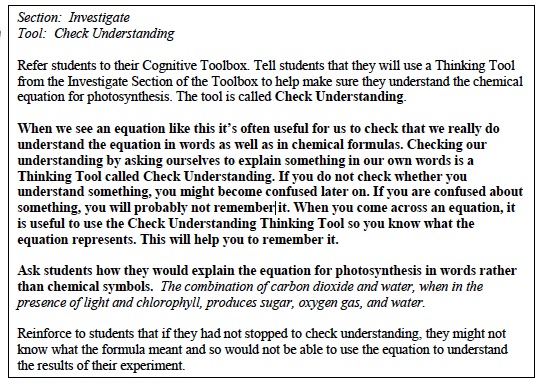
- Tell students that during this Core Experience Learning Lab, they will perform various experiments to allow them to observe the needs of plants and the products of photosynthesis.
- Play the video below. Stop to ask students questions or answer students’ questions when necessary. Remind students to follow along with their SDRs and make any notes that they think might be helpful.
- After the video, direct students to divide into their lab groups to discuss their strategy for the lab. For example, they may assign certain group members to perform specific functions during the lab.
Note: The purpose of the video is to allow students to anticipate the laboratory experience they will soon encounter. Students should leave this PreLab session with a firm idea of what to expect and how to perform in the lab.
Note: Homework is posted below the video.
HOMEWORK
Tell students that they should review the Investigation in preparation for the Lab.