
Teacher Portal:
Open Inquiry: The Pendulum
Introduction
The Pendulum: Introduction
 The pendulum has played an enormously important role in the development of modern physics and mechanics. In the sixteenth, seventeenth, and even into the eighteenth century, the pendulum was used by great scientists such as Galileo Galilei (1564-1642), Isaac Newton (1642- 1727), and others to study fundamental properties of force and motion. One of the reasons that the pendulum was so useful in an era when fast and accurate measurements of time were technically impossible (hour-glasses, sundials, and water clocks could not measure short periods of time accurately) is because freefall of a mass from its point of release, caused by the force of gravity, could be slowed down for study. In other words, when the pendulum’s bob (object at the end of the pendulum string) is raised and released, it will swing down solely due to the force of gravity acting upon it (so long as it is only released and not pushed). The inclined plane was also extremely useful in studying force and motion for similar reasons.

Potential and Kinetic Energy
In addition to its other uses in the history of science and modern science education, the pendulum is also an excellent model to demonstrate the concept of potential and kinetic energy, particularly the transition and interplay between them. While this is not the main point of this Open Inquiry, students may well recognize the relevance of the two energy forms, thus it is worth a slight digression to briefly discuss this issue here.
 When the pendulum bob is positioned at its extreme amplitude, that is the angle between the string at the vertical position just prior to its release, the bob is not moving and all of its energy is in the form of potential energy (indicated in yellow in the figure here). Once released, gravity acts on the mass, causing it to fall toward the vertical position. At the bottom of the pendulum swing, at the vertical position just prior to its continued movement beyond this point, 100% of the energy present is in the form of kinetic energy (indicated in red in the figure) – the energy of motion. Importantly, as shown in this Figure, as the bob swings to the vertical position, the loss of potential energy is exactly in proportion to the gain in kinetic energy (changing from yellow to red in the figure). That is, at some point in the downward swing, exactly 50% of the total energy will be in the form of potential energy and 50% will be in the form of kinetic energy. Thus, since the total energy in the system is the same at any point in the swing, this simple experiment nicely illustrates Newton’s Law of Conservation of Energy which states that energy can not be destroyed or created, but simply changes forms.
Although the conceptual knowledge about the pendulum and the factors that affect its period is a valuable component of this Open Inquiry, the most important facet of the investigation is the inquiry process through which students design and test their experiments and collect and analyze their data. Therefore, much of the discussion and analysis should focus on how the experiments were conducted and why students drew their conclusions.
The Scientific Method
The important component of the Open Inquiry is its integration of the Scientific Method into the inquiry process. The integral parts of the Scientific Method have been seamlessly incorporated into previous CELLs as part of focus questions in the SDRs. The Open Inquiry brings these pieces together and to the attention of the students as their next step into scientific thinking and inquiry.
The Scientific Method has been used to approach scientific problems for several centuries. In fact, the application of the Scientific Method is largely what makes modern science “modern”. In earlier times, philosophical and even theological arguments were used to explain physical phenomena. The Scientific Method exists in various formats and scientists themselves don’t actually sit and say, “Alright, now I am going to use the Scientific Method.” Rather, the Scientific Method and its procedures become second nature to them during the course of years of scientific training and practice.
In this Open Inquiry, we employ a form of the Scientific Method that has the following steps:
- Observation
- Question
- Hypothesis
- Prediction
- Test
- Data
- Conclusion(s)
Unlike in the case of completely “open” and authentic inquiry, in this LabLearner Open Inquiry, students are directed by the teacher to observe the system of the pendulum and the potential factors (variables) that could potentially influence the period of its swing. The students may then begin to formulate questions in their minds concerning which of the variables of mass, string length, or amplitude is likely to influence the period. This should then lead to the formation of a hypothesis. In the Concept Day presentation, students will learn that hypotheses are generally not stated as questions, but rather as statements. Thus a statement such as magnetism is related to electrical current is a good example of a hypothesis.
Once a hypothesis is stated, students should then make a prediction based upon it. In this Open Inquiry, examples of reasonable student predictions may include (note that not all reasonable predictions will necessarily prove to be correct):
- If the mass of the bob is increased, then the period will increase.
- If the mass of the bob is increased, then the period will decrease.
- If the amplitude of the pendulum is increased, then the period will increase.
- Etc.
Next, students will design experiments to test their predictions, conduct the experiments, and gather data. Finally, based on their data, students will be able to formulate conclusions regarding the validity of their predictions. By comparing results from experiments that address each of the three potential variables presented in this Open Inquiry, students will arrive at their own conclusions.
Independent and Dependent Variables
Students sometimes have difficulty grasping the concept of independent and dependent variables. This concept may be simplified and systematized by thinking in terms of cause and effect relationships – or If-Then statements. Thus, in the following statement (which contains both a hypothesis and a prediction based upon it):
“If magnetism is related to electrical current, then increasing the current will increase the magnetic field”,
the independent variable is the variable that will be altered or manipulated in an experiment. The dependent variable, on the other hand, will be the variable that is measured during or at the end of an experiment as a result of changes made to the independent variable.
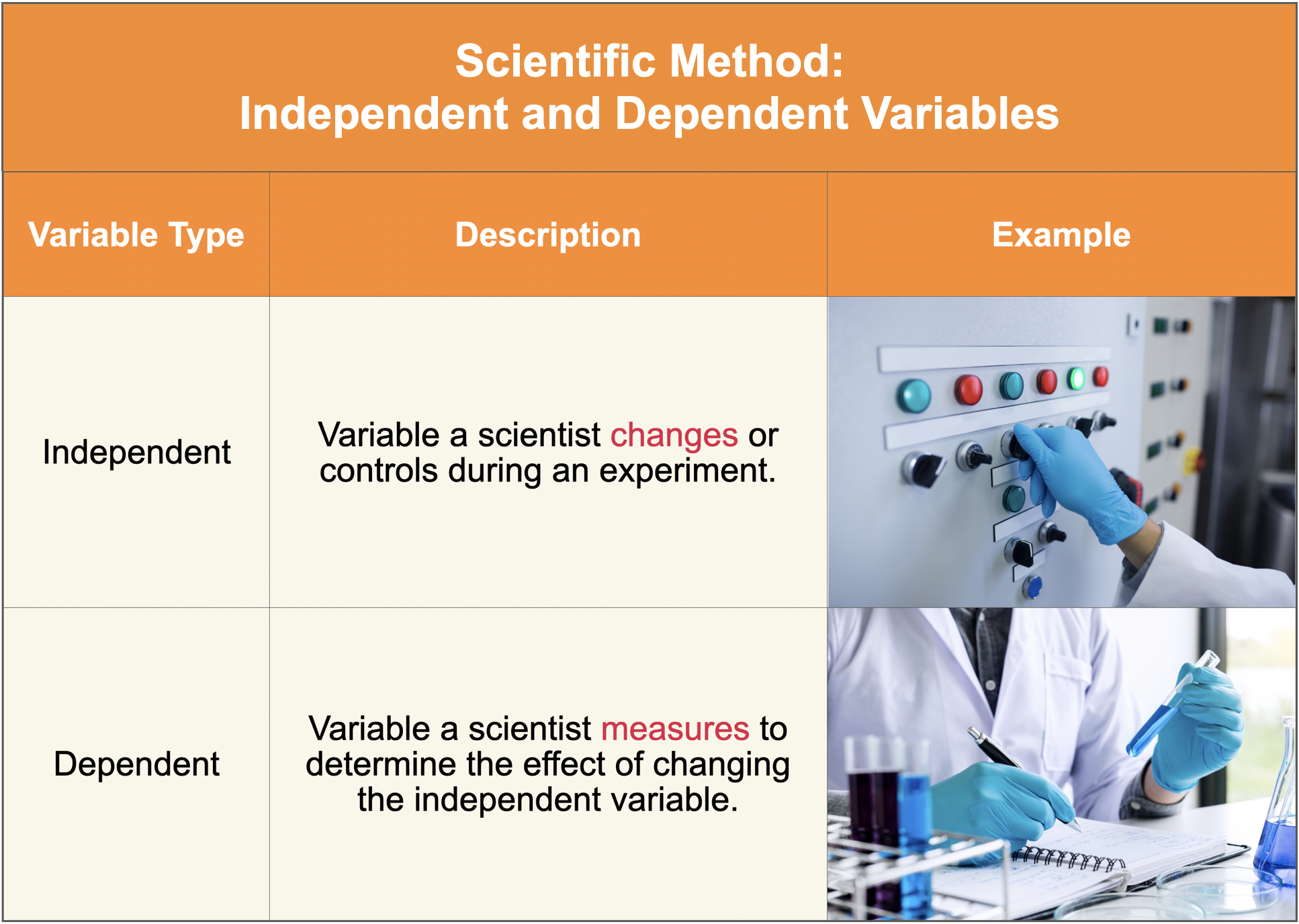
For example in this Open Inquiry, an experimental design in which string length is varied with subsequent measurement of the period, string length is the independent variable while the period is the dependent variable. Thus, the experiment was designed to find out if a change in the independent variable, string length, causes an effect on the dependent variable, the period.
In this Open Inquiry, students will be able to formulate a hypothesis about the characteristics of a pendulum and make a prediction based on the hypothesis. They will then choose the variables they need to examine to test their prediction, assign the independent and dependent variables, decide how to measure the dependent variable, and then design and conduct an experiment. After the experiment, they will then analyze their data to determine what effect, if any, changes in the independent variable had on the dependent variable. Even though this is a relatively simple experiment, students will nonetheless have practiced the essential steps that all scientists follow in routine experimental design.