
Teacher Portal:
Light
Investigation 4 – PostLab
ZERO-IN
Italicized font represents information to be shared orally or physically completed with the students at this time.
The non-italicized font represents additional information included to support the teacher’s understanding of the content being introduced within the CELL.
ANALYZE IT
Instruct students to complete the Analysis Questions in their SDRs then discuss them as a class. Use the suggested responses below to guide students’ answers.
- Which medium produced the greatest refraction of light? Use data to support your answer. Light was refracted the most as it passed from the air into the oil, as oil had the highest index of refraction and the greatest difference in the index of refraction compared to air. The difference in refraction was also apparent by comparing the angle of refraction between the three mediums. The greatest change in the angle of incidence and the angle of refraction occurred in the oil as compared to the semicircle and water.
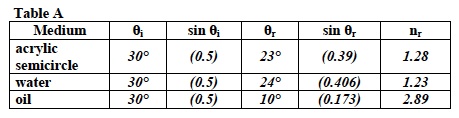
- How does the index of refraction affect the amount that light waves are bent or refracted? The greater the index of refraction the greater the refraction of light.
- When you observed the pins through the semicircle, the water, and the oil did they appear different than when viewed without the semicircle, water, and oil? Why? Student answers may vary. It is likely that students will have observed few, if any, visible signs of refraction when viewing the pins through the air as compared to viewing them through the semicircle, water, and oil.
Note: Questions marked with a triangle (∆) are included to enrich students’ understanding. These questions do not appear in students’ SDRs but should be used as additional discussion points during the PostLab.
- ∆ Why is the refraction of light more apparent when it passes through some mediums as compared to others? What factors contribute to the refraction of light? By combining the results of their experiments, students should begin to understand that both the refractive index and curvature of a medium contribute to the refraction of light. Although light is refracted as it passes from air through a flat piece of glass or plastic, the refraction is difficult to observe because the light waves exiting the medium remain parallel to the waves entering the medium. However, when light waves pass through a curved object the waves are refracted by the medium and exit the object at a different angle from which they entered because of the curvature of the object. Because the exiting waves are no longer parallel to the entering waves, it is easier to observe the effects of refraction.
GET FOCUSED
Instruct students to complete the Focus Question in their SDRs then discuss it as a class. Use the suggested response below to guide students’ answers.
- How does a change in mediums affect the wavelength of light? When light passes from one medium to another, the speed of the wavelengths change. This causes the light wave to change directions. This process is called refraction. Each medium changes the speed of light in a particular way. This characteristic of the medium is called its refractive index. Air has a refractive index of 1. The more a medium slows the passage of light, the greater its refractive index, as seen when acrylic was compared to water and oil.
COMPREHENSION CHECK
The Comprehension Check is designed to summarize the CELL and provide the teacher with an informal way to assess students’ understanding of the big ideas.
If time permits, ask your students to answer each question below. Use the suggested responses below to guide students’ answers.
- What is the relationship between a wave and its medium? The behavior of light is influenced by the medium with which it interacts. In this Core Experience Learning Lab students investigated four ways in which light interacted with a medium: absorption, transmission, reflection, and refraction. Students observed that as light interacted with transparent media, some light was absorbed by the media and some was transmitted. The ratio of transmitted to absorbed light was dependent upon the concentration of pigment within the media or the shade of the color of the transparent media. The greater the concentration of the pigment or the darker the shade, the more light that was absorbed and the less transmitted. The lower the concentration of pigment or the lighter the shade, the more light that was transmitted and the less absorbed.
Students should also have observed that as light interacted with opaque objects, it was absorbed or reflected from the object but was not transmitted through the object. Students should recall that the way in which light was reflected from opaque objects was dependent on the way in which it made contact with the objects. The relationship between the incident light (light that hit the object) and the reflected light was described by the Law of Reflection which states that the angle at which light is reflected is equal to the angle at which it is incident upon an object. It was this particular pattern of interaction with a medium that allowed students to use mirrors to observe the image of the bear 180 degrees behind the bear.
Finally, students should suggest that in addition to its absorption and transmission through transparent media, light is bent or refracted as it passes from one transparent medium to another. The extent to which light is refracted depends upon the differences in the indices of refraction of the two media. As light travels from a medium with a lower index of refraction to one with a higher index of refraction, the greater the difference between the two indices of refraction, the more light will be refracted or bent. The relationship between the angles at which light enters the two media and the indices of refraction of each medium is described by Snell’s Law: ni sin Øi = nr sin Ør
Through the application of Snell’s Law, students should indicate that they were able to determine the extent of refraction between two media. As a result of these experiments, students should have concluded that when two media are compared the relationship between refraction and the index of refraction can be stated as follows: the greater the index of refraction of a medium, the greater the refraction of light.
- How does wavelength affect the perception of light? Students should be able to draw on their experiments with both different colored transparent media and the spectrophotometer, and different colored opaque objects and colored filters when answering this question. From those experiments, students should have concluded that the color of objects is dependent upon differences between the absorption and transmission (transparent media) or absorption and reflection (opaque media) of different wavelengths of light.
For transparent media, the color we observe correlates to the wavelength or wavelengths of light transmitted through the media. For example, when testing the red colored solution students found that the wavelengths of light that we perceive as red (600 – 700 nm) were transmitted through the solution whereas all other wavelengths of visible light were absorbed by the solution.
For opaque objects, students found that the color of the object results from the reflection of a particular wavelength of light. For example, the cube that appeared blue reflected the wavelengths of light that corresponded to the blue end of the spectrum and absorbed the longer yellow, orange, and red wavelengths of light.