Teacher Portal:
Light
Investigation 2 – Concept Day
ZERO-IN
Italicized font represents information to be shared orally or physically completed with the students at this time.
The non-italicized font represents additional information included to support the teacher’s understanding of the content being introduced within the CELL.
ASK WHY
Remind students that light is all around us. It has the ability to tan or burn our skin. It can be harnessed to melt metals, create electricity, and heat our food. It gives us sight, color, warmth, and enables gadgets like computers, cameras, televisions, traffic lights, mirrors, eyeglasses, and microscopes to function.
BRANCH OUT
Explain to students that physicists have created blue LEDs (light-emitting diodes) that have made today’s flat-panel, full-color computer monitors and TV screens possible. The technology also is being incorporated into water purifiers, which use ultraviolet light to kill bacteria and viruses in water.
PRINT IT
Use your browser to download a printable PDF as a help during the slide presentation and to make additional notes. In your browser, go to File > Print and then choose to save as PDF.
NAVIGATE IT
Once the slide presentation is launched
- use your left and right arrows to advance or go back in the slide presentation, and
- hover your mouse over the left edge of the presentation to get a view of the thumbnails for all the slides so that you can quickly move anywhere in the presentation.
- Click HERE to launch the slide presentation for the CELL.
SHARE IT

SLIDE LIGHT-2-1
- In this Investigation, we will begin with a brief discussion about light and energy. We will discuss how the Sun produces photons through a nuclear fusion reaction.
Note: Students will have been exposed to this topic briefly in the sixth-grade CELL, Space. They will once again consider light and energy later in the Photosynthesis and Ecosystems CELLs.
- We will then turn our attention to the Law of Refraction and a brief look at part of the experimental setup for the Investigation 2 lab.
______________________________________________
SLIDE LIGHT-2-2
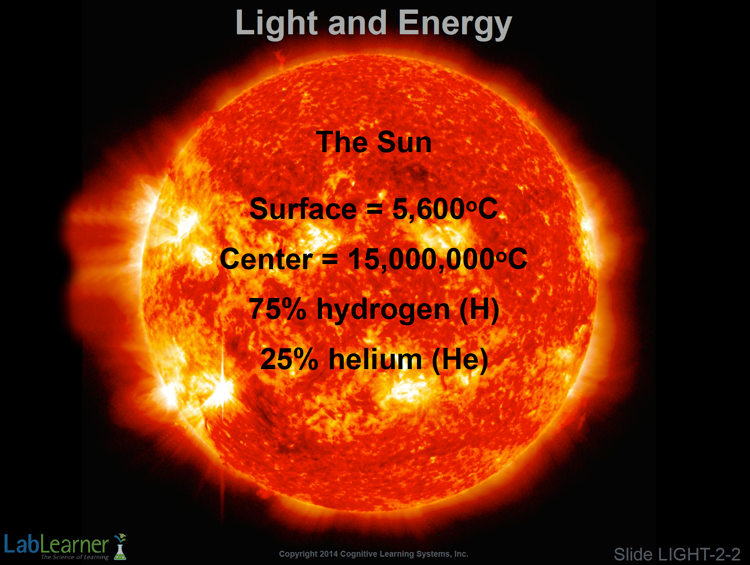
- The Sun is the ultimate source of nearly all energy on Earth. But how does it transfer this energy to us from such a great distance (149,600,000 km)? It does so by converting matter into energy in the form of photons through a magnificent reaction call nuclear fusion.
- This slide presents data about the Sun that is important for the nuclear fusion reaction to occur. Nuclear fusion requires great temperature and pressure – these two conditions are met in the Sun’s interior. In addition, it requires an abundant supply of hydrogen atoms. As seen here, the Sun is composed of 75% hydrogen.
Note: The helium component of the Sun’s composition was mostly formed as the result of nuclear fusion, as will be seen in the following slide. Its percentage will increase at the expense of hydrogen until all of the hydrogen fuel for nuclear fusion is depleted.
______________________________________________
SLIDE LIGHT-2-3
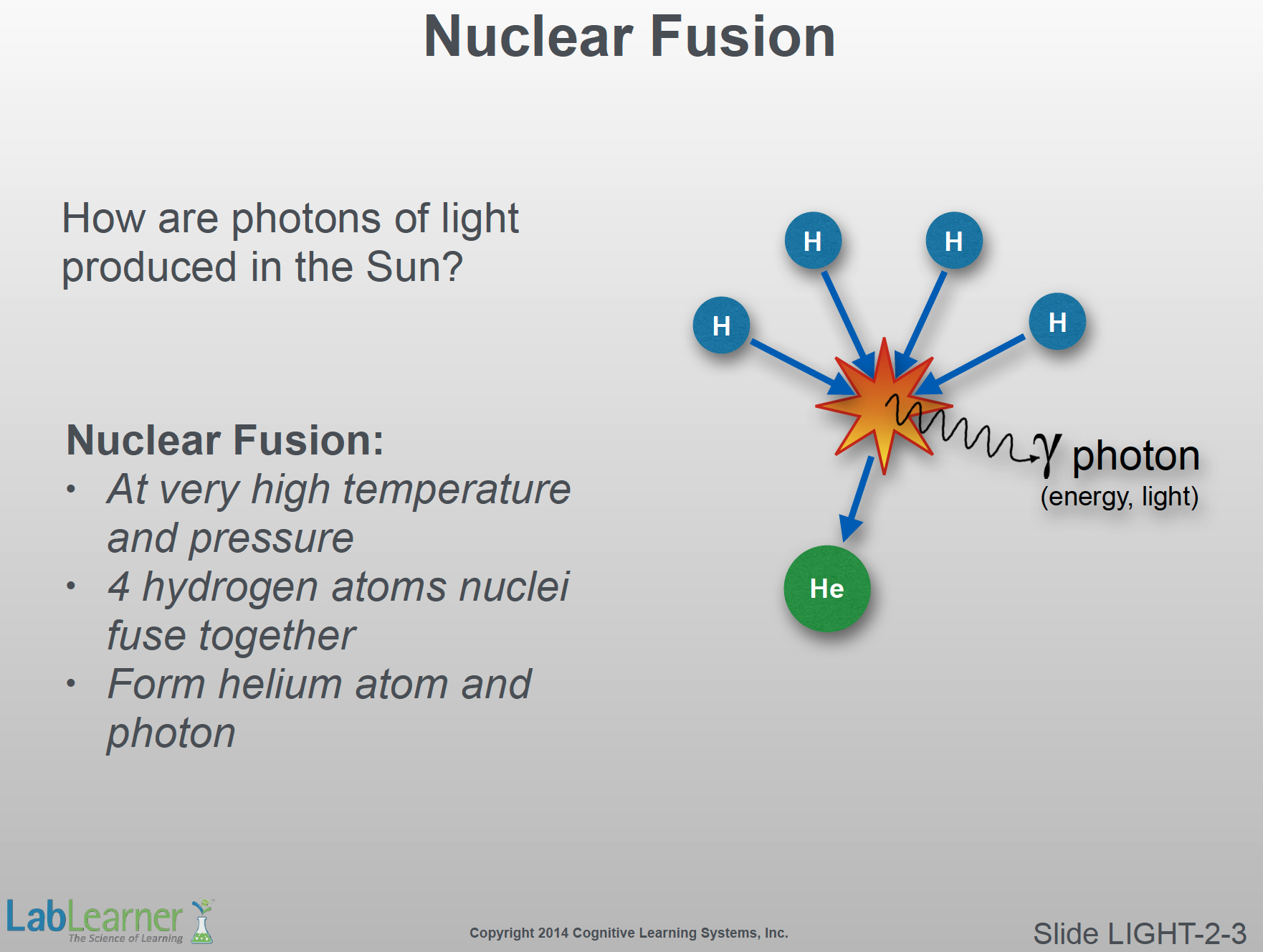
- In this slide, we introduce the concept of nuclear fusion. It is called nuclear fusion because four hydrogen atoms come together with such force that their nuclei fuse. This only occurs near the center of the Sun, where the temperature and pressure are the most intense.
- Since hydrogen atoms are composed of a single proton in their nuclei, sometimes they are simply referred to as “protons” and so the Sun’s nuclear fusion reaction is sometimes called proton-proton fusion.
- This slide shows a graphic that depicts 4 hydrogen atoms (protons) colliding with each other. This collision results in the formation of one helium atom and also the release of energy in the form of a photon. Photons are often depicted by the lower case Greek letter gamma and a squiggle line arrow.
______________________________________________
SLIDE LIGHT-2-4
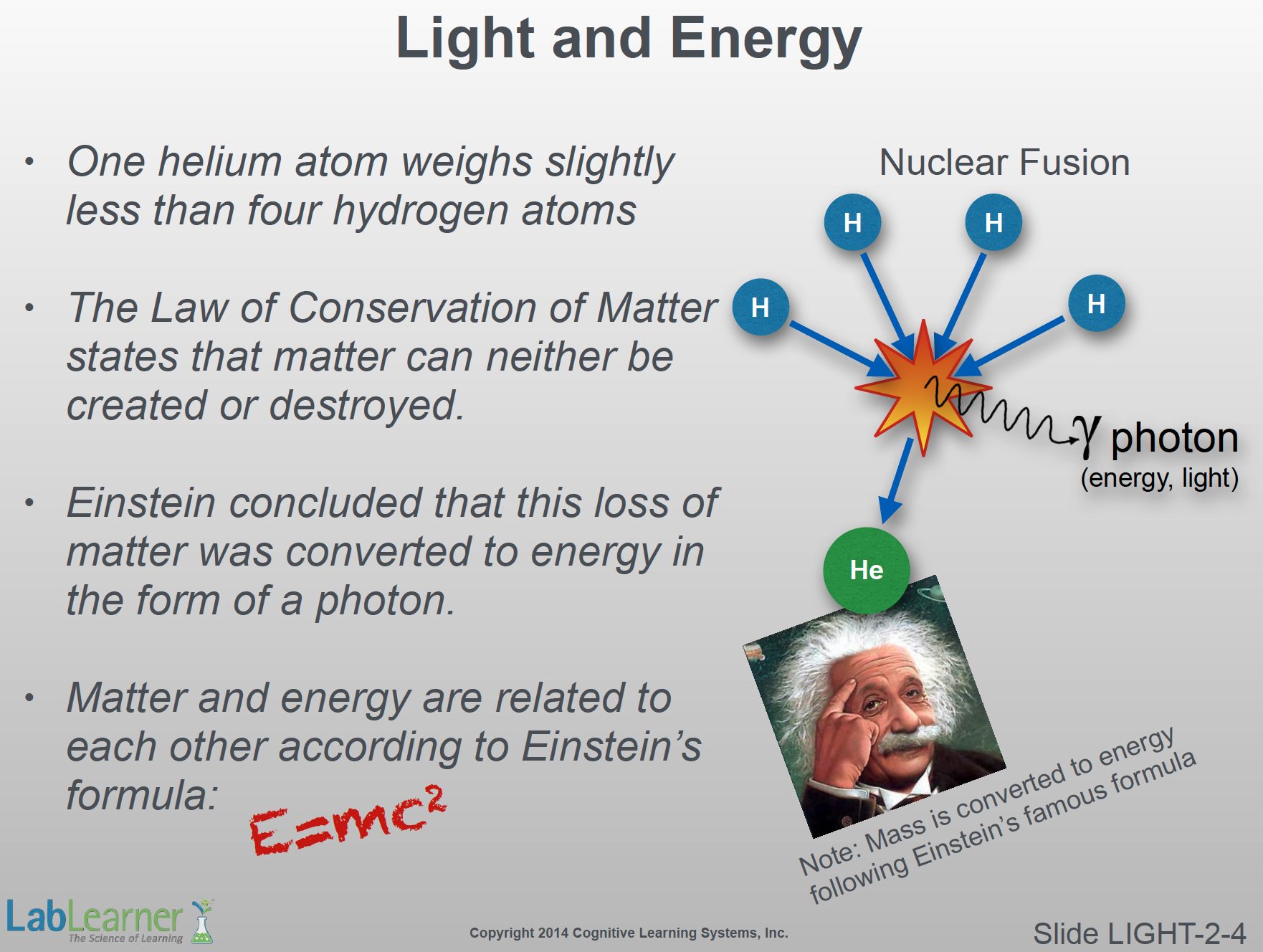
- In this slide, Albert Einstein’s contribution to physics and the relationship between light and energy is accentuated.
- In the nuclear fusion reaction, four hydrogen nuclei collide and fuse together to form a single atom of helium. By simply looking up the molecular mass of hydrogen and helium atoms on the Periodic Table of Elements, one can easily calculate that four atoms of hydrogen have a slightly higher mass than a single helium atom. How can this be when the Law of Conservation of Matter states that matter can neither be created nor destroyed?
- Einstein proposed a relationship between matter and energy in his famous formula: E=mc2. In this equation, E stands for energy, m for mass, and c for the speed of light. Thus, the mass lost in the nuclear fusion reaction can be converted to energy in the form of a photon.
- Photons leaving the surface of the Sun take about eight and a half minutes to reach Earth. The energy they carry has had a profound impact on our planet. Without them, there would be no life on Earth.
______________________________________________
SLIDE LIGHT-2-5
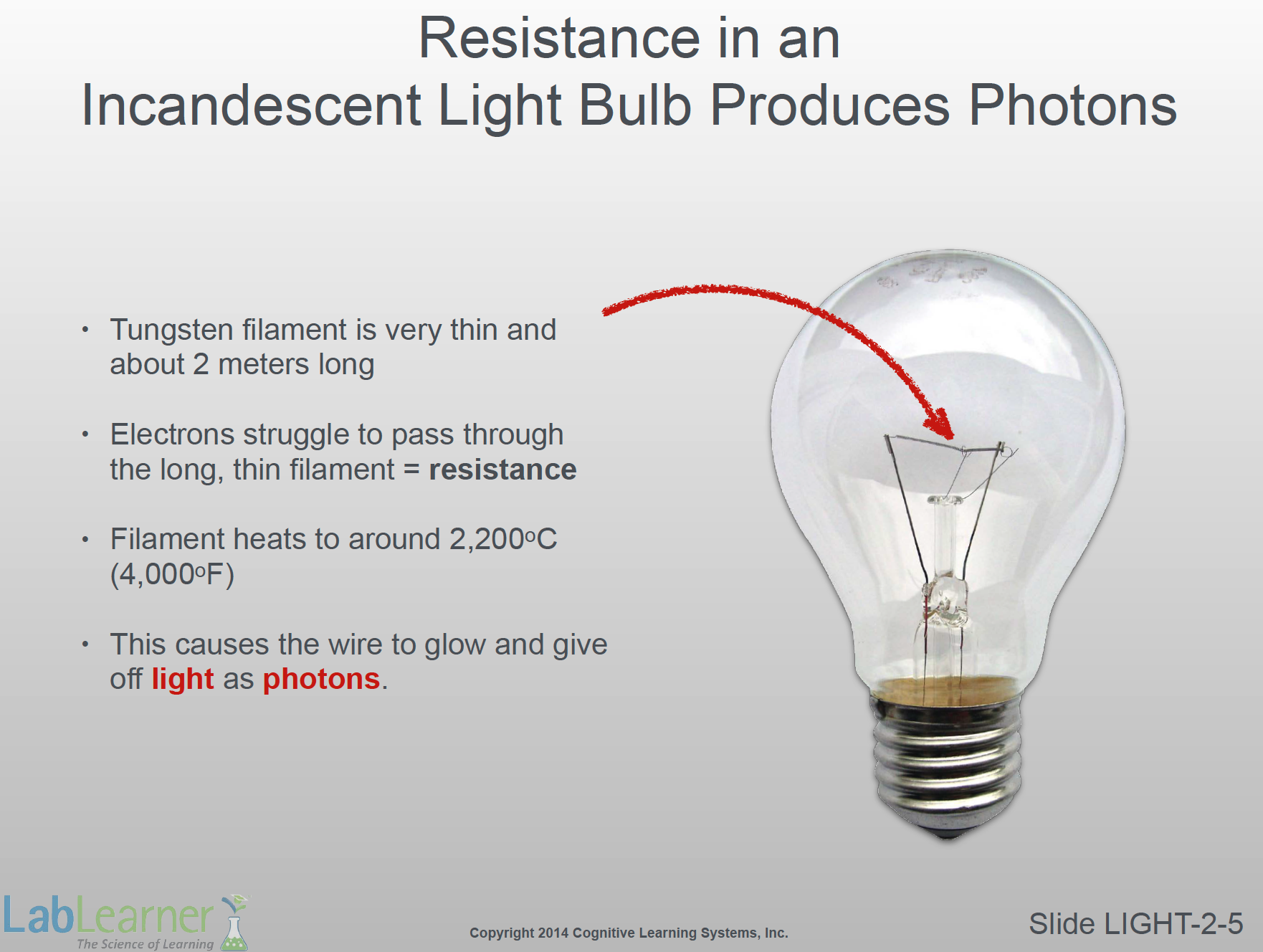
Note: This slide is simply included to remind students that photons may also be produced on Earth. Students will have seen a similar slide in the CELL Electricity and Magnetism.
- The extreme heat that the thin, long tungsten filament attains causes it to glow “white-hot” and emit photons. These photons carry energy on their way at the speed of light (299,792,458 m/s). Photons emitted from an incandescent light bulb can warm surfaces and power photoelectric cells in the same way that sunlight can.
______________________________________________
SLIDE LIGHT-2-6
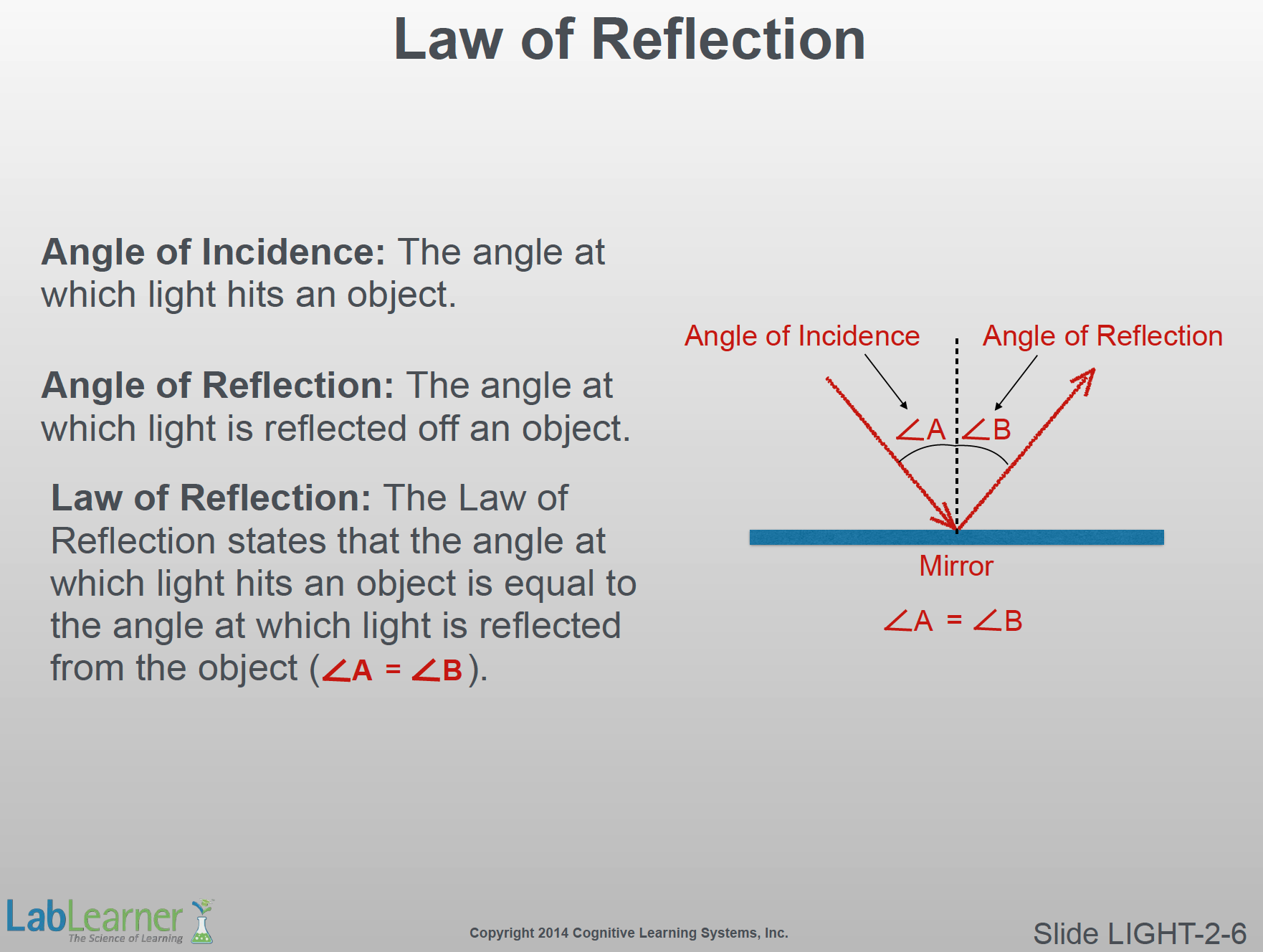
- We now turn our attention to the reflection of light. When light strikes any reflective surface, the angle at which it hits it is referred to as the angle of incidence. The angle at which it is reflected from the surface, a mirror, in this case, is known as the angle of reflection. The angle of incidence is equal to the angle of reflection. This is known as the Law of Reflection. In other words, the angle at which light is reflected from a surface is exactly the same as the angle at which it strikes the surface. Students will measure and work with both the angle of incidence and the angle of reflection in Investigation 2 lab.
______________________________________________
SLIDE LIGHT-2-7
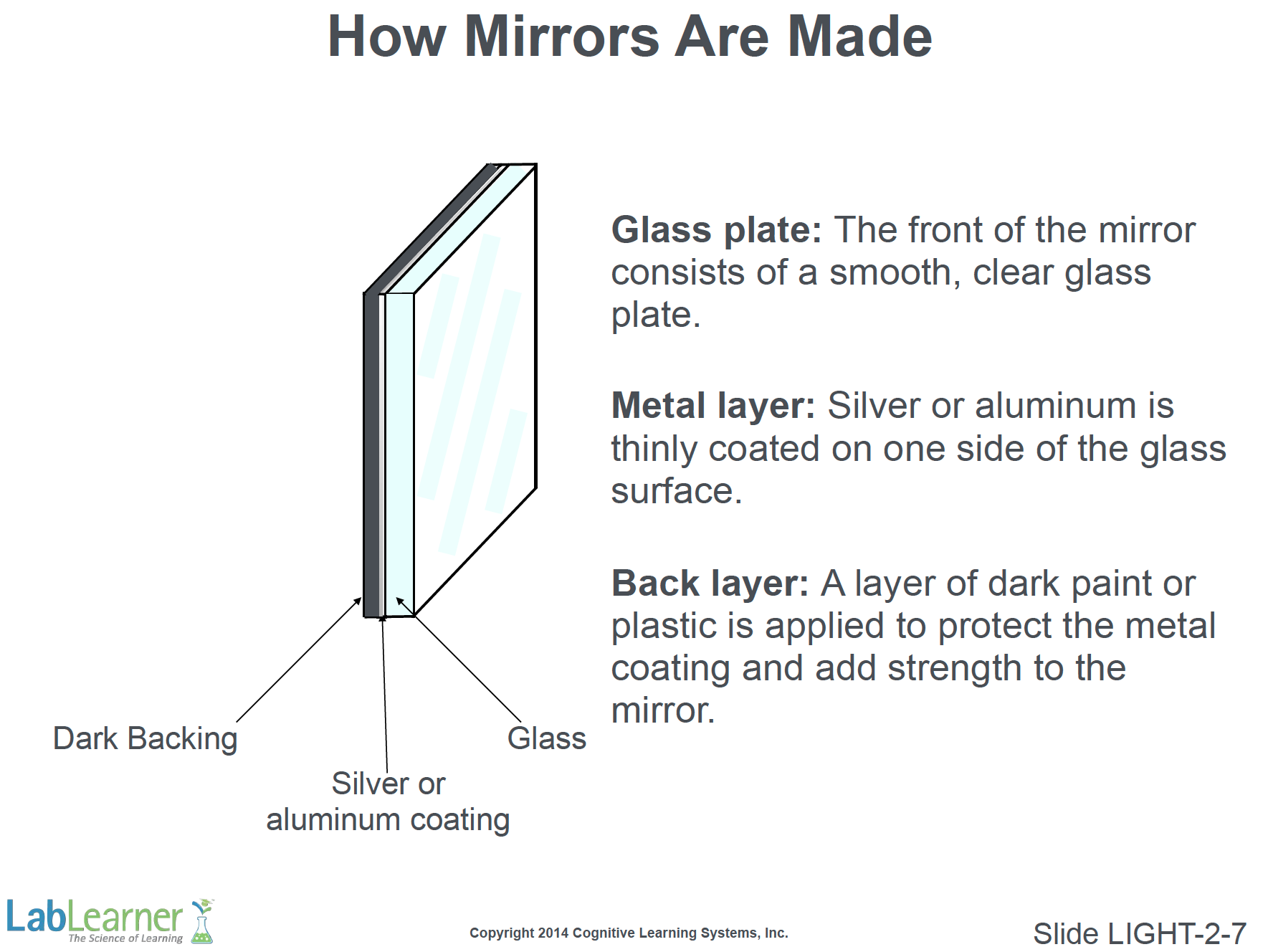
- This slide shows how a mirror is made. A sheet of glass is coated with a metal, usually either silver or aluminum. Silver, of course, is reserved for more expensive mirrors. Finally, a dark coating is applied to the back of the mirror, to the metal surface, to protect the coating and strengthen the mirror.
- The type of mirror shown here and the type students will use in the lab is referred to as a plane mirror. Plane mirrors are manufactured using a flat sheet of glass. Other types of mirrors are concave and convex mirrors. Concave mirrors “cave” inwards. They reflect an image that is magnified and are used for dental tools, makeup mirrors, telescopes, and other applications where image magnification is desired. Convex mirrors, on the other hand, swell outward in a smooth dome-like manner. Convex mirrors reduce the size of the images they reflect and are used in situations where a wide-angle of view is desired like in department stores and at some intersections to aid in seeing oncoming traffic.
______________________________________________
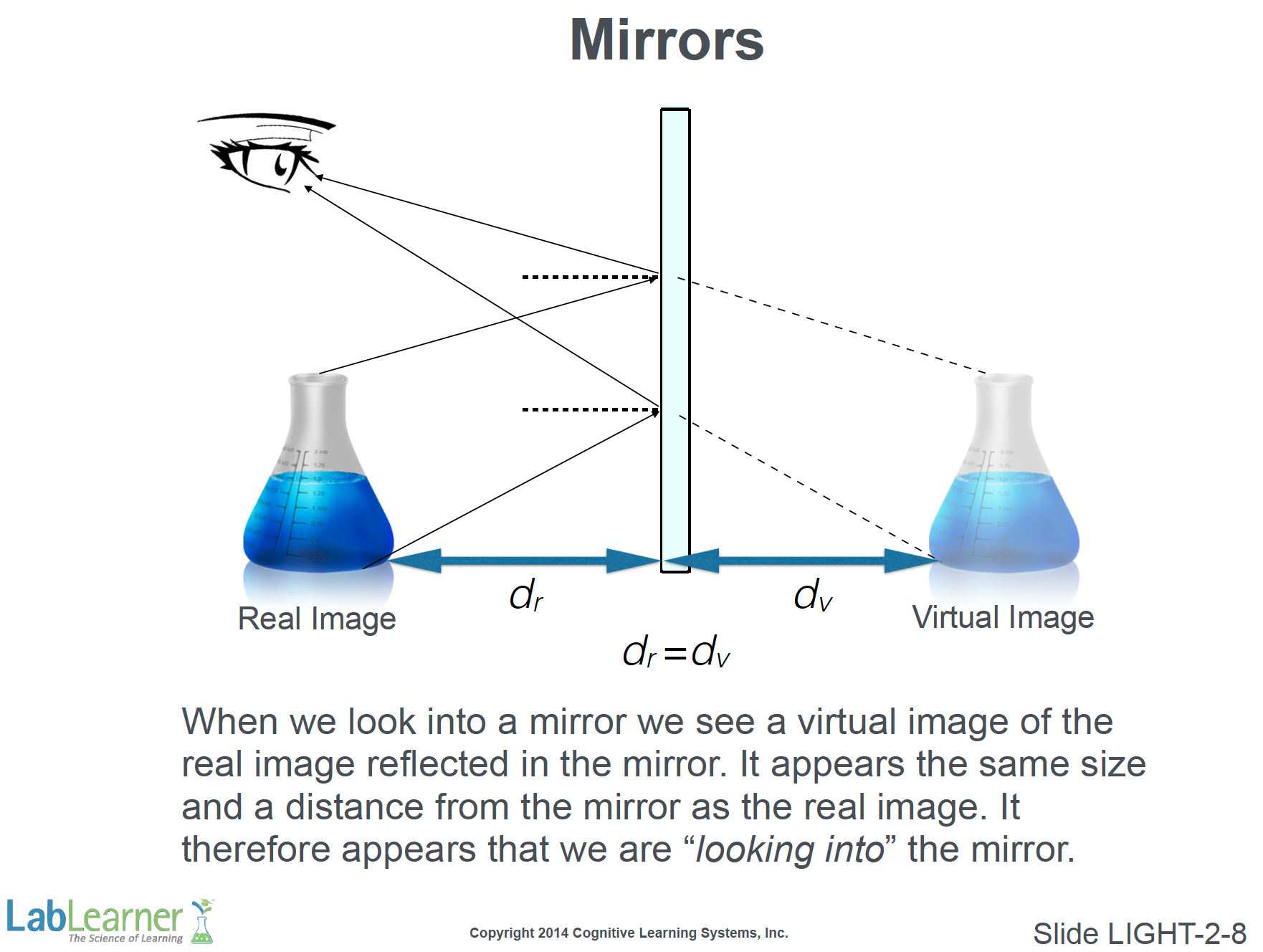
SLIDE LIGHT-2-8
- Mirrors are very interesting devices but unfortunately, we can not go into great detail in discussing them here. For example, one may notice that the reflection one sees in a mirror appears to reverse the sidedness of an object. If we hold our left hand in front of a plane mirror, we see a reflection of what is exactly like our right hand, not our left hand. Print likewise appears to be flipped backward when reflected in a mirror. And yet, a plane mirror never inverts an image upside down, only left to right.
- The diagram in this slide shows another interesting aspect of plane mirrors. That is that reflected objects appear as if they were actually behind the plane of the mirror. We say that we look “into a mirror” because of the sense of depth we perceive. Thus, a real image is reflected in a mirror and appears to be behind or in the mirror at exactly the same distance that the real object is located from the mirror’s surface. The reflection of an object that we see in a mirror is referred to as a virtual image.
______________________________________________
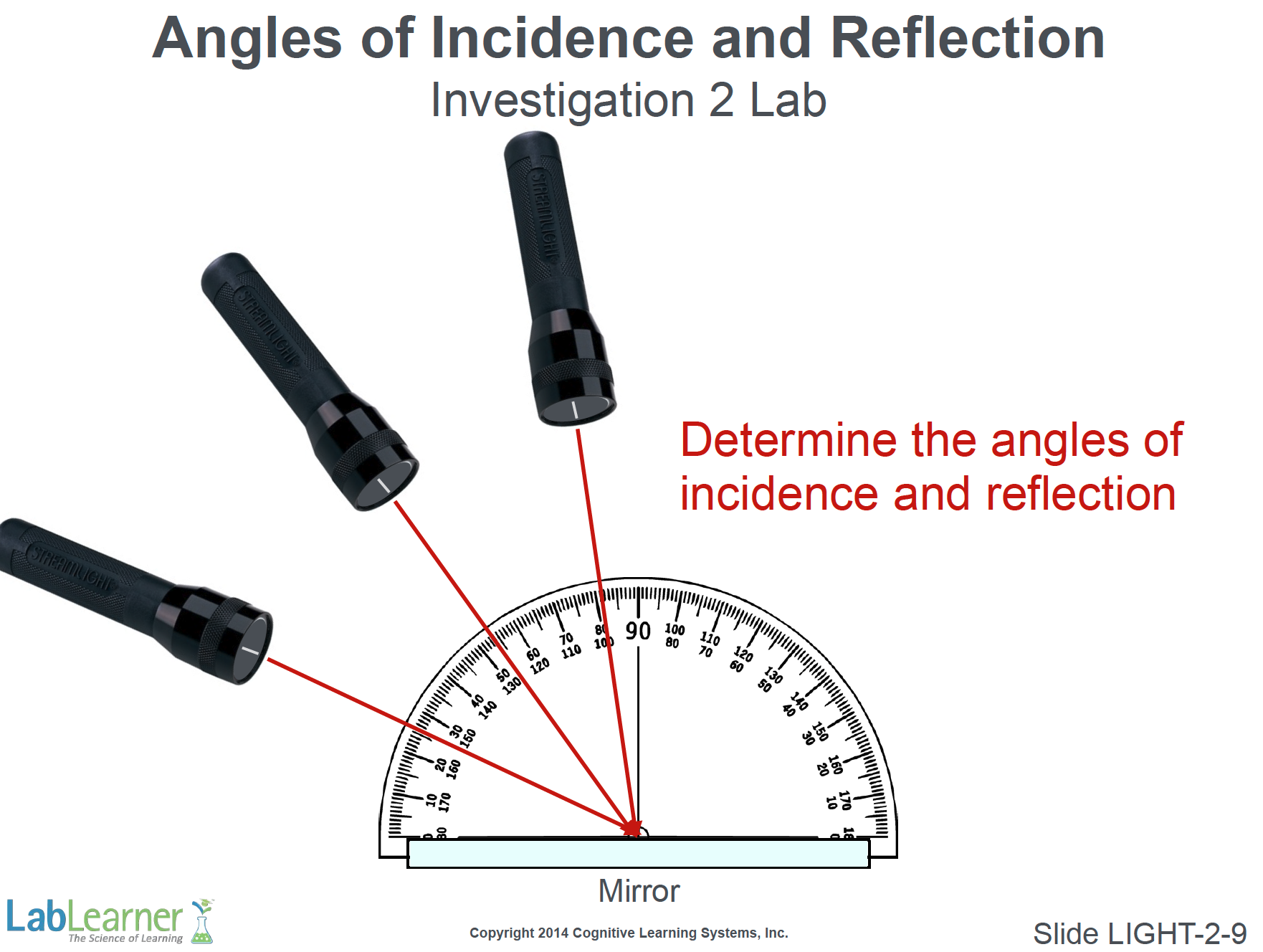
SLIDE LIGHT-2-9
- This final slide depicts a part of the lab for Investigation 2. In this set of experiments, students will use a flashlight, plane mirror, and a protractor to study the relationship between the angle of incidence and the angle of refraction. Students will then use this information and a set of plane mirrors to see around corners by exploiting the properties of reflected light.