
Teacher Portal:
Kinetic and Potential Energy
Investigation 1 – PostLab
ZERO-IN
Italicized font represents information to be shared orally or physically completed with the students at this time.
The non-italicized font represents additional information included to support the teacher’s understanding of the content being introduced within the CELL.
ANALYZE IT
Instruct students to complete the Analysis Questions in their SDRs then discuss them as a class. Use the suggested responses below to guide students’ answers.
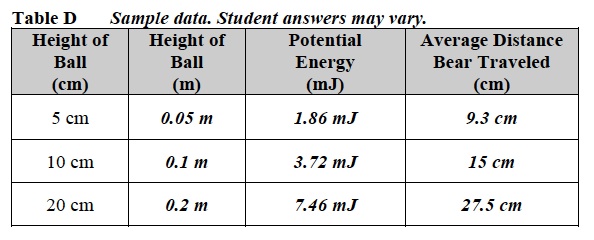
- Look at the data in Table D. The independent variable is the item that is changed in the experiment. What is the independent variable in the experiment? The independent variable is the height of the ball.
- Look at the data in Table D. How did potential energy change with height? The potential energy increased as the height of the ball above the table increased.
- Look at the data in Table D. The dependent variable is the item that is being measured in the experiment. What is the dependent variable in the experiment? The dependent variable is the distance the average distance the bear traveled.
Direct students to create a graph that compares the potential energy of the ball with the distance the bear traveled.
Note: If necessary, assist students in graphing potential energy versus the average distance traveled. If students have not used best-fit lines before, have them read the procedure Drawing of a Best Fit Line. Make a graph on the board using one group’s data, and demonstrate drawing a best fit line to the class.
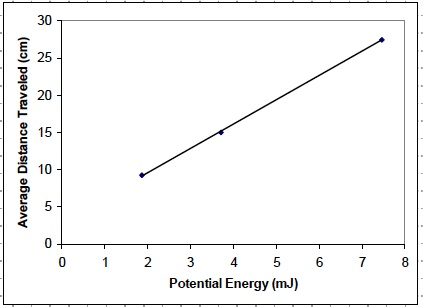
- Look at the graph. What is the relationship between the potential energy of the pendulum ball and the distance the bear traveled? Describe the data that support your answer. The greater the potential energy, the greater the distance the bear traveled. As the potential energy increased from 1.86 mJ to 3.72 mJ, the distance the bear traveled changed from 9.3 cm to 15 cm.
Note: If students are having difficulty understanding this relationship, pick out a few points on the x-axis (potential energy) and show how the corresponding values on the y-axis get larger as the potential energy increases.
- How is the distance the bear traveled related to its kinetic energy? Think about the experiment with the hand and woodblock to help answer this question. Like the woodblock, the bear traveled the farthest distance when its kinetic energy was the greatest.
- How is the kinetic energy of the bear related to the potential energy of the pendulum ball? As the potential energy of the pendulum ball increased, the kinetic energy of the bear increased.
- Think about all of the results of the experiments performed. What conclusions can you make about the height of the pendulum ball, the potential energy of the ball, the kinetic energy of the ball, and the kinetic energy of the bear? Describe the data that support your answer. As the height of the pendulum ball increased from 5 cm to 20 cm, its potential energy increase from 1.86 mJ to 7.46 mJ. The increase in potential energy resulted in an increase in the kinetic energy of the ball. As the kinetic energy of the ball was transferred to the bear, the increase in kinetic energy of the ball produced an increase in the kinetic energy of the bear. This was shown by the increase in the distance that the bear traveled (9.3 cm to 27.5 cm).
- Describe the type of energy at each step in the pendulum ball experiment. The ball started out with potential energy. It had potential energy because it was not moving and was lifted above the surface of the table. The potential energy was converted to kinetic energy as the ball began to move. When the ball hit the bear, the kinetic energy in the ball was transferred to the bear, and the bear moved.
Direct students to go back to their predictions in Question 21 of Trial 2. Ask students:
- Look at Table D and your graph. Based on your data, was your prediction correct? Student answers may vary. Students should now understand that the potential energy of the ball increases with height. Students should also understand that an increase in potential energy leads to a corresponding increase in kinetic energy.
GET FOCUSED
Instruct students to complete the Focus Question in their SDRs then discuss it as a class. Use the suggested response below to guide students’ answers.
- How does the transfer of potential energy to kinetic energy relate to the Law of Conservation of Energy? Students should recall that the Law of Conservation of Energy says that energy cannot be created or destroyed but can be changed from one form to another. The focus question asks students to relate the Law of Conservation of Energy to the transfer of energy from potential energy to kinetic energy. Students should draw on their observations from Investigation One in answering this question. They should understand that all of the energy changes observed in the Investigation were due to the transfer of energy from potential to kinetic or from kinetic to kinetic and not because energy disappeared or was created.