
Teacher Portal:
Genes and Proteins
Investigation 2 – PostLab
ZERO-IN
Italicized font represents information to be shared orally or physically completed with the students at this time.
The non-italicized font represents additional information included to support the teacher’s understanding of the content being introduced within the CELL.
ANALYZE IT
Instruct students to complete the Analysis Questions in their SDRs then discuss them as a class. Use the suggested responses below to guide students’ answers.
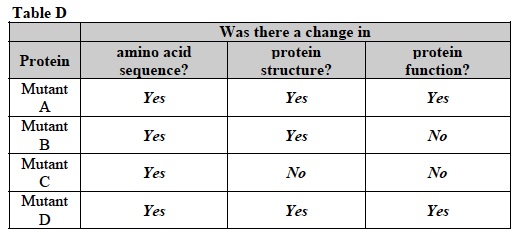
- For each mutant protein model, was there a change in the amino acid sequence as compared to the wild type protein? Record the answer (Yes or No) in Table D.
- Compare the way the model wild-type protein looked to the way the model mutant proteins looked. For each mutant protein model, was there a change in the structure as compared to the wild-type protein? Record the answers (Yes or No) in Table D.
- Compare the rate of water transfer for the wild-type protein to the rate for each mutant. For each protein model, was there a change in the function of the protein as compared to the wild-type protein? Record the answers (Yes or No) in Table D.
- Describe any changes in function observed with the model mutant proteins. Use data to support your answer. Mutant proteins A and D showed changes in function compared to the wild-type model protein. The rate of water transfer for Mutant A was lower (4 ml/s) than the rate for the wild-type (6.7 ml/s). Mutant D showed an increased rate of water transfer (16.5 ml/s) compared to the wild-type rate (6.7 ml/s). Student values will vary.
- Look at the results in Table D. Did every change in amino acid sequence cause a change in protein structure? Explain your answer. No. The change in amino acid sequence for mutant protein C did not cause a change in protein structure. Mutant C had the same structure (looked the same) as the wild-type protein.
- Look at the results in Table D. Did every change in protein structure cause a change in function? Explain your answer. No, not every change in protein structure caused a change in function. Changes in the protein structures following mutations A and D caused a change in protein function. However, the change in protein structure following mutation B did not cause a change in protein function.
- Are all mutations harmful? Explain your answer. No. Some mutations can be beneficial. Mutant D had a faster rate of water transfer than the wild-type protein. The rate of water transfer was 16.5 m/s for Mutant D compared to a transfer rate of 6.7 m/s for the wild-type protein. Assuming that a higher rate of water transfer would be beneficial, this would be a beneficial mutation.
GET FOCUSED
Instruct students to complete the Focus Question in their SDRs then discuss it as a class. Use the suggested response below to guide students’ answers.
- Can mutations in DNA cause changes in an organism? Explain. Yes. Mutations in DNA can lead to changes in the amino acid sequence of a protein. Changes in amino acid sequence can cause changes to protein structure. Changes in protein structure may cause changes in function. If a protein cannot function properly, some of the functions of the organism may be affected because the functions of an organism often depend on the functions of the proteins within the organism. However, not all mutations cause changes in an organism. Some mutations in DNA do not cause changes in the amino acid sequence of a protein and therefore do not change a protein’s structure or function. Some mutations in DNA cause changes in amino acid sequences without changing the structure and function of a protein. Some mutations cause changes in the structure of a protein without affecting the function of a protein.