
Teacher Portal:
Genes and Proteins
Investigation 2 – Lab

ZERO-IN
Italicized font represents information to be shared orally or physically completed with the students at this time.
The non-italicized font represents additional information included to support the teacher’s understanding of the content being introduced within the CELL.
MINDSET
This Investigation is designed to:
- build student understanding of the relationship between the amino acid sequence of a protein and its overall structure,
- prompt students to understand how the structure of a protein is directly related to its function, and
- promote student discovery that changes in protein structure are not always detrimental to protein function and may even enhance protein function.
BE PREPARED
Teacher Preparation for the Investigation includes the following. This preparation should be done prior to students arriving in the lab.
- Place all materials at the distribution center.
- Make sure that there are plenty of paper towels available to students throughout the Investigation.
- Divide students into pairs.
Note: Each student lab group will need the materials listed below.
Student Preparation for the Investigation includes having students gather the following materials. This preparation takes place on lab day after student lab groups have settled at their assigned lab tables.
Note: The materials are listed in students’ SDRs. They are also listed below for your reference.
- (2) clear plastic rectangular containers
- (1) 1 L graduated cylinder
- (1) stopwatch
- (4) glass marbles
- (1) weigh dish
- (1) rubber band
- (1) calculator
- paper towels to clean up any water spills during the course of the Investigation
INVESTIGATE
- Inform students that in this Investigation, they will build a model of an imaginary protein that has the function of transporting water.
- Explain that instead of modeling the entire protein, they will only be modeling the structure of the site within the protein that binds the water.
- Explain that the amino acids in the binding site dictate the structure of the binding site and that students will investigate the effects of changing the amino acids that form the binding site.
- Encourage students to reflect on the PreLab video as they move through the procedural steps.
- Explain to students that during the Experiment, every procedural step is important. If one step is skipped, data can become invalid. To help students keep on track, direct them to read each step thoroughly, complete the step, then check it off (Read it – Do it – Check it off).
- Direct students to complete the procedural steps in their SDRs.
Note: The procedural steps are listed below for your reference. Teacher “Notes” are inserted, as needed, to help facilitate the lab.
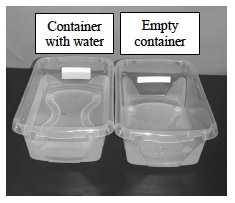
- Fill 1 plastic container with 3 liters of water and place it on the lab table.
- Place the empty plastic container next to the container filled with water. The edges of the containers should be touching.
- Question: Look at the amino acid sequence of the water-binding site of each protein in Table A. How are the amino acid sequences for the water-binding site for mutant proteins A, B, C, and D different from the wildtype amino acid sequence? Circle the differences in the amino acid sequences between mutant proteins A, B, C, and D and the wild-type protein.
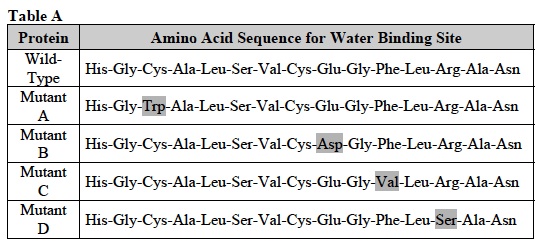

- Will the function of each of the mutant proteins change as compared to the wild type protein? Student answers will vary.
Trial 1
- In this Trial, you will model the wild-type protein. One partner will model the protein. The other partner will use the stopwatch.
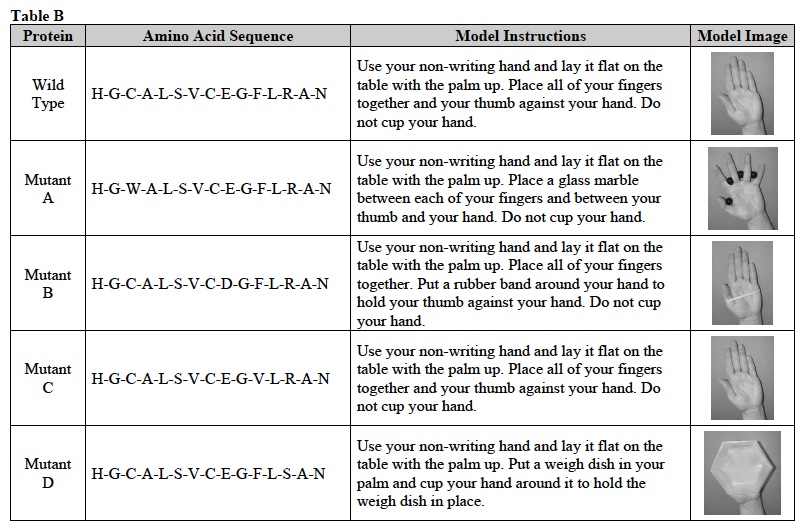
- Use the instructions in Table B to produce a model of the wild-type protein.
- Place the model wild-type protein in the container with water.
- The person holding the stopwatch should start the stopwatch and say, “Go.”
- Using the model protein, transfer water from the container with water to the other container for 30 seconds. Be sure not to change the structure of the protein.
- At the end of 30 seconds, the person holding the stopwatch should say, “Stop.”
- Measure the amount of water transferred by pouring the water from the second container into a graduated cylinder.
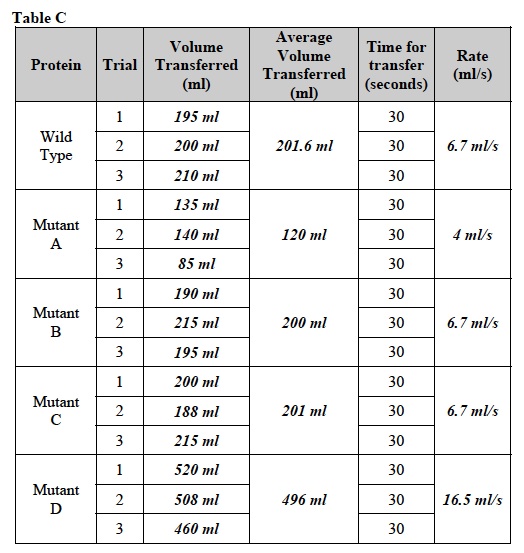
- Record: Write the volume of water transferred by the wild-type protein in Table C next to “Trial 1.”
- Pour the water back into the first container.
- Repeat the experiment two more times for the wild-type protein.
- Record: Write the volume transferred in Trial 2 and Trial 3 in Table C.
- Calculate: Find the average volume of water transferred by the wildtype protein and write this number in Table C.
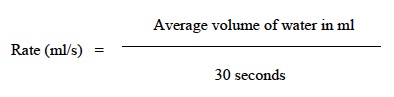
- Record: Calculate the rate of water transfer using the following equation. Write this number in the column labeled “Rate” Table C.
Trial 2
- In this Trial, you will model Mutant Protein A. One partner will model the protein, and the other partner will use the stopwatch.
- Use the instructions in Table B to produce a model of mutant protein A.
- Using the model protein, transfer water from the container with water to the other container for 30 seconds. Be sure not to change the structure of the protein.
- Measure the amount of water transferred by pouring the water from the second container into a graduated cylinder.
- Record: Write the volume of water transferred by mutant protein A in Table C next to “Mutant A, Trial 1.”
- Pour the water back into the first container.
- Repeat the experiment two more times for mutant protein A.
- Record: Write the volume transferred in Trial 2 and Trial 3 in Table C.
- Calculate: Find the average volume of water transferred by mutant protein A and write this number in Table C.
- Record: Calculate the rate of water transfer by dividing the average volume of water by 30 seconds. Write this number in the column labeled “rate” in Table C.
Trial 3
- In this Trial, you will model Mutant Protein B. One partner will model the protein, and the other partner will use a stopwatch.
- Repeat steps 1a through 1i from Trial 2 using mutant protein B.
- Record: Write your results for each mutant protein in Table C.
Trial 4
- In this Trial, you will model Mutant Protein C. One partner will model the protein, and the other partner will use a stopwatch.
- Repeat steps 1a through 1i from Trial 2 using mutant protein C.
- Record: Write your results for each mutant protein in Table C.
Trial 5
- In this Trial, you will model Mutant Protein D. One partner will model the protein, and the other partner will use a stopwatch.
- Repeat steps 1a through 1i from Trial 2 using mutant protein D.
- Record: Write your results for each mutant protein in Table C.
CLEAN UP
Let students know your expectations for clean up. Ask them to clean up.