
Teacher Portal:
Friction
Investigation 4 – PostLab

ZERO-IN
Italicized font represents information to be shared orally or physically completed with the students at this time.
The non-italicized font represents additional information included to support the teacher’s understanding of the content being introduced within the CELL.
ANALYZE IT
After students have investigated at least two ways of altering the surfaces of the woodblock or the table, review their conclusions as a class. Use the suggested responses below to guide students’ answers.
- Does the smoothness of the two surfaces in contact affect the frictional force between the surfaces? Yes.
- What is the relationship between the smoothness of the surface and frictional force? The more smooth the two surfaces, the less frictional force.
- Why is this information valuable? What are some real-life situations in which this knowledge may be helpful? In life, we encounter situations in which friction is helpful and situations in which it is a hindrance. Take, for instance, a snowy and icy road. The smooth surface of the ice makes driving dangerous. The frictional force between the ice and the tires of a car is very low. However, if gravel is spread on top of the ice, the frictional force between the road and the tires of a car becomes greater. In this instance, a high frictional force is extremely helpful.
Tell students that the coefficient of friction describes the degree of mechanical and molecular interaction between two surfaces.
- The coefficient of friction varies between 0 and 1 and has no units.
- Given a constant normal reaction force (described later), a greater coefficient of friction indicates that two surfaces in contact have greater resistance to sliding than a lower coefficient of friction.
- For example, soccer cleats on grass have a greater coefficient of friction than skates on ice.
Instruct students to refer to the equation listed in the Background box in the Investigation 4 Student Data Record, Ffriction = μR. Tell students that the equation indicates what factors affect frictional force.
Tell students that the letter R represents a quantity called normal reaction force.
- When pulling an object across the table, the normal reaction force is essentially the force of gravity on that object.
- In other words, for students’ experiments, R represents the object’s weight.
Explain to students that μ (the Greek letter mu) represents the coefficient of friction.
Tell students that using the formula Ffriction = μR, they can calculate the coefficient of friction for each of the surface combinations tested.
- If students are not proficient in manipulating equations, write the following on the board to aid them in solving for μ.
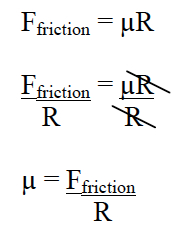
- Tell students that they must first know the weight of the woodblock.
Note: Students must convert the mass in grams to the mass in kilograms. Then, students must multiply the mass by the acceleration due to gravity, or 9.8 m/s2. Students have been provided room for their calculations in their Investigation Four Data Record.

Tell students to find the coefficient of friction for each of the three surface combinations tested. Remind students that R is the weight of the woodblock.
Instruct students to record their calculations in Table C of their Investigation 4 Student Data Record.
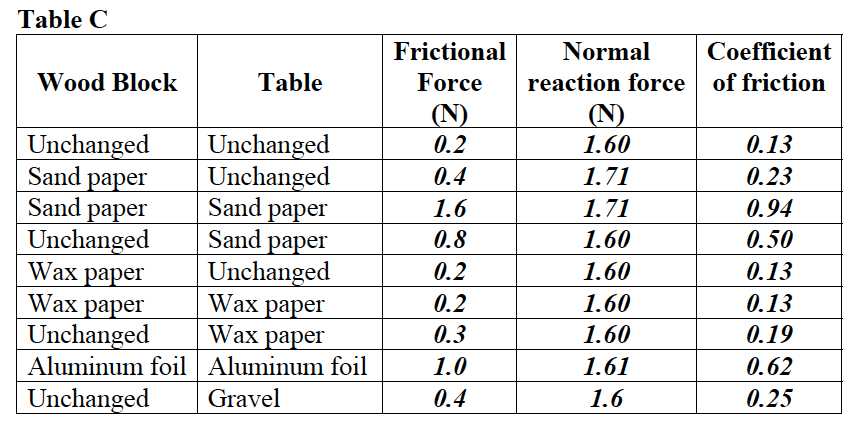
Analyze the relationship between the coefficient of friction and frictional force. To do this, graph the data.
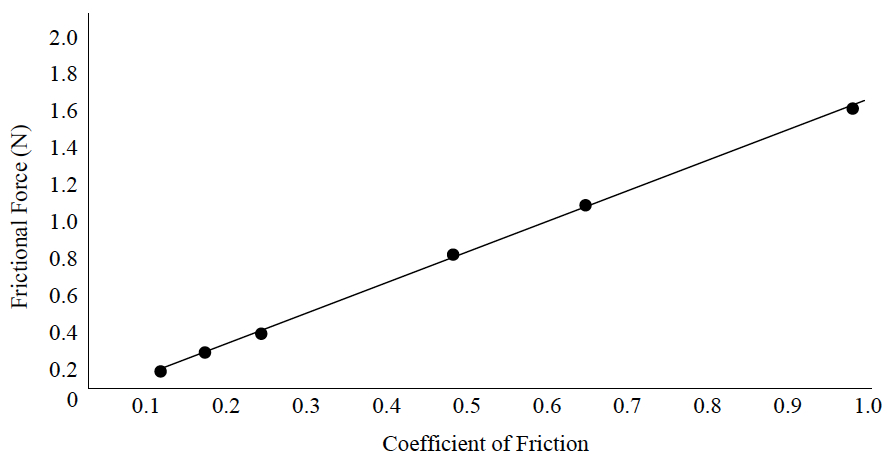
- Based on your graph, what is the relationship between the coefficient of friction and frictional force? As the coefficient of friction between two surfaces increased, the frictional force between the object and the surface it moves over increased. Instruct students to answer the question in their Investigation 3 Student Data Record.
- Can you list two situations where it is advantageous to have a high frictional force or coefficient of friction? Hint: Use a Mind Movie to generate some really exciting examples! Use your imagination to analyze the two surfaces that are in contact with one another, and how you could change the force of friction by varying the variables you investigated in this Core Experience Learning Lab. When riding a bike on an icy road, a person may ride more safely with a high frictional force between tires and the ice. A high frictional force may keep a person from sliding. A high frictional force could be generated by altering the type of surface in contact with the ice. Chains placed on the tires would increase the coefficient of friction and increase the frictional force. A rock climber wishes for a high frictional force between his or her shoes and the rocks. This friction allows the climber to safety climb without slipping. The shoes a rock climber uses have surfaces with a higher coefficient of friction than regular shoes or sneakers.
- Can you list two situations where is it advantageous to have a low frictional force or the coefficient of friction? An ice skater benefits from low frictional force between his or her skates and the ice rink. This low frictional force allows the skater to move smoothly. When opening a drawer in a filing cabinet, a person’s job is made easier by a low frictional force. If little friction acts between the drawer and the cabinet, a person is able to open the drawer with little exertion.
GET FOCUSED
Instruct students to complete the Focus Question in their SDRs then discuss it as a class. Use the suggested response below to guide students’ answers.
- How does the smoothness of the two surfaces in contact affect the frictional force between the two surfaces? The smoother the two surfaces, the less frictional force. The less smooth the two surfaces, the more frictional force.
COMPREHENSION CHECK
The Comprehension Check is designed to summarize the Core Experience Learning Lab and provide the teacher with an informal way to assess students’ understanding of the big ideas.
If time permits, ask your students to answer each question below. Use the suggested responses below to guide students’ answers.
- What is the relationship between speed, velocity, and acceleration? Throughout this Core Experience Learning Lab, students had the opportunity to use the terms speed, velocity, and acceleration. Through their experiments, students should have come to assign each term a distinctly different definition. Speed is a term used to indicate how much distance is traveled in a given time. Velocity is a measure of the magnitude of distance per time as well as the direction of the motion. Therefore, a change in velocity occurs when an object in motion either changes speed or changes direction. Acceleration denotes a change in velocity in a period of time. Positive acceleration represents an increase in velocity away from the origin, whereas negative acceleration represents a decrease in velocity while moving away from the origin.
- How does force change motion? This Core Experience Learning Lab allowed students to concentrate on the effect of frictional force and applied force on motion. Students found that frictional force between two surfaces opposed applied force acting on one of those surfaces. When trying to move a woodblock across a table, students applied a force to the block. The force which resisted motion was frictional force. The greater frictional force, the greater resistance to motion. Students also found that certain factors affect the frictional force and others do not. Through experimentation, students found that weight and surface type affect the force of friction between two objects. The velocity of the object and the total surface area of the two objects in contact with one another, however, did not affect the force of friction, because forces affect motion, we can better understand how objects will move if we understand the factors that affect a certain force. For example, from our Core Experience Learning Lab, we know that if we want to slow an object’s motion, we increase friction. To do this, we could increase the coefficient of friction or increase its weight, but increasing its surface area or its velocity would not alter the frictional force. Objects in motion stay in motion unless acted on by an external force, and objects at rest remain at rest unless acted upon by an external force. In our experiments, the woodblock remained at rest until students applied a force which moved the object. Both the woodblocks and the pennies remained in motion until friction applied a force in the opposite direction of their movement, which caused the woodblock and the pennies to stop. Students also found that objects can be in motion even though the sum of the forces is equal to 0 N. This occurs when objects are moving at a constant velocity. Students observed this each time we applied force to move wood blocks at a constant velocity during our trials.
- How does a change in motion affect potential and kinetic energy? An object at rest on the top of a ramp has potential energy. This potential energy is converted to kinetic energy as the object moves down the ramp. At the bottom of the ramp, the object slows to a stop. The kinetic energy of the block must have been transferred to another type of energy. As the woodblock was resting on the table and had no height, it had no potential energy. The kinetic energy of the woodblock had to be transformed into a type of energy other than potential. This type of energy was heat energy, which resulted from the force of friction between the wood and the table.
- Based on your experiments, how does force affect motion? Objects in motion stay in motion unless acted on by an external force, and objects at rest remain at rest unless acted upon by an external force. In our experiments, the woodblock remained at rest until students applied a force which moved the object. Both the woodblocks and the pennies remained in motion until friction applied a force in the opposite direction of their movement, which caused the woodblock and the pennies to stop. Students also found that objects can be in motion even though the sum of the forces is equal to 0 N. This occurs when objects are moving at a constant velocity. Students observed this each time we applied force to move wood blocks at a constant velocity during our trials.
- Why is it important to understand the variables that affect friction? How do these help you better understand the motion of objects? By understanding variables that affect the magnitude of the force of friction, we better understand how frictional force affects motion. For example, changing the surface area of an object (assuming the type of surface is similar) will not affect the frictional force and therefore will not change an object’s motion. However, changing the mass of an object or its surface will affect the frictional force and therefore affect its motion.