
Teacher Portal
Friction: Investigation 4 –
Lab

ZERO-IN
Italicized font represents information to be shared orally or physically completed with the students at this time.
The non-italicized font represents additional information included to support the teacher’s understanding of the content being introduced within the CELL.
MINDSET
This Investigation is designed to:
- demonstrate to students that the frictional force between an object and a surface depends on the smoothness of the combination of surfaces,
- encourage students to calculate the coefficient of friction between two surfaces, and
- use graphs to illustrate the relationships between frictional force and the coefficient of friction between surfaces
BE PREPARED
Teacher Preparation for the Investigation includes the following. This preparation should be done prior to students arriving in the lab.
- Cut five (5) pieces of sandpaper in half lengthwise, creating ten (10) pieces approximately 11.5 cm x 27.9 cm.
- Each group will have two pieces to use in their experiments.
- By taping the two pieces end to end, they will create a long sandpaper “track” over which to pull the woodblock.
- The other three (3) remaining pieces of sandpaper should be cut to create at least five (5) pieces approximately 14 cm x 17 cm. These pieces will be used to wrap around the woodblock.
- Place all materials at a central location.
- Divide the class into five cooperative groups.
Student Preparation for the Investigation includes having students gather the following materials. This preparation takes place on lab day after student groups have settled at their assigned lab tables.
Note: The materials are listed in students’ SDRs. They are also listed below for your reference.
- (1) 5 N spring scale
- (1) woodblock with hook
- (1) meter stick
- (1) roll of masking tape
- (1) penny per student
Note: The following materials should be available at the distribution center:
- (10) 11.5 x 27.9 cm pieces of sandpaper
- (5) 14 x 17 cm pieces of sandpaper
- (1) roll of wax paper
- (1) roll of aluminum foil
- gravel
Note: If students were unable to leave their pieces of tape on the table, instruct them to set up their lab table as in Investigation One through Three, using four pieces of tape to create a starting line and a finish line. The lines should be 50 cm apart.
Direct one student from each lab group to collect the materials listed in their SDRs.
INVESTIGATE
- Tell students that the variable they will investigate is the smoothness of the surface.
- Before beginning the experiment, ask students to identify the independent and the dependent variable in this experiment.
- Surface type is the independent variable and frictional force is the dependent variable in the experiment students will perform.
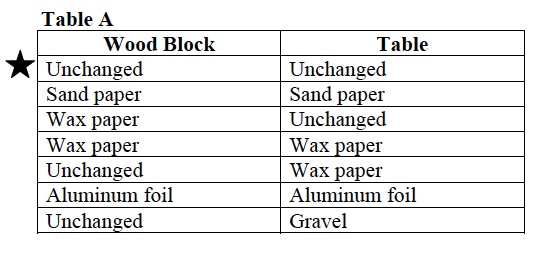
- Tell students that they will investigate three combinations of surfaces. Tell students to look at Table A of their Investigation 4 Student Data Record. The table outlines all of the possible combinations of surfaces they may investigate. All students must measure the frictional force of the woodblock against the table, the first combination listed and marked with a star. Students must choose two additional combinations to explore.
- Explain to students that during the Experiment, every procedural step is important. If one step is skipped, data can become invalid. To help students keep on track, direct them to read each step thoroughly, complete the step, then check it off (Read it – Do it – Check it off).
- Encourage students to reflect on the PreLab video as they move through the procedural steps.
- Direct students to complete procedural steps in their SDRs.
Note: The procedural steps are listed below for your reference. Teacher “Notes” are inserted to help facilitate the lab.
- Arrange four pieces of tape on your table so that you have a starting line and a finish line 50 cm apart.
- In this Investigation, you will alter the surface of the woodblock and the table so that each becomes either more or less smooth.
- You will investigate a total of three combinations.
- Look at Table A. Decide which combinations you would like to investigate.
- Everyone will investigate the first combination marked with a star.
- Mark a star beside two other combinations you would like to investigate.
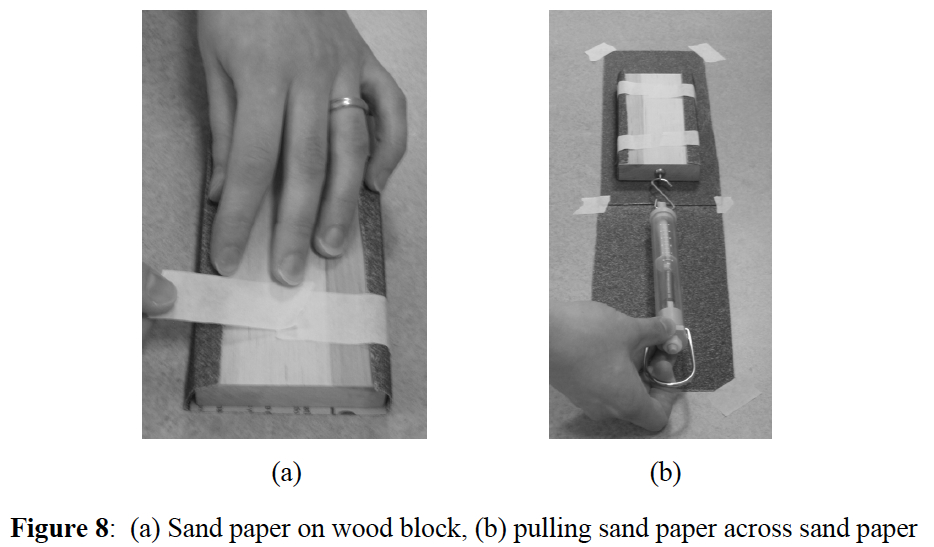
- To alter the surface of the woodblock (Figure 8-a):
- Wrap a piece of sandpaper, wax paper, or aluminum foil around the bottom of the block.
- Tape the paper or foil to the block.
- To alter the surface of the table (Figure 8-b):
- If using sandpaper, wax paper, or aluminum foil, spread it on the table so that it covers the table from 20 cm before the starting line to 20 cm after the finish line.
- Tape the edges of the paper or foil to the table.
Note: The piece of wax paper or foil that students lay on the table should cover the table from 20 cm before the starting line to 20 cm after the finish line. These pieces can be the width of the roll. If using sandpaper, students will need two long pieces (11.5 cm x 27.9 cm) By placing the two pieces end to end, they will be able to cover approximately 55 cm of the bench. Although this does not provide the 50 cm length of the bench that the aluminum foil and the wax paper provide, students should be able to obtain an accurate measurement of frictional force by reading the spring scale throughout the distance pulled and calculating an approximate average force.
- If using gravel, spread it on the table so that it covers the same area as the paper and foil.
Note: Students should spread gravel from 20 cm before the starting line to 20 cm after the finish line, just as with the paper or foil.
- Obtain the materials from the distribution center.
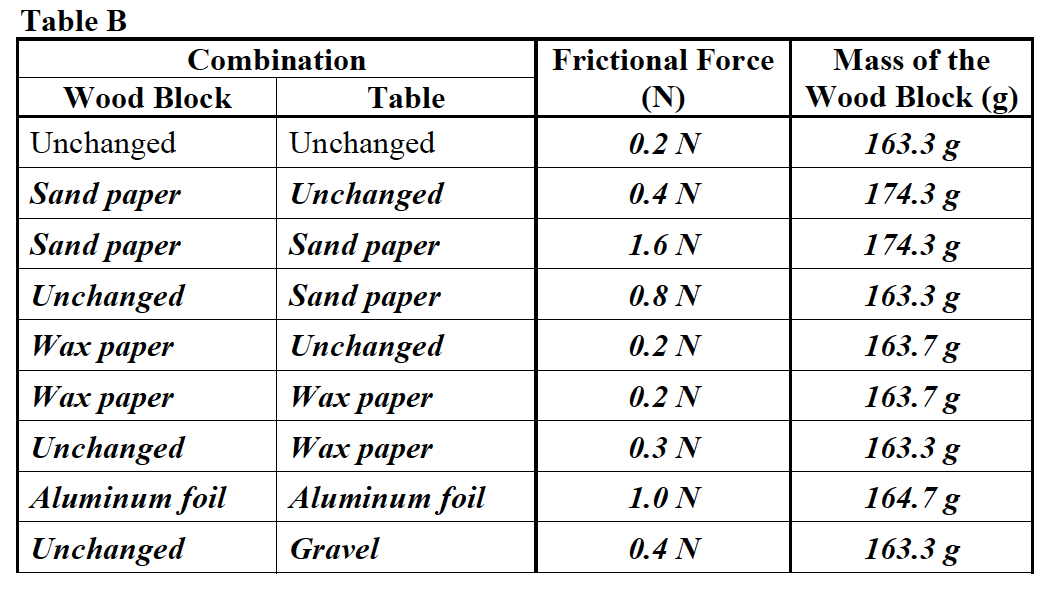
- Perform each trial: a. Measure the frictional force between the two surfaces using the spring scale.
- Measure the mass of the woodblock using the triple beam balance.
Note: The mass of the woodblock may vary as students wrap it with aluminum foil, wax paper, or sandpaper.
- Record: Write the frictional force and mass for each trial in Table B.
Note: Allow time for student exploration.
Note: If one group completes the tasks earlier than the rest of the groups, encourage the group that worked more quickly to perform another trial.
CLEAN UP
Let students know your expectations for clean up. Ask them to clean up.