
Teacher Portal:
Friction
Investigation 3 – PostLab

ZERO-IN
Italicized font represents information to be shared orally or physically completed with the students at this time.
The non-italicized font represents additional information included to support the teacher’s understanding of the content being introduced within the CELL.
ANALYZE IT
Instruct students to refer to the two graphs they created to illustrate the effect of weight on frictional force and the effect of surface area on the frictional force.
Direct students attention to the relationships illustrated with these two graphs. If necessary, ask students the following questions to focus their attention. Use the suggested responses below to guide students’ answers.
- What is the relationship between weight and frictional force? As the weight of the woodblock increased, the frictional force between the woodblock and the table increased.
- What is the relationship between surface area and frictional force? Varying the surface area of the woodblock in contact with the table did not affect the frictional force between the woodblock and the table.
Note: Students have an additional prompt in their Data Record that suggests they might benefit from using the “What’s New?” Thinking Tool. Allow students to reflect on their precious understanding regarding friction, particularly if you determined that students initially had misconceptions or if you observed students reacting with surprise to their results.
Encourage students to apply these conclusions to real-life situations. Read each of the following scenarios to the class and encourage the application of their experimental results.
- Draw the following diagram on the board before reading the scenario.
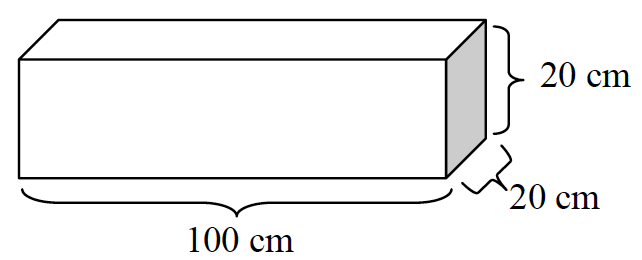
- Imagine that you must move a box full of books to the next room. The dimensions of the box are 100 cm by 20 cm by 20 cm. The box is too difficult to carry and must be pushed along the floor. How could you make pushing the box easier? Student suggestions may vary. Students should know from their experiments that surface area does not affect frictional force, so flipping the box on its smaller end will reduce its surface area but not reduce frictional force resisting movement. Students should also know from their experiments that weight does affect frictional force. Therefore, students could remove some books from the box, effectively reducing its weight, before pushing the box to the next room. In this way, students will have made pushing the box easier.
- Your older brother has just gotten his driver’s license, and he is eager to drive his small two-door car. However, it is mid-winter, and the roads are often covered with snow and ice. Your parents want your brother to be safe when he drives. What can your parents do to keep your brother’s car from sliding on the slick roads? Student suggestions may vary. In the scenario, the brother’s car is small and likely lightweight. The parents in the scenario may wish to place some heavy bags of gravel, bags of kitten litter, or other heavy objects in the trunk to increase frictional force between the car and the road. This increase in frictional force may keep the brother’s car from slipping on the wet and icy roads.
GET FOCUSED
Instruct students to complete the Focus Questions in their SDRs then discuss them as a class. Use the suggested responses below to guide students’ answers.
- What is the relationship between weight and frictional force? As the weight of a load increased, the frictional force between the load and the surface it moves on increased.
- What is the relationship between the surface area of an object in contact with another surface and the frictional force between two surfaces? As the surface area of a load increased, the frictional force between the load and the surface remained constant.