
Teacher Portal
Friction: Investigation 2 –
Concept Day
ZERO-IN
Italicized font represents information to be shared orally or physically completed with the students at this time.
The non-italicized font represents additional information included to support the teacher’s understanding of the content being introduced within the CELL.
ASK WHY
Remind students that friction plays the role of both hero and villain in our world. Activities like walking and eating would be impossible without it. Nails would slip from boards, knots would come untied, and hair clips would fall out if it weren’t for friction On the other hand, skinned knees, scuff marks on floors, and wear and tear of moving parts are caused by friction. Learn about this force then decide if you think friction is a hero or villain.
BRANCH OUT
Explain to students that automotive engineers design cars so that the amount of friction between the moving parts of the engine is reduced. Less friction means less wear and tear on the engine. They also work to reduce the coefficient of friction of the car body to zero so that it can move through the air efficiently – think of a sleek race car.
PRINT IT
Use your browser to download a printable PDF as a help during the slide presentation and to make additional notes. In your browser, go to File > Print and then choose to save as PDF.
NAVIGATE IT
Once the slide presentation is launched
- use your left and right arrows to advance or go back in the slide presentation, and
- hover your mouse over the left edge of the presentation to get a view of the thumbnails for all the slides so that you can quickly move anywhere in the presentation.
- Click HERE to launch the slide presentation for the CELL.
SHARE IT

FRICTION-2-1
Note: The main focus of the Lab for this Investigation is to determine the effect of velocity on friction. However, as there are no additional theoretical or conceptual components required to understand the Lab and its results, we will devote the major portion of this Concept Day presentation to examples of friction in the real world.
- Ask students: Why does friction cause heat?
- Remind students that friction is a force that opposes motion. Motion is kinetic energy.
- Explain that since friction acts against the motion, the kinetic energy that would have resulted in free or unimpeded motion is released as heat. This heat can be tremendous, depending on the amount of kinetic energy involved.
_______________________________________________

FRICTION-2-2
- Inform students that the first example of the tremendous amount of heat that can be produced by friction is shown in the reentry of the Space Shuttle into the Earth’s atmosphere.
Note: This slide was also used in the CELL Heat and Heat Transfer. In that instance, we focused on the insulating properties of the tiles that line the Shuttle’s bottom surface.
- Remembering that friction is caused by kinetic energy, ask students to consider the enormous amount of energy that the moving Space Shuttle brings to bear on the gas molecules in the atmosphere.
- Explain that the Space Shuttle has a mass of over 75,000 kilograms (165,000 pounds) empty. As it hits the Earth’s atmosphere, it is typically moving at about 27,000 km/hr (17,000 mpg).
- Inform students that, taken together, the shuttle has enough energy (about 3.23 x 10¹²joules) to heat an average house in a cold climate such as Colorado for some 41 years! Due to friction, this causes temperatures on the Shuttle’s reentry surface that reach 1,650oC.
Note: It might prove interesting to ask students why excessive heat production is not a problem as the Shuttle moves in orbit at the same speed and with the same mass as at reentry into the Earth’s atmosphere. Students should indicate that there are no molecules in outer space for the Space Shuttle to interact with. Therefore, no friction would come into play.
_______________________________________________

FRICTION-2-3
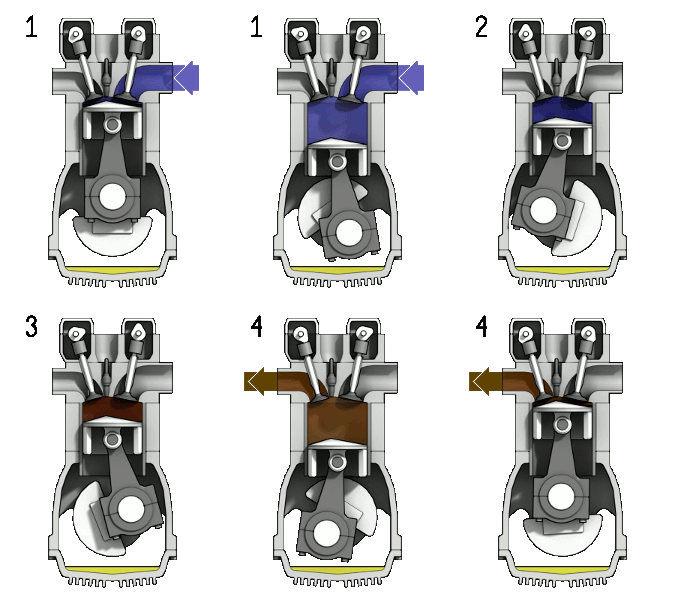
- Inform students that the next example of the tremendous amount of heat that can be produced by friction under more everyday conditions is shown in the heat generated by a piston inside an internal combustion engine.
- Explain that in the automobile engine, the piston fits snuggly in the cylinder and moves up and down thousands of times per minute.
- Explain that the image on the left of the slide is a computer model showing how heat is actually distributed in a piston (the temperatures are given in oF).
- Explain that the photo on the lower right is a piston that is partially melted by the temperatures associated with engine friction.
- Tell students that much of the heat generated by internal combustion engines is due to the moving of metal surfaces against each other. In addition, of course, heat is generated as a result of the combustion reaction itself. It is also noteworthy that the function of motor oil is to reduce friction between moving metal parts in the engine.
_______________________________________________

FRICTION-2-4
- Explain that this slide illustrates one of the earliest and most important uses of friction by humans, namely the ability to start a fire on demand.
- Inform students that the photo on the right depicts a scene where friction is used to produce heat and start a fire. There is debate, however estimates of the earliest control of fire by man range from 200,000 years ago to over one million years ago.
- Inform students that the image on the left is of a modern match.
- Explain that wooden or paper sticks are coated with flammable chemicals and then “struck” against a rough surface. The friction generated by the striking action produces enough heat to ignite the chemical coating, which results in a flame.
Note: It is interesting that after all of this time, the fire started with common matches like the one on this slide is still caused by the heat produced by friction as it was hundreds of thousands of years ago!
_______________________________________________

FRICTION-2-5
- Explain that this slide illustrates that friction is not limited to our planet Earth. One of Saturn’s moons, Enceladus, has the interesting property of sending large plumes of water vapor into space.
- As the model in the lower left of this slide suggests, this plume of water vapor may be the result of heat generated by friction.
- The hypothesis is that there are large faults in the ice crust of the moon that, due to tidal forces (caused by the gravitational pull from the giant Saturn), slide against one another and generate heat through friction. The thought is that this heat then acts to vaporize ice and water in the faults, forming the magnificent plumes.
_______________________________________________

FRICTION-2-6
- Inform students that the final example of friction at work involves rock climbing.
- Notice, in the large photo, that in the absence of good finger and toeholds, the friction of the sole of the climber’s shoes, fingertips and the rock face is the only force working against gravity. i
- Ask students to imagine spraying this rock front with oil to reduce friction. What impact do you think this would have on the climber?
- Explain that the insert photo shows a situation where a climber is taking advantage of a crevasse to scale a rock wall. This technique may be used even when there are no finger or toeholds. Under these circumstances, it is only the force of friction that suspends the climber perhaps hundreds of meters above the ground.
Note: Some students may be familiar with this arrangement of forces if they have ever climbed up in a doorway or narrow hallway simply by “jamming” themselves between the two vertical surfaces and crawling upward.
_______________________________________________

FRICTION-2-7
- Inform students that this slide was first presented in Investigation 1.
- Use it to review the calculation of velocity where v = d/t.
_______________________________________________

FRICTION-2-8
- Inform students that the final slide shows the experimental setup for Trials 1 through 4 of Investigation 2.
Note: The teacher may wish to use this slide to give students a general overview of the Lab.