
Teacher Portal:
Friction
Investigation 1 – PostLab

ZERO-IN
Italicized font represents information to be shared orally or physically completed with the students at this time.
The non-italicized font represents additional information included to support the teacher’s understanding of the content being introduced within the CELL.
ANALYZE IT
Instruct students to analyze the activity in which they pulled the woodblock 1 m. Use the suggested responses below to guide students’ answers.
- What is the resistance to motion that you feel as you pull the block? The resistance is caused by the frictional force.
- What force keeps the block from slowing down? The force applied by pulling on the spring scale keeps the block from slowing down.
As a class, discuss acceleration. Use the suggested responses below to guide students’ answers.
- Between the two lines, did the block slow down, speed up, or change direction? No, the velocity of the block remained constant.
- Acceleration is a change in velocity. What was the acceleration of the block pulled between the two lines? The acceleration was zero, since the velocity of the block did not change.
- Can an object have an acceleration of 0 m/s2 while the object is moving? Yes. If the object is moving but not speeding up, slowing down, or changing direction, velocity remains constant. An object at constant velocity has no acceleration. If the object is not moving, its velocity also remains constant. An object at constant velocity also has no acceleration.
Instruct students to perform the following calculations.
- The block you pulled had an acceleration of 0 m/s2. Use the formula ΣF = ma to determine F. Remember than ΣF represents the sum of the forces, not just the force exerted to pull or just the force of friction on the block. The sum of the forces is zero because the acceleration of the block was zero. Instruct students to answer the question in their Investigation One Data Record.
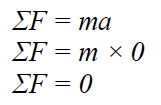
Tell students that the two large forces acting on the woodblock as it was pulled were the force of friction and the force applied to pull it. Therefore, the sum of the forces was equal to the force of friction plus the applied force.
Emphasize that by understanding this formula, students should begin to comprehend that the force they measured with the spring scale was a measure of the force of friction.

- Using this formula, calculate the frictional force between the block and the table. By using the spring scale, students measured the force applied to pull the block. From previous calculations of acceleration, we know that the acceleration was zero and the sum of the force was equal to 0. Therefore:
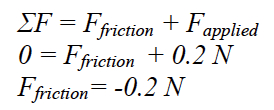
Note: Students may be confused by the “negative” force. Remind students that the negative number indicates the direction of the force of friction. The applied force was a positive number. Since force takes into account magnitude and direction, the frictional force was a force of the same magnitude in the opposite direction of the applied force.
Discuss the energy transfer which occurred between the woodblock and the table. Use the suggested responses below to guide students’ answers.
- What type of energy was present as the woodblock was moved across the table? Kinetic energy was present.
- As the block slowed, what happened to the kinetic energy? Kinetic energy decreased.
- The Law of Conservation of Matter and Energy states that energy and matter are never produced nor destroyed. According to this principle, what happened to the kinetic energy of the block? The kinetic energy of the block must have been transferred to another type of energy. As the woodblock was resting on the table and had no height, it had no potential energy. The kinetic energy of the woodblock had to be transformed into a type of energy other than potential. This type of energy was heat energy, which resulted from the force of friction between the wood and the table.
Note: If students have a difficult time understanding this transformation from kinetic to heat energy, instruct them to rub their hands together vigorously.
- What form of energy do your hands have? Students’ hands have kinetic energy.
- While rubbing your hands, how do they begin to feel? Students will feel warmth in their hands.
- Into what type of energy was kinetic energy transformed? As the woodblock was pulled along the table, kinetic energy was transformed into heat energy.
- Ask students what factors they think influence the frictional force. Student answers will vary but may include velocity, surface area, smoothness of surfaces, and the weight of the object. Instruct students to record their ideas in their Investigation One Data Record. Tell students that in the next three Investigations, students will investigate these variables.
Ask students to generate hypothetical experiments to test their ideas about influencing factors of frictional force between two surfaces.
Tell students to record their experiments in their Investigation 1 Student Data Record.
GET FOCUSED
Instruct students to complete the Focus Questions in their SDRs then discuss them as a class. Use the suggested responses below to guide students’ answers.
- What is the relationship between speed, velocity, and acceleration? Speed is a term used to indicate how much distance is traveled in a given time. Velocity is a measure of the magnitude of distance per time as well as the direction of the motion. Therefore, a change in velocity occurs when an object in motion either changes speed or changes direction. Acceleration denotes a change in velocity in a period of time. Positive acceleration represents an increase in velocity away from the origin, whereas negative acceleration represents a decrease in velocity while moving away from the origin.
- How does frictional force affect motion? Frictional force decreases the velocity of an object. That is, it decreases the speed of an object.