
Teacher Portal:
Electricity and Magnetism
Investigation 1 – PostLab

ZERO-IN
Italicized font represents information to be shared orally or physically completed with the students at this time.
The non-italicized font represents additional information included to support the teacher’s understanding of the content being introduced within the CELL.
ANALYZE IT
- Instruct students to complete the Analysis Questions in their SDRs then discuss them as a class. Use the suggested responses below to guide students’ answers.
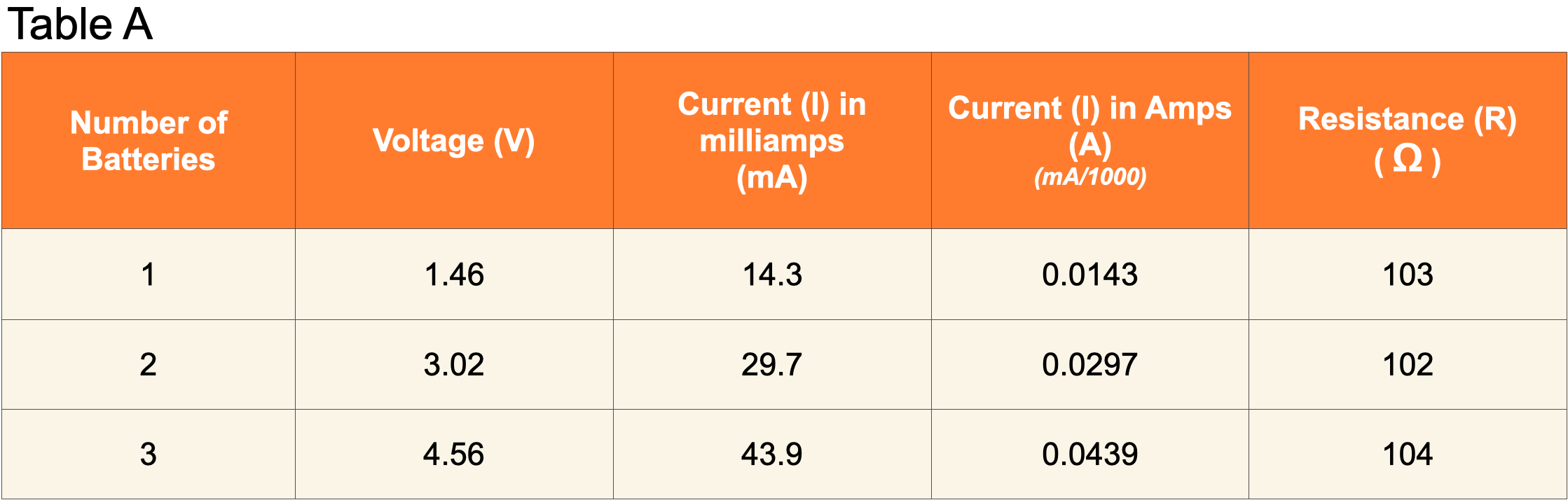
- Create a best fit line graph showing the effect of changing voltage on current in the circuit with Resistor A. Use the data from Table A to create the graph. Refer to the procedures for Determination and Graphing of Independent and Dependent Variables and Drawing of a Best Fit Line if necessary.
-
Note: If necessary, students should refer to the procedures for Determination and Graphing of Independent and Dependent Variables and Drawing of a Best Fit Line.
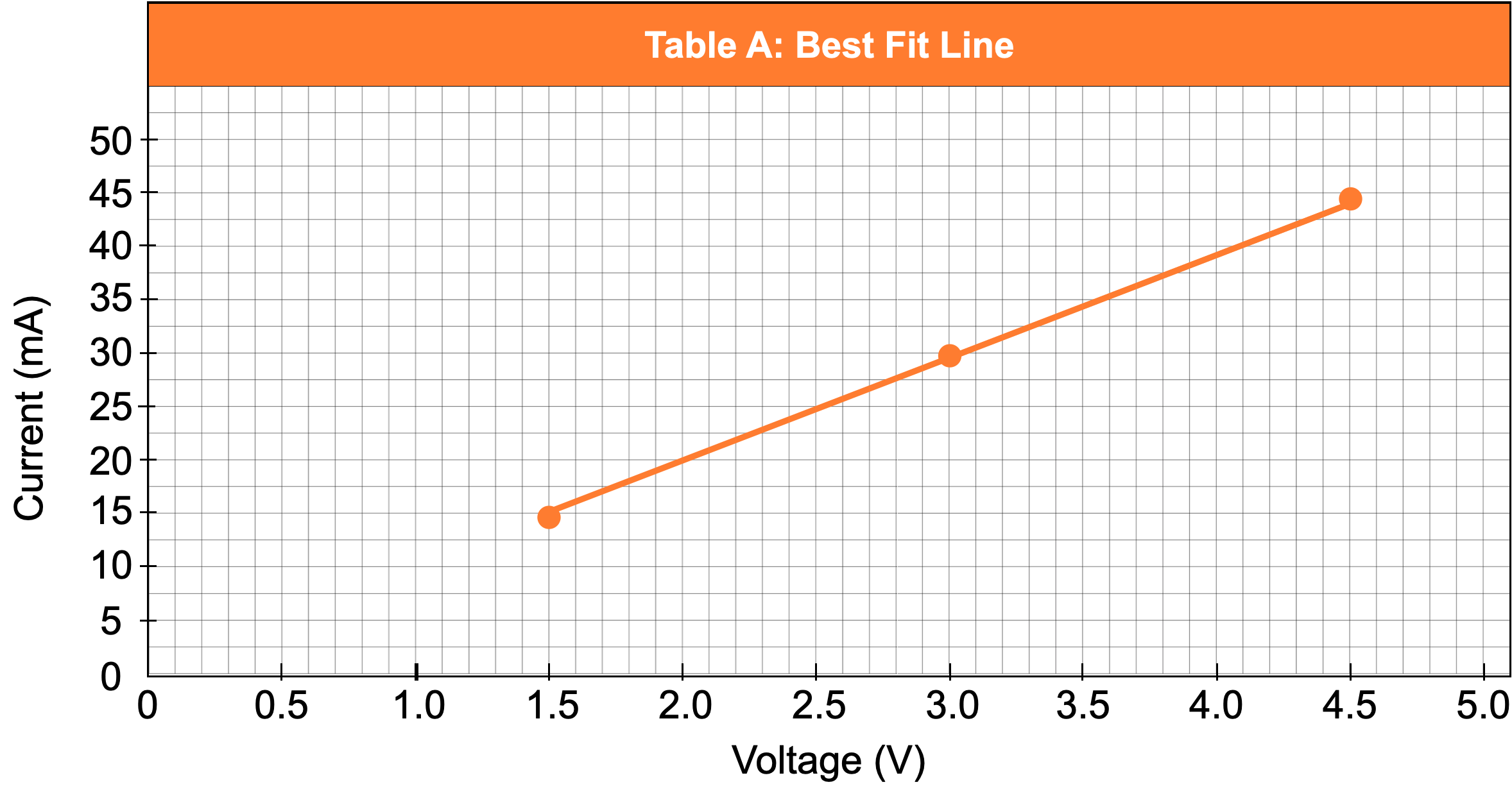 Ask students to analyze their graphs by answering the question. Use the suggested response below to guide students’ answers.
- Look at the graph above. How would you describe the relationship between voltage and current for Resistor A? There is a direct relationship between voltage and current because the current increased as the voltage increased.
 Ask students to analyze their graphs by answering the question. Use the suggested response below to guide students’ answers.

- Create a graph showing the effect of changing voltage on current in the circuit with Resistor B. Using the data from Table B to create the graph.Refer to the procedures for Determination and Graphing of Independent and Dependent Variables and Drawing of a Best Fit Line if necessary.

- Look at the graph above. How would you describe the relationship between voltage and current for Resistor B? There is a direct relationship between voltage and current because current increased as the voltage increased.
- Compare the two graphs. Do both show the same relationship between voltage and current? Are there any differences between the two graphs? Explain your answer. Both graphs show the relationship between voltage and current because current increases as voltage increases in both graphs. However, the scale on the y-axis is much larger for the first graph than it is for the second graph.
- Use Ohm’s law to calculate the amount of resistance supplied by Resistor A.
- Convert milliamps as shown before making your calculations. Record your answers in Table A.
- Use the formula for Ohm’s Law below to calculate resistance.

- What happened to resistance as the number of batteries and voltage of the circuit increased? Did the resistance increase, decrease, or remain constant? Resistance remained constant.
- Use Ohm’s law to calculate the amount of resistance supplied by Resistor B. Convert milliamps to amps as shown before making your calculations. Record your answer in Table A.
- Use the formula for Ohm’s Law aain to calculate resistance.
- In both circuits as the voltage increased, the current increased. What happened to resistance in both circuits as the voltage and current increased? The values for resistance in both circuits stayed the same.
- Ohm’s law states that the voltage through a conductor is proportional to the current through it (V= IR). Did the circuits with the two different resistors both follow Ohm’s law? The circuits both followed Ohm’s law because resistance remained constant in each circuit and as the voltage increased with the addition of batteries, the current increased proportionally.
GET FOCUSED
Instruct students to complete the Focus Question in their SDRs then discuss it as a class. Use the suggested response below to guide students’ answers.
- What is the relationship between voltage, current, and resistance? Use your results to explain your answer. The change in current in a circuit is directly proportional to the change in voltage. As voltage in a circuit increases, current increases but the resistance to the flow of current remains constant. As the number of batteries in each of the two circuits increased, the voltage increased, and the current increased, but the resistance in the first trials remained constant. In addition, the change in current in a circuit is inversely proportional to the resistance. As the resistance in a circuit increases, the current decreases. Two different resistors were used in the two different circuits. Although current increased as the voltage increased in both circuits, the circuit with the greater resistance had a lower current than the circuit with the lesser resistance. The relationship between voltage, current, and resistance is described by Ohm’s law V= IR.