
Teacher Portal
Ecosystems
Investigation 2 – PreLab
ZERO-IN
Italicized font represents information to be shared orally or physically completed with the students at this time.
The non-italicized font represents additional information included to support the teacher’s understanding of the content being introduced within the CELL.
ASK WHY
Remind students that they depend on healthy ecosystems for their survival. Healthy ecosystems perform essential services that we depend on, including clean air, clean water, food, clothing, fuel, and lumber products. In addition, healthy ecosystems regulate floodwaters and keep lands fertile and crops pollinated.
BRANCH OUT
Remind students that ecologists study populations of organisms and how those organisms interact with each other and with their physical environment.
GET FOCUSED
Inform students that the Investigation is designed to help them to answer the following Focus Question:
- What affects the efficiency of energy transfer within an ecosystem? The efficiency of energy transfer is affected by the use of energy by an organism. All organisms must use some energy to live, and therefore cannot store all the energy that they consume. Therefore, the transfer of energy from one level to another is not 100% efficient.
Note: This question is located in students’ SDRs at the beginning and end of the Investigation.
Note: These are succinct responses to the Focus Questions and are placed here for your reference at this time. Fully developed responses to the Focus Questions can be found on the PostLab page.
GO DEEPER
As a class, read the Background(s) in the Investigation. Have students read the information aloud or silently to themselves. When students have finished, discuss the following concepts as a class:
- When a plant absorbs light energy from the Sun, it converts the light energy to chemical energy through photosynthesis.
- When animals consume plant material, their cells can release the energy in the plant biomass through a process called cellular respiration. The same thing happens when animals consume other animals.
- The cells then use the energy released through respiration to live.
- This process is called cellular respiration because cells take in oxygen and release carbon dioxide.
- The more energy an organism needs and uses to live, the more oxygen it will take in.
Note: These concepts are integrated into the Background(s) and are used to deepen students’ comprehension of the big ideas.
LEARN THE LabLearner LINGO
The following list includes Key Terms that the teacher should introduce, as appropriate, within the CELL. These terms should be used, as appropriate, by teachers and students during everyday classroom discourse.
- ecosystem
- producers
- consumers
- detritivore
- detritus
- trophic level
- biomass
- Law of Conservation of Energy
- Law of Conservation of Matter
Note: Definitions to these terms can be found on the Introduction page to the CELL.
Note: Additional words may be bolded within the Background(s). These words are not Key Terms and are strictly emphasized for exposure at this time.
SET FOR SUCCESS
- As a class, review what was investigated in Investigation One.
Note: Students discovered that the amount of energy in each level of an ecosystem is smaller than the amount of energy in the level below it and this indicates that energy transfer is inefficient. Students also discovered that higher levels of an ecosystem have smaller amounts of biomass than the levels below them.
- As a class, elicit prior knowledge about the reasons why energy transfer may be inefficient.
- Ask students to suggest what may be happening to light energy that is not captured by producers.
Note: Some light energy that is not captured by plants may be absorbed by the ground or water. Additional energy may be reflected off the surface of the ground or water. More energy may be absorbed or reflected by animals. Finally, in urban areas energy may be absorbed or reflected by manmade structures
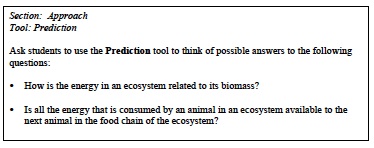
- Play the video below. Stop to ask students questions or answer students’ questions when necessary. Remind students to follow along with their SDRs and make any notes that they think might be helpful.
- After the video, direct students to divide into their lab groups to discuss their strategy for the lab. For example, they may assign certain group members to perform specific functions during the lab.
Note: The purpose of the video is to allow students to anticipate the laboratory experience they will soon encounter. Students should leave this PreLab session with a firm idea of what to expect and how to perform in the lab.
Note: Homework is posted below the video.
HOMEWORK
Tell students that they should review the Investigation in preparation for the Lab.