
Teacher Portal:
Ecosystems
Investigation 1 – PostLab
ZERO-IN
Italicized font represents information to be shared orally or physically completed with the students at this time.
The non-italicized font represents additional information included to support the teacher’s understanding of the content being introduced within the CELL.
ANALYZE IT
Instruct students to complete the Analysis Questions in their SDRs then discuss them as a class. Use the suggested responses below to guide students’ answers.
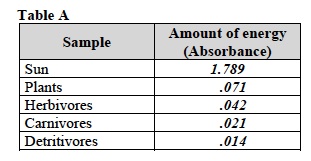
- Create a bar graph to show the relationship between the energy in an ecosystem and the levels of an ecosystem. Use the data from Table A to create the graph.
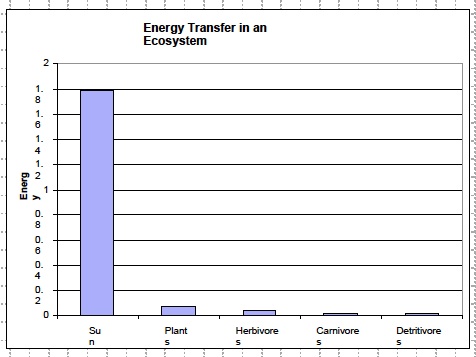
- Which level of the sample ecosystem is considered the bottom level? Which level is considered the top level? In the sample ecosystem, plants are the lowest level and detritivores are the highest level.
- Is all of the energy from the Sun transferred from one level to the next? How did the amount of energy change from one level to the next? Explain your answer using data from the experiment. Not all of the energy from the Sun was transferred to the producers. The amount of energy from the Sun was the highest, with 1.789 units of energy. Energy levels decreased with each new level of the ecosystem or food chain, with detritivores having only 0.014 units of energy. The lowest amount of energy was at the top level of the ecosystem.
- Study your graph. How could the energy relationship between the levels be described in terms of a food chain? Each level is dependent upon the previous level for energy. All consumers obtain energy by consuming organisms from the level below. Plants, however, obtain energy by capturing it from sunlight and storing it as chemical energy through the process of photosynthesis. The energy relationship can be shown in a food chain as follows: Sun – Plants – Herbivores – Carnivores – Detritivores.
- Is energy flow efficient from one level of an ecosystem to the next? Use your data to support your answer. Based on the results of the experiment, energy flow is not efficient from one level of an ecosystem to the next. Each level has a smaller amount of energy than the previous level.
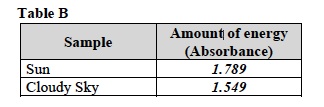
- How did the presence of clouds in the sky affect the amount of energy that reaches the Earth? The presence of clouds in the sky decreased the amount of energy that reaches the Earth from the Sun, causing a decrease from 1.789 to 1.549.
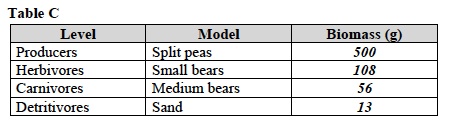
- Look at the data in Table C. At which level of the ecosystem is most of the biomass located? Most of the biomass is located in the bottom (Plants) level of the ecosystem.
- At which level of the ecosystem is the least amount of biomass located? The least amount of biomass is located in the detritivore level.
- Do you see a pattern in the amount of biomass as you move up the levels in the ecosystem? Explain. The amount of biomass decreases as the ecosystem level increases.
- Look back at the graph of energy at each level of the ecosystem. What type of pattern did you see? The amount of energy decreased from one level to the next.
- Is the pattern in the energy graph similar to the pattern of changes in biomass through the ecosystem? Explain your answer. The order in which the highest to lowest amount of energy was found was parallel to the order in which the highest to lowest amount of biomass was found. The most energy and biomass were found in the plant level, the next lowest was the herbivore, then the carnivore, then the detritivore.
- Do you think the amount of energy in one level is related to the amount of biomass in that level? Explain your answer. Student answers may vary. Energy is contained in the biomass of each level. Thus, the amount of biomass in a level determines the amount of energy contained in the level.
- Based on the results of the “Cloudy Sky” experiment, how might dust from a volcanic eruption affect the amount of energy and the amount of biomass in an ecosystem? Dust from volcanic eruptions spreads due to wind currents and the force generated by the eruption. This dust blocks sunlight from reaching plants, either by floating in the air or settling on leaves or over the surface of water. This reduces the amount of visible light which can be captured by the chloroplasts of leaves and converted into chemical energy during photosynthesis. By preventing capture of energy through photosynthesis, the volcanic dust causes a decrease in the amount of energy in the ecosystem. After an eruption, the amount of energy in each level would be lower than the amount found in these levels before the eruption because less energy would enter the ecosystem at the plant level.
GET FOCUSED
Instruct students to complete the Focus Questions in their SDRs then discuss them as a class. Use the suggested responses below to guide students’ answers.
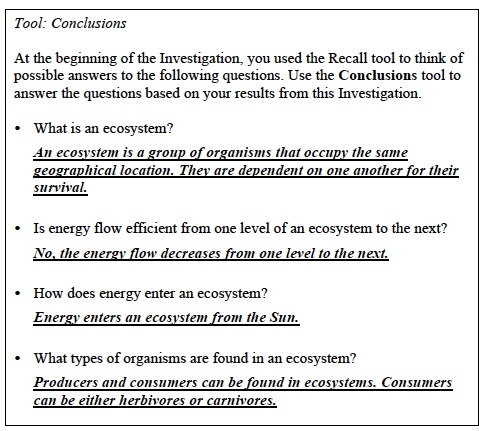
- How does energy move through an ecosystem? Energy enters an ecosystem through the energy from the Sun. Plants use the sun’s energy for photosynthesis and to produce their own food. When herbivores eat the plants, energy from the plants is obtained by the herbivores. When carnivores eat herbivores, they obtain energy from the herbivores. When scavengers consume carnivores, they obtain the energy from the carnivores. The energy at each level of an ecosystem is contained in the biomass of organisms at that level. Therefore energy is transferred from one level to another as consumers in one level eat the biomass from the level below.
- What affects the amount of energy in an ecosystem? The amount of energy in an ecosystem is affected by the amount of energy that can be captured by plants through photosynthesis. The amount of energy that can be captured by plants is determined by the amount of energy that reaches the Earth from the Sun.
ANALYZE IT – OPTIONAL EXTENSION
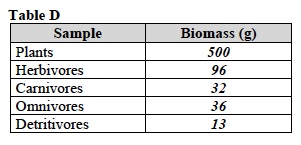
- How did adding omnivores to the ecosystem affect the change in biomass through the ecosystem? Adding omnivores changed the distribution of the biomass in the ecosystem. The addition of omnivores added more feeding pressure on the herbivores, decreasing the number of carnivores that the ecosystem could support
- Knowing what you do about the relationship between energy and biomass in an ecosystem, how would adding omnivores to the ecosystem affect the flow of energy through the ecosystem? Adding omnivores to the ecosystem changed the path of energy flow, but did not alter the overall direction of energy flow. Energy continued to move from the point where light energy was converted to chemical energy to the level of the Detritivores. Energy constantly moved up through the pyramid and did not flow back toward the lower levels.