
Teacher Portal:
Cellular Organization
Investigation 4 – Lab
ZERO-IN
Italicized font represents information to be shared orally or physically completed with the students at this time.
The non-italicized font represents additional information included to support the teacher’s understanding of the content being introduced within the CELL.
MINDSET
This Investigation is designed to:
- introduce the concept of solutions of differing concentrations,
- reinforce the operation of the microscope and preparation of a wet mount slide,
- provide a method by which students can distinguish the cell walls and cell membranes of plant cells,
- observe the cellular effects of osmosis and infer the function of the cell wall and cell membrane within plant cells, and
- infer differences in membrane permeability based on microscopic observations of plant cells.
BE PREPARED
Teacher Preparation for the Investigation includes the following. This preparation should be done prior to students arriving in the lab.
- Fill a 400 ml beaker with 150 ml of tap water. Label the beaker “tap water” with a piece of masking tape. 2.
- Fill a 400 ml beaker with 150 ml of 2% salt solution. To create the 2% salt solution, use the triple beam balance to obtain 3 g of salt. Add the salt to 150 ml of water and stir. Label the beaker “2% salt solution” with a piece of masking tape.
- Fill a 400 ml beaker with 150 ml of 4% salt solution. To create the solution, use the triple beam balance to obtain 6 g of salt. Add the salt to 150 ml of water and stir. Label the beaker “4% salt solution” with a piece of masking tape.
- Fill a 400 ml beaker with 150 ml of 8% salt solution. To create the solution, use the triple beam balance to obtain 12 g of salt. Add the salt to 150 ml of water and stir. Label the beaker “8% salt solution” with a piece of masking tape.
- Place the materials at the distribution center.
- Divide the class into five cooperative groups.
Note: Each student lab group will need the materials listed below.
Student Preparation for the Investigation includes having students gather the following materials. This preparation takes place on lab day after student lab groups have settled at their assigned lab tables.
Note: The materials are listed in students’ SDRs. They are also listed below for your reference.
- (1) microscope
- (4) 50 ml beakers
- (4) plastic droppers
- (4) glass slides
- (4) coverslips
- (4) pieces of tape
- (1) paper towel
- (1) forceps
- (1) scalpel
- (4) 50 ml beakers with 20 ml of one of the following: tap water, 2% salt solution, 4% salt solution, and 8% salt solution
Half of the groups in the class will need
- (1) piece of red onion
Half of the groups in the class will need
- (2) Elodea leaves
Note: Half of the student groups in the class will create wet mount slides of onion cells, and the other half will create wet mount slides of Elodea leaf.
Direct one student from each lab group to collect the materials listed in their SDRs.
INVESTIGATE
- Review the concept of osmosis with students. Include the following in the review.
- Osmosis describes the diffusion of water across a selectively permeable membrane.
- Osmosis occurs when the concentration of solutes on two sides of a membrane is not equivalent and when the solutes cannot pass through the membrane. In such a circumstance, water diffuses through the membrane in a direction that promotes a greater balance in the solute concentrations on both sides of the membrane.
- Tell students that they will observe how the structure of the cell wall and cell membrane affects the movement of molecules in and out of plant cells. They will do this by placing plant cells in solutions of various concentrations of salt and observing the behavior of the cells.
- Encourage students to reflect on the PreLab video as they move through the procedural steps.
- Explain to students that during the Experiment, every procedural step is important. If one step is skipped, data can become invalid. To help students keep on track, direct them to read each step thoroughly, complete the step, then check it off (Read it – Do it – Check it off).
- Direct students to complete the procedural steps in their SDRs.
Note: The procedural steps are listed below for your reference. Teacher “Notes” are inserted, as needed, to help facilitate the lab.
- Prepare your plant specimen to make four wet mount slides.
- If using onion, carefully peel a thin layer when preparing the slides.
- If using Elodea leaf, obtain three or four leaves or sections of leaves. The Elodea leaf is only two or three cells thick, so you will be able to place the whole leaf or section on a slide.
Note: students may use the scalpel to cut each Elodea leaf into small pieces, approximately 2 or 3 mm wide, so that the specimens fit well under the coverslip.
- Create four wet mount slides of your plant. Prepare the slides with the following liquids:
- Slide A: tap water
- Slide B: 2% salt solution
- Slide C: 4% salt solution
- Slide D: 8% salt solution
Note: Using a thin permanent marker, students should label each slide by writing on the edge of the slide. Wiping the slides with ethanol or fingernail polish remover (consisting largely of acetone) will remove the permanent marker when students are finished with the slides.
- Compare the concentration of salt in each solution. Which has the most salt? Which has the least salt?
- Suggested Response: Tap water has the lowest concentration of salt, containing no added salt. (Although no salt was added to the sample labeled tap water, small amounts of sodium or chloride may have been present initially.) The 2% solution contains slightly more salt, and the 4% salt solution contains more salt than the tap water or the 2% solution. The 8% solution contains the most salt.
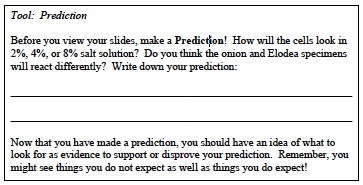
Note: Since the leaves of the Elodea plant contain two layers of cells, it is important that students focus on only one layer of cells at a time to view each cell with ease.
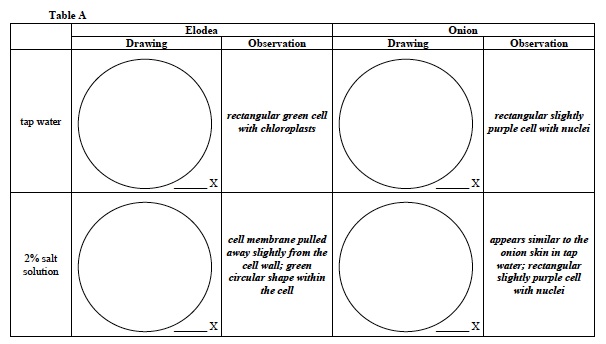
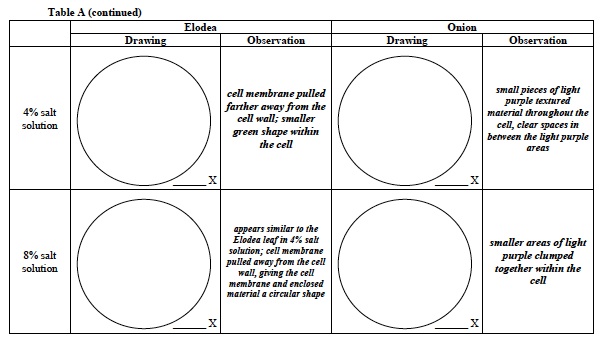
- Record: View each of the four slides. Record your observations by writing or drawing what you observe in the correct columns of Table A.
- Switch slides with another group so that you can observe the plant that you have not yet viewed.
- Record: View each of the four slides. Record your observations by writing or drawing what you observe in the correct columns of Table A
Note: When recording, students should keep in mind the following questions: • Are the sizes of the cells the same or different? • Has the arrangement of the cell wall and cell membrane changed? • Can I distinguish between the cell wall and cell membrane? • Has the arrangement of the cytoplasm and other organelles changed?
CLEAN UP
Let students know your expectations for clean up. Ask them to clean up.